
The Science of Plant-Based Baking: How Aquafaba and Alternative Binders Replace Eggs
Food scientists and culinary test kitchens have decoded the molecular mechanics of plant-based baking, using chickpea proteins, seed mucilage, and starches to perfectly replicate the multifunctional role of the egg.
By Factlen Editorial Team
- Food Scientists & Researchers
- Focusing on the molecular mechanics and industrial optimization of plant-based proteins.
- Culinary Test Kitchens
- Prioritizing reproducible results, precise ratios, and recipe adaptation for the home cook.
- Plant-Based Home Bakers
- Valuing accessibility, ethical consumption, and practical pantry staples.
What's not represented
- · Commercial Egg Producers
- · Industrial Bakery Manufacturers
Why this matters
Understanding the chemistry behind plant-based substitutions empowers home cooks to adapt any recipe with confidence. By moving away from guesswork and toward food science, bakers can create high-quality, allergy-friendly, and ethical desserts without compromising on texture or flavor.
Key points
- Aquafaba mimics egg whites through a combination of globulin proteins and natural surfactants called saponins.
- Whipping aquafaba denatures its proteins, allowing them to trap air and form a viscoelastic foam.
- Adding an acid like cream of tartar is essential to lower the pH and stabilize aquafaba foam for baking.
- Flax and chia seeds replace the binding power of eggs by forming a thick mucilage gel when hydrated.
- Fruit purees provide moisture through pectin, while baking soda and vinegar provide chemical leavening.
- Starches like tapioca and cornstarch replace egg yolks in custards through thermal gelatinization.
The egg is a culinary miracle. For centuries, pastry chefs and home bakers have relied on its unparalleled versatility to build the foundation of cakes, cookies, and soufflés. When cracked into a bowl, an egg acts as a master multitasker: it binds disparate ingredients, leavens batters into airy sponges, provides essential moisture, and emulsifies fats with liquids. For those adopting plant-based diets or managing severe allergies, removing the egg traditionally left a structural vacuum. Early vegan baking often resulted in dense, crumbly, or flat compromises. However, the landscape has fundamentally shifted. Today, plant-based baking is no longer a game of trial and error; it is a precise discipline grounded in colloid science, protein biochemistry, and hydrocolloid physics.[6]
To successfully replace an egg, one must first deconstruct its exact function within a specific recipe. A single egg is composed of roughly 75 percent water, 12 percent protein, and 10 percent fat, distributed between the lipid-rich yolk and the protein-dense white. In a chewy chocolate chip cookie, the egg acts primarily as a binder. In a towering angel food cake, whipped egg whites provide the crucial leavening and aeration. In a rich custard, the yolk's lecithin serves as a powerful emulsifier and thickener. Because no single plant-based ingredient perfectly replicates this entire matrix, modern culinary science relies on a targeted toolkit of specialized substitutes, deploying specific plant proteins, starches, and mucilages to mimic the egg's distinct roles.[4][5]
The most revolutionary breakthrough in this plant-based toolkit is undoubtedly aquafaba. Coined from the Latin words for water and bean, aquafaba is the viscous, golden liquid left over after cooking legumes, most commonly chickpeas. Discovered as a viable culinary ingredient in the mid-2010s by a software engineer experimenting with vegan meringues, aquafaba behaves astonishingly like egg whites. When subjected to the mechanical energy of a whisk, this seemingly mundane byproduct transforms into a voluminous, glossy foam capable of supporting macarons, mousses, and marshmallows. Its discovery solved the most elusive challenge in vegan pastry: finding a reliable, plant-based foaming agent that could hold its structure under heat.[4][6]

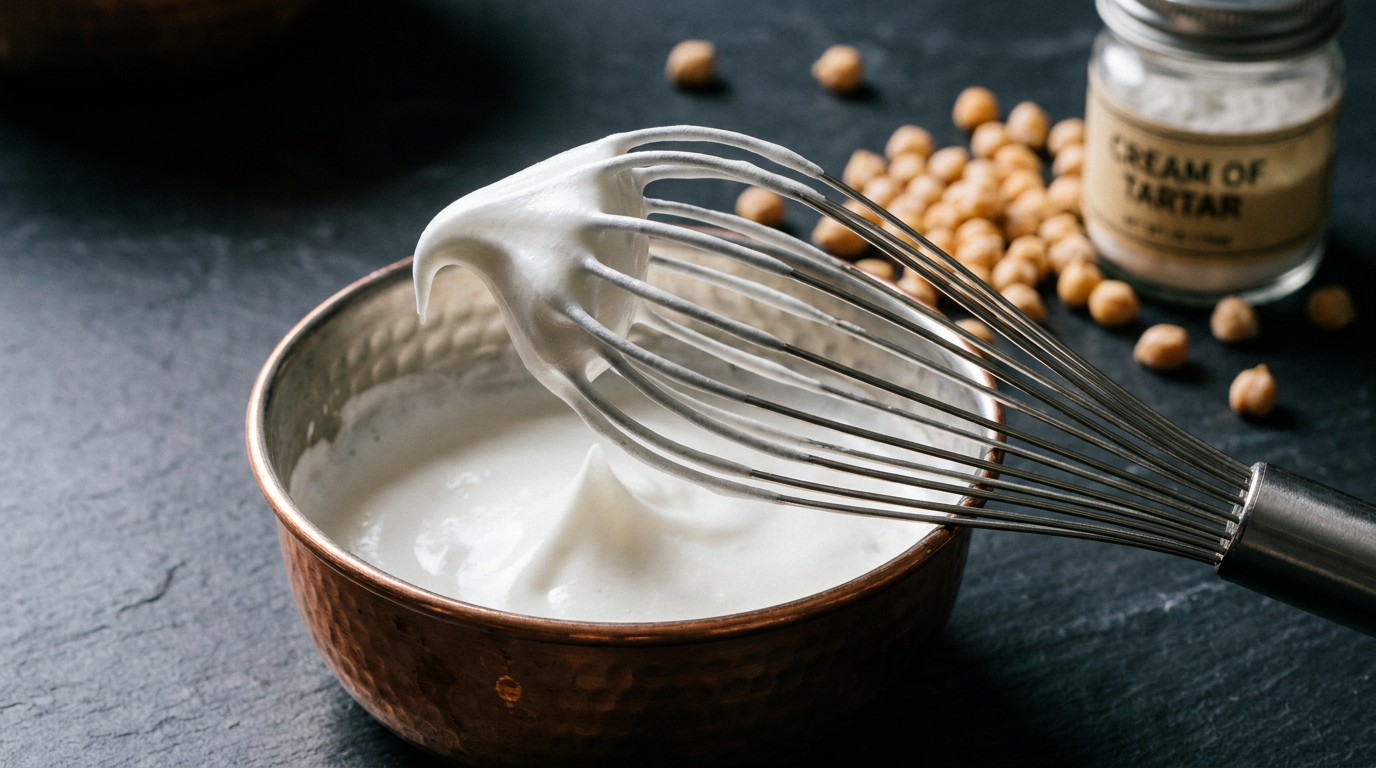
The foaming magic of aquafaba is not a culinary accident, but a fascinating display of protein physics. Chickpea water is far more than just diluted starch; it contains a precise concentration of heat-stable seed storage globulins, specifically vicilin and legumin. During the canning or boiling process, thermal denaturation causes these complex proteins to partially unfold, exposing hydrophobic (water-repelling) regions that are normally buried deep within their molecular structure. When a baker whips the liquid, introducing air into the mixture, these exposed hydrophobic domains rapidly migrate to the air-water interface. They align themselves around the trapped air bubbles, forming a protective, viscoelastic network that prevents the bubbles from popping.[1][3]
Beyond globulin proteins, aquafaba's unique properties are heavily supported by the presence of saponins. Saponins are naturally occurring phytochemicals found abundantly in chickpeas that act as powerful natural surfactants. Much like soap, surfactants lower the surface tension of a liquid. In the context of aquafaba, saponins reduce the surface tension of the chickpea water from roughly 72 millinewtons per meter down to around 40, allowing the liquid to stretch and encapsulate air rapidly during the initial stages of whipping. This synergistic relationship between the rapid-foaming saponins and the structure-building globulin proteins is what gives chickpea aquafaba its distinct advantage over the cooking liquid of other beans.[2][4]
However, while aquafaba foams beautifully, the resulting structure is inherently fragile. Without intervention, the protein network will eventually drain and collapse, reverting to a puddle of liquid. To achieve true oven stability—essential for baking crisp meringues or airy sponges—the chemical environment must be carefully tuned. Culinary test kitchens have demonstrated that lowering the pH of the aquafaba is critical. By adding a small amount of acid, typically cream of tartar (potassium bitartrate), bakers alter the electrical charge of the proteins. This acidic environment encourages stronger intermolecular cross-linking, including hydrogen bonding and hydrophobic aggregation, transforming the delicate bubbles into a cohesive, elastic film that can withstand the heat of an oven.[1][6]
However, while aquafaba foams beautifully, the resulting structure is inherently fragile.
As aquafaba moves from home-kitchen hack to industrial application, food scientists are actively working to optimize its performance and sensory profile. One historical drawback of chickpea water is its mildly earthy, "beany" aroma, which can occasionally bleed into delicate desserts. Recent studies have explored fermenting aquafaba with edible basidiomycetes (mushrooms) prior to whipping. This controlled fermentation process significantly reduces the olfactory scores for "beany" odors, resulting in a more neutral, slightly sweet profile ideal for chocolate mousses. Furthermore, researchers have found that the hydrothermal conditions of the chickpeas—whether they are pressure-cooked, boiled, or commercially canned—drastically impact the liquid's apparent viscosity and ultimate foam stability.[2][3]

While aquafaba is the undisputed champion of aeration, it lacks the fat and structural density required to act as a heavy binder in doughs. For dense baked goods like cookies, brownies, and hearty muffins, bakers turn to the science of hydrocolloids, most commonly utilizing the "flax egg" or "chia egg." When ground flaxseeds or whole chia seeds are mixed with warm water and left to rest, they undergo a rapid physical transformation, thickening into a viscous, gel-like substance that closely mimics the texture of a beaten whole egg.[4][5]
This gelling phenomenon is driven by the seeds' epidermal layers, which are exceptionally rich in mucilage. Mucilage is a complex, highly branched polysaccharide that is intensely hydrophilic (water-loving). When exposed to water, these polysaccharide chains rapidly hydrate, uncoil, and trap massive amounts of liquid within their molecular matrix, forming a thick hydrocolloid suspension. In a cookie dough, this mucilage network acts as a flexible glue, binding flour, sugar, and fats together. While flax and chia eggs provide excellent cohesion and a chewy crumb, they offer absolutely no leavening power, making them unsuitable for recipes that require a delicate rise.[5][6]
When a recipe requires both moisture retention and a tender crumb, fruit and vegetable purees step in to fill the void. Unsweetened applesauce, mashed bananas, and pumpkin puree are classic plant-based substitutes utilized in quick breads, pancakes, and dense cakes. Their effectiveness relies primarily on their high water content and the presence of pectin, a structural heteropolysaccharide found in the cell walls of fruits. Pectin helps to hold moisture within the baked good, preventing it from drying out during the baking process, while the fruit's natural fibers provide a soft, dense structure.[4][5]

Because fruit purees and seed gels cannot trap air like whipped eggs, plant-based bakers must often supplement their recipes with chemical leavening agents to achieve the necessary lift. The most common and effective technique is the strategic combination of baking soda (sodium bicarbonate, a base) and an acid, such as apple cider vinegar or lemon juice. When these two ingredients interact within a wet batter, they trigger an immediate acid-base chemical reaction, rapidly releasing carbon dioxide gas.[5][6]
This sudden burst of carbon dioxide creates thousands of microscopic bubbles within the batter. As the cake or muffin bakes, the heat of the oven causes these gas bubbles to expand, pushing the surrounding batter upward and creating a light, spongy texture. Because this reaction occurs instantaneously upon mixing, batters relying on the baking soda and vinegar method must be transferred to the oven immediately to capture the lift before the gas escapes. This precise chemical hack is particularly favored in vegan chocolate cakes and red velvet sponges, where the vinegar also helps to tenderize the gluten.[5][6]
Finally, for recipes that rely on the rich, thickening power of egg yolks—such as custards, lemon curds, and pastry creams—bakers utilize refined starches like cornstarch, tapioca, or arrowroot powder. Unlike proteins, which coagulate under heat, these starches rely on a process called thermal gelatinization. When a starch slurry is heated in the presence of a liquid, the intermolecular bonds within the starch granules begin to break down. The granules absorb water, swell significantly, and eventually burst, releasing amylose and amylopectin molecules that entangle to form a thick, glossy gel.[4][5]

The evolution of plant-based baking substitutes highlights a broader shift in modern gastronomy: the democratization of food science. What began as experimental workarounds in vegan kitchens has been rigorously quantified by culinary test kitchens and academic researchers. By understanding the exact molecular mechanics of how proteins unfold, how polysaccharides hydrate, and how starches gelatinize, bakers can now manipulate plant-based ingredients to achieve textures and flavors that are indistinguishable from their egg-based counterparts. As research continues to refine these techniques, the science of the eggless bake is proving that culinary tradition can be seamlessly rewritten through chemistry.[1][3][6]
How we got here
Pre-2014
Vegan bakers rely heavily on dense substitutes like bananas, flax, and tofu, struggling to replicate the airy foam of egg whites.
December 2014
French musician Joël Roessel discovers that the water from canned beans can be whipped into a foam, sharing his findings on a blog.
March 2015
Software engineer Goose Wohlt discovers that chickpea liquid can be whipped exactly like egg whites to make vegan meringues, coining the term 'aquafaba'.
2017
America's Test Kitchen publishes 'Vegan for Everybody,' rigorously standardizing aquafaba ratios and stabilizing techniques for home cooks.
2023–2026
Food science researchers publish peer-reviewed studies on the exact protein mechanics, saponin levels, and fermentation techniques to optimize aquafaba on an industrial scale.
Viewpoints in depth
Food Scientists & Researchers
Focusing on the molecular mechanics and industrial optimization of plant-based proteins.
For food chemists and academic researchers, the egg is a complex matrix of proteins and lipids that must be deconstructed to be replaced. This camp focuses on the precise molecular interactions—such as how vicilin and legumin proteins unfold at the air-water interface, or how mucilage polysaccharides hydrate. Their goal is to move beyond home-kitchen hacks to develop standardized, highly functional plant-protein isolates and optimized extraction methods (like controlled fermentation) that can be utilized by the commercial food industry.
Culinary Test Kitchens
Prioritizing reproducible results, precise ratios, and recipe adaptation for the home cook.
Organizations like America's Test Kitchen approach plant-based substitutes through the lens of rigorous, empirical testing. They are less concerned with isolating individual proteins and more focused on how accessible pantry ingredients behave in a standard oven. This camp establishes the 'golden rules' of substitution—such as the exact ratio of cream of tartar needed to stabilize aquafaba, or the specific baked goods where a flax egg will succeed or fail. Their priority is ensuring that a vegan recipe yields a texture and flavor indistinguishable from a traditional bake.
Plant-Based Home Bakers
Valuing accessibility, ethical consumption, and practical pantry staples.
For the everyday vegan or allergy-conscious baker, the priority is finding functional, affordable substitutes that don't require a chemistry degree to utilize. This perspective champions the ingenuity of using what is already in the pantry—repurposing the liquid from a can of chickpeas or mashing an overripe banana. They value the democratization of these techniques, sharing tips and visual guides across online communities to make egg-free baking accessible to anyone, regardless of their dietary restrictions.
What we don't know
- Whether industrial fermentation of aquafaba can be scaled affordably for mass-market commercial bakeries.
- The exact long-term shelf stability of aquafaba-based foams compared to traditional egg-white meringues without the use of synthetic preservatives.
Key terms
- Aquafaba
- The viscous liquid leftover from cooking legumes, most commonly chickpeas, used as a foaming egg white substitute.
- Denaturation
- The process where proteins lose their natural, folded structure due to external stress like heat or mechanical whipping.
- Saponins
- Naturally occurring phytochemicals in chickpeas that act as surfactants, lowering surface tension to help create foam.
- Mucilage
- A complex, water-loving carbohydrate found in flax and chia seeds that swells to form a thick, binding gel.
- Gelatinization
- The process by which starch granules absorb water and swell when heated, thickening liquids into a gel.
Frequently asked
Can I use the liquid from canned beans other than chickpeas?
Yes, but chickpea aquafaba is preferred because it has the most neutral flavor and the optimal balance of saponins and globulin proteins for stable foaming.
Do flax eggs work in light, fluffy cakes?
No, flax and chia eggs provide excellent binding power but zero leavening. They are best used in dense baked goods like cookies, brownies, and hearty muffins.
Why does my aquafaba meringue collapse in the oven?
Aquafaba foam is fragile and requires an acidic environment to stabilize the protein network. Adding a small amount of cream of tartar lowers the pH and prevents collapse.
Can I freeze leftover aquafaba?
Yes, aquafaba freezes exceptionally well. Bakers often freeze it in one-tablespoon portions in ice cube trays for easy measuring later.
Sources
Source coverage
6 outlets
3 viewpoints surfaced




[1]America's Test KitchenCulinary Test Kitchens
Vegan for Everybody: Foolproof Plant-Based Recipes
Read on America's Test Kitchen →[2]Current Research in Food ScienceFood Scientists & Researchers
Foaming properties and olfactory profile of fermented chickpea aquafaba
Read on Current Research in Food Science →[3]University of Milan Food ScienceFood Scientists & Researchers
By-products valorization: physico-chemical and foaming properties of chickpeas cooking water
Read on University of Milan Food Science →[4]ChatelainePlant-Based Home Bakers
Our scientific guide to vegan substitutes for common baking ingredients
Read on Chatelaine →[5]VegKitPlant-Based Home Bakers
The best egg substitutes for vegan baking
Read on VegKit →[6]Factlen Editorial TeamCulinary Test Kitchens
Synthesis by Factlen editorial team
Read on Factlen Editorial Team →

Every angle. Every day.
Get food drink stories with full source coverage and perspective breakdowns delivered to your inbox.