
AI Mods and Adaptive Hardware Mark a Breakthrough Summer for Gaming Accessibility
Recent industry conferences and hardware releases highlight a surge in inclusive gaming, driven by AI-powered mods for blind players, eye-tracking technology, and standardized accessibility tags.
By Factlen Editorial Team
- Accessibility Advocates
- Pushing for standardized features and hardware compatibility across all platforms.
- Independent Modders
- Using emerging AI tools to retrofit accessibility into mainstream titles.
- Hardware Manufacturers
- Integrating inclusive design into the foundational ecosystem of their platforms.
What's not represented
- · Able-bodied players who benefit from accessibility features like subtitles and remappable controls
- · Small indie studios struggling with the financial cost of implementing comprehensive accessibility suites
Why this matters
For the estimated 450 million gamers with disabilities, these advancements mean the difference between being locked out of a cultural touchstone and being able to play, compete, and connect alongside everyone else.
Key points
- Over 50 AI-driven mods have recently been released to help blind players navigate mainstream video games.
- Xbox launched new modular Adaptive Thumbstick Toppers to provide better grip and leverage for players with limited mobility.
- SpecialEffect showcased 'Eye Gaze Games,' bringing eye-tracking and switch controls to mobile gaming.
- The Accessible Games Initiative (AGI) is pushing to standardize accessibility tags across all digital console storefronts.
- Consultancies are increasingly embedding disabled professionals directly into the game development cycle.
The summer of 2026 is shaping up to be a watershed moment for video game accessibility, moving the industry far beyond the basic subtitle and colorblind options of the past. At recent industry events, including the Game Accessibility Conference (GAconf) and the Nordic Game showcase, developers and advocates highlighted a wave of breakthroughs fundamentally changing who can participate in the medium. Driven by the rapid integration of artificial intelligence, new adaptive hardware, and a push for standardized storefront labeling, the gaming landscape is becoming increasingly navigable for the estimated 450 million players globally who identify as having a disability.[1][3][5]
One of the most significant shifts discussed at GAconf was the explosion of AI-driven accessibility mods designed specifically for blind and low-vision players. In just the past few months, independent modders have released over 50 modifications for mainstream titles, utilizing AI tools to bridge the gap between inaccessible game engines and screen-reading software. These tools act as a real-time translation layer, interpreting visual cues, on-screen text, and environmental layouts, and converting them into audio feedback. This grassroots movement is effectively retrofitting complex, visually demanding games, allowing blind players to experience titles that were previously entirely locked off to them.[1][5]
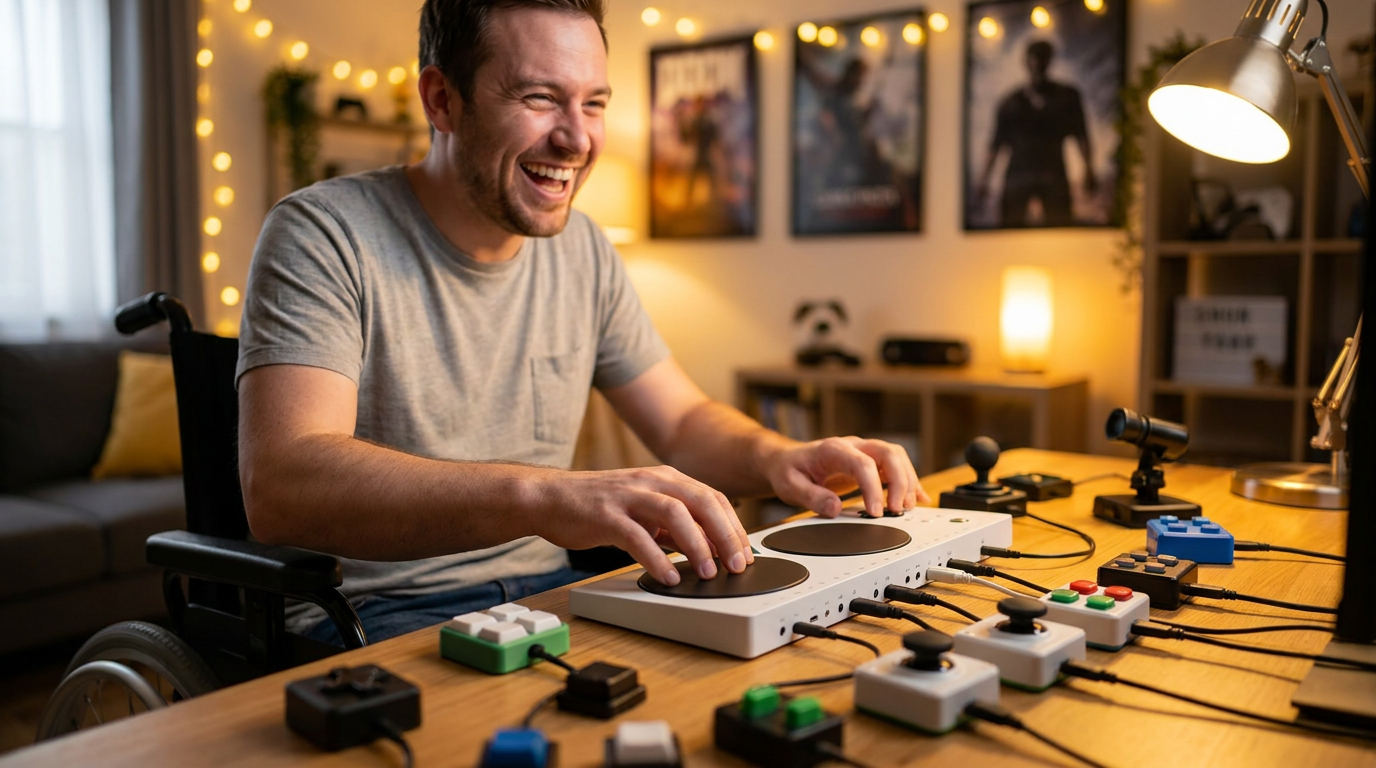
While modders are tackling the software side, major platform holders are continuing to iterate on physical hardware. In late May, Xbox celebrated Global Accessibility Awareness Day by launching new Adaptive Thumbstick Toppers through its Design Lab, including a specialized "Goal Post" shape designed for players with limited hand mobility. These physical add-ons attach to the existing Xbox Adaptive Joystick, providing more customized leverage and grip. Microsoft's ongoing investment in this space underscores a broader industry realization: adaptive hardware cannot be a one-size-fits-all solution, but must instead offer a modular ecosystem that players can tailor to their specific motor requirements.[2]

The push for diverse control methods is also expanding into the mobile gaming sector, a platform that has historically relied heavily on standardized touchscreen inputs. At the Nordic Game 2026 conference, the UK-based charity SpecialEffect presented their "Eye Gaze Games" initiative. This suite of mobile experiences is engineered from the ground up to support a wide array of alternative inputs, including eye-tracking technology, specialized joysticks, and accessibility switches. By decoupling the games from the necessity of touch, developers are opening up mobile gaming to players with severe motor disabilities, ensuring they have access to the same casual, on-the-go entertainment as their peers.[3]
The push for diverse control methods is also expanding into the mobile gaming sector, a platform that has historically relied heavily on standardized touchscreen inputs.
Beyond hardware and in-game software, a major logistical hurdle for disabled gamers has always been the point of purchase: knowing whether a game is actually playable before spending money on it. To solve this, the Accessible Games Initiative (AGI)—a collective of publishers and developers—has been working to establish a standardized set of accessibility tags for digital storefronts. These tags provide clear, uniform definitions for features like high-contrast modes, remappable controls, and screen-reader support. Xbox has already integrated these standardized AGI tags into its digital store, and accessibility advocates are currently mounting pressure on PlayStation and Nintendo to adopt the same universal language.[4][5]

The standardization of these tags is crucial because it removes the guesswork and financial risk for disabled consumers. Historically, a player might purchase a game advertised as having "subtitle support," only to find the text is unreadably small or lacks speaker attribution. By adhering to the AGI's strict definitions, developers are held to a higher, more transparent standard. Advocates argue that this systemic change at the storefront level is just as important as the in-game features themselves, as it empowers players to make informed decisions and signals to developers that accessibility is a core metric of a game's commercial viability.[4][5]
Another area seeing renewed focus is the implementation of "Copilot" or "Controller Assist" modes. This system-level feature, currently championed by Xbox and PlayStation, allows two separate physical controllers to be registered as a single player input. This means a disabled player can use an adaptive controller for certain actions while a friend or family member uses a standard gamepad to handle more complex or rapid inputs simultaneously. As the industry moves forward, advocates are heavily lobbying for Nintendo to introduce similar system-level support for the Switch 2, which would allow players to seamlessly combine standard Joy-Cons with third-party adaptive switches.[4]

Ultimately, the advancements showcased throughout the summer of 2026 point to a maturation in how the industry views inclusive design. Rather than treating accessibility as a post-launch patch or a niche charity project, major studios and indie developers alike are beginning to embed these considerations into the foundational architecture of their games. Internal data from major publishers indicates that 84 percent of players utilizing these features report improved social interaction, highlighting that video games are not just solitary entertainment, but vital digital communities. By tearing down the barriers to entry, the industry is ensuring that millions more can connect, compete, and belong.[2][5]
Crucially, this wave of innovation is increasingly being guided by disabled professionals working directly within the industry. Consultancies like Many Cats Studios are partnering with major publishers to embed lived expertise into the development cycle from day one, rather than relying on external audits at the end of a project. This shift from "designing for" to "designing with" the disabled community is perhaps the most significant breakthrough of all. As AI tools become more sophisticated and hardware becomes more modular, the presence of disabled developers in the room ensures that these technologies are deployed to solve real-world friction points, cementing accessibility as a permanent pillar of game design.[1][5]
How we got here
2020
The modern wave of video game accessibility progress begins, with major AAA titles introducing foundational options.
2025
The Accessible Games Initiative (AGI) is formed to standardize accessibility tags across digital storefronts.
May 2026
Xbox releases new Adaptive Thumbstick Toppers and revamps its Accessible Gaming platform.
June 2026
GAconf and Nordic Game showcase a boom in AI-driven accessibility mods and eye-tracking mobile games.
Viewpoints in depth
Accessibility Advocates
Pushing for standardized features and hardware compatibility across all platforms.
Advocates emphasize that while individual games and mods are making strides, systemic change is required. They are lobbying for universal adoption of the Accessible Games Initiative (AGI) tags across all digital storefronts, ensuring players don't have to guess if a game is playable for them before purchasing. Furthermore, they highlight the need for cross-platform hardware compatibility, arguing that disabled players shouldn't have to buy multiple expensive adaptive controllers for different consoles.
Independent Modders & AI Developers
Using emerging AI tools to retrofit accessibility into mainstream titles.
For this community, waiting for official developer support is no longer necessary. By leveraging AI to interpret on-screen text and visual cues, modders have rapidly released over 50 accessibility patches for blind and low-vision players in recent months. They view AI not just as a generative tool, but as a real-time translation layer that can bridge the gap between inaccessible legacy code and screen-reader software.
Major Hardware Manufacturers
Integrating inclusive design into the foundational ecosystem of their platforms.
Companies like Microsoft view accessibility as both a moral imperative and a massive market expansion. By developing first-party adaptive hardware—like the new Goal Post thumbstick toppers—and integrating system-level features such as Copilot mode, they aim to make their ecosystems the default choice for disabled gamers. Their focus is shifting from retrofitting old games to ensuring all new first-party titles are built with inclusive design from day one.
What we don't know
- Whether Nintendo and PlayStation will fully adopt the AGI standardized tags on their digital storefronts.
- How quickly AI translation tools can be natively integrated into major game engines like Unreal and Unity.
Key terms
- Accessible Games Initiative (AGI)
- A collective effort by game publishers to create standardized accessibility tags and definitions for digital storefronts.
- Screen Reader
- Software that translates on-screen text and interface elements into synthesized speech for blind and low-vision users.
- Copilot Mode
- A system-level feature that allows two separate controllers to act as a single player input, aiding those who need physical assistance while playing.
- Eye Gaze Technology
- Hardware and software that tracks a user's eye movements to control a game or device without requiring physical hand input.
Frequently asked
What are AI accessibility mods?
These are community-created modifications that use artificial intelligence to translate visual game elements into audio cues or text compatible with screen readers, allowing blind players to navigate mainstream games.
Are adaptive controllers available for all consoles?
While Xbox and PlayStation both offer dedicated adaptive controllers, advocates are currently pushing for cross-platform compatibility so players don't have to buy multiple expensive devices for different systems.
What is the Accessible Games Initiative (AGI)?
The AGI is a coalition working to standardize how accessibility features are tagged and described on digital game stores, making it easier for players to find games they can comfortably play.
Sources
Source coverage
5 outlets
3 viewpoints surfaced





[1]GAconfIndependent Modders
GAconf 2026: Game Accessibility Conference Schedule
Read on GAconf →[2]Xbox WireHardware Manufacturers
Xbox Celebrates Global Accessibility Awareness Day with Improved Adaptive Thumbstick Toppers and More
Read on Xbox Wire →[3]Nordic GameHardware Manufacturers
Accessibility Revolution! | Gaming's New Frontier | NG26
Read on Nordic Game →[4]Access-AbilityAccessibility Advocates
2026 Gaming Accessibility Predictions / Questions
Read on Access-Ability →[5]Factlen Editorial TeamAccessibility Advocates
Synthesis by Factlen editorial team
Read on Factlen Editorial Team →



Every angle. Every day.
Get entertainment stories with full source coverage and perspective breakdowns delivered to your inbox.