
The Thermodynamic Flaw in Most Portable Air Conditioners—And How to Fix It
Single-hose portable air conditioners actively pull hot air into the rooms they are trying to cool. Experts and new federal standards are pointing consumers toward dual-hose designs to save energy and money.
By Factlen Editorial Team
- Thermodynamic Analysts
- Focuses on the physics of negative pressure and the necessity of dual-hose designs for actual net cooling.
- Energy Regulators
- Focuses on consumer protection, accurate labeling, and phasing out misleading efficiency claims.
- Budget-Conscious Consumers
- Acknowledges that single-hose units are cheaper and easier to install, making them a necessary compromise for some renters despite the inefficiency.
What's not represented
- · Appliance Manufacturers
- · Retailers
Why this matters
Understanding the physics of portable air conditioners can save you hundreds of dollars in electricity bills while keeping your home significantly cooler. It also prevents the unnecessary carbon emissions caused by running fundamentally inefficient appliances.
Key points
- Single-hose portable air conditioners create negative pressure, pulling hot outside air into the room.
- Dual-hose units fix this flaw by using a closed loop to cool their internal components.
- The older ASHRAE BTU rating system overstates a portable unit's real-world cooling capacity.
- The Department of Energy's SACC rating reveals that single-hose units lose 30% to 40% of their advertised power.
- Strict new DOE efficiency standards took full effect in January 2025, requiring accurate SACC labeling.
Summer heat is arriving, and millions of renters are preparing to buy portable air conditioners. But many consumers are unknowingly purchasing a machine that actively fights its own cooling efforts. The standard single-hose portable air conditioner is plagued by a fundamental thermodynamic flaw, one that wastes electricity and inflates energy bills.[6]
The issue lies in how air conditioners manage heat. To cool a room, an air conditioner must absorb thermal energy from the indoor air and exhaust it outside. A traditional window unit sits half-outside, using outdoor air to cool its hot condenser coils. But a portable unit sits entirely inside the room, requiring a different mechanism to shed its heat.[6]
In a single-hose design, the machine takes the cold, conditioned air from inside the room, runs it over the hot condenser to cool the internal components, and blasts that heated air out the window. While this successfully cools the machine, it creates a severe vacuum—or negative pressure—inside the room.[1]
Physics dictates that this vacuum must be equalized. As the air conditioner pumps air out the window, warm, unconditioned air from outside and adjacent rooms is aggressively sucked in through the cracks under doors, around window frames, and through floorboards. The machine is literally pulling hot air into the room it is trying to cool.[5]

The inefficiency is so profound that thermodynamics experts and science journalists have argued single-hose units should be phased out entirely. The constant influx of warm air forces the compressor to run continuously, drawing maximum electricity while struggling to lower the ambient temperature.[1]
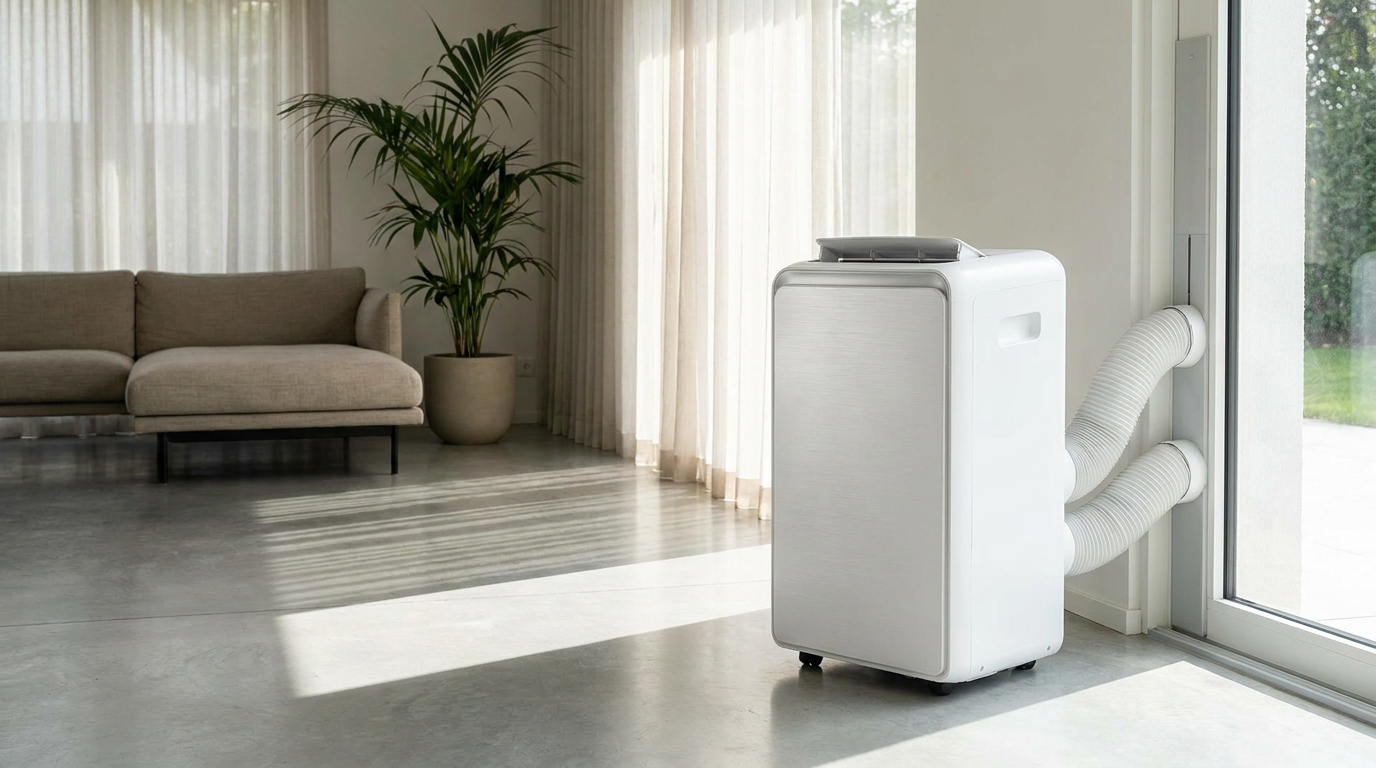
The engineering fix is straightforward: the dual-hose portable air conditioner. These units feature one hose to pull outside air in to cool the condenser, and a second hose to exhaust that heated air back outside.[1]
Because a dual-hose unit uses outside air to cool its internal components, it never exhausts the room's conditioned air. The room remains neutrally pressurized, the cold air stays inside, and the closed-loop system operates with significantly higher efficiency.[5]

The performance gap between these two designs is not merely theoretical. It is so severe that the U.S. Department of Energy (DOE) had to intervene and change how portable air conditioners are legally marketed to the public.[2]
The performance gap between these two designs is not merely theoretical.
For years, portable air conditioners were sold using ASHRAE BTU ratings. This test measured cooling capacity in a perfectly sealed, idealized laboratory environment. Under ASHRAE testing, a single-hose unit might boast an impressive 14,000 BTU capacity, leading consumers to believe it could cool a large living space.[4]
However, ASHRAE testing ignored the heat radiating from the plastic exhaust hose sitting inside the room, and it completely ignored the negative pressure sucking hot air through the door. It measured the cold air coming out of the vent, but not the net cooling effect on the room.[4]
To protect consumers from misleading marketing, the DOE introduced the Seasonally Adjusted Cooling Capacity (SACC) rating. SACC testing accounts for hose heat and infiltration air, providing a highly accurate, real-world measure of net cooling power.[3]
The SACC data exposed the reality of single-hose designs. When subjected to real-world testing, single-hose units routinely lose 30% to 40% of their advertised capacity. That 14,000 BTU unit actually delivers only about 8,500 BTUs of net cooling to the room.[3][6]

The regulatory landscape has continued to tighten. In May 2023, the DOE published updated test procedures to capture the performance of newer variable-speed compressors, ensuring that efficiency metrics keep pace with hardware advancements.[3]
As of January 2025, strict new energy conservation standards for portable air conditioners have taken full effect across the United States. Manufacturers can no longer hide behind idealized lab numbers; they must prominently display the SACC rating and the Combined Energy Efficiency Ratio (CEER) on the yellow EnergyGuide label.[2][3]
Despite the overwhelming evidence and regulatory shifts, single-hose units still dominate store shelves. They are cheaper to manufacture, easier to unbox, and require a slightly smaller window bracket. For a consumer on a strict budget, they often remain the only accessible option.[6]

While dual-hose units carry a higher upfront purchase price, their efficiency makes them cheaper to operate over time. Because they do not fight incoming hot air, their compressors cycle off more frequently, drawing significantly less electricity over a long, hot summer.[5]
On a macro level, the widespread use of single-hose units represents a massive waste of electricity. In a warming world where electrical grids are increasingly strained by summer demand, running millions of appliances that actively pull hot air indoors is a compounding climate liability.[1]
The evidence is definitive. For anyone looking to cool a room effectively while minimizing their carbon footprint and energy bill, ignoring the large ASHRAE number and investing in a dual-hose system is the scientifically sound choice.[6]
How we got here
1975
The Energy Efficiency Ratio (EER) is introduced to measure the efficiency of standard air conditioners.
2017
The Department of Energy introduces the SACC rating to expose the real-world inefficiency of portable units.
May 2023
The DOE publishes updated test procedures to accurately measure variable-speed portable ACs.
January 2025
Strict new DOE compliance standards for portable AC efficiency take full effect across the United States.
June 2026
Science experts renew calls to phase out single-hose units entirely due to their inherent thermodynamic flaws.
Viewpoints in depth
Thermodynamic Analysts
Focuses on the physics of negative pressure and the necessity of dual-hose designs for actual net cooling.
Engineers and thermodynamic experts argue that single-hose portable air conditioners are fundamentally broken by design. Because they use the room's already-cooled air to chill their internal condenser coils and then blast that air outside, they create a vacuum. This negative pressure guarantees that warm, unconditioned air will be sucked into the room through any available crack or gap. From a physics standpoint, the machine is actively fighting its own cooling efforts, leading experts to suggest that single-hose designs should be phased out entirely in favor of closed-loop, dual-hose systems.
Energy Regulators
Focuses on consumer protection, accurate labeling, and phasing out misleading efficiency claims.
For regulatory bodies like the Department of Energy, the primary concern is transparency and grid strain. For decades, manufacturers used the ASHRAE rating system, which measured cooling in a perfect lab environment and ignored the realities of negative pressure and heat radiating from the exhaust hose. By enforcing the Seasonally Adjusted Cooling Capacity (SACC) standard, regulators force manufacturers to advertise the true, net cooling power of their devices. This protects consumers from buying undersized units and helps reduce the massive energy waste caused by millions of inefficient appliances running simultaneously during summer heatwaves.
Budget-Conscious Consumers
Acknowledges that single-hose units are cheaper and easier to install, making them a necessary compromise for some renters despite the inefficiency.
Despite the clear scientific and regulatory consensus against single-hose units, they remain massively popular for practical reasons. They are significantly cheaper to manufacture and purchase, making them the only accessible option for many low-income renters. Furthermore, a single hose requires a smaller window bracket, which is easier to install in cramped or non-standard windows. For a consumer who simply needs to survive a two-week heatwave on a strict budget, the long-term thermodynamic inefficiency is often an acceptable trade-off for immediate, affordable relief.
What we don't know
- Whether manufacturers will eventually stop producing single-hose units entirely as efficiency standards continue to tighten.
- Exactly how much excess strain single-hose portable ACs place on national electrical grids during peak summer heatwaves.
Key terms
- Single-hose AC
- A portable air conditioner that uses indoor air to cool its condenser, exhausting that air outside and creating negative pressure in the room.
- Dual-hose AC
- A portable unit with two hoses—one to pull outside air in to cool the condenser, and one to exhaust it back out—creating a closed loop.
- ASHRAE Rating
- An older, idealized lab measurement of cooling capacity that does not account for the heat generated by the unit or air infiltration.
- SACC (Seasonally Adjusted Cooling Capacity)
- A newer Department of Energy metric that reflects real-world performance, factoring in the heat of the exhaust hose and negative pressure.
- CEER (Combined Energy Efficiency Ratio)
- A metric that measures an air conditioner's cooling capacity relative to its power consumption, including standby power.
Frequently asked
Why is my portable AC rated at two different BTUs?
Manufacturers list the older ASHRAE rating (an idealized lab measurement) alongside the newer SACC rating, which reflects the actual cooling power in a real room.
Can I convert my single-hose AC to a dual-hose?
Generally no. The internal compartments for the condenser and evaporator are not sealed off from each other in a way that allows a simple second hose to be attached effectively.
Are dual-hose units more expensive to run?
No, they are cheaper to run. Because they cool the room faster and don't suck warm air in from outside, the compressor runs for less time, saving electricity.
What is negative pressure in a room?
It is a state where air is being pushed out of a room faster than it is supplied, causing warm outside air to be sucked in through cracks and gaps to equalize the pressure.
Sources
Source coverage
6 outlets
3 viewpoints surfaced






[1]New ScientistThermodynamic Analysts
Most portable air conditioners suck – but there's an easy fix
Read on New Scientist →[2]U.S. Department of EnergyEnergy Regulators
Energy Conservation Standards for Portable Air Conditioners
Read on U.S. Department of Energy →[3]Federal RegisterEnergy Regulators
Energy Conservation Program: Test Procedure for Portable Air Conditioners
Read on Federal Register →[4]ASHRAEEnergy Regulators
Method of Testing for Rating Portable Air Conditioners
Read on ASHRAE →[5]HVAC Engineering CommunityThermodynamic Analysts
Dual hose vs Single hose efficiency analysis
Read on HVAC Engineering Community →[6]Factlen Editorial TeamBudget-Conscious Consumers
Synthesis by Factlen editorial team
Read on Factlen Editorial Team →

More in science
See all 5 stories →Stem Cell Therapy
Stem Cell Transplant Banishes Severe Autoimmune Disease for 15 Years in Landmark Study
7 sources

Evolutionary Biology
The Tropical Butterfly That Defies Aging: How a Pollen Diet Unlocked Extreme Longevity
6 sources

Ice Giants
Carbon Monoxide Discovery Reveals Uranus's True Icy Core
7 sources

Every angle. Every day.
Get science stories with full source coverage and perspective breakdowns delivered to your inbox.