
Global Battery Boom Reaches Tipping Point, Driving Down Wholesale Electricity Prices
Massive deployments of utility-scale batteries across the US, Europe, and Australia are actively flattening the "duck curve" in 2026, stabilizing grids and undercutting expensive gas peaker plants.
By Factlen Editorial Team
- Market Analysts & Grid Researchers
- Focus on how batteries are fundamentally altering market mechanics and displacing gas.
- Clean Energy Developers
- Driven by falling hardware costs and lucrative arbitrage opportunities.
- Consumer & Retail Market Watchers
- Cautiously optimistic about wholesale price drops but focused on retail bill relief.
What's not represented
- · Fossil Fuel Peaker Plant Operators
- · Grid Transmission Planners
Why this matters
For years, the transition to renewable energy was bottlenecked by the sun setting just as evening power demand spiked. The rapid scaling of cheap battery storage is finally solving this mismatch, promising a more resilient grid and long-term relief for consumer electricity bills.
Key points
- The US energy storage sector installed a record 9.7 GWh of capacity in the first quarter of 2026.
- In Australia, batteries set wholesale electricity prices nearly a third of the time, driving costs down 12%.
- Battery hardware costs have plummeted to record lows of roughly $70 per kilowatt-hour.
- Storage systems are successfully absorbing excess daytime solar and displacing expensive gas plants at night.
The global energy transition has crossed a critical threshold in the first half of 2026. After years of being treated as a peripheral technology or a future promise, utility-scale battery storage is now actively dictating wholesale electricity prices across the world's major power grids.[1][8]
The shift is most visible in Australia's National Electricity Market (NEM), widely considered a canary in the coal mine for global grid transitions. During the first quarter of 2026, batteries set the marginal price of electricity nearly a third of the time, driving a 12% reduction in average wholesale power costs.[1][8]
Industry analysts note that power grids have reached a genuine inflection point. In a system historically dominated by coal and gas, the technology that provides the marginal megawatt increasingly sets the market price, and batteries are now firmly in the driver's seat.[1]

The mechanics behind this price drop are straightforward but revolutionary. Grids have long struggled with the "duck curve"—a phenomenon where abundant daytime solar power goes to waste, followed by a sharp spike in demand when the sun sets and people return home from work.[1][3]
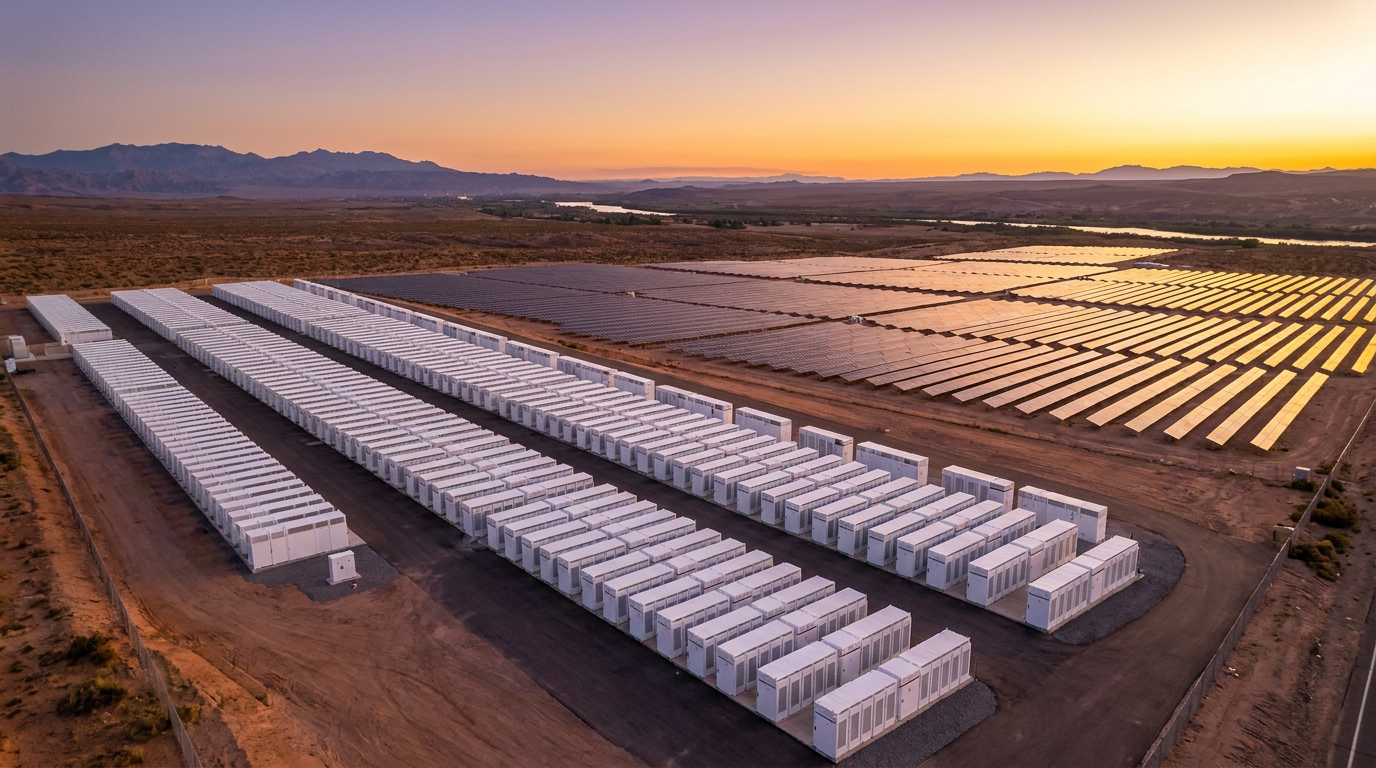
Today's grid-scale batteries act as a massive sponge. They absorb excess solar generation during daylight hours—often when wholesale prices drop to zero or even turn negative—and discharge that cheap power into the grid during the lucrative evening peak.[1][8]
This daily arbitrage is devastating the business model of traditional gas peaker plants. In Europe, where burning fossil gas is typically the most expensive way to generate electricity, batteries are increasingly stepping in. In Italy, for example, battery systems are beginning to meet early evening demand, displacing gas generation that historically cost over €110 per megawatt-hour.[3]

This daily arbitrage is devastating the business model of traditional gas peaker plants.
The sheer volume of new capacity coming online is staggering. The United States energy storage sector posted its strongest first quarter in history in 2026, installing 9.7 gigawatt-hours (GWh) of new capacity. To put that in perspective, it is enough energy to power roughly 300,000 homes for a full day during an outage.[2]
This deployment boom is largely driven by economics. Battery costs have plummeted by an average of 20% annually over the last decade, recently hitting record lows of around $70 per kilowatt-hour. At these prices, the financial case for pairing solar farms with massive battery installations is undeniable.[3][7]
The surge in battery capacity is arriving just in time to manage a new grid crisis: the explosive growth of artificial intelligence. Data centers are driving unprecedented electricity demand, prompting major technology companies to sign large-scale battery storage agreements to ensure their facilities do not destabilize local grids.[2][5]

While wholesale prices are dropping, the impact on everyday consumer bills is more nuanced. Network transmission charges—the cost of maintaining poles and wires—remain high. However, regulators in markets like Australia are already factoring cheaper wholesale costs into their 2026–2027 default market offers, resulting in benchmark price cuts of up to 7% for millions of households.[4]
The residential sector is also playing a role. The proliferation of home batteries, subsidized by government schemes and integrated into Virtual Power Plants (VPPs), allows households to store their own rooftop solar and export it during peak events, further reducing the grid's reliance on centralized fossil fuels.[4][8]
Despite the momentum, energy analysts caution that the current fleet of lithium-ion batteries—which typically discharge for two to four hours—is only solving the first phase of the transition. Managing intra-day volatility is a solved problem, but managing multi-day weather events remains a challenge.[1][5]

The next frontier for the market is long-duration energy storage. Technologies capable of discharging power for 10 to 12 hours, or even across multiple days, will be required to firmly back up renewable generation during prolonged periods of low wind or heavy cloud cover.[1]
For now, however, the 2026 milestones represent a decisive victory for grid modernization. By successfully decoupling electricity generation from the moment of consumption, battery storage is proving that a fully decarbonized, highly reliable power grid is not just theoretically possible, but economically inevitable.[1][6]
How we got here
2015–2025
Battery costs fall by an average of 20% annually, improving the business case for utility-scale storage.
2024
European grids experience record numbers of negative electricity price hours due to excess daytime solar.
2025
Renewables surpass coal as the world's largest source of electricity, accelerating the need for grid balancing.
Q1 2026
The US installs a record 9.7 GWh of storage, while Australian batteries begin setting wholesale prices a third of the time.
Viewpoints in depth
Market Analysts & Grid Researchers
Focus on how batteries are fundamentally altering market mechanics and displacing gas.
Analysts emphasize that the era of batteries acting merely as backup power is over. By actively participating in price formation, storage systems are smoothing out intraday volatility and reducing the grid's reliance on expensive fossil-fuel peaker plants. However, they caution that the current fleet of short-duration lithium-ion batteries must eventually be supplemented by long-duration technologies to handle multi-day weather lulls.
Clean Energy Developers
Driven by falling hardware costs and lucrative arbitrage opportunities.
For developers, the business case has never been stronger. With battery cell prices hitting record lows, the strategy has shifted from simply capturing curtailed solar energy to actively trading on the wholesale market. By absorbing power when prices are negative and discharging during the lucrative evening peak, developers are securing rapid returns on investment while simultaneously racing to meet the massive new power demands of AI data centers.
Consumer & Retail Market Watchers
Cautiously optimistic about wholesale price drops but focused on retail bill relief.
Consumer watchdogs welcome the deflationary pressure batteries are putting on wholesale electricity markets. However, they are quick to point out that wholesale costs only make up a portion of a household's utility bill. With network transmission charges remaining high, advocates are pushing regulators to ensure that the massive savings generated by grid-scale batteries are actually passed down to everyday ratepayers rather than absorbed by utility profit margins.
What we don't know
- How quickly long-duration storage technologies can scale to manage multi-day weather events.
- Whether the deflationary impact of batteries can fully offset the massive electricity demands of new AI data centers.
Key terms
- Duck Curve
- A graph showing the timing imbalance between peak solar power generation (midday) and peak electricity demand (evening).
- Arbitrage
- The practice of buying electricity when prices are low or negative, storing it, and selling it back to the grid when prices are high.
- Marginal Price
- The cost of the last unit of electricity needed to meet demand at any given moment, which sets the wholesale price for all generators.
- Peaker Plant
- A power plant, typically running on natural gas, that only operates during times of high electricity demand.
- Long-Duration Storage
- Battery systems designed to discharge power continuously for 8 to 12 hours or more, rather than just 2 to 4 hours.
Frequently asked
Why are batteries lowering electricity prices?
Batteries absorb excess, cheap solar power during the day and discharge it during the evening peak. This replaces the need to turn on expensive natural gas power plants, lowering the overall wholesale cost.
Will this make my home electric bill cheaper?
Wholesale price drops are beginning to lower default market offers in some regions, but retail bills also include fixed network and transmission charges, which limits the immediate savings for consumers.
Are there enough batteries to power the grid during a storm?
Current lithium-ion batteries are designed to manage daily shifts in demand (2 to 4 hours). Handling multi-day weather events will require the deployment of emerging long-duration storage technologies.
Sources
Source coverage
8 outlets
3 viewpoints surfaced







[1]ESS NewsMarket Analysts & Grid Researchers
Batteries are setting prices, but long-duration storage will define the market
Read on ESS News →[2]Exact SolarClean Energy Developers
Battery Storage Sets Q1 Record While Fueling AI Boom
Read on Exact Solar →[3]EmberMarket Analysts & Grid Researchers
Early signs of the impact of batteries - European Electricity Review 2026
Read on Ember →[4]SolarQuotesConsumer & Retail Market Watchers
Battery Boom Delivers Power Bill Drop For 2026/27
Read on SolarQuotes →[5]WTWMarket Analysts & Grid Researchers
Renewable Energy Market Review 2026
Read on WTW →[6]ACOREClean Energy Developers
2026: A Year of Clean Energy Momentum Despite Headwinds
Read on ACORE →[7]ENACTClean Energy Developers
2026 Global Market Trends: Solar and Battery Storage
Read on ENACT →[8]The EnergyConsumer & Retail Market Watchers
Battery boom drives deep autumn price cuts
Read on The Energy →
Every angle. Every day.
Get energy stories with full source coverage and perspective breakdowns delivered to your inbox.