
The 2026 Guide to Buying a Used EV: How New Battery Health Mandates Change the Market
New regulations and independent diagnostic certificates are finally making it easy for used EV buyers to verify battery health, removing the biggest hurdle to affordable electric driving.
By Factlen Editorial Team
- Consumer Advocates & Regulators
- Championing transparency, standardized OBD access, and mandatory state-of-health displays to protect used-car buyers.
- Independent Diagnostic Firms
- Capitalizing on the transparency gap for older models by offering third-party testing, certificates, and warranties.
- Automakers & Dealerships
- Adapting to new mandates and utilizing health certificates to boost consumer confidence and used EV resale values.
What's not represented
- · Early EV adopters who suffered severe degradation on pre-2018 air-cooled models.
- · Independent mechanics who previously struggled to afford brand-specific EV diagnostic software.
Why this matters
Used electric vehicles are currently heavily depreciated, offering massive bargains. With new 2026 tools to objectively measure battery degradation, buyers can confidently snag these deals without fearing a sudden, catastrophic replacement bill.
Key points
- Starting with the 2026 model year, CARB regulations require automakers to display a clear battery 'State of Health' metric in the vehicle.
- The mandates also require standardized diagnostic ports, allowing independent mechanics to read battery data without proprietary tools.
- For older EVs, a booming third-party market is providing independent Battery Health Certificates and warranties.
- Real-world data shows the average EV retains roughly 95% of its original battery capacity after five years of use.
- The combination of steep vehicle depreciation and slow battery degradation creates significant financial opportunities for used EV buyers.
The used electric vehicle market in 2026 has become a buyer's paradise. As a wave of three-year lease returns floods dealership lots, prices have plummeted, creating unprecedented bargains for consumers looking to transition away from internal combustion engines. Yet, despite the steep discounts, a persistent hesitation continues to sideline potential buyers: battery anxiety. Consumers are projecting the rapid degradation they experience with their smartphones onto 4,000-pound vehicles, fearing that a three-year-old EV will suddenly lose its ability to hold a charge and leave them stranded on a highway.
For decades, purchasing a used car relied on established mechanical science. A trusted mechanic could perform a compression test, inspect the timing belt, and listen to the transmission to determine a vehicle's remaining lifespan. Electric vehicles, however, replaced those mechanical components with a sealed chemical black box. Assessing the health of a used EV battery historically required trusting the dealership or relying on crude range estimates, leaving buyers fearful of inheriting a degraded battery that might require a catastrophic $10,000 replacement. Without objective data, the used EV market has struggled to build the baseline trust required for mass adoption.
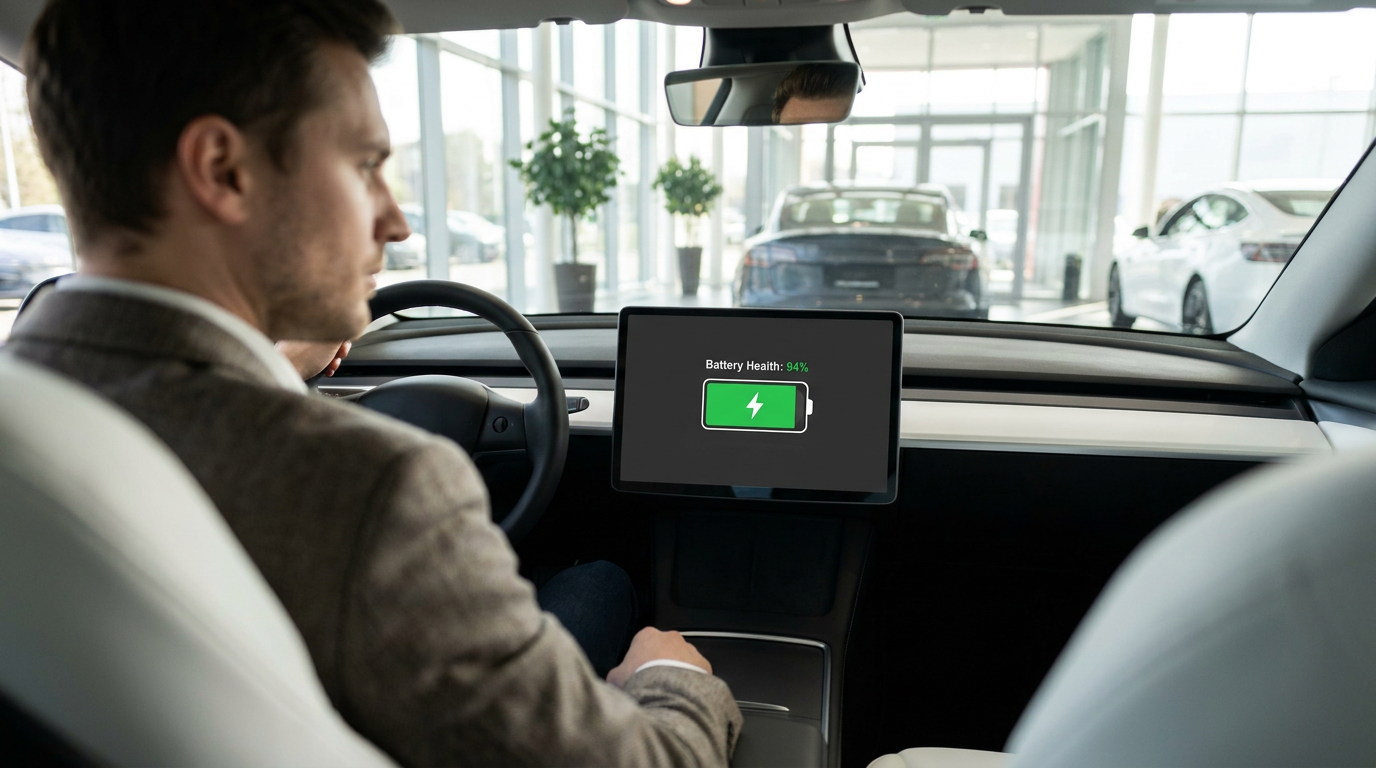
That era of guesswork is officially ending. Starting with the 2026 model year, a sweeping set of regulations from the California Air Resources Board (CARB) is fundamentally changing how automakers must report battery health. Under the Advanced Clean Cars II (ACC II) framework, manufacturers are now required to provide a "customer-readable state of health metric" directly within the vehicle's infotainment system. This mandate ensures that any prospective buyer can sit in the driver's seat, navigate the touchscreen, and instantly see exactly how much of the battery's original capacity remains. By forcing this data out of the hidden engineering menus and into the consumer's hands, regulators are aiming to build the same trust in the used EV market that the odometer provides for gas-powered cars.[1][2]

The CARB regulations go beyond just dashboard displays. Automakers must now implement standardized On-Board Diagnostics (OBD-II) access for their zero-emission vehicles. Previously, EV diagnostic data was often proprietary, requiring expensive, brand-specific software to read. The 2026 standardization breaks this monopoly, allowing independent mechanics and third-party scanners to access detailed battery data, reducing the barriers to entry for repairing and evaluating used EVs. To further backstop consumer confidence, the ACC II rules establish strict new warranty floors. For vehicles in the 2026 through 2029 model years, manufacturers must warrant that the battery will maintain at least 70 percent of its certified range for 10 years or 150,000 miles. If a battery degrades past that threshold within the warranty window, the automaker is on the hook for the repair or replacement.[1][2]
The regulatory momentum extends far beyond California. The United States Environmental Protection Agency (EPA) has advanced parallel federal requirements for battery state-of-health monitors, while international regulators are taking even more aggressive steps. In the United Arab Emirates, for example, the Road and Transport Authority has mandated that all used EVs over three years old must obtain a certified Battery Health Certificate to qualify for comprehensive insurance renewal in 2026. While the 2026 mandates solve the transparency problem for new cars rolling off the assembly line, millions of pre-2026 EVs are already circulating in the secondary market. To bridge this gap, an entire private-sector industry of independent battery certification has emerged. Market analysts project that the EV battery health certification sector will surge from a $0.7 billion valuation in 2026 to $20.0 billion over the next decade.[2][5][7]

To bridge this gap, an entire private-sector industry of independent battery certification has emerged.
Major dealership networks are rapidly adopting these third-party tools to move inventory. In the United Kingdom, dealer groups like Arnold Clark have partnered with diagnostic specialists such as Moba to provide verified battery health certificates with every used EV sale. These certificates function as a "Battery Passport," detailing the state of health, fast-charging cycle counts, and thermal management history. Some independent firms are taking the concept even further by backing their diagnostics with hard cash. Companies like Aviloo have launched independent EV battery warranties for used buyers. After testing a vehicle's state of health, Aviloo sets a minimum capacity threshold; if the battery drops below that line within a year, the warranty pays out a cash compensation directly to the consumer.[6][8][9]
The irony of the lingering battery anxiety is that real-world data proves it is largely unfounded. As independent diagnostic firms aggregate millions of data points, the consensus is clear: modern EV batteries are outlasting the vehicles themselves. A comprehensive 2026 report by EV research firm Recurrent found that the average electric vehicle retains 95 percent of its original range after five years of use. The data challenges the persistent myth that EV batteries degrade as rapidly as smartphone batteries. According to the 2025 Battery Performance Index produced by Generational, which analyzed over 8,000 electric vehicles across 36 manufacturers, even older models show remarkable resilience. The study found that four-to-five-year-old EVs maintain a median battery health of 93.5 percent, while eight-to-nine-year-old vehicles still retain roughly 85 percent of their original capacity.[3][4][9]

Interestingly, the diagnostic data reveals that raw mileage is not the primary enemy of battery longevity. Calendar aging—the natural chemical degradation that occurs over time—and thermal stress from extreme climates play a much larger role than the odometer reading. A newer, high-mileage fleet vehicle driven in a temperate climate often boasts a healthier battery than an older, low-mileage car parked outside in extreme heat. Charging habits also leave a distinct footprint on a battery's state of health. Frequent reliance on high-voltage DC fast chargers accelerates cyclic aging, putting more stress on the internal cell chemistry. Conversely, vehicles that are primarily charged overnight on Level 2 AC home chargers tend to preserve their capacity significantly longer, rewarding owners who treat fast charging as an occasional necessity rather than a daily routine.[4][9]
For the informed consumer, this convergence of robust battery durability and plummeting used car prices creates a massive financial arbitrage. An electric vehicle might lose 40 to 50 percent of its financial value in its first three years due to standard depreciation curves, yet it will have lost only about 5 percent of its functional utility. This disconnect between market perception and engineering reality means that buyers who understand how to verify battery health can secure premium transportation for a fraction of the cost of a new vehicle.[3][9]

The era of guessing is definitively over. Between the strict 2026 regulatory mandates forcing transparency onto the dashboard and the booming market for independent diagnostic certificates, buying a used EV has transformed from a leap of faith into a data-driven transaction. Armed with verified state-of-health metrics, consumers can now confidently navigate the used market, knowing exactly what they are buying and how long it will last. The black box has finally been opened, removing the last major hurdle to widespread used EV adoption.[9]
How we got here
August 2022
CARB proposes the Advanced Clean Cars II regulations, introducing the first major battery durability and transparency mandates.
December 2023
CARB finalizes requirements for standardized OBD-II diagnostic access for zero-emission vehicles.
March 2024
The EPA proposes parallel federal rules for battery state-of-health monitors and warranties.
June 2026
Independent diagnostic firms like Aviloo launch cash-backed battery warranties for the European and UK used EV markets.
Model Year 2026
The CARB mandates officially take effect, requiring customer-readable health metrics in all new EVs sold in participating states.
Viewpoints in depth
Consumer Advocates & Regulators
Regulators view battery transparency as essential for consumer protection and the long-term viability of the EV transition.
For years, consumer protection groups have argued that the lack of standardized battery health data created an unfair asymmetry in the used car market. Regulators like CARB and the EPA agree, viewing the 2026 mandates as a necessary step to prevent buyers from unknowingly purchasing heavily degraded vehicles. By forcing automakers to display a clear State of Health metric and open their diagnostic ports, regulators aim to democratize vehicle data, ensuring that independent mechanics can service EVs and buyers can verify exactly what they are paying for.
Independent Diagnostic Firms
Third-party certification companies see a massive market opportunity in providing objective, verified battery data.
With millions of pre-2026 electric vehicles already on the road lacking built-in health displays, independent diagnostic firms are rushing to fill the void. Companies in this sector argue that manufacturer-provided data can sometimes be opaque or overly optimistic, making third-party verification crucial. By offering plug-in diagnostic tests, detailed 'Battery Passports,' and even independent warranties, these firms are building a multi-billion-dollar industry centered entirely on providing neutral, verifiable peace of mind to hesitant used-car shoppers.
Automakers & Dealerships
While initially resistant to strict warranty mandates, the industry is embracing certificates to move used inventory.
Automakers initially pushed back against some of the stricter 2026 warranty requirements, arguing that battery degradation is heavily influenced by unpredictable consumer charging habits rather than manufacturing defects. However, on the retail side, dealerships are increasingly embracing battery health certificates. Dealers recognize that 'battery anxiety' is the single biggest factor depressing used EV prices and slowing inventory turnover. By proactively providing verified health reports from companies like Moba or Aviloo, dealerships can justify higher resale prices and close sales faster.
What we don't know
- How strictly the EPA will enforce its proposed federal battery health mandates compared to California's finalized CARB rules.
- Whether the proliferation of third-party battery certificates will fully stabilize the volatile depreciation curves of used EVs.
- How automakers will handle warranty claims for batteries that degrade just above the 70% threshold but still significantly impact daily driving range.
Key terms
- State of Health (SoH)
- A percentage metric comparing an EV battery's current maximum capacity to its original factory capacity.
- Battery Management System (BMS)
- The internal computer that monitors and regulates the battery pack's temperature, charging rates, and cell balance.
- OBD-II
- On-Board Diagnostics, a standardized port that allows mechanics and diagnostic tools to read a vehicle's internal computer data.
- Calendar Aging
- The natural, unavoidable degradation of battery chemistry over time, regardless of how many miles the vehicle is driven.
- Cyclic Aging
- Battery degradation caused by the physical stress of repeatedly charging and discharging the cells.
Frequently asked
What is an EV Battery Health Certificate?
A verified diagnostic report detailing a used EV's State of Health (SoH), remaining capacity, and charging history, often provided by independent testing firms.
How much range does an EV actually lose over time?
Real-world data shows average EVs lose only about 5% of their range after five years, and roughly 15% after eight years.
What do the 2026 CARB regulations change for EV buyers?
Starting with the 2026 model year, automakers must include a customer-readable battery health metric in the dashboard and standardize diagnostic ports for third-party mechanics.
Does fast charging ruin an electric car battery?
While frequent DC fast charging can accelerate degradation slightly compared to Level 2 home charging, modern thermal management systems prevent catastrophic damage.
Sources
Source coverage
9 outlets
3 viewpoints surfaced









[1]California Air Resources BoardConsumer Advocates & Regulators
Advanced Clean Cars II Regulations: 2026 ZEV and PHEV Test Procedures
Read on California Air Resources Board →[2]WardsAutoConsumer Advocates & Regulators
Recent EPA and CARB Rulemakings Advance EV Requirements
Read on WardsAuto →[3]Kelley Blue BookAutomakers & Dealerships
Report: EV Batteries Degrade Less Than You Might Believe
Read on Kelley Blue Book →[4]Drive ElectricAutomakers & Dealerships
Concerned about EV battery life? This new study may surprise you
Read on Drive Electric →[5]Fact.MRIndependent Diagnostic Firms
EV Battery Health Certification & Second-Life Services Market Size
Read on Fact.MR →[6]EV PoweredIndependent Diagnostic Firms
Aviloo launches EV battery warranty for used buyers
Read on EV Powered →[7]eSanadConsumer Advocates & Regulators
Used EV Battery Health Certificate and UAE Insurance 2026
Read on eSanad →[8]WhichEVIndependent Diagnostic Firms
UK dealer group expands its EV aftersales services with diagnostic testing
Read on WhichEV →[9]Factlen Editorial TeamAutomakers & Dealerships
Synthesis by Factlen editorial team
Read on Factlen Editorial Team →

More in shopping
See all 7 stories →Sleep Tech
Do Sleep Trackers Actually Work? The Clinical Evidence on Wearable Accuracy
8 sources
Summer Sales
Amazon, Target, and Walmart Shift Summer Sales to June, Creating a Retail 'Mega-Week'
6 sources

Display Tech
OLED vs. Mini-LED: The 2026 Gaming Monitor Trade-Off Analysis
6 sources

Used EVs
The 2026 Guide to Buying a Used EV: Battery Health, Tax Credits, and What to Know
8 sources

Every angle. Every day.
Get shopping stories with full source coverage and perspective breakdowns delivered to your inbox.