
Do Sleep Trackers Actually Work? The Clinical Evidence on Wearable Accuracy
Consumer wearables are highly accurate at measuring total sleep time and heart rate, but clinical evidence shows they still struggle to map specific sleep stages like deep and REM sleep.
By Factlen Editorial Team
- Clinical Sleep Specialists
- Medical professionals who rely on brainwave data and warn against over-interpreting wearable scores.
- Quantified Self Advocates
- Athletes and biohackers who use wearables to optimize daily performance and recovery.
- Factlen Synthesis
- An evidence-based evaluation weighing clinical accuracy against behavioral utility.
What's not represented
- · Users with diagnosed severe sleep disorders like narcolepsy
- · Low-income consumers priced out of subscription-based wearables
Why this matters
Millions of consumers rely on sleep trackers to dictate their daily readiness and health decisions. Understanding where these devices provide medical-grade data versus where they are simply guessing is crucial for using them effectively without developing sleep anxiety.
Key points
- Consumer wearables are highly accurate at detecting total sleep time and distinguishing sleep from wakefulness.
- Devices struggle to accurately map specific sleep stages like deep and REM sleep, as they cannot measure brain waves.
- Overnight cardiovascular metrics, such as resting heart rate and respiratory rate, are tracked with near-clinical precision.
- While trackers can encourage better sleep hygiene, they can also trigger 'orthosomnia'—anxiety driven by chasing perfect sleep scores.
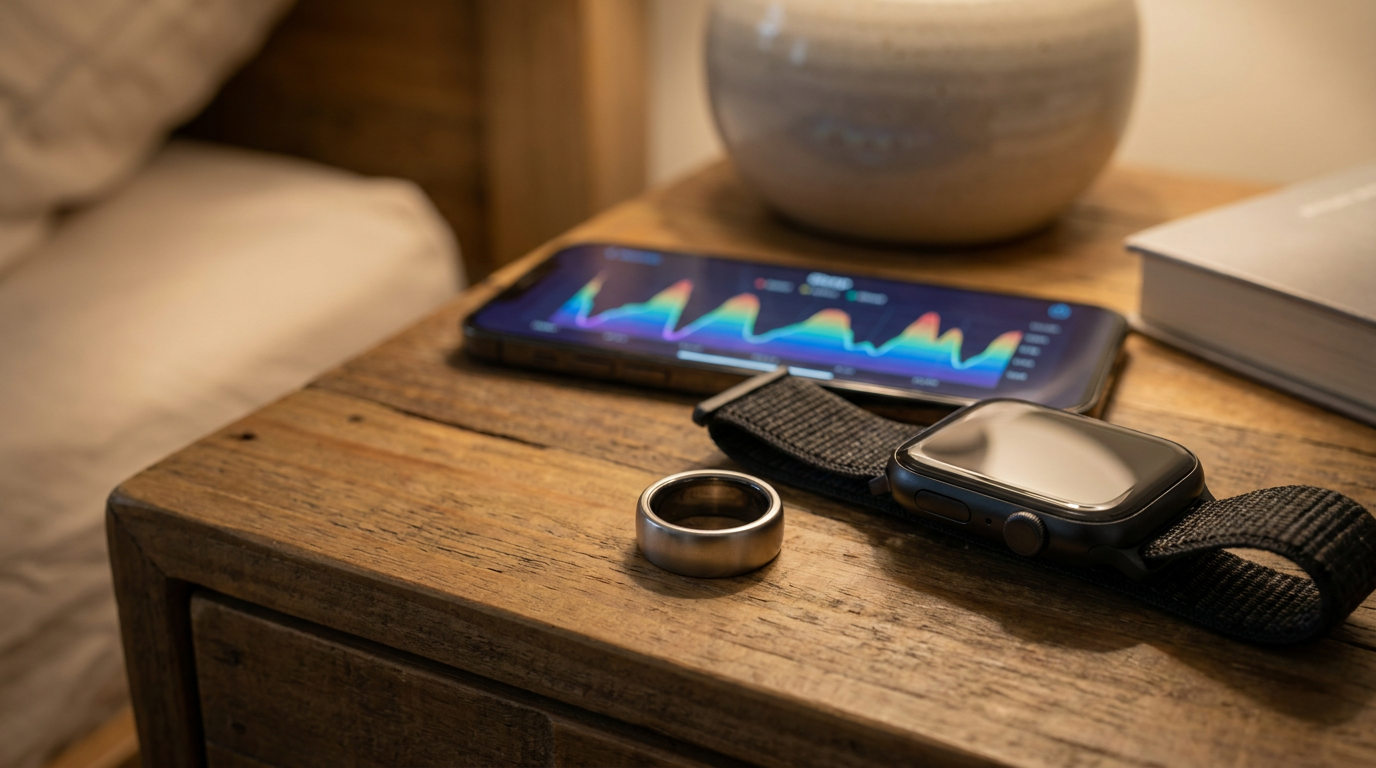
The consumer sleep technology market has exploded over the past decade, with millions of people strapping smartwatches, titanium rings, and biometric bands to their bodies each night. Devices like the Oura Ring, Whoop, and Apple Watch promise to decode the mysteries of human slumber, offering morning readiness scores and detailed breakdowns of overnight sleep architecture. For many users, these metrics have become the ultimate arbiter of how they should feel when they wake up.[6][7]
But as these devices transition from niche fitness accessories to mainstream health monitors, a critical question has emerged: how clinically accurate is the data they provide? To answer this, medical researchers have spent the last several years testing consumer wearables against polysomnography—the medical gold standard for sleep tracking, which uses electrodes to measure brain waves, eye movements, and muscle activity in a clinical laboratory setting.[1][8]
The resulting evidence reveals a stark divide between what wearables do exceptionally well and where their algorithms are essentially making educated guesses. When evaluating the claim that wearables accurately measure total sleep duration, the clinical evidence is remarkably strong. When it comes to two-stage classification—simply determining whether a user is asleep or awake—modern wearables are highly effective.[1][6]

A recent meta-analysis of validation studies found that top-tier consumer devices consistently achieve 85 to 95 percent sensitivity in detecting sleep. The average bias for total sleep time compared to clinical polysomnography is remarkably low, often falling within 10 to 15 minutes over the course of an eight-hour night. For the average consumer looking to ensure they are getting enough baseline rest, this margin of error is entirely acceptable.[1][2]
However, clinical specialists note that devices can still be fooled by simple stillness. Because wearables rely heavily on accelerometers to detect movement, a user who is lying perfectly still in bed while awake with insomnia may be incorrectly logged as sleeping. This limitation can occasionally artificially inflate a user's sleep efficiency score, masking the severity of underlying sleep onset issues.[4]
The evidence becomes significantly weaker when evaluating the claim that wearables can accurately map specific sleep stages, such as light, deep, and REM sleep. This is where consumer devices face their greatest physiological limitation. Wearables attempt to estimate sleep stages using photoplethysmography to track heart rate variability and accelerometers to track movement. But true sleep staging is defined by brain wave activity, which wrist and finger sensors simply cannot read.[3][4]
The evidence becomes significantly weaker when evaluating the claim that wearables can accurately map specific sleep stages, such as light, deep, and REM sleep.
Independent validation studies, including recent trials at Brigham and Women's Hospital, show that while modern devices perform better than older models, their multi-stage accuracy remains strictly moderate. Statistical agreement with polysomnography for four-stage classification typically yields a Cohen's kappa value between 0.40 and 0.65, indicating that the devices are frequently guessing when transitioning between deep and light sleep.[1][6]

In practical terms, this means devices frequently confuse deep sleep with light sleep. Real-world testing across multiple devices worn simultaneously often yields wildly different results for the exact same night. In some independent tests, deep sleep estimates varied by up to 76 percent between different brands worn by the same user, highlighting the proprietary and often subjective nature of the algorithms used by different manufacturers.[6]
Conversely, the evidence supporting the claim that wearables accurately track overnight heart rate and respiratory rate is exceptionally strong. While they struggle to read brain waves, modern wearables are highly sophisticated at measuring cardiovascular metrics. Validation studies confirm that the bias and precision errors for resting heart rate and respiratory rate are incredibly low compared to clinical electrocardiograms.[1]
This precision makes devices highly reliable for tracking baseline physiological stress and recovery. A spike in overnight respiratory rate or a sudden drop in heart rate variability is a clinically validated indicator of impending illness, overtraining, or systemic stress. Even if the accompanying sleep stage breakdown is imperfect, the cardiovascular data provides a highly accurate window into the body's autonomic nervous system.[6][7]
The final major claim—that using a sleep tracker actively improves overall sleep quality—carries mixed and highly conditional evidence. The psychological impact of sleep tracking is a double-edged sword. For many users, the simple act of monitoring sleep creates a positive behavioral loop. It encourages consistent bedtimes, highlights the negative impact of late-night alcohol, and gamifies basic sleep hygiene.[2][5]

On the other hand, sleep specialists are increasingly diagnosing a phenomenon known as orthosomnia—a condition where the pursuit of perfect sleep metrics causes profound anxiety. When users wake up feeling refreshed but see a low recovery score on their phone, the resulting nocebo effect can ruin their day and trigger performance anxiety the following night, actively degrading their actual sleep quality.[3][5]
Ultimately, the scientific consensus suggests that consumer sleep trackers are best viewed as behavioral mirrors rather than clinical diagnostic tools. They cannot diagnose sleep apnea or perfectly map REM cycles, but they are highly effective at tracking total sleep duration, monitoring cardiovascular baselines, and nudging users toward healthier nighttime routines—provided the user doesn't let the data dictate how they feel.[3][8]
Viewpoints in depth
Clinical Sleep Specialists
Medical professionals who rely on brainwave data and warn against over-interpreting wearable scores.
Clinicians emphasize that sleep is fundamentally a neurological process, not a cardiovascular or kinetic one. While they acknowledge wearables are useful for identifying broad patterns like total sleep deprivation, they caution that consumer devices cannot diagnose conditions like obstructive sleep apnea or insomnia. They frequently see patients who suffer from 'orthosomnia,' where the anxiety of chasing a perfect sleep score actively disrupts the patient's ability to fall asleep naturally.
Quantified Self Advocates
Athletes and biohackers who use wearables to optimize daily performance and recovery.
For this camp, the absolute clinical accuracy of a sleep stage is less important than the baseline trend. If a device consistently measures HRV and resting heart rate, users can reliably adjust their daily training load or recognize when they are fighting off an illness. They view the wearable not as a medical diagnostic tool, but as a behavioral compass that holds them accountable to consistent bedtimes and highlights the detrimental effects of late-night meals or alcohol.
Device Manufacturers
The engineers and companies developing the algorithms that power consumer wearables.
Manufacturers argue that while their devices don't use EEG, their machine-learning algorithms are becoming increasingly sophisticated at inferring sleep stages from peripheral signals like temperature, pulse, and micro-movements. They point to continuous firmware updates that refine these models over time, arguing that a device worn 365 days a year provides a more holistic picture of a user's health than a single, highly disruptive night spent wired up in a clinical sleep lab.
What we don't know
- Whether the proprietary algorithms used by wearable companies are biased toward flattering the user with higher scores to encourage continued use.
- How the long-term, multi-year use of sleep trackers impacts a person's innate ability to self-regulate rest without digital feedback.
- The exact degree to which upcoming non-contact tracking technologies will bridge the accuracy gap with clinical polysomnography.
Key terms
- Polysomnography (PSG)
- The medical gold standard for sleep testing, conducted in a lab using sensors that measure brain waves, blood oxygen, heart rate, and breathing.
- Photoplethysmography (PPG)
- An optical technology used in wearables that shines light into the skin to measure blood flow and calculate heart rate.
- Orthosomnia
- An unhealthy obsession with achieving perfect sleep metrics, often resulting in anxiety that paradoxically worsens sleep quality.
- Cohen's kappa
- A statistical measure used in research to evaluate the level of agreement between two different measurement methods, accounting for chance.
Frequently asked
Can a smartwatch or smart ring diagnose sleep apnea?
No. While some newer devices have FDA clearance to flag potential signs of sleep apnea using blood oxygen sensors, they cannot officially diagnose the condition. A clinical sleep study is required for a formal diagnosis.
Why do different trackers give me different deep sleep numbers?
Consumer trackers estimate sleep stages using movement and heart rate, not brain waves. Because each company uses a different proprietary algorithm to guess what those physical signals mean, their estimates for deep and REM sleep often vary wildly.
What is the most accurate metric these devices track?
Total sleep duration and cardiovascular metrics like resting heart rate and respiratory rate are highly accurate. Devices are excellent at knowing when you are generally asleep versus awake, and very precise at measuring your pulse.
Should I take my sleep tracker off if it makes me anxious?
Yes. Sleep specialists recommend 'data fasting' if you experience orthosomnia—anxiety driven by chasing perfect sleep scores. If a low score ruins your morning even when you feel rested, the device is doing more harm than good.
Sources
Source coverage
8 outlets
3 viewpoints surfaced








[1]Journal of Clinical Sleep MedicineClinical Sleep Specialists
Validation of wearable sleep trackers against polysomnography
Read on Journal of Clinical Sleep Medicine →[2]Johns Hopkins MedicineClinical Sleep Specialists
Do Sleep Trackers Really Work?
Read on Johns Hopkins Medicine →[3]Cleveland ClinicClinical Sleep Specialists
Do Sleep Trackers Actually Work?
Read on Cleveland Clinic →[4]Michigan MedicineClinical Sleep Specialists
Why Sleep Trackers Won't Actually Improve Your Sleep
Read on Michigan Medicine →[5]Mito HealthQuantified Self Advocates
Do Sleep Trackers Improve Sleep Quality?
Read on Mito Health →[6]The Longevity StoreQuantified Self Advocates
Sleep Trackers Accuracy vs Polysomnography
Read on The Longevity Store →[7]Sleep FoundationQuantified Self Advocates
Best Sleep Trackers of 2026
Read on Sleep Foundation →[8]Factlen Editorial TeamFactlen Synthesis
Synthesis by Factlen editorial team
Read on Factlen Editorial Team →

Every angle. Every day.
Get shopping stories with full source coverage and perspective breakdowns delivered to your inbox.