
The Rise of Astrotourism: Why Dark Skies Are 2026's Most Sought-After Destination
As light pollution obscures the stars for 83% of the global population, travelers are increasingly seeking out certified dark-sky reserves and celestial events. The booming astrotourism industry offers an economic lifeline to remote communities while driving a new wave of nocturnal conservation.
By Factlen Editorial Team
- Conservationists & Astronomers
- Argue that preserving the night sky is an urgent ecological and scientific imperative, viewing tourism as a tool to enforce lighting ordinances.
- Rural Municipalities
- View astrotourism primarily as a vital economic engine that replaces lost extractive industry jobs and justifies the upfront costs of retrofitting infrastructure.
- Hospitality & Travel Operators
- Treat natural darkness as a premium, highly marketable amenity that drives off-season bookings and caters to the growing demand for soft adventure.
- Factlen Editorial Team
- Synthesizes these views, noting the paradox that scaling astrotourism inherently risks introducing the very light pollution it seeks to escape.
What's not represented
- · Local residents who oppose strict dark-sky lighting ordinances due to safety or cost concerns.
- · Daytime tourism operators who may lose market share as destination marketing shifts toward the night.
Why this matters
Light pollution is erasing our view of the cosmos, severing a connection to the night sky that has guided human culture for millennia. The financial incentives of astrotourism are finally giving local governments a profitable reason to turn off the lights and protect natural darkness.
Key points
- Astrotourism is surging as 83 percent of the global population now lives under light-polluted skies, making natural darkness a rare commodity.
- The industry is projected to grow from $1.18 billion in 2025 to $3.47 billion by 2034, driven by eclipse chasers and luxury travelers.
- Because stargazing requires overnight stays, it injects significantly more capital into rural economies than traditional daytime tourism.
- To protect their skies, certified destinations are implementing strict lighting ordinances, including downward-facing shields and warm-temperature LEDs.
- The August 2026 total solar eclipse across Europe is expected to be a watershed moment for the mainstream adoption of nocturnal travel.
For decades, the rhythm of global tourism has been dictated by the sun. Travelers wake early to beat the crowds, spend their daylight hours exploring, and retreat indoors when darkness falls. But as the travel industry moves through 2026, a profound inversion is taking place. Millions of travelers are now planning their itineraries around the night, driven by a desire to witness celestial phenomena and experience pristine, star-filled skies. This shift will reach a fever pitch in August 2026, when a total solar eclipse sweeps across mainland Europe for the first time in nearly three decades, drawing massive crowds to vantage points in Spain, Iceland, and Greenland.[4]
This movement, broadly known as astrotourism, encompasses everything from casual stargazing in remote national parks to the highly coordinated global migrations of "umbraphiles"—dedicated eclipse chasers who travel the world to stand in the moon's shadow. It represents a departure from traditional adventure travel, which often prioritizes physical conquest or adrenaline. Instead, astrotourism is rooted in what researchers call "celestial ecotourism," an experience that fosters a sense of transcendence and a humbling awareness of humanity's tiny footprint in the wider universe.[4][5]
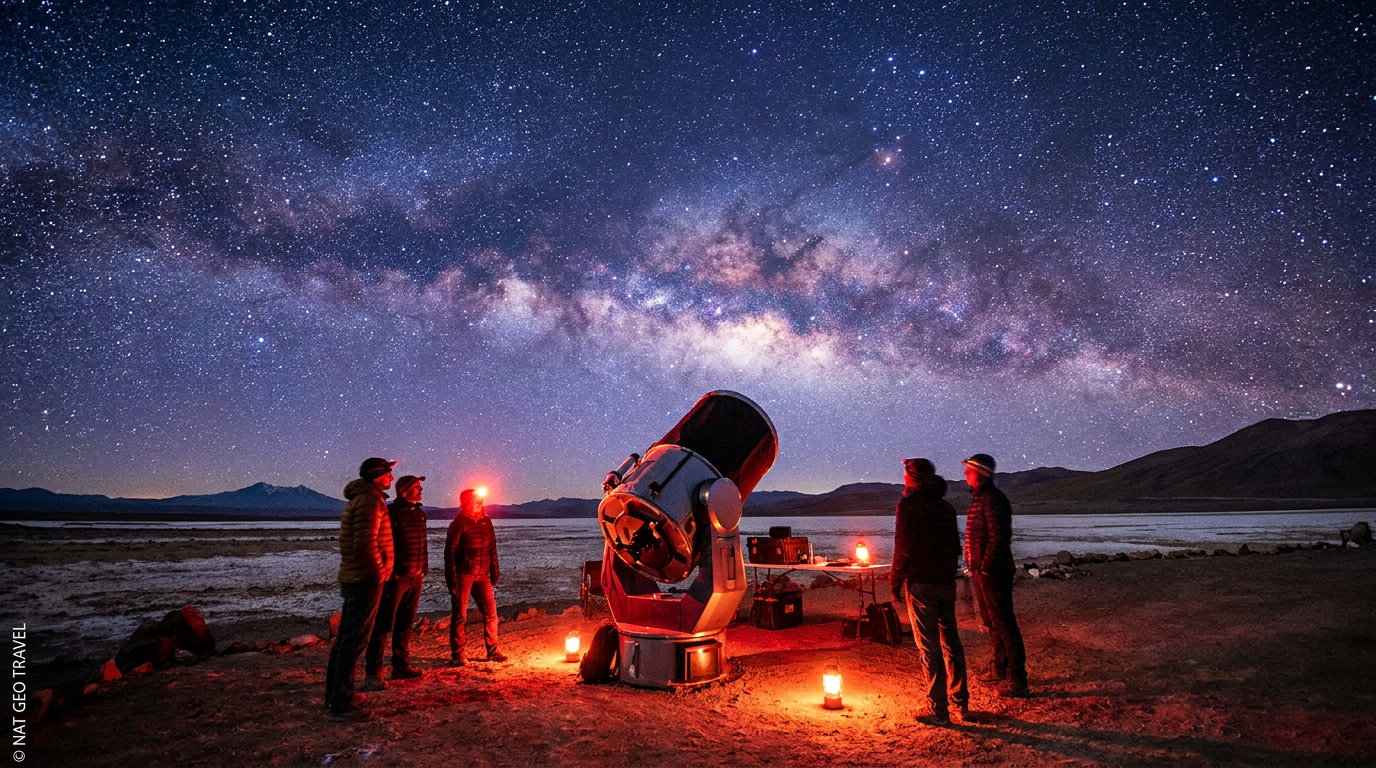
The sudden boom in nocturnal travel is driven primarily by a modern crisis of scarcity. For the vast majority of human history, a brilliant canopy of stars was a universal nightly experience. Today, approximately 83 percent of the global population lives under light-polluted skies, meaning that pristine darkness has transformed from a ubiquitous natural right into a rare, highly sought-after commodity. For urban dwellers, seeing the Milky Way is no longer a matter of simply looking up; it requires a dedicated expedition.[3]
The mechanism erasing our view of the cosmos is known as skyglow—the diffuse luminance of the night sky caused by artificial light scattering through atmospheric particles. The problem is accelerating rapidly. According to data tracked by the National Park Service and dark-sky advocates, average night-sky brightness increased by roughly 9.6 percent annually between 2011 and 2022. The proliferation of cheap, unshielded LED lighting has made the skies twice as bright as they were just a decade ago, effectively cutting the number of visible stars in half for the average observer.[1]

The loss of the night sky is not merely an aesthetic tragedy; it has profound physiological and psychological consequences. Artificial light at night disrupts human circadian rhythms and wreaks havoc on nocturnal ecosystems, confusing migratory birds and disrupting insect populations. Conversely, researchers note that exposure to truly dark skies triggers a unique psychological response. The sheer scale of the cosmos provides a cognitive reset, offering travelers a rare sense of perspective and relief from the hyper-connected, screen-dominated realities of modern life.[5][6][8]
In response to this growing demand for darkness, a rigorous certification industry has emerged. Organizations like DarkSky International have become the Michelin guides of the night, certifying more than 200 Dark Sky Places across 22 countries. These designations are not handed out lightly. To earn the title of a Dark Sky Reserve or Sanctuary, a region must prove that it possesses exceptional starry nights and, crucially, must implement strict local ordinances to protect that darkness from future development.[1][8]
The mechanics of preserving a dark sky rely entirely on responsible lighting infrastructure. The goal is not to plunge communities into dangerous, pitch-black conditions, but rather to deploy light only where and when it is needed. This involves retrofitting streetlights with physical shields that direct illumination exclusively downward, preventing photons from escaping into the atmosphere. It also requires shifting away from harsh, blue-rich LEDs in favor of warmer color temperatures—typically under 3000 Kelvin—which scatter less easily in the night air and are less disruptive to wildlife.[6]
The mechanics of preserving a dark sky rely entirely on responsible lighting infrastructure.
For rural and remote communities, the transition to dark-sky lighting is increasingly being funded by the sheer economic power of astrotourism. Unlike traditional day-trippers who might drive through a scenic area, buy a tank of gas, and leave, astrotourists are inherently bound to the night. This biological reality forces them to book overnight accommodations, eat dinner at local restaurants, and hire local guides, injecting significantly more capital into the local economy per capita than daytime visitors.[2]

The financial projections are staggering. In the Colorado Plateau—a sprawling, arid region in the American Southwest boasting a high concentration of certified dark-sky parks—astrotourists are expected to spend $5.8 billion over a ten-year period. This influx of nocturnal capital is projected to generate $2.4 billion in higher wages and support roughly 10,000 new jobs annually. In Utah alone, recent surveys indicate that nearly 62 percent of state and national park visitors now participate in some form of night-sky recreation.[2]
Globally, the numbers reflect a massive structural shift in the travel economy. The worldwide astrotourism market, valued at $1.18 billion in 2025, is projected to nearly triple to $3.47 billion by 2034. This compound annual growth rate of over 12 percent is being fueled not just by independent backpackers, but by high-net-worth individuals seeking exclusive, educational experiences in the world's most remote corners. As the industry scales, it is attracting significant institutional investment, transforming formerly niche stargazing spots into highly developed, premium destinations.[3]
The luxury hospitality sector has rapidly adapted to this new reality. In destinations renowned for their atmospheric stability and low light pollution—such as Chile's Atacama Desert, southern Iceland, and the Maldives—darkness is now marketed as a premium amenity. High-end resorts are moving far beyond placing a decorative telescope in the corner of a room. They are constructing permanent, state-of-the-art private observatories, installing glass ceilings directly above beds, and employing resident astronomers to guide guests through the constellations.[1]

This evolution aligns perfectly with broader demographic shifts in adventure travel. As the median age of adventure travelers rises, there is a growing preference for "soft adventure"—experiences that prioritize deep immersion, learning, and connection over extreme physical risk. Astrotourism fits this mandate perfectly. It requires patience rather than peak physical fitness, making it highly accessible to multi-generational families and older travelers who still crave a profound sense of discovery without the physical toll of traditional mountaineering or endurance sports.[7]
However, the explosive growth of astrotourism presents a difficult paradox. The industry relies entirely on the pristine nature of remote environments, yet the act of bringing thousands of tourists into these fragile areas inherently threatens the very darkness they come to see. More visitors mean more rental cars sweeping headlights across the landscape, more demand for illuminated infrastructure, and more glowing smartphone screens disrupting the night vision of fellow stargazers.[6][8]
To prevent dark-sky destinations from being loved to death, site managers are implementing strict mitigation strategies. Many certified parks now require visitors to use red-light headlamps, which do not degrade human night vision or disrupt wildlife to the same degree as white light. Others are establishing remote parking areas and utilizing shuttle systems to keep vehicle headlights far away from primary observation zones, ensuring that the local infrastructure scales sustainably.[6][8]

As the travel industry looks beyond 2026, astrotourism is cementing itself not as a fleeting trend, but as a permanent pillar of the sustainable travel movement. By assigning a tangible, massive economic value to natural darkness, the industry has finally given local governments a profitable reason to turn off the lights. In the end, the quest to see the stars is doing more than just filling hotel rooms; it is actively reversing decades of light pollution, reclaiming the night sky for future generations.[4][8]
How we got here
Pre-2010s
Stargazing remains a niche hobby primarily pursued by amateur astronomers with specialized equipment.
2011–2022
Global night-sky brightness increases by an average of 9.6 percent annually, rapidly eroding natural darkness.
2024–2025
The solar maximum triggers spectacular global aurora displays, pushing astrotourism into the mainstream travel consciousness.
2025
The global astrotourism market surpasses $1.18 billion, with luxury hospitality brands heavily investing in private observatories.
August 2026
A total solar eclipse sweeps across mainland Europe, drawing millions of 'umbraphiles' and cementing nocturnal travel as a major industry pillar.
Viewpoints in depth
The Conservationist View
Focuses on the ecological and scientific urgency of preserving natural darkness.
For astronomers and ecologists, the loss of the night sky is a slow-moving environmental disaster. They point to data showing that artificial skyglow disrupts the migratory patterns of birds, decimates insect populations, and severs humanity's oldest connection to the cosmos. From this perspective, astrotourism is highly valuable not for its economic output, but because it provides the necessary political and financial leverage to force municipalities to adopt strict dark-sky lighting ordinances.
The Rural Economic View
Views the night sky as a renewable resource capable of revitalizing remote communities.
Local governments and rural development boards see astrotourism as a crucial lifeline, particularly for areas transitioning away from mining, logging, or other extractive industries. Because stargazing inherently requires overnight stays, it injects significantly more capital into local hospitality sectors than daytime pass-through tourism. For these stakeholders, the upfront cost of retrofitting streetlights with downward-facing shields is a calculated investment that yields massive, recurring dividends from high-spending visitors.
The Hospitality Industry View
Treats pristine darkness as a premium, highly marketable luxury amenity.
Travel operators and luxury hoteliers recognize that as light pollution engulfs the developed world, true darkness has become a scarce luxury. They are capitalizing on this by transforming their properties into dedicated observation hubs, complete with resident astronomers and private observatories. This camp argues that by commodifying the night sky, they are catering to an aging demographic of adventure travelers who seek profound, awe-inspiring experiences without the extreme physical risks of traditional outdoor sports.
What we don't know
- Whether remote, pristine environments can handle the physical infrastructure required for mass astrotourism without degrading the landscape.
- How the eventual end of the current solar maximum will affect the long-term baseline demand for night-sky travel.
- If developing nations will adopt dark-sky lighting standards as they modernize their electrical grids, or if light pollution will continue to accelerate globally.
Key terms
- Astrotourism
- Travel specifically undertaken to observe astronomical phenomena, visit space-related facilities, or experience naturally dark skies.
- Skyglow
- The diffuse brightening of the night sky over inhabited areas, caused by artificial light scattering through particles in the atmosphere.
- Umbraphile
- A dedicated eclipse chaser who travels the globe specifically to stand in the path of totality during a solar eclipse.
- Color Temperature
- A measurement in Kelvin that describes how warm or cool a light source appears; dark-sky initiatives advocate for warmer, lower-Kelvin bulbs that scatter less light.
- Light Shielding
- The practice of designing or retrofitting outdoor light fixtures with physical barriers so that light is directed only downward, preventing it from escaping into the sky.
Frequently asked
What is astrotourism?
Astrotourism is a form of travel focused on experiencing the night sky, observing astronomical phenomena like eclipses or auroras, and visiting areas free from artificial light pollution.
What makes a location an International Dark Sky Place?
To be certified by organizations like DarkSky International, a location must possess exceptional natural darkness and implement strict local lighting ordinances to protect the sky from future light pollution.
Why is light pollution increasing so rapidly?
The rapid increase is largely driven by urban sprawl and the widespread adoption of cheap, unshielded LED lighting, which scatters harsh blue light into the atmosphere.
How does astrotourism benefit local economies?
Because stargazing happens at night, astrotourists are required to book overnight accommodations and eat at local restaurants, injecting significantly more money into rural economies than daytime pass-through visitors.
Sources
Source coverage
8 outlets
4 viewpoints surfaced







[1]ForbesHospitality & Travel Operators
The Rise Of Astrotourism: 25 Hotels Leading The Stargazing Trend
Read on Forbes →[2]U.S. National Park ServiceRural Municipalities
Night Skies: An Economic Value
Read on U.S. National Park Service →[3]Market InteloHospitality & Travel Operators
Astro Tourism Market Research Report 2034
Read on Market Intelo →[4]Explore WorldwideHospitality & Travel Operators
Travel Trends 2026 | Annual Report On Where People Go & Why
Read on Explore Worldwide →[5]MDPIConservationists & Astronomers
Astrotourism–Exceeding Limits of the Earth and Tourism Definitions?
Read on MDPI →[6]TWordConservationists & Astronomers
Astrotourism: The Fight Against Light Pollution
Read on TWord →[7]Nayara ResortsHospitality & Travel Operators
The Top 10 Travel Trends of 2026
Read on Nayara Resorts →[8]Factlen Editorial TeamFactlen Editorial Team
Synthesis by Factlen editorial team
Read on Factlen Editorial Team →
Every angle. Every day.
Get travel stories with full source coverage and perspective breakdowns delivered to your inbox.