
The Billion-Dollar Chemistry Behind the Perfect Fast-Food French Fry
The modern fast-food french fry is not just a cut potato; it is a highly engineered marvel of thermodynamics, chemistry, and sensory psychology. From dextrose baths to stress relaxation tests, food scientists have perfected a global standard of crunch.
By Factlen Editorial Team
- Food Engineers & Chemists
- Focus on thermodynamic consistency, texture analysis, and scaling agricultural products.
- Public Health Researchers
- Focus on reducing oil absorption, acrylamide formation, and sodium levels through alternative heating methods.
- Culinary Traditionalists
- Advocate for fresh-cut, single-fry methods, prioritizing natural potato flavor over engineered uniformity.
What's not represented
- · Potato Farmers & Agricultural Suppliers
- · Fast-Food Kitchen Workers
Why this matters
Understanding the engineering behind everyday foods reveals the invisible systems that shape our diets and cravings. By decoding the science of the fry, consumers gain insight into how industrial food production manipulates texture and temperature to trigger neurological rewards.
Key points
- Fast-food fries undergo a complex 15-step engineering process to eliminate the natural inconsistencies of agricultural potatoes.
- Potatoes are blanched to remove natural sugars, then coated in dextrose to ensure a uniform golden-brown Maillard reaction.
- The double-fry method and flash-freezing process break down the potato's cellular structure, creating a fluffy interior and a rigid moisture barrier.
- Food scientists use Texture Analyzers to measure the exact shatter of the crust, maximizing the dopamine-triggering effect known as dynamic contrast.
Every day, millions of customers pull up to drive-thru windows across the globe expecting a minor miracle of consistency. Whether ordered in Tokyo, New York, or Mumbai, a fast-food french fry is expected to deliver the exact same golden crunch, fluffy interior, and precise level of saltiness. This global uniformity generates tens of billions of dollars annually—with McDonald's alone selling an estimated $13 billion worth of fries each year. Yet, the humble potato is an inherently inconsistent agricultural product, varying wildly in sugar content, moisture, and starch depending on the soil and season. Bridging the gap between a chaotic tuber and a globally identical menu item requires stripping the potato of its natural unpredictability.[5]
The modern fast-food fry is not merely a sliced vegetable dropped into hot oil; it is a highly engineered edible technology. The transformation begins on the cutting floor, where high-pressure water cannons shoot potatoes through grid blades at speeds exceeding 60 miles per hour. The resulting sticks are cut to a precise width—often exactly seven millimeters. This dimensional uniformity is not just for aesthetic appeal. It ensures that every single fry cooks at the exact same rate, and it builds subconscious expectation patterns in the consumer's brain, where predictable satisfaction breeds intense cravings.[5]
Once cut, the raw potatoes undergo a rigorous chemical reset. The first step is blanching, where the fries are submerged in hot water to deactivate the natural enzymes that cause uneven browning. This hot bath also leaches out the potato's natural, unpredictable sugars. If a restaurant were to fry a raw potato straight from the ground, the varying sugar levels would result in some fries turning burnt and bitter while others remained pale. By stripping the natural sugars, food engineers create a blank canvas.[2]
To restore the color in a perfectly controlled manner, the fries are bathed in a precise solution of dextrose—a simple sugar. When the fry eventually hits the hot oil, this dextrose triggers the Maillard reaction, a chemical interplay between amino acids and reducing sugars that guarantees a uniform, golden-brown hue every single time. Alongside the dextrose, a chemical called sodium acid pyrophosphate is introduced. This additive prevents the iron in the potato from reacting with phenolic compounds, ensuring the fry does not oxidize and turn an unappetizing gray during its long journey through the frozen supply chain.[4][5]

The most critical step in the engineering process is the double-fry method, a technique that has been extensively reverse-engineered by culinary scientists. At the processing plant, the fries undergo a brief par-fry at roughly 365 degrees Fahrenheit. This initial plunge into hot oil accomplishes two vital structural tasks: it partially cooks the starches in the outer layers, and it creates a microscopic moisture barrier. This barrier is essential for preventing the fry from absorbing too much oil during its final cook at the restaurant.[2]
Following the par-fry, the potatoes are flash-frozen. While freezing is necessary for global distribution, it serves a secondary, structural purpose. The rapid drop in temperature creates jagged ice crystals inside the potato. These crystals pierce the cellular structure of the tuber, breaking down the internal matrix. When the fry is eventually cooked, this internal cellular damage allows the potato to steam into a perfectly fluffy, mashed-potato-like texture, contrasting sharply with the rigid exterior.[2]
While freezing is necessary for global distribution, it serves a secondary, structural purpose.
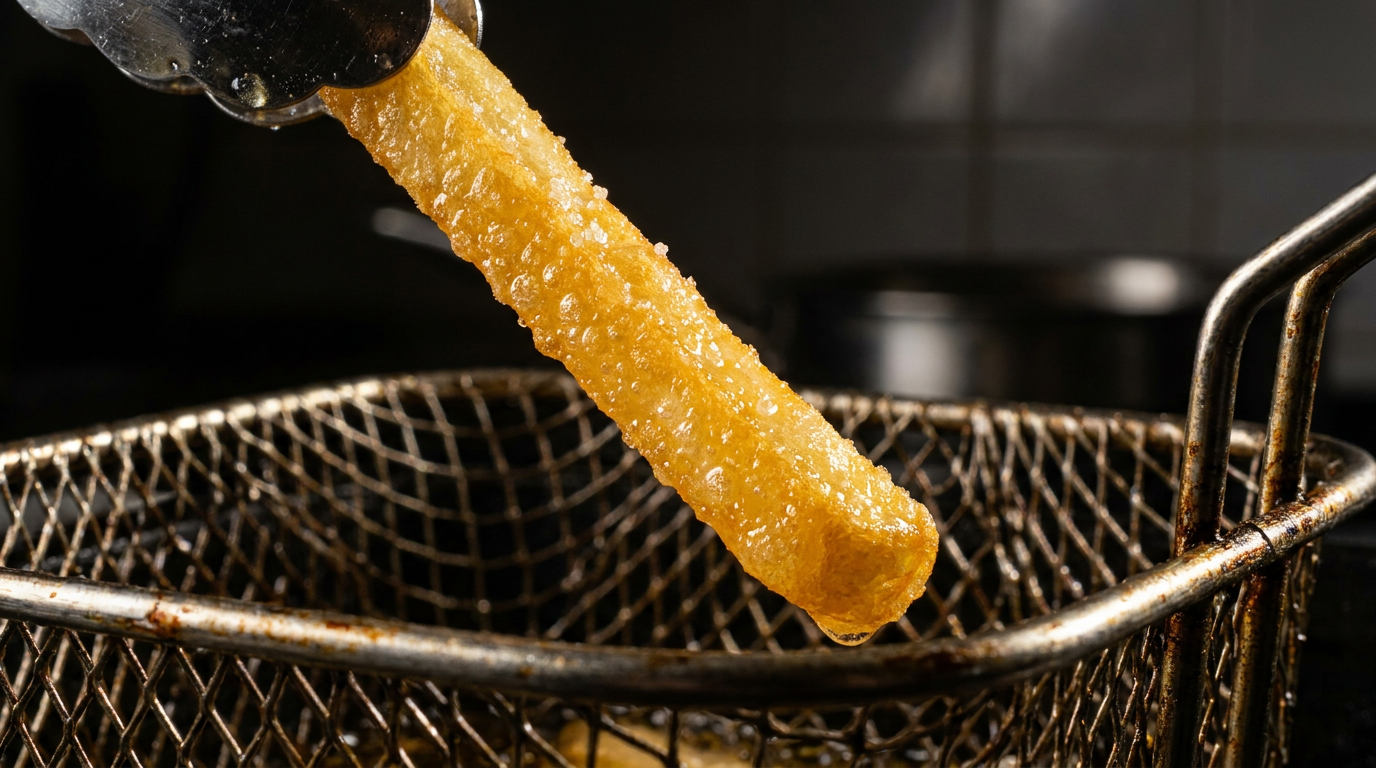
The final transformation occurs at the restaurant level, plunging the frozen, chemically primed potato sticks into oil heated to between 340 and 350 degrees Fahrenheit. This stage is a masterclass in thermodynamics. As the cold fry hits the hot oil, the moisture just beneath the surface immediately boils, turning into steam. This steam pushes outward with immense pressure, creating a violent bubbling effect in the fryer.[1]
Food engineers, such as those at the University of California, Davis, have spent decades studying this specific heat transfer. The outward pressure of the escaping steam actually acts as a physical shield, preventing the frying oil from seeping deep into the potato's core. As long as the fry is actively steaming, it is repelling oil. Once the bubbling stops, the fry begins to absorb fat rapidly, which is why precise fryer timers are strictly enforced in fast-food kitchens.[3]

To measure the success of this thermodynamic dance, researchers employ specialized equipment like Texture Analyzers. In laboratory settings, scientists conduct stress relaxation tests, compressing freshly cooked potato patties to measure the exact resilience and bounce-back of the crust. They quantify the crunch, turning a subjective culinary experience into hard, replicable data. This ensures the crust is thick enough to hold its shape but brittle enough to shatter pleasantly upon the first bite.[3]
That precise shatter is the key to the fry's addictive nature, a phenomenon food scientists refer to as dynamic contrast. The human brain is hardwired to seek out novel sensory experiences. When a crisp, rigid shell instantly gives way to a soft, steaming interior, it triggers a rush of dopamine. The fast-food fry is engineered to maximize this exact textural whiplash, delivering a sensory reward that a uniformly soft or uniformly crunchy food simply cannot match.[5]
The delivery of salt is equally calculated. In top-tier fast-food operations, salt is not applied randomly; it is sprinkled onto the fries the moment they leave the fryer, ideally when the surface temperature is around 185 degrees Fahrenheit. At this specific heat, the residual surface oil is still fluid enough to act as an adhesive, and the temperature is high enough to partially dissolve the salt crystals. This maximizes flavor penetration, ensuring the sodium hits the taste buds instantly, reaching the brain's bliss point without overwhelming the palate.[5]

Despite achieving near-perfection in texture and taste, the industry continues to innovate, driven by health and sustainability pressures. Because up to 20 percent of a french fry's calories come from absorbed oil, researchers are exploring alternative heating methods. One promising avenue involves infrared energy, using high-intensity heat lamps to mimic the rapid heat transfer of deep-frying without the need for a liquid fat bath.[1]
Simultaneously, scientists are closely monitoring the chemical breakdown of the frying oils themselves. As oil is repeatedly heated, it develops Total Polar Materials (TPM), which can degrade the flavor and color of the final product. Modern fast-food chains are increasingly adopting automated sensors to track TPM levels in real-time, ensuring the oil is filtered or replaced at the exact moment it begins to compromise the Maillard reaction.[4]

The fast-food french fry is a testament to the power of industrial food science. By breaking down a simple vegetable into its constituent chemical and structural parts, engineers have created a product that defies agricultural variance. It is a triumph of chemistry, thermodynamics, and psychology, served in a cardboard carton—a perfectly calculated crunch that tastes exactly the same, no matter where in the world you take a bite.[6]
How we got here
1990s
Food engineers begin shifting from observational frying to using mathematical formulas and predictive computer models to study heat transfer.
2003
Researchers begin experimenting with infrared energy and high-velocity hot air to mimic the thermodynamics of frying without oil.
2016
Culinary scientists successfully reverse-engineer the fast-food double-fry process for home kitchens, highlighting the role of blanching and freezing.
2023
Studies on Total Polar Materials (TPM) advance, allowing restaurants to better track oil degradation and maintain optimal Maillard reactions.
2025
Fast-food fry sales reach an estimated $13 billion annually for top chains, driven by precision engineering and sensory psychology.
Viewpoints in depth
Food Engineers & Chemists
Focus on thermodynamic consistency, texture analysis, and scaling agricultural products.
For food scientists, the french fry represents a pinnacle of controlled variables. Their primary goal is overcoming the natural inconsistencies of agricultural products—varying starch and water levels across different potato harvests. By utilizing techniques like blanching, dextrose leveling, and precise heat-transfer modeling, they view the fry not just as food, but as a successful application of thermodynamics and materials science that can be scaled globally.
Culinary Traditionalists
Advocate for fresh-cut, single-fry methods, prioritizing natural potato flavor over engineered uniformity.
Traditional chefs and farm-to-table advocates often push back against the hyper-engineered nature of the fast-food fry. They argue that stripping the potato of its natural sugars and relying on chemical additives like sodium acid pyrophosphate removes the inherent terroir of the vegetable. This camp champions the fresh-cut, single-fry or traditional Belgian double-fry methods, accepting seasonal variations in color and texture as a mark of authenticity rather than a defect.
Public Health Researchers
Focus on reducing oil absorption, acrylamide formation, and sodium levels through alternative heating methods.
Public health experts acknowledge the sensory triumph of the modern fry but focus on its metabolic cost. With up to 20 percent of a fry's calories coming from absorbed oil, researchers in this camp are pushing for innovations like infrared frying and advanced air-blasting techniques. Their objective is to decouple the 'dynamic contrast' texture from deep-fat frying, aiming to reduce cardiovascular risks and limit the formation of acrylamides without sacrificing the dopamine-triggering crunch.
What we don't know
- Whether emerging infrared frying technologies can successfully replicate the exact thermodynamic pressure of deep-frying at a commercial scale.
- How upcoming regulations on ultra-processed foods might force fast-food chains to alter their chemical stabilization processes.
Key terms
- Maillard Reaction
- A chemical reaction between amino acids and reducing sugars that gives browned food its distinctive flavor and golden color.
- Dynamic Contrast
- A sensory phenomenon where a sudden shift in texture—like a crispy shell giving way to a soft center—triggers a strong positive response in the brain.
- Total Polar Materials (TPM)
- A chemical marker used by the food industry to measure the degradation and quality of frying oil over time.
- Par-frying
- The process of partially cooking food in oil before freezing it, which helps create a moisture barrier for the final fry.
- Stress Relaxation Test
- A mechanical test used by food scientists to measure how well a food's crust bounces back after being compressed.
Frequently asked
Why do fast-food fries taste bad when they get cold?
As the fry cools, the moisture from the fluffy interior migrates outward into the crust. This destroys the 'dynamic contrast' by making the exterior soggy, while the starches inside crystallize and turn gritty.
Why is sugar added to fast-food french fries?
Natural potatoes vary in sugar content depending on the season. By washing away natural sugars and adding a precise amount of dextrose, engineers ensure the fries brown uniformly via the Maillard reaction.
What is sodium acid pyrophosphate?
It is a food-grade additive used to prevent the potatoes from oxidizing. Without it, the iron in the potato would react with phenolic compounds, turning the fry an unappetizing gray after it is cut and frozen.
Can you replicate the fast-food fry at home?
Yes, but it requires multiple steps. Culinary experts recommend boiling the cut potatoes in water with a touch of vinegar, par-frying them, freezing them completely, and then executing a final high-heat fry.
Sources
Source coverage
6 outlets
3 viewpoints surfaced






[1]Science News ExploresPublic Health Researchers
In Search of the Perfect French Fry
Read on Science News Explores →[2]HackadayCulinary Traditionalists
Reverse Engineering The McDonald's French Fry
Read on Hackaday →[3]UC Davis MagazineFood Engineers & Chemists
Want Fries with That?
Read on UC Davis Magazine →[4]MDPIFood Engineers & Chemists
French Fries' Color and Frying Process in Relation to Used Plant Oils
Read on MDPI →[5]The MakingPublic Health Researchers
How McDonald's Fries Are Made – The $13 Billion Food Engineering Story
Read on The Making →[6]Factlen Editorial TeamFood Engineers & Chemists
Synthesis by Factlen editorial team
Read on Factlen Editorial Team →
Every angle. Every day.
Get food drink stories with full source coverage and perspective breakdowns delivered to your inbox.