
Induction vs. Gas Cooktops: The Complete Efficiency and Performance Breakdown
As induction technology challenges the traditional dominance of gas stoves, homeowners face a complex choice between modern electromagnetic efficiency and classic open-flame control.
By Factlen Editorial Team
- Efficiency and Health Advocates
- This camp prioritizes the environmental and physiological benefits of eliminating indoor combustion.
- Consumer Reviewers
- This perspective weighs the daily conveniences of induction against its infrastructural hurdles and upfront costs.
- Appliance Manufacturers
- This group focuses on producing and marketing the distinct features of both technologies to different consumer segments.
What's not represented
- · Renters who have no control over their kitchen appliances or electrical infrastructure
- · Professional restaurant owners balancing commercial gas setups against commercial induction costs
Why this matters
Choosing the right cooktop impacts not only your daily culinary experience and kitchen cleanup time, but also your household's long-term energy bills and indoor air quality.
Key points
- Induction cooktops use electromagnetic fields to heat pans directly, achieving 85-90% energy efficiency.
- Gas cooktops lose up to 60% of their heat to the surrounding air but offer intuitive visual flame control.
- Induction eliminates indoor air pollutants like nitrogen dioxide and carbon monoxide associated with burning gas.
- Switching to induction often requires dedicated 240-volt electrical upgrades and ferromagnetic cookware.
- The flat glass surface of an induction cooktop is significantly easier to clean than heavy gas grates.
The great kitchen debate of the decade is no longer about granite versus quartz countertops; it is about how we generate heat. For generations, the blue flame of a gas cooktop was the undisputed symbol of a serious home chef. Today, induction technology is rapidly rewriting the rules of culinary performance, challenging traditional gas stoves with promises of unprecedented speed and efficiency.[7]
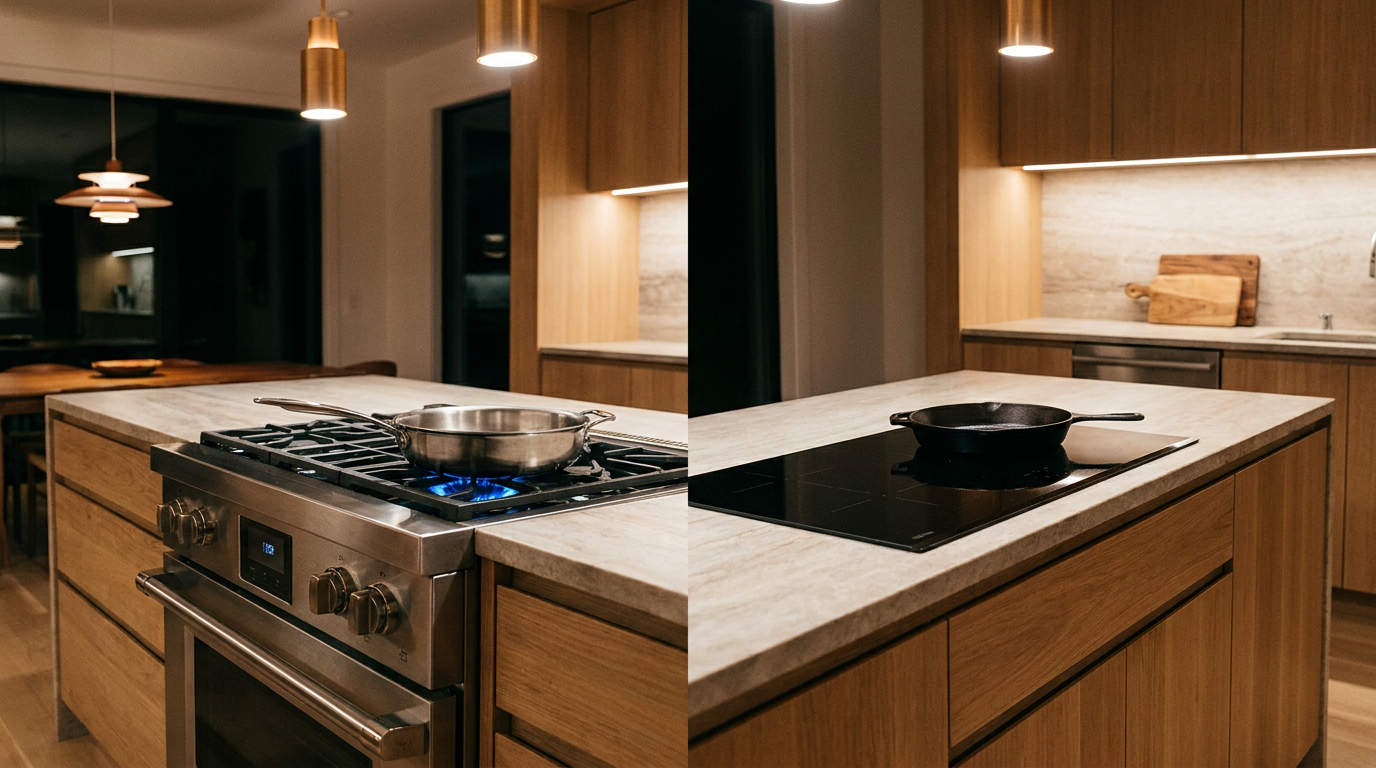
Understanding the fundamental mechanics is essential to evaluating the trade-offs. Gas cooktops rely on combustion, burning natural gas or propane to create an open flame that heats the bottom of a pan, which in turn heats the food. Induction, however, bypasses the thermal middleman. It uses copper coils beneath a ceramic glass surface to generate an oscillating magnetic field. When ferromagnetic cookware is placed on the zone, this field induces an electrical current directly inside the metal, turning the pan itself into the heat source.[5][6]
When examining the case for induction, the most compelling argument is sheer energy efficiency. Because the heat is generated directly within the cookware, very little energy escapes into the surrounding environment. This direct transfer mechanism fundamentally changes the math of cooking, keeping the kitchen significantly cooler during heavy meal preparation and reducing the overall load on household HVAC systems.[1][7]
The evidence for this efficiency is stark and well-documented. The U.S. Department of Energy reports that induction cooktops convert between 85 and 90 percent of their electrical energy into usable heat. In contrast, gas cooktops are notoriously inefficient, transferring only 40 to 55 percent of their thermal energy to the food, with the remainder lost as ambient heat radiating around the sides of the pan.[1]

Another major pillar in the case for induction is cooking speed and precision. Because nearly all the generated energy goes directly into the metal, induction can bring liquids to a boil at a fraction of the time required by gas. Furthermore, the digital controls allow for immediate, precise adjustments, dropping from a rolling boil to a delicate simmer the instant the setting is changed, without the residual heat lag associated with traditional electric coils.[3]
The evidence supporting this speed advantage is consistently verified by independent testing. Consumer Reports has found that induction cooktops can boil water 20 to 40 percent faster than their highest-performing gas counterparts. High-end induction burners can output the equivalent of 7,400 watts, boiling a gallon of water in roughly three minutes—a task that can take a 23,000 BTU gas burner up to 14 minutes.[2]

The case for induction also extends heavily into health and safety. The absence of an open flame eliminates the risk of combustible materials catching fire, and because the glass surface is only warmed by the residual heat of the pan, the risk of severe burns is drastically reduced. More importantly, induction cooking produces zero indoor air pollutants, a growing concern among public health officials.[1][2]
The case for induction also extends heavily into health and safety.
The evidence regarding indoor air quality has become a major catalyst for the technology's adoption. Burning natural gas releases combustion byproducts, including nitrogen dioxide, carbon monoxide, and formaldehyde. Recent environmental studies have linked these emissions to increased risks of childhood asthma and poorer overall indoor air quality, prompting some municipalities to restrict new gas hookups entirely.[1][2]
Conversely, the case against induction—and the enduring argument for gas—centers on installation friction, upfront costs, and cookware compatibility. Transitioning from gas to induction is rarely a simple swap. It often requires hiring an electrician to install a dedicated 240-volt circuit, which can add hundreds or thousands of dollars to the project. Additionally, induction requires ferromagnetic pots and pans; materials like pure copper, aluminum, and glass are entirely incompatible.[2][4]
The case for gas is also deeply rooted in culinary tradition and tactile control. For many seasoned cooks, the visual feedback of an open flame is intuitive and irreplaceable. Gas allows for aggressive techniques that induction strictly prohibits, such as charring peppers directly on the grates, tossing ingredients in a round-bottomed wok, or tilting a pan to baste a steak without breaking the heat connection.[4][5]

The evidence from appliance experts acknowledges these traditional advantages while noting the limitations of induction's power delivery. As reviewers point out, many induction cooktops utilize power sharing across burners. If multiple zones are set to maximum output simultaneously, the appliance will automatically throttle the power to stay within its electrical limits, meaning a chef cannot run four pots at a rolling boil at the exact same time.[4]
Maintenance and cleaning present another clear divergence. The case for induction highlights its flat, continuous glass surface. Because the glass itself does not get hot enough to bake on spills, cleaning usually requires nothing more than a quick wipe with a damp cloth. Gas cooktops, with their heavy cast-iron grates, burner caps, and intricate crevices, require significantly more labor to keep pristine and are prone to stubborn, baked-on grease.[3][6]
Ultimately, this technology fits well when a household prioritizes energy efficiency, indoor air quality, and rapid cooking speeds. It is the ideal choice for modern kitchen renovations where safety is a paramount concern—particularly in homes with young children or elderly residents—and for cooks who despise the tedious cleanup associated with traditional gas grates.[7]

However, induction does not fit when a homeowner faces prohibitive electrical upgrade costs or lives in an area with highly unreliable power grids, as gas stoves can often still be ignited during an outage. It is also less suitable for culinary traditionalists who rely heavily on non-magnetic specialty cookware, require the visual intuition of an open flame, or frequently employ aggressive pan-tossing techniques.[4][7]
As the appliance industry continues to innovate, the gap between these two technologies is narrowing in some areas and widening in others. While gas will likely remain a beloved staple for specific culinary applications, the overwhelming momentum in efficiency, speed, and environmental health suggests that the magnetic pull of induction will only grow stronger in the years ahead.[7]
How we got here
1970s
Westinghouse introduces the first modern induction cooktops for home kitchens, but high costs limit adoption.
2010s
Advances in electronics and manufacturing bring induction prices down, sparking widespread adoption in Europe and Asia.
2022–2026
Growing awareness of indoor air quality and energy efficiency drives a massive surge in induction popularity across North America.
Viewpoints in depth
Efficiency and Health Advocates
This camp prioritizes the environmental and physiological benefits of eliminating indoor combustion.
Public health officials and energy experts argue that the transition away from gas is a necessary step for both household health and broader climate goals. By removing open flames, homes eliminate localized emissions of nitrogen dioxide and carbon monoxide, which have been strongly linked to respiratory issues. Furthermore, they emphasize that the 85-90% thermal efficiency of induction drastically reduces overall energy waste compared to the massive ambient heat loss of traditional gas burners.
Culinary Traditionalists
This perspective values the tactile control, visual feedback, and versatility of open-flame cooking.
For many seasoned chefs and enthusiastic home cooks, cooking is an inherently sensory experience that induction disrupts. This camp argues that the visual cue of a flame is crucial for intuitive temperature management. They also highlight the physical limitations of induction, noting that techniques like charring vegetables directly on the grate, tossing a wok, or using specialty copper and aluminum cookware are impossible without a traditional gas setup.
Appliance Industry Experts
This group focuses on the practical realities of installation, maintenance, and long-term reliability.
Industry technicians and reviewers take a pragmatic view, weighing the daily conveniences of induction against its infrastructural hurdles. While they universally praise the effortless cleanup of a flat glass surface and the rapid boiling speeds, they caution buyers about the hidden costs of electrical upgrades. They also note that induction units, being highly complex electronic devices, can be more expensive to repair out-of-warranty than the relatively simple mechanical valves of a gas stove.
What we don't know
- How quickly the electrical grid infrastructure in older neighborhoods can support mass adoption of 240-volt induction ranges.
- Whether the long-term repair costs of complex induction electronics will offset their daily energy savings over a 15-year lifespan.
Key terms
- Electromagnetic Induction
- A process where a magnetic field generates an electric current directly inside ferromagnetic cookware, creating heat without a traditional heating element.
- Ferromagnetic
- Materials like iron or certain steel alloys that have a high susceptibility to magnetization, making them compatible with induction cooktops.
- Power Sharing
- A feature in some induction cooktops where multiple burners draw from the same electrical circuit, meaning they cannot all run at maximum power simultaneously.
- BTU (British Thermal Unit)
- A traditional measure of heat output used to rate the power of gas burners.
Frequently asked
Do I need to buy all new pots and pans for an induction cooktop?
Not necessarily. If a magnet sticks firmly to the bottom of your current cookware, such as cast iron or most stainless steel, it will work on an induction stove.
Will an induction cooktop heat up my kitchen like a gas stove does?
No. Because induction transfers heat directly to the cookware rather than the surrounding air, it keeps the kitchen significantly cooler than gas cooking.
Can I use an induction cooktop during a power outage?
Unlike gas stoves, which can often be lit manually with a match during an outage, induction cooktops require electricity and will not function without power.
Sources
Source coverage
7 outlets
3 viewpoints surfaced







[1]U.S. Department of EnergyEfficiency and Health Advocates
Induction Cooking: Better for You, Better for the Environment
Read on U.S. Department of Energy →[2]Consumer ReportsEfficiency and Health Advocates
Induction vs. Gas Ranges: Which Is Better?
Read on Consumer Reports →[3]WirecutterConsumer Reviewers
The Best Induction Cooktops
Read on Wirecutter →[4]Yale ApplianceConsumer Reviewers
Induction vs. Gas Cooking: Pros and Cons
Read on Yale Appliance →[5]KitchenAidAppliance Manufacturers
Induction vs. Gas Cooktops: How to Choose
Read on KitchenAid →[6]MaytagAppliance Manufacturers
What's the Difference Between Induction vs. Gas Cooktops?
Read on Maytag →[7]Factlen Editorial TeamConsumer Reviewers
Synthesis by Factlen editorial team
Read on Factlen Editorial Team →
Every angle. Every day.
Get shopping stories with full source coverage and perspective breakdowns delivered to your inbox.