
How Mass Timber is Reshaping City Skylines and Slashing Carbon Emissions
Cross-laminated timber is allowing architects to build wooden skyscrapers that rival steel and concrete in strength while acting as massive carbon sinks. This engineered wood is transforming urban construction from a climate problem into a climate solution.
By Factlen Editorial Team
- Sustainable Design Advocates
- Argue that mass timber is the most viable, immediate path to decarbonizing the notoriously polluting construction industry.
- Conservation Watchdogs
- Emphasize that the climate math only works if forestry practices are strictly regulated and old-growth forests are protected from commercial harvesting.
- Structural Traditionalists
- Acknowledge timber's innovation but maintain that steel and concrete remain irreplaceable for certain mega-structures, foundations, and infrastructure projects.
What's not represented
- · Local indigenous communities whose ancestral lands overlap with commercial forestry operations.
- · Steel and concrete manufacturers facing potential market disruption from engineered wood.
Why this matters
The built environment generates nearly 40% of global carbon emissions, largely from concrete and steel production. Transitioning to mass timber could turn future cities from carbon emitters into vast carbon sinks, fundamentally altering our approach to sustainable urban growth.
Key points
- Mass timber uses engineered wood panels that rival traditional steel and concrete in structural strength.
- CLT buildings act as massive carbon sinks, locking away CO2 absorbed by trees during their growth.
- Prefabricated timber panels can reduce on-site construction time by up to 25% and require less labor.
- Unlike traditional light-frame lumber, mass timber chars in a fire, protecting its structural core from collapse.
- International building codes are rapidly updating to allow timber skyscrapers of 18 stories and higher.
The urban skyline is changing, not just in shape, but in substance. For over a century, steel and concrete have been the undisputed kings of urban construction, dictating the aesthetics and engineering of the modern metropolis. Now, wood is making a towering comeback, driven by a need to decarbonize the global economy and rethink how we build our habitats. [2][3]
This isn't the standard two-by-four lumber used in suburban home framing. The revolution is driven by "mass timber," a category of engineered wood products designed for massive structural applications. The most prominent of these is Cross-Laminated Timber (CLT). CLT is created by gluing layers of solid-sawn lumber together, with each layer oriented perpendicular to the adjacent one. [6]
This cross-hatching technique creates massive panels that boast extraordinary strength and dimensional stability. By distributing the structural load across multiple axes, CLT panels can rival traditional structural steel and concrete in load-bearing capacity, allowing architects to design buildings that reach dozens of stories into the air. [1][6]

The immediate question most people ask when confronted with the idea of a wooden skyscraper is about fire safety. Counterintuitively, mass timber performs exceptionally well in fires. Unlike light-frame wood that ignites quickly, massive timber panels char on the outside when exposed to flames. [3][6]
This char layer acts as a natural insulator for the interior wood, cutting off oxygen and allowing the core to retain its structural integrity for hours. In many rigorous fire tests, mass timber has actually outperformed unprotected steel, which can warp, buckle, and collapse rapidly under extreme heat. [6]
The primary driver behind the mass timber boom is environmental necessity. Concrete and steel production are notoriously carbon-intensive, accounting for roughly 11% of global greenhouse gas emissions just in their manufacturing processes. Every ton of cement produced releases roughly a ton of carbon dioxide into the atmosphere. [4][7]
Trees, conversely, absorb carbon dioxide as they grow. When harvested sustainably and locked into a building's structure, that carbon remains sequestered for the life of the building. A mid-rise timber building can sequester thousands of tons of CO2, effectively turning the structure into a massive, long-term carbon sink. [4]

When harvested sustainably and locked into a building's structure, that carbon remains sequestered for the life of the building.
Beyond the environmental benefits, mass timber is transforming the construction process itself. Because CLT panels are prefabricated in climate-controlled factories to exact digital specifications—complete with precision cutouts for doors, windows, and plumbing—they arrive on-site ready to be assembled. [2][5]
This flat-pack approach to architecture reduces on-site construction time by up to 25% and requires a significantly smaller labor force. It also drastically reduces construction noise, dust, and waste, which is a major boon for dense urban environments where prolonged construction causes severe disruptions. [5][7]
Furthermore, mass timber is roughly one-fifth the weight of a comparable concrete structure. This lighter footprint means buildings require smaller, less resource-intensive foundations. This is particularly advantageous when building over existing structures, transit tunnels, or on sites with poor soil conditions. [1][6]

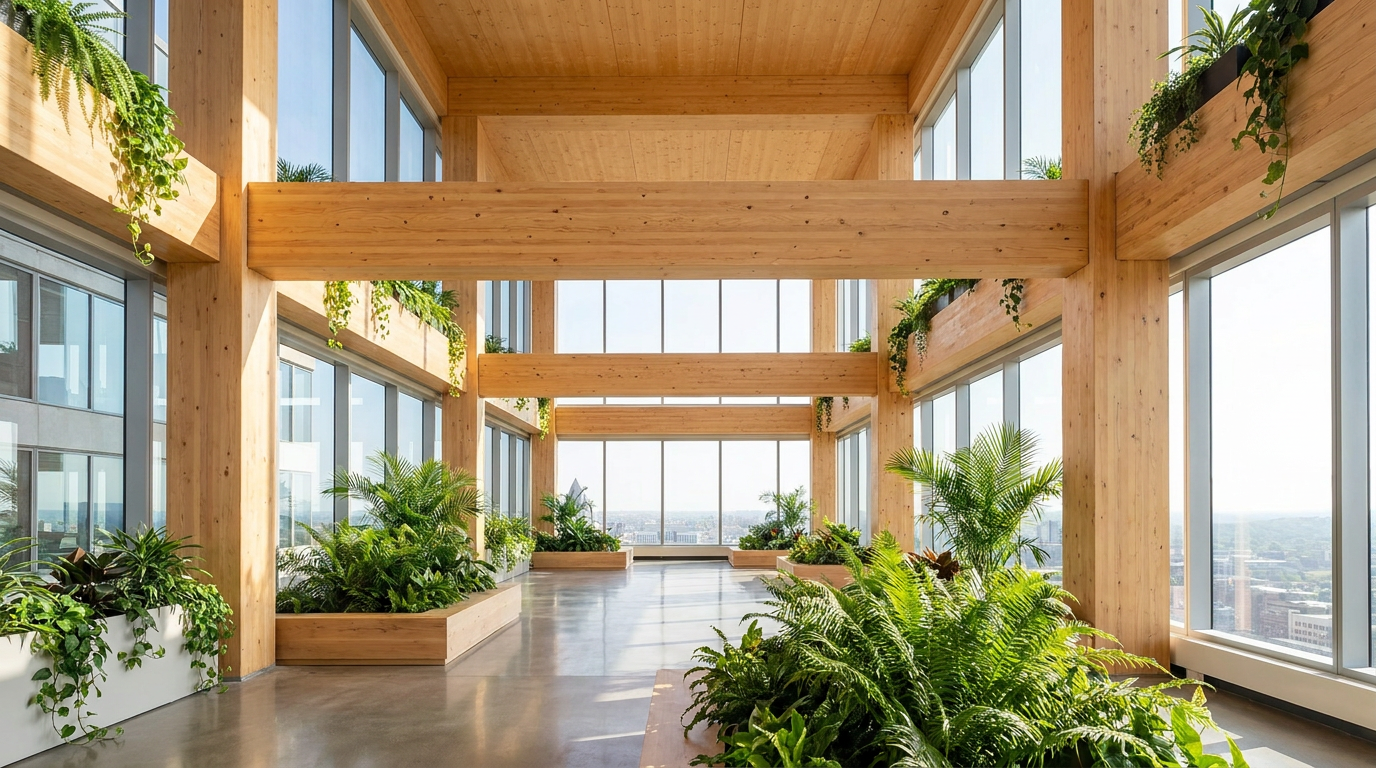
Then there is the human element. Architects and psychologists alike point to the benefits of "biophilic design"—the integration of natural elements into the built environment. Exposed wood interiors have been shown in multiple studies to lower stress, reduce heart rates, and improve overall well-being and productivity for occupants. [3][5]
Despite the momentum, the transition is not without hurdles. The mass timber supply chain is still developing globally. While Europe has a mature CLT manufacturing base, North America and Asia are currently racing to scale up production facilities to meet surging commercial demand, occasionally leading to supply bottlenecks. [7]
Environmentalists also caution that the climate benefits of mass timber rely entirely on sustainable forestry practices. If increased demand leads to deforestation or the harvesting of old-growth forests, the carbon math quickly falls apart. Certification systems like the Forest Stewardship Council (FSC) are critical to ensuring the wood is sourced responsibly. [4][7]

Building codes have also had to play catch-up. For decades, regulations strictly limited the height of wooden structures due to the legacy of historical urban fires. However, recent updates to the International Building Code (IBC) now permit mass timber buildings up to 18 stories, and special variances are allowing even taller structures to rise. [3][6]
As manufacturing scales, regulations adapt, and the urgency of the climate crisis deepens, mass timber is poised to move from a niche architectural statement to a mainstream construction standard. The 21st-century city may soon look surprisingly like the forests we once cleared to build them—a towering, carbon-sequestering canopy of engineered wood. [1][2]
How we got here
1990s
Cross-Laminated Timber (CLT) is initially developed and patented in Austria and Germany.
2009
The Stadthaus in London (9 stories) becomes one of the first tall timber residential buildings in the world.
2019
The International Code Council approves sweeping changes allowing mass timber buildings up to 18 stories.
2022
Ascent in Milwaukee opens at 25 stories, claiming the title of the world's tallest timber-concrete hybrid building.
2026
Mass timber manufacturing facilities rapidly expand across North America and Asia to meet surging commercial demand.
Viewpoints in depth
Sustainable Architects' View
View mass timber as the only viable path to decarbonizing the construction industry.
For architects focused on climate change, mass timber represents a paradigm shift. The built environment is responsible for a massive portion of global emissions, and incremental efficiency improvements in concrete production are no longer seen as sufficient. By switching to a renewable resource that actively sequesters carbon, sustainable designers argue that the construction industry can transform from a leading climate offender into a critical tool for carbon mitigation. They emphasize that the aesthetic and psychological benefits of exposed wood are secondary bonuses to the urgent environmental imperative.
Forestry Conservationists' View
Support the material in theory but warn that aggressive scaling must be tightly regulated.
Conservation groups acknowledge the carbon-storing potential of mass timber, but they view the booming demand with cautious optimism. Their primary concern is the supply chain. If the demand for CLT outpaces the capacity of sustainably managed forests, it could incentivize the logging of old-growth forests or lead to monoculture tree farming that devastates local biodiversity. They argue that mass timber is only a climate solution if every piece of wood is rigorously tracked and certified by organizations like the FSC, ensuring that the forest ecosystem remains intact and continues to absorb carbon.
Traditional Construction Industry's View
Acknowledge the innovation but emphasize the continued necessity of steel and concrete.
Engineers and developers rooted in traditional materials recognize mass timber as a valuable new tool, particularly for mid-rise residential and commercial office spaces. However, they caution against viewing it as a universal replacement. For subterranean foundations, massive infrastructure projects, and ultra-tall super-slender skyscrapers, concrete and steel remain structurally and economically irreplaceable. They advocate for a hybrid future, where timber is used for the bulk of a building's superstructure, while concrete and steel are deployed strategically where their specific tensile and compressive strengths are absolutely necessary.
What we don't know
- How the global timber supply chain will handle a massive, sudden surge in demand without compromising sustainability.
- The long-term maintenance costs and moisture resilience of mass timber skyscrapers over a 100-year lifespan.
- Whether developing nations will adopt the technology or stick to cheaper, locally sourced traditional concrete.
Key terms
- Cross-Laminated Timber (CLT)
- An engineered wood panel made of glued layers of sawn lumber, with each layer oriented perpendicular to the next for maximum strength and stability.
- Mass Timber
- A broad category of engineered wood products designed for heavy structural applications in large buildings, replacing steel and concrete.
- Biophilic Design
- An architectural approach that connects building occupants more closely to nature, often using natural lighting, plants, and exposed wood to improve well-being.
- Carbon Sequestration
- The process of capturing and storing atmospheric carbon dioxide, which mass timber achieves by locking the carbon absorbed by trees inside the building's structure.
Frequently asked
Is a mass timber building a fire hazard?
No. During a fire, the outer layer of mass timber chars, creating a natural insulating barrier that protects the structural integrity of the inner wood for hours, often outperforming unprotected steel.
Does building with wood cause deforestation?
It can, if not managed properly. The environmental benefits rely entirely on sourcing wood from certified, sustainably managed forests where new trees are planted to replace harvested ones.
Is mass timber cheaper than concrete?
The material itself can sometimes be more expensive, but savings in labor, faster construction times, and the need for lighter foundations often make the overall project cost highly competitive.
How tall can a wooden skyscraper be?
Recent updates to the International Building Code allow mass timber buildings up to 18 stories, though special variances have allowed hybrid timber structures to reach 25 stories and beyond.
Sources
Source coverage
7 outlets
3 viewpoints surfaced







[1]Factlen Editorial TeamSustainable Design Advocates
Synthesis by Factlen editorial team
Read on Factlen Editorial Team →[2]DezeenSustainable Design Advocates
The mass timber revolution: How wood is building the cities of the future
Read on Dezeen →[3]Architectural RecordStructural Traditionalists
Pushing the Limits of Tall Timber Construction
Read on Architectural Record →[4]Nature SustainabilityConservation Watchdogs
Carbon sequestration potential of mass timber in global urban development
Read on Nature Sustainability →[5]ArchDailySustainable Design Advocates
Biophilic Design and the Psychological Benefits of Exposed Timber
Read on ArchDaily →[6]WoodWorksStructural Traditionalists
Mass Timber Performance: Fire, Seismic, and Structural Integrity
Read on WoodWorks →[7]Bloomberg CityLabConservation Watchdogs
The Supply Chain Bottlenecks Slowing the Wooden Skyscraper Boom
Read on Bloomberg CityLab →


Every angle. Every day.
Get culture stories with full source coverage and perspective breakdowns delivered to your inbox.