
The Dawn of Commercial Air Taxis: How eVTOLs Are Finally Taking Flight
Electric vertical takeoff and landing (eVTOL) aircraft are launching their first commercial passenger services in 2026, moving urban aviation from prototype to reality.
By Factlen Editorial Team
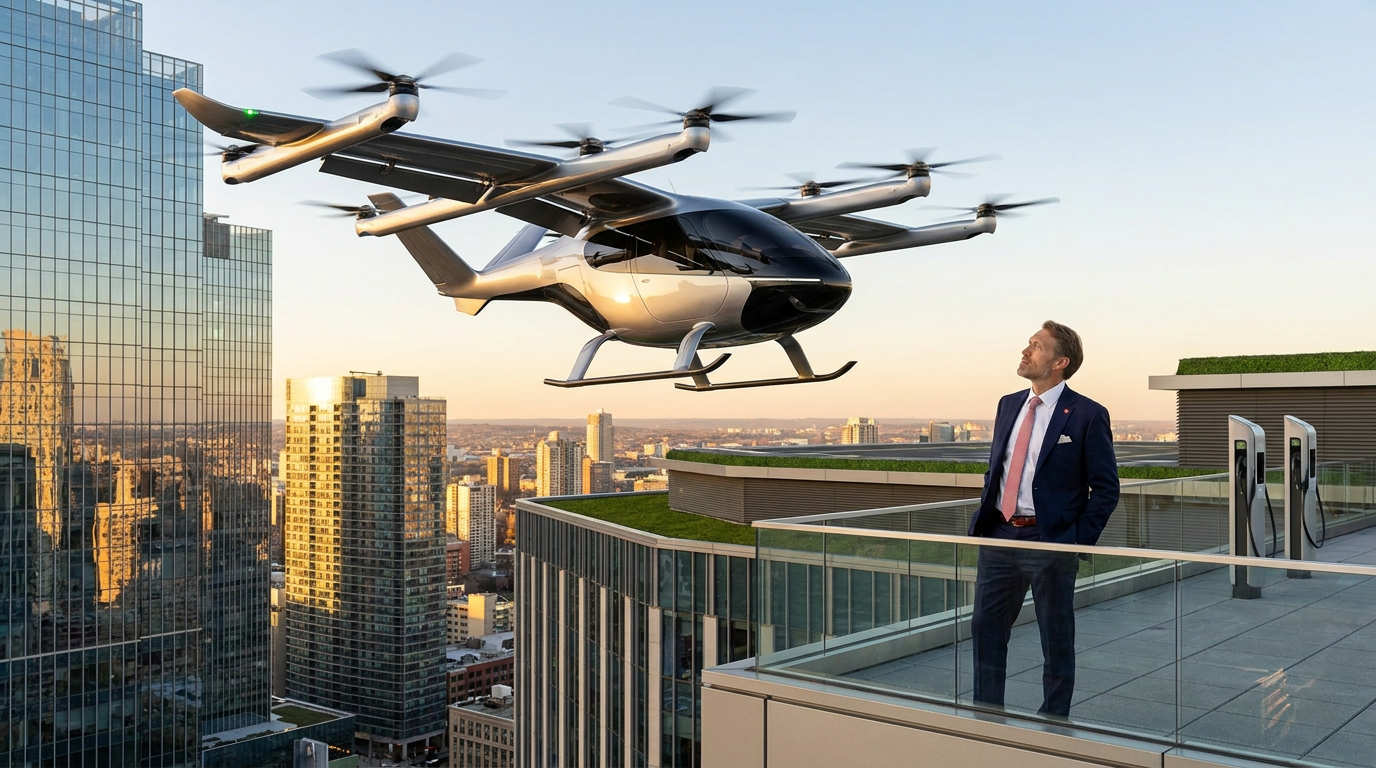
- Urban Air Mobility Advocates
- Proponents argue that eVTOLs will decarbonize short-haul transit and relieve ground congestion.
- Aviation Regulators
- Safety agencies emphasize that the integration of new aircraft types must not compromise the safety of the national airspace.
- Infrastructure Planners
- City planners focus on the logistical challenges of vertiport construction and grid capacity.
- Aviation Economists
- Financial analysts question the long-term unit economics and accessibility of air taxi services.
What's not represented
- · Local City Residents
- · Traditional Helicopter Operators
Why this matters
The launch of commercial eVTOL services marks the biggest shift in urban transportation since the subway. By moving short-haul transit into the sky, electric air taxis promise to drastically cut commute times and reduce ground-level emissions, fundamentally changing how people live and work in major metropolitan areas.
Key points
- Joby and Archer are launching commercial eVTOL passenger flights in the UAE in 2026.
- The FAA's eIPP program is allowing early cargo and medical flights in the US this summer.
- eVTOLs use Distributed Electric Propulsion, making them significantly quieter and safer than traditional helicopters.
- Current battery technology limits flights to short, high-traffic regional hops of around 100 miles.
- Early passenger fares will likely be premium, with companies looking to autonomy to lower long-term costs.
For decades, the promise of the "flying car" has been a staple of science fiction, perpetually hovering just out of reach. But in 2026, the aviation industry is finally crossing the threshold from prototype to commercial reality. Electric vertical takeoff and landing (eVTOL) aircraft—battery-powered vehicles that lift off like helicopters and fly like airplanes—are moving out of the testing phase and into active airspace. This year marks the beginning of revenue-generating air taxi services, fundamentally reshaping how passengers navigate congested urban corridors. After billions of dollars in research and development, the technology has matured enough to meet the rigorous demands of daily commercial operations.[2][7]
The most immediate breakthroughs are happening in the United Arab Emirates. Both Joby Aviation and Archer Aviation, two of the leading American eVTOL manufacturers, are launching their first commercial passenger flights in Dubai and Abu Dhabi, respectively, by the second half of 2026. Backed by a top-down government push for smart-city infrastructure, the UAE has provided a streamlined regulatory environment that allows these companies to bypass some of the bureaucratic gridlock slowing domestic U.S. launches. Joby is building a vertiport network connecting Dubai International Airport to downtown, while Archer is converting existing facilities like the Abu Dhabi Cruise Terminal into hybrid landing pads.[1]
In the United States, the timeline is slightly longer for paying passengers, but the skies are already getting busy. The Federal Aviation Administration (FAA) recently launched the eVTOL Integration Pilot Program (eIPP), a sweeping initiative designed to accelerate the deployment of advanced air mobility. The program greenlit eight projects across 26 states, allowing manufacturers to conduct pre-certification commercial cargo and medical flights starting in the summer of 2026. This allows the FAA to gather real-world operational data before finalizing the permanent rules that will govern passenger air taxis, ensuring that safety protocols are based on actual flight hours rather than theoretical models.[3][5]

To understand why eVTOLs are suddenly viable, it helps to look at the physics of how they fly. Traditional helicopters rely on a single massive combustion engine driving a complex, mechanically linked main rotor. eVTOLs replace this with Distributed Electric Propulsion (DEP). By spreading multiple small electric motors across the aircraft's wings and tail, DEP eliminates single points of mechanical failure. If one or even two motors fail mid-flight, the flight computer instantly redistributes power to the remaining rotors, allowing the aircraft to maintain stability and land safely without the catastrophic risks associated with traditional rotorcraft.[2][7]
Different manufacturers are taking distinct engineering approaches to this concept. Joby's "S4" aircraft uses six tilting rotors; they point upward for vertical lift and pivot forward to act like traditional airplane propellers during cruise. Archer's "Midnight" utilizes a "lift-plus-cruise" design, featuring six tilting rotors on the front of the wing and six fixed lift propellers on the back that lock into an aerodynamic position once the aircraft is flying forward. BETA Technologies, meanwhile, uses an even simpler design for its Alia aircraft: four fixed vertical-lift propellers and a rear pusher propeller, eliminating the mechanical complexity of tilting mechanisms entirely.[2]
The shift to electric propulsion solves one of the biggest hurdles to urban aviation: noise. Helicopters generate a loud, low-frequency "thump" because the tip of a massive rotor blade is breaking the sound barrier, while the tail rotor chops through the turbulent air of the main rotor. eVTOLs, spinning smaller blades at slower, variable speeds, produce a sound profile that blends into ambient city noise. During a recent demonstration flight from John F. Kennedy International Airport to downtown Manhattan, Joby's aircraft was reportedly barely audible from the ground as it cruised up the Hudson River, a crucial factor for community acceptance.[2]

The shift to electric propulsion solves one of the biggest hurdles to urban aviation: noise.
However, the technology is strictly bound by the current limits of battery chemistry. Lithium-ion batteries are heavy and hold significantly less energy by weight than jet fuel. As a result, today's eVTOLs are not designed for cross-country travel. They typically feature a maximum range of around 100 miles and cruise speeds of up to 200 mph. This makes them highly specialized vehicles, purpose-built for short, high-traffic hops—such as ferrying passengers from a major airport to a downtown financial district in 10 minutes rather than an hour in gridlock. They are regional connectors, not long-haul replacements.[7]
The path to carrying everyday passengers in the U.S. requires navigating the FAA's rigorous Type Certification process, which proves the aircraft meets the safety standards of commercial airliners. Joby Aviation is currently in Stage 4 of this process, known as Type Inspection Authorization, where FAA pilots formally fly the production-intent aircraft for credit. Both Joby and Archer expect to receive their final Type Certificates by late 2026 or early 2027, which will officially unlock U.S. revenue passenger service and allow them to scale their operations across major metropolitan hubs like Los Angeles and New York.[7]
While passenger air taxis capture the public imagination, the earliest U.S. operations will focus on logistics. Companies like BETA Technologies are leveraging the FAA's eIPP to fly cargo and medical supplies. By partnering with existing operators like Metro Aviation and UPS, BETA aims to prove the safety and reliability of its aircraft on predictable, uncrewed routes before putting human passengers on board. This "cargo-first" approach provides a lower-risk environment to test battery performance, charging infrastructure, and airspace integration, building public trust through essential services like organ transport and rapid medical delivery.[3][6]

Infrastructure remains a critical bottleneck. For eVTOLs to scale, cities need a network of "vertiports"—dedicated landing zones equipped with high-voltage charging stations. While early operations will utilize existing helipads and regional airports, scaling up requires significant grid upgrades. A single vertiport charging multiple eVTOLs simultaneously draws power equivalent to a small neighborhood, requiring close coordination with local utility companies to ensure the electrical grid can handle the localized spikes in demand. Real estate developers are already racing to secure rooftop rights in dense urban centers to build these future transit hubs.[1][4]
Then there is the question of economics. Building a new aircraft type is incredibly capital-intensive; U.S. eVTOL manufacturers have raised over $15 billion since 2020. To recoup these costs, companies must operate their aircraft at high utilization rates. While manufacturers claim that fares will eventually rival an Uber Black car service, early flights will likely be priced at a premium. The aircraft only seat four passengers, and the cost of a highly trained pilot must be amortized across those few tickets, meaning the initial customer base will likely be corporate travelers and luxury commuters.[2][7]
To fundamentally change the unit economics, the industry is already looking toward autonomy. Wisk Aero, a Boeing subsidiary, is bypassing piloted aircraft entirely to develop a fully autonomous, six-seat eVTOL. By removing the pilot, the company frees up a revenue-generating seat and eliminates a major operational expense. Wisk is participating in the FAA's eIPP in Texas to test its autonomous systems, though regulators will require an immense burden of proof before allowing pilotless passenger flights over populated areas. The transition to autonomy is widely viewed as the key to making air taxis affordable for the general public.[3]

The commercial launch of eVTOLs in 2026 represents a rare moment where regulatory policy, private capital, and technological maturity are aligning. Major airlines are already positioning themselves for this future; Delta Air Lines has backed Joby, while United Airlines has placed a massive order with Archer. As these electric aircraft begin their first revenue flights in the UAE and expand their test footprints across the U.S., the daily commute is poised to enter the third dimension, offering a cleaner, faster alternative to the gridlocked highways below.[1][2][4]
How we got here
2020–2023
Major eVTOL manufacturers raise billions in capital and begin flying full-scale prototypes.
April 2026
Joby Aviation conducts a highly publicized demonstration flight from JFK to downtown Manhattan.
Summer 2026
The FAA launches the eIPP, allowing pre-certification commercial cargo and medical flights in the US.
Late 2026
Joby and Archer launch the world's first commercial passenger eVTOL services in the UAE.
2027
Anticipated final FAA Type Certification, unlocking full passenger revenue service in the United States.
Viewpoints in depth
Urban Air Mobility Advocates
Proponents argue that eVTOLs will decarbonize short-haul transit and relieve ground congestion.
This camp, which includes manufacturers and environmental technologists, views electric aviation as a necessary evolution for crowded megacities. They argue that replacing combustion-engine helicopters and idling ground traffic with zero-emission electric flight will significantly reduce local air pollution. Furthermore, by utilizing the 'third dimension' of airspace, cities can bypass the multi-billion-dollar costs of expanding ground-level highways or tunneling new subways.
Aviation Regulators
Safety agencies emphasize that the integration of new aircraft types must not compromise the safety of the national airspace.
Regulators like the FAA and EASA are taking a measured, data-driven approach. While they acknowledge the benefits of advanced air mobility, their primary mandate is safety. This camp insists that eVTOLs must meet the same rigorous '10-to-the-minus-9' failure probability standards as commercial airliners. They are focused on the complexities of integrating slow-moving, low-altitude electric aircraft into airspace already crowded with commercial jets, drones, and traditional helicopters.
Aviation Economists
Financial analysts question the long-term unit economics and accessibility of air taxi services.
Skeptics and financial analysts point out that aviation is notoriously capital-intensive. This camp argues that the high costs of pilot training, battery replacement, and vertiport construction will make it difficult to achieve the low fares promised by manufacturers. They warn that until fully autonomous, pilotless flight is approved—which could take another decade—eVTOLs may remain a premium service accessible primarily to affluent business travelers rather than a true mass-transit solution.
What we don't know
- The exact price per ticket when commercial passenger service launches in the US.
- How quickly local power grids can be upgraded to support high-frequency vertiport charging.
- The timeline for the FAA to approve fully autonomous, pilotless passenger flights.
Key terms
- eVTOL
- Electric Vertical Takeoff and Landing aircraft, which hover like helicopters but fly on battery power.
- Distributed Electric Propulsion (DEP)
- A design using multiple small electric motors spread across the aircraft for redundancy and efficiency.
- Type Certification
- The rigorous regulatory approval process by the FAA confirming an aircraft design meets all safety standards.
- Vertiport
- Dedicated infrastructure for eVTOLs to land, load passengers, and recharge their batteries.
- Lift-plus-cruise
- An aircraft design that uses separate propellers for vertical lift and forward flight.
Frequently asked
Are eVTOLs just electric helicopters?
No. While they take off vertically, they transition to wing-borne forward flight like an airplane, making them faster, quieter, and more efficient than helicopters.
When can I ride in one in the US?
Full commercial passenger service in the US is expected around 2027, though pre-certification demonstration flights begin in summer 2026.
How much will a ticket cost?
Early fares are expected to be premium, roughly equivalent to an Uber Black car service, though companies aim to lower costs as operations scale.
Are they safe?
eVTOLs feature high redundancy, meaning if one or more electric motors fail, the aircraft can still land safely. They must meet the same rigorous safety standards as commercial airliners.
Sources
Source coverage
7 outlets
4 viewpoints surfaced







[1]Aviation WeekAviation Economists
Archer, Joby Advance UAE Commercial Launches In 2026
Read on Aviation Week →[2]Business InsiderUrban Air Mobility Advocates
Joby and Archer aim to launch commercial service as soon as this year
Read on Business Insider →[3]AIN OnlineAviation Economists
FAA eVTOL Integration Pilot Program Flips the Script on Certification
Read on AIN Online →[4]Smart Cities DiveInfrastructure Planners
Air taxis could begin operating this year in New York, Los Angeles
Read on Smart Cities Dive →[5]Federal Aviation AdministrationAviation Regulators
Duffy and FAA Unveil Eight Selections for Pilot Program Testing Next-Gen Aircraft in America's Skies
Read on Federal Aviation Administration →[6]BETA TechnologiesInfrastructure Planners
BETA Selected for FAA eVTOL Integration Pilot Program
Read on BETA Technologies →[7]eVTOL TravelUrban Air Mobility Advocates
From concept to commercial reality — the journey of electric air taxis
Read on eVTOL Travel →
Every angle. Every day.
Get automotive stories with full source coverage and perspective breakdowns delivered to your inbox.