
NASA Taps Relativity Space for 2028 Mars Weather Mission
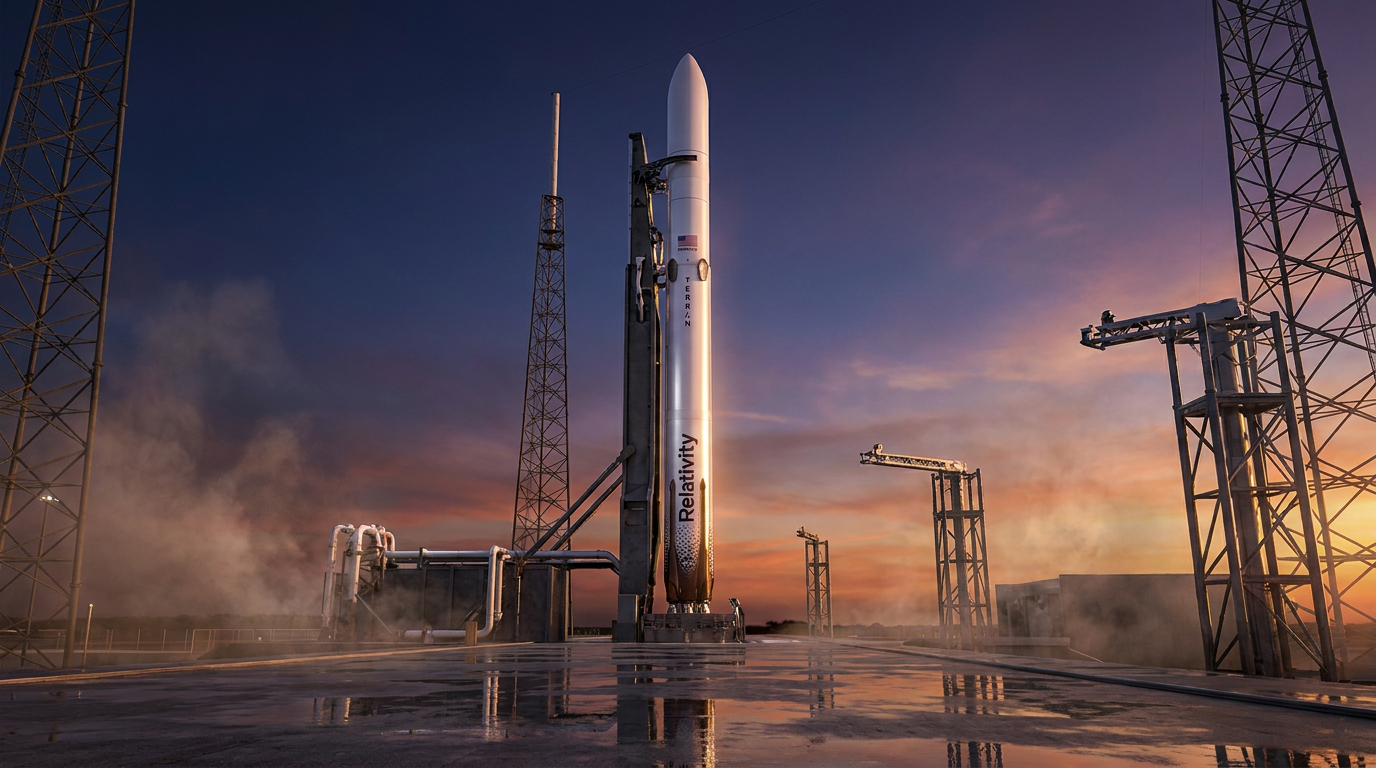
NASA has selected Relativity Space to launch the Aeolus mission in 2028, marking a new era of commercial delivery services for deep-space planetary science.
By Factlen Editorial Team
- NASA & Space Agencies
- Argues that commercial partnerships allow the agency to focus its budget on high-value science rather than launch logistics.
- Commercial Space Industry
- Views deep-space delivery as the next major market, proving that private companies can operate beyond Earth orbit.
- Planetary Scientists
- Focuses on the unprecedented daily weather data Aeolus will provide, which is critical for safely landing future missions.
- Aerospace Skeptics
- Highlights the significant risks of trusting a flagship Mars payload to a company that has never successfully reached orbit.
What's not represented
- · Taxpayer Watchdogs
- · Legacy Aerospace Contractors
Why this matters
Landing on Mars is notoriously dangerous due to unpredictable dust storms and atmospheric density changes. By mapping Martian weather daily, this mission will lay the critical groundwork needed to safely land future human and robotic explorers.
Key points
- NASA has partnered with Relativity Space to launch the Aeolus weather satellite to Mars in 2028.
- The mission marks a shift toward using commercial delivery services for deep-space planetary science.
- Aeolus will carry four instruments to provide the first daily, global view of Martian winds and dust.
- Relativity Space, led by former Google CEO Eric Schmidt, will provide the Terran R rocket and spacecraft.
- The mission will also test a 'Relay Data Center' in orbit to run AI models and beam data back to Earth.
- The partnership carries risk, as Relativity Space has not yet successfully reached Earth orbit.
NASA has formalized a new public-private partnership with Relativity Space to launch a dedicated weather satellite to Mars in 2028. The mission, named Aeolus, marks a significant shift in how the space agency conducts deep-space research. Instead of designing and building the spacecraft in-house, NASA is purchasing a commercial delivery service to the Red Planet.[1][2][7]
The division of labor is stark and unprecedented for a Martian mission. NASA’s Ames Research Center will focus entirely on designing and building the scientific payload—a suite of four advanced weather instruments. Relativity Space, led by former Google CEO Eric Schmidt, will provide the spacecraft, the launch vehicle, and the interplanetary flight operations required to get the hardware to Mars.[1][3][5]
“Public-private partnerships like this are a force multiplier for science,” NASA Administrator Jared Isaacman announced. By offloading the transportation logistics to the commercial sector, the agency can dedicate its budget strictly to high-value scientific instruments and data processing.[1][2][7]
The scientific stakes for Aeolus are high. Landing on Mars remains one of the most challenging engineering problems in space exploration. The Martian atmosphere is thick enough to cause severe aerodynamic heating during entry, but too thin to allow heavy spacecraft to brake effectively using parachutes alone.[5]

Furthermore, the Martian atmosphere is notoriously unpredictable. Global dust storms can engulf the entire planet for months, drastically altering atmospheric density at the exact altitudes where spacecraft need to decelerate. Previous orbiters have studied the atmosphere, but their observations have been partial and independent of one another.[1][5]
Aeolus is designed to solve this data gap. The payload consists of four complementary instruments that will work in tandem to provide the first integrated, daily, global view of Martian winds, temperatures, dust, and clouds.[1][3]
The instrument suite includes the Doppler Wind and Temperature Sounder (DWTS-Ozone), which will measure wind and temperature profiles from the surface up to 60 kilometers in altitude. A Thermal Limb Sounder (TLS) will provide vertical temperature profiles and track water-ice clouds.[3][7]
A Thermal Limb Sounder (TLS) will provide vertical temperature profiles and track water-ice clouds.
Rounding out the payload are the Surface Radiometric Sensor Package (SuRSeP), which measures surface energy balance, and a Wide-Field Context Camera (WFCC) that will capture daily global images of atmospheric activity. Together, these tools will generate the detailed environmental models required to reduce risks for future crewed and uncrewed landings.[1][3][5]

For Relativity Space, the mission is a massive proving ground. Founded in 2015 around the concept of 3D-printing entire rockets, the company has faced significant hurdles. Its first vehicle, the Terran 1, failed to reach orbit during its maiden flight in March 2023 due to a second-stage engine anomaly.[2][4][5]
Following that setback, the company pivoted to developing the Terran R, a much larger, partially reusable rocket designed to compete with SpaceX's Falcon 9. However, the Terran R has not yet flown, and Relativity Space has never successfully placed a payload into Earth orbit, let alone navigated the complex orbital mechanics required to reach Mars.[4][5]
The company's trajectory shifted dramatically in March 2025 when Eric Schmidt acquired a controlling stake and installed himself as Chief Executive Officer. Schmidt brought not only substantial financial backing but also a radical new vision for the aerospace manufacturer: deploying data centers in space.[3][4][6]
The Aeolus mission will serve as the first literal manifestation of Schmidt's ambition. In addition to the NASA weather instruments, the 2028 mission will fly what Relativity calls a “Relay Data Center.” This onboard server-class computing and mass storage system will be capable of running artificial intelligence models in Mars orbit and beaming large volumes of data back to Earth over optical and radio links.[4]

This dual-purpose architecture highlights the evolving nature of commercial spaceflight. Relativity describes Aeolus as flying for a “philanthropic customer,” with NASA acting as a partner that provides the atmospheric instruments. The arrangement allows Relativity to test its deep-space capabilities and computing hardware while delivering top-tier science for the space agency.[4]
The risks are undeniable. NASA is candid about the fact that commercial partnerships carry inherent uncertainties, especially when relying on an unproven launch vehicle. Some of the agency's previous startup partners in the lunar delivery program have faced bankruptcies or mission failures.[4]
Yet, the potential payoff justifies the gamble. If successful, Aeolus will not only provide the meteorological foundation necessary for human missions to Mars but also prove that the commercial space industry can reliably extend its reach beyond the Moon. For NASA, treating Mars as a commercial delivery destination could dramatically lower costs and increase the cadence of planetary discovery for decades to come.[1][2][7]
How we got here
March 2023
Relativity Space's first 3D-printed rocket, Terran 1, fails to reach orbit during its maiden flight.
March 2025
Former Google CEO Eric Schmidt acquires a controlling stake in Relativity Space and becomes CEO.
June 2026
NASA announces the public-private partnership for the 2028 Aeolus mission.
2028
Target launch window for the Aeolus spacecraft and Terran R rocket to journey to Mars.
Viewpoints in depth
NASA's strategic shift
The agency views commercial delivery as a force multiplier for planetary science.
NASA leadership, including Administrator Jared Isaacman, argues that the agency should not be in the business of building basic transportation infrastructure if the private sector can do it cheaper. By purchasing a 'ride' to Mars under a Space Act Agreement, NASA can redirect its budget toward developing cutting-edge scientific instruments. This model mirrors the successful Commercial Resupply Services program used for the International Space Station, but pushes the boundary into deep space.
Relativity Space's orbital ambitions
The company sees Aeolus as a stepping stone to building an interplanetary industrial base.
For Relativity Space and its CEO Eric Schmidt, the mission is about more than just delivering NASA's payload. It is a critical test of their 3D-printed Terran R rocket and their broader vision of deploying 'Relay Data Centers' in space. By proving they can navigate to Mars and operate server-class computing in orbit, the company aims to position itself as a primary infrastructure provider for the future commercialization of the solar system.
The scientific consensus
Researchers emphasize that landing on Mars requires better atmospheric data.
Planetary scientists have long struggled with the unpredictable nature of the Martian atmosphere, where sudden global dust storms can drastically alter air density. Because spacecraft rely on precise atmospheric friction to decelerate during entry, this unpredictability poses a massive risk to heavy payloads and future human missions. Researchers view the Aeolus payload's ability to provide daily, global weather maps as a mandatory prerequisite for the next era of Mars exploration.
The risk assessment
Industry observers caution that the mission relies on entirely unproven technology.
Aerospace analysts and skeptics point out the glaring risk at the center of the partnership: Relativity Space has never successfully reached orbit. Its first rocket, Terran 1, failed in 2023, and the larger Terran R has yet to fly. Trusting a sophisticated, multi-million-dollar NASA science payload to a company without a track record of orbital success represents a significant gamble, echoing the mixed results of NASA's recent commercial lunar payload program.
What we don't know
- It remains unclear exactly how much the mission will cost, as neither NASA nor Relativity Space has disclosed the contract's financial value.
- Relativity Space has not yet successfully flown its Terran R rocket, leaving the launch vehicle's reliability unproven.
Key terms
- Aeolus
- A NASA-developed suite of four scientific instruments designed to map Martian weather patterns and atmospheric conditions.
- Terran R
- A partially reusable, 3D-printed heavy-lift rocket currently under development by Relativity Space.
- Aerodynamic heating
- The extreme heat generated by the friction of a spacecraft entering a planet's atmosphere at high speeds.
- Relay Data Center
- A concept by Relativity Space to place server-class computing and data storage in orbit to process AI models in space.
- Space Act Agreement
- A legal framework used by NASA to partner with commercial entities for space exploration and technology development.
Frequently asked
What is the Aeolus mission?
A 2028 NASA mission to Mars that will provide the first daily, global view of Martian weather, including winds, temperatures, and dust storms.
Why is NASA partnering with Relativity Space?
NASA is using a commercial delivery model to save costs. NASA builds the scientific instruments, while Relativity Space provides the rocket and spacecraft.
Has Relativity Space flown to Mars before?
No. The company has yet to successfully reach Earth orbit, making this a high-stakes proving ground for its new Terran R rocket.
What role does Eric Schmidt play?
The former Google CEO acquired a controlling stake in Relativity Space in 2025 and serves as its CEO, pushing a vision to put data centers in orbit.
Sources
Source coverage
7 outlets
4 viewpoints surfaced







[1]NASANASA & Space Agencies
NASA Announces Public-Private Partnership to Advance Mars Science
Read on NASA →[2]Space.comNASA & Space Agencies
A private company will build and launch NASA's next Mars orbiter in 2028
Read on Space.com →[3]EngadgetAerospace Skeptics
NASA Is Sending An Orbiter To Mars With Eric Schmidt's Relativity Space
Read on Engadget →[4]TNWAerospace Skeptics
NASA picks Eric Schmidt's Relativity Space for Mars
Read on TNW →[5]Universe Space TechPlanetary Scientists
NASA brings in a private company for a scientific mission to Mars
Read on Universe Space Tech →[6]Relativity SpaceCommercial Space Industry
Leadership - Relativity Space
Read on Relativity Space →[7]SpaceQCommercial Space Industry
Private industry takes the wheel for new NASA mission to Mars
Read on SpaceQ →

More in technology
See all 6 stories →Quantum Security
Post-Quantum Cryptography Reaches Tipping Point as Global Migration Begins
6 sources

Digital Footprint
The Great Digital Purge: Why a Generation is Erasing Its Internet Past
7 sources

Quantum Tech
How Quantum Error Correction is Finally Making Quantum Computers Useful
6 sources

Active Gaming
Nex Playground's Controller-Free Active Gaming Console Launches in the UK
8 sources

Every angle. Every day.
Get technology stories with full source coverage and perspective breakdowns delivered to your inbox.