
The Next Generation of Nuclear Power: How Small Modular Reactors Work
Small modular reactors (SMRs) promise to solve the cost and safety issues of traditional nuclear plants by shrinking the technology and building it in factories. As tech giants and governments pour billions into the sector, here is how the new physics of nuclear energy actually works.
By Factlen Editorial Team
- Nuclear Innovators & Tech
- Argue that SMRs are essential for providing firm, zero-carbon baseload power to support AI growth and grid stability.
- Economic Skeptics
- Warn that unproven first-of-a-kind costs may make SMRs too expensive compared to rapidly cheapening solar, wind, and battery storage.
- Nonproliferation Analysts
- Highlight the security challenges of distributing dozens of smaller reactors globally, particularly those using higher-enriched HALEU fuel.
What's not represented
- · Local communities hosting first-of-a-kind SMR sites
- · Renewable energy developers competing for grid interconnection
Why this matters
SMRs could provide the missing piece for a zero-carbon grid, offering 24/7 reliable power to back up renewables, run AI data centers, and decarbonize heavy industry without the decade-long construction delays of legacy nuclear plants.
Key points
- SMRs generate up to 300 megawatts of power, a fraction of traditional gigawatt-scale nuclear plants.
- Components are factory-assembled and shipped to the site, aiming to drastically reduce construction costs and delays.
- Next-generation passive safety systems use natural physics to cool the reactor without external power.
- Advanced fuels allow some SMRs to run for years, or even decades, without needing to be refueled.
- Their smaller footprint allows them to replace retiring coal plants or power remote industrial sites.
The world's energy grid is facing a dual mandate: decarbonize completely, and expand massively to feed the voracious appetite of artificial intelligence and global electrification. Traditional nuclear power, with its zero-carbon, round-the-clock output, should be the obvious answer. Yet, the legacy nuclear industry has been paralyzed by decade-long construction schedules and crippling cost overruns.[7]
Enter the Small Modular Reactor (SMR). Rather than building sprawling, custom-engineered gigawatt facilities in the field, SMRs represent a fundamental shift in how nuclear energy is deployed. They shrink the reactor down to a fraction of its traditional size and shift the construction process from a bespoke mega-project to a standardized manufacturing assembly line.[3][4]
The definition of an SMR rests on two pillars. First is capacity: while a conventional nuclear plant generates 1,000 megawatts (MW) or more, an SMR typically produces between 50 and 300 MW. To put that in perspective, a single 300 MW module can provide enough continuous electricity to power roughly 300,000 homes.[4][6]
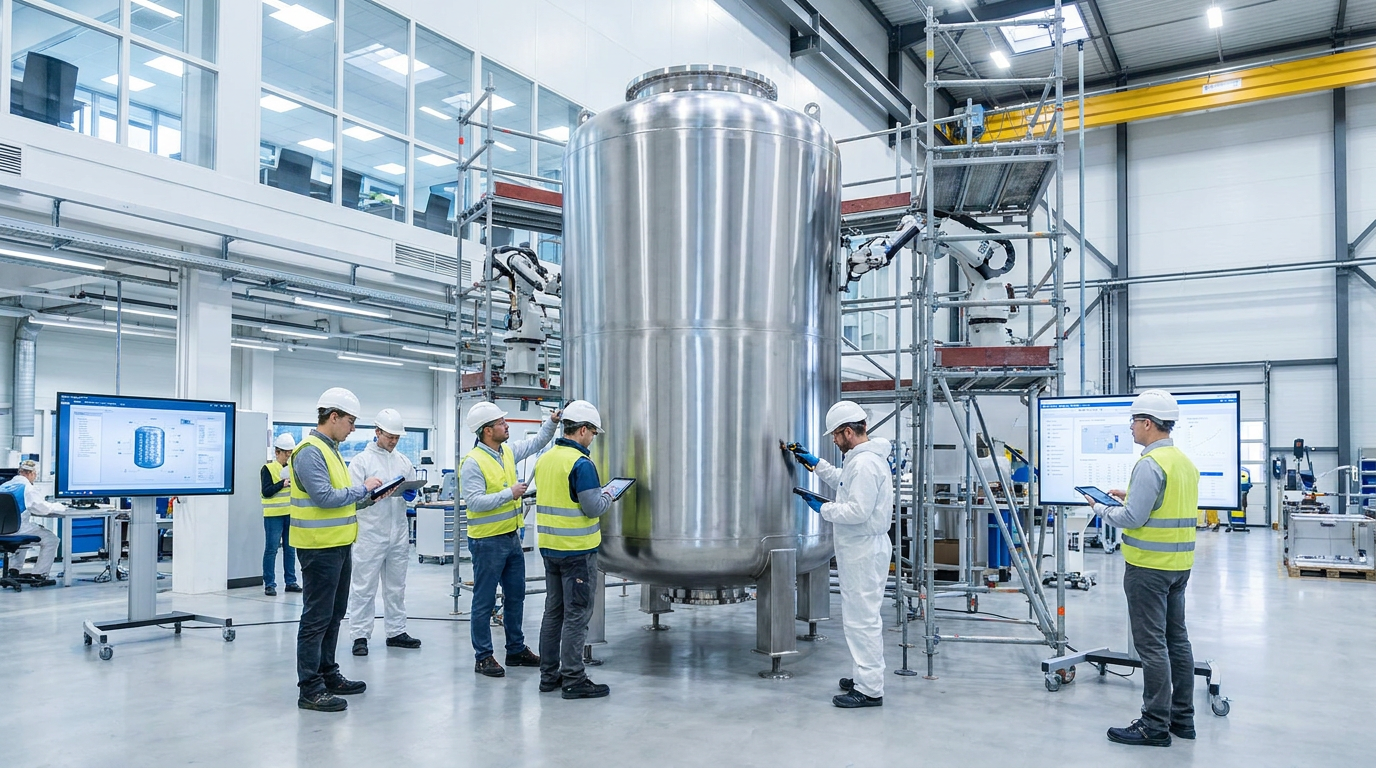
The second pillar is modularity. Traditional nuclear plants are built entirely on-site, subject to weather delays, local labor shortages, and complex supply chain logistics. SMRs are designed to have their major components—or even the entire reactor module—fabricated in a controlled factory environment.[2][3]

Once assembled, these modules are shipped by truck, rail, or barge to the final destination, where they are essentially plugged in. This approach trades the "economies of scale" that drove the massive reactors of the 20th century for "economies of series"—driving down costs through mass production, standardized parts, and repeatable quality control.[3][5]
Beyond economics, the most profound shift SMRs offer is in their safety physics. Legacy reactors rely on "active" safety systems—complex networks of diesel generators, electric pumps, and valves that must actively push cooling water into the reactor core during an emergency. If power is lost, the system is compromised.[1][7]
SMRs, by contrast, are designed around "passive" or "inherent" safety. Because the reactor core is much smaller, it generates significantly less decay heat. This allows engineers to rely on basic laws of physics—natural circulation, convection, and gravity—to cool the reactor if something goes wrong.[1][5]
SMRs, by contrast, are designed around "passive" or "inherent" safety.
In many SMR designs, if the plant loses all external power, the water inside the reactor naturally circulates as it heats and cools, safely dissipating heat into an underground pool or the surrounding atmosphere. These systems require no human intervention, no AC power, and no additional water to safely shut down, making them virtually "walk-away safe."[1][5]

The fuel inside these next-generation reactors is also evolving. While some SMRs use the same low-enriched uranium as traditional plants, many advanced designs utilize High-Assay Low-Enriched Uranium (HALEU). Conventional reactor fuel is enriched to about 3% to 5% uranium-235; HALEU is enriched to between 5% and 20%.[4][6]
This higher concentration of fissile material allows SMRs to achieve higher burnup rates and operate for much longer periods without refueling. While a traditional plant must be shut down every 18 to 24 months to swap out fuel rods, some SMR designs can run for three to seven years. Certain advanced microreactors are even designed to operate for up to 30 years on a single fuel load.[1][4]
The physical footprint of an SMR unlocks deployment opportunities that were previously impossible. Because they require less space and, in many cases, significantly less cooling water, SMRs can be sited in locations that cannot support a gigawatt-scale plant.[2][5]
This flexibility makes them ideal candidates for repowering retiring coal plants, utilizing the existing transmission infrastructure and providing new jobs for the local workforce. They are also uniquely suited for remote communities, island grids, and industrial clusters that currently rely on expensive, carbon-intensive diesel generators.[2][3]

Furthermore, SMRs are not limited to electricity generation. Many designs operate at much higher temperatures than traditional water-cooled reactors, producing high-quality industrial heat. This thermal energy can be piped directly into chemical plants, used for seawater desalination, or utilized to produce clean hydrogen, decarbonizing heavy industries that are difficult to run on electricity alone.[1][4]
The global race to commercialize this technology is already underway. Russia and China have taken the early lead, with Russia operating a floating SMR since 2020 and China connecting a high-temperature gas-cooled SMR to its grid in 2023.[4][5]
In the West, a surge of public and private investment is accelerating development. The U.S. Department of Energy and the European Union have launched massive funding initiatives to support SMR commercialization. Simultaneously, major technology companies—desperate for reliable, zero-carbon power to run their expanding AI data centers—are directly investing billions into SMR startups.[4][5]
Despite the momentum, the industry faces significant hurdles. The first wave of SMRs will inevitably face high "first-of-a-kind" costs before factory production can scale. Additionally, the supply chain for advanced fuels like HALEU is currently underdeveloped, and national regulatory bodies are still adapting their licensing frameworks—which were written for massive legacy plants—to accommodate these novel, modular designs.[4][7]
If these initial hurdles can be cleared, SMRs represent a paradigm shift in global energy. By turning nuclear power plants from bespoke mega-projects into manufactured products, SMRs offer a realistic path to a resilient, zero-carbon grid capable of powering the next century of human advancement.[7]
How we got here
1950s-1960s
The U.S. Navy pioneers small, pressurized water reactors to power nuclear submarines and aircraft carriers.
2020
Russia connects the Akademik Lomonosov, a floating SMR, to its grid, marking the first modern commercial deployment.
2023
China begins commercial operation of the HTR-PM, a high-temperature gas-cooled modular reactor.
February 2024
The European Commission launches the European SMR Industrial Alliance to accelerate deployment across the EU.
2025-2026
Major technology companies announce billions in direct investments into SMR startups to power future AI data centers.
Viewpoints in depth
Nuclear Innovators & Tech
Argue that SMRs are essential for providing firm, zero-carbon baseload power to support AI growth and grid stability.
Proponents in the technology and nuclear sectors view SMRs as the only viable solution to a looming energy crisis. As artificial intelligence data centers drive unprecedented spikes in electricity demand, intermittent renewables like wind and solar cannot guarantee the 24/7 uptime these facilities require. Innovators argue that by applying manufacturing principles to nuclear energy, SMRs can finally deliver the promise of cheap, abundant, and entirely carbon-free baseload power. They point to the massive investments from tech giants as proof that the private sector recognizes nuclear as the ultimate firm-power backstop for a clean grid.
Economic Skeptics
Warn that unproven first-of-a-kind costs may make SMRs too expensive compared to rapidly cheapening solar, wind, and battery storage.
Energy economists and renewable advocates caution against viewing SMRs as a silver bullet, pointing to the nuclear industry's long history of overpromising and underdelivering on costs. They argue that the first wave of SMRs will inevitably suffer from high "first-of-a-kind" expenses, making the electricity they produce significantly more expensive than existing alternatives. Skeptics suggest that by the time SMR manufacturing scales up enough to actually lower costs in the 2030s, advancements in long-duration battery storage and geothermal energy may have already solved the grid reliability problem at a fraction of the price.
Nonproliferation Analysts
Highlight the security challenges of distributing dozens of smaller reactors globally, particularly those using higher-enriched HALEU fuel.
International security experts raise concerns about the global proliferation of SMR technology. Traditional nuclear plants are massive, highly centralized, and heavily guarded facilities. SMRs, by design, are meant to be widely distributed, potentially placing nuclear material in remote locations or industrial parks. Furthermore, many advanced SMR designs rely on High-Assay Low-Enriched Uranium (HALEU). Because HALEU is enriched up to 20%—much closer to weapons-grade than the 5% fuel used in legacy plants—analysts warn that a global SMR supply chain will require entirely new, stringent international safeguards to prevent the diversion of fissile material.
What we don't know
- The true cost per megawatt-hour of the first commercial SMR fleets once factory production begins.
- How quickly national regulatory bodies can adapt their licensing processes to approve novel reactor designs.
- Whether the global supply chain can produce enough HALEU fuel to meet projected SMR demand by the 2030s.
Key terms
- Small Modular Reactor (SMR)
- A nuclear reactor generating 300 megawatts or less, designed to be factory-built and shipped to its operating site.
- HALEU
- High-Assay Low-Enriched Uranium; an advanced nuclear fuel enriched between 5% and 20%, allowing reactors to run longer between refueling.
- Passive Safety
- Engineering designs that rely on natural forces like gravity and convection to safely shut down and cool a reactor without external power.
- Baseload Power
- The minimum amount of electric power needed to be supplied to the electrical grid at any given time, traditionally provided by coal or nuclear plants.
- Light Water Reactor
- The most common type of traditional nuclear reactor, which uses ordinary water as both a coolant and a neutron moderator.
Frequently asked
Are SMRs safer than traditional nuclear plants?
Yes, most SMRs utilize "passive safety" systems. They rely on natural physics like gravity and convection to cool the reactor in an emergency, requiring no external power or human intervention.
What happens to the nuclear waste?
SMRs still produce radioactive waste, but advanced fuels and higher efficiency mean they generally produce less volume per megawatt-hour. The waste is stored securely on-site in dry casks before eventual long-term geological disposal.
How much power does an SMR produce?
SMRs typically generate between 50 and 300 megawatts of electricity. A 300 MW reactor can provide enough continuous power for roughly 300,000 homes.
Can SMRs be built faster than old nuclear plants?
That is the goal. By manufacturing components in a factory and assembling them on-site, SMR developers aim to cut construction times from the typical 10+ years down to 3 to 5 years.
Sources
Source coverage
7 outlets
3 viewpoints surfaced







[1]International Atomic Energy AgencyNonproliferation Analysts
Small modular reactors: flexible and affordable power generation
Read on International Atomic Energy Agency →[2]U.S. Department of EnergyNuclear Innovators & Tech
Benefits of Small Modular Reactors (SMRs)
Read on U.S. Department of Energy →[3]World Nuclear AssociationNuclear Innovators & Tech
Small Modular Reactors
Read on World Nuclear Association →[4]Stanford UniversityEconomic Skeptics
Energy Spotlight: Small Modular Reactors (SMRs)
Read on Stanford University →[5]European CommissionNonproliferation Analysts
Small modular reactors
Read on European Commission →[6]U.S. Energy Information Administration
Small modular reactors and microreactors under development in the United States
Read on U.S. Energy Information Administration →[7]Factlen Editorial TeamNuclear Innovators & Tech
Synthesis by Factlen editorial team
Read on Factlen Editorial Team →
Every angle. Every day.
Get energy stories with full source coverage and perspective breakdowns delivered to your inbox.