
How Micro-Fragmentation and Acoustic Enrichment Are Rebuilding Coral Reefs
Marine biologists are deploying advanced techniques like micro-fragmentation, acoustic enrichment, and multi-trophic ecosystems to actively rebuild the world's dying coral reefs.
By Factlen Editorial Team
- Technological Interventionists
- Advocates for using rapid structural rebuilding techniques to prevent total ecosystem collapse.
- Genetic Diversifiers
- Focuses on assisted reproduction to ensure long-term climate resilience.
- Ecological Holists
- Believes that focusing solely on corals ignores the broader environmental context.
What's not represented
- · Local coastal communities who rely on reefs for subsistence fishing and tourism.
- · Climate policymakers who focus on emission reductions rather than localized ecological interventions.
Why this matters
Coral reefs support a quarter of all marine life and protect coastlines from devastating storm surges. These new technologies offer a realistic pathway to keep these critical ecosystems alive while the world works to stabilize global temperatures.
Key points
- Micro-fragmentation forces slow-growing corals to grow up to 50 times faster by triggering a rapid healing response.
- Genetically identical coral fragments can seamlessly fuse together to form massive, sexually mature colonies in months instead of decades.
- Acoustic enrichment uses underwater speakers to play healthy reef sounds, significantly increasing the settlement rates of drifting coral larvae.
- Multi-trophic restoration integrates sponges and herbivores to naturally clean the water and protect young corals from disease.
For decades, marine conservation has relied on a strategy of passive hope: protect a patch of ocean, restrict fishing, and wait for the reef to heal itself. But as global ocean temperatures rise and bleaching events become more frequent, waiting is no longer a viable ecological option. In response, marine biologists have shifted from being observational park rangers to active bio-engineers. A new wave of restoration technology is fundamentally changing how fast, and how effectively, a dead reef can be brought back to life. The primary bottleneck in natural reef recovery is time. Massive reef-building species, such as brain and star corals, are the foundational architecture of the marine ecosystem, providing the complex three-dimensional structure that shelters thousands of other species. Yet, these crucial organisms grow at an agonizingly slow rate of just a few millimeters per year, meaning a severely damaged reef might naturally take centuries to recover—time that the modern climate simply does not afford.[5][7]
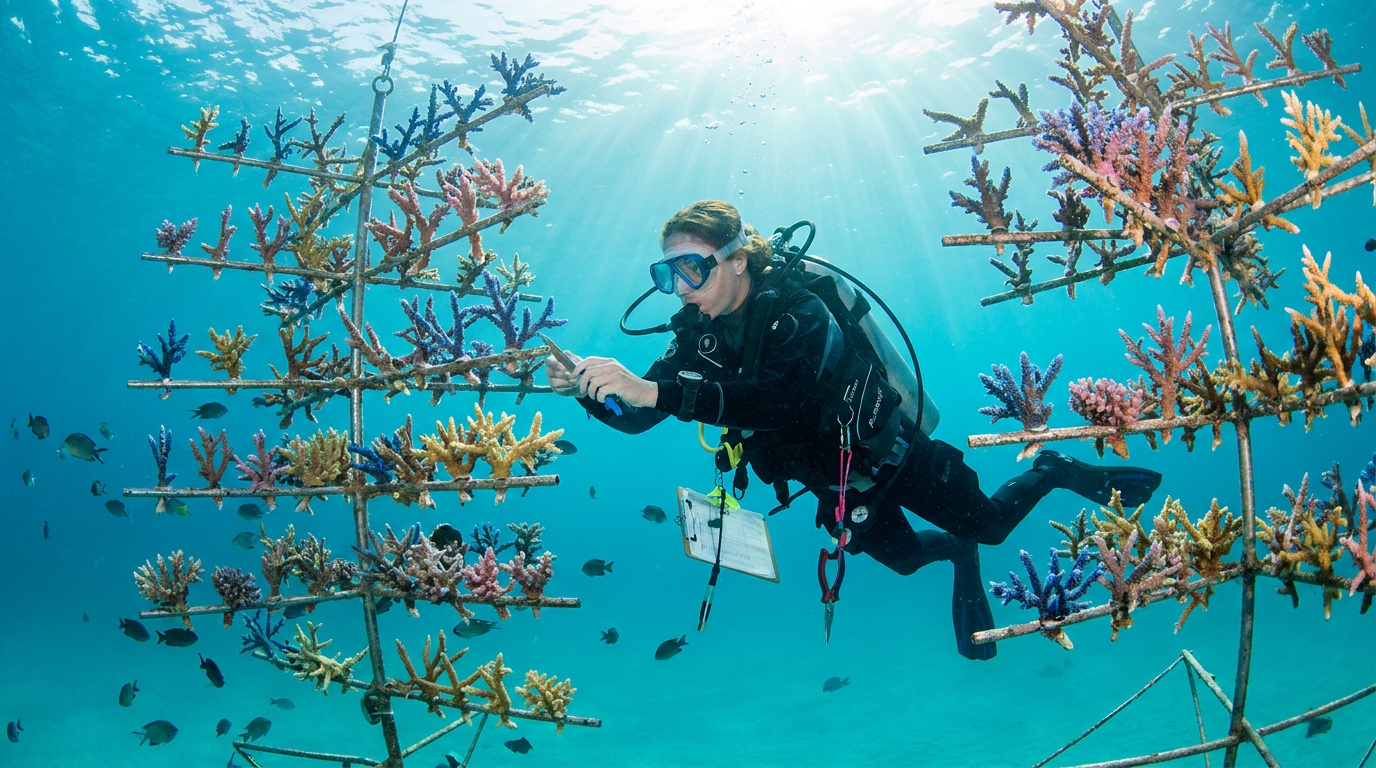
To bypass this biological speed limit, scientists have turned to a highly effective technique known as micro-fragmentation. The process involves taking a slow-growing, massive coral colony and deliberately cutting it into tiny pieces using a specialized diamond-blade saw, reducing the coral to fragments often no larger than a single square centimeter. While this intervention sounds destructive, it triggers a profound and ancient biological survival response. When a coral is broken or severely damaged, its biological imperative shifts entirely away from sexual reproduction and redirects all available energy toward rapid asexual growth. The organism races to heal the wound, encrust the surrounding area, and secure its survival against competing algae. By intentionally inducing this trauma in a controlled nursery environment, marine biologists can force the coral into a state of hyper-accelerated growth, turning a slow-growing boulder coral into a rapidly expanding sheet of living tissue.[3]
The results of this forced acceleration are staggering. Studies published in the journal PeerJ demonstrate that these micro-fragments grow between 25 and 50 times faster than they would in their natural, unbroken state. In one controlled observation, fragments of the mountainous star coral (*Orbicella faveolata*) expanded by an astonishing 63 square centimeters in a single month. But the true breakthrough of micro-fragmentation lies in the fusion phase. Because all the fragments cut from a single donor colony share the exact same DNA, their immune systems recognize each other as "self." When these rapidly growing fragments are placed a few centimeters apart on an artificial substrate or a dead reef skeleton, they grow outward and seamlessly fuse back together. This isogenic fusion allows scientists to assemble a massive, sexually mature coral colony in a matter of months, achieving a structural scale that would naturally take decades of undisturbed growth.[3]

However, micro-fragmentation has a critical ecological vulnerability: it is essentially a cloning operation. While the technique rapidly rebuilds the physical three-dimensional structure of the reef, it does not create any new genetic diversity. This leaves the newly fused, cloned corals highly susceptible to the exact same marine heatwaves or infectious diseases that killed their predecessors. To solve this genetic bottleneck, researchers are increasingly relying on assisted reproduction. During rare, synchronized mass spawning events—which often occur only once a year under the light of a full moon—scientists dive onto the reefs to capture floating coral eggs and sperm. These gametes are then rushed back to controlled laboratory environments where they are fertilized and carefully reared. This process creates millions of genetically unique larvae, ensuring that the next generation of the reef possesses the varied genetic toolkit necessary to adapt to warming waters and novel pathogens.[5]
The challenge then becomes getting these lab-reared, genetically diverse larvae to survive in the wild. In nature, the odds are overwhelmingly stacked against them; less than one percent of wild coral larvae successfully find a suitable place to attach and grow, with the vast majority drifting aimlessly into the open ocean or being consumed by predators. This is where the emerging science of acoustic enrichment enters the equation. Coral larvae, despite lacking ears or a central nervous system, are highly sensitive to the vibrations and pressure changes of underwater sound. A healthy coral reef is an incredibly loud environment, crackling continuously with the sound of snapping shrimp and thrumming with the grunts, clicks, and purrs of feeding fish. Degraded reefs, by contrast, are eerily silent, offering no auditory beacon for drifting larvae to follow, leaving them lost in the water column.[1][5]

The challenge then becomes getting these lab-reared, genetically diverse larvae to survive in the wild.
To guide these vulnerable larvae home, researchers at the Woods Hole Oceanographic Institution have begun dropping waterproof speakers into dead reef zones, broadcasting the recorded soundscapes of vibrant, healthy ecosystems. The acoustic illusion works with remarkable efficiency. In recent field trials, golfball coral larvae exposed to healthy reef sounds settled onto the degraded reef at significantly higher rates during their first 36 hours in the water compared to silent control sites. The sound acts as a dinner bell and a homing beacon, signaling to the microscopic corals that the area is safe and capable of supporting life. Once that critical 36-hour window passes, the larvae become desperate to settle anywhere, making the immediate deployment of acoustic enrichment a vital tool for ensuring that lab-reared corals actually attach to the specific restoration sites where they are needed most.[1]
The benefits of acoustic enrichment extend far beyond the corals themselves, playing a crucial role in resurrecting the broader food web. Playback experiments documented in Nature Communications have shown that broadcasting healthy reef sounds doubles the overall abundance of juvenile fish moving into a degraded area and increases species richness by 50 percent. This acoustic beacon effectively calls in the ecological cleanup crew—specifically herbivorous fish like parrotfish and surgeonfish that graze aggressively on the macroalgae that would otherwise smother young, vulnerable corals. By artificially seeding the soundscape, conservationists can kickstart a positive feedback loop: the sound attracts fish, the fish clean the reef, the clean reef allows corals to grow, and the growing corals eventually produce their own natural sounds, rendering the underwater speakers obsolete as the ecosystem becomes self-sustaining.[2][6]

Yet, even with fast-growing coral clones and an abundance of grazing fish, a reef cannot survive if the underlying water quality is toxic or laden with disease. This realization has sparked a push toward multi-trophic restoration, an approach that rebuilds the entire ecological support system rather than focusing on corals in isolation. According to research published by the Royal Society, modern restoration must move beyond a single-species mindset. By deliberately integrating filter-feeding sponges, detritivores like sea cucumbers, and various suspension feeders into coral nurseries and outplant sites, scientists can naturally scrub the water of harmful pathogens. Sponges, for instance, can filter thousands of liters of water a day, removing bacteria and viral loads that cause devastating coral diseases, while sea cucumbers process the sediment, preventing the buildup of suffocating organic matter.[4]
The synthesis of these advanced technologies represents a profound paradigm shift in marine conservation. Modern reef restoration is no longer a matter of simply planting coral and walking away; it is a highly synchronized, multi-disciplinary deployment. Micro-fragmented clones provide the immediate physical architecture and three-dimensional complexity required to break wave energy and shelter marine life. Acoustically guided, lab-reared larvae supply the necessary genetic resilience, ensuring the reef can adapt to future thermal stress. Meanwhile, multi-trophic companion species maintain the environmental balance, acting as the immune system and waste management infrastructure of the recovering habitat. Together, these interventions transform reef restoration from a passive waiting game into an active, engineered recovery process capable of outpacing natural degradation.[7]

The lingering uncertainty among marine researchers is ultimately one of scale and global atmospheric policy. While these active interventions are proving wildly successful across localized hectares and specific bays, the ocean is vast, and the overarching threat of global climate change cannot be solved by underwater speakers and diamond-blade saws alone. If ocean temperatures continue to rise unchecked, even the most genetically diverse and acoustically enriched reefs will eventually succumb to thermal bleaching. Ultimately, these advanced technologies are designed to buy time. By actively keeping these critical ecosystems alive, structurally sound, and genetically diverse today, scientists are ensuring that when global carbon emissions are curtailed and ocean temperatures eventually stabilize, there will still be a living, breathing foundation left to rebuild the rainforests of the sea.[7]
How we got here
2015
PeerJ publishes foundational research demonstrating micro-fragmentation accelerates coral growth by up to 50 times.
2019
Nature Communications reveals that acoustic enrichment can double fish abundance on degraded reefs.
2024
Woods Hole Oceanographic Institution proves acoustic enrichment significantly boosts coral larval settlement.
2026
Multi-trophic restoration frameworks are formalized, integrating sponges and herbivores into coral nurseries.
Viewpoints in depth
Technological Interventionists
Advocates for using rapid structural rebuilding techniques to prevent total ecosystem collapse.
This camp argues that the immediate priority is rebuilding the three-dimensional architecture of the reef as quickly as possible. By utilizing micro-fragmentation and acoustic enrichment, they believe we can force a rapid structural recovery that breaks wave energy and provides immediate habitat. They acknowledge the risks of cloning but argue that a cloned reef is better than a dead reef, prioritizing immediate physical survival over long-term genetic perfection.
Genetic Diversifiers
Focuses on assisted reproduction to ensure long-term climate resilience.
Researchers in this camp warn that relying too heavily on micro-fragmentation creates a dangerous monoculture. If an entire reef is built from the clones of a few donor corals, a single novel disease or heatwave could wipe out the entire restoration effort overnight. They argue that funding and effort must be heavily directed toward assisted reproduction and larval seeding, ensuring that the reefs of tomorrow have the diverse genetic toolkit required to survive in a warming ocean.
Ecological Holists
Believes that focusing solely on corals ignores the broader environmental context.
This perspective argues that planting corals in toxic or pathogen-heavy water is a waste of resources. They advocate for multi-trophic restoration, emphasizing that a reef is a complex machine requiring many moving parts. By introducing sponges to filter water and sea cucumbers to clean the sediment, they believe restoration efforts must rebuild the entire ecological support system, creating a self-sustaining environment where young corals can actually survive.
What we don't know
- Whether acoustically enriched and micro-fragmented reefs can survive the severe marine heatwaves projected for the 2030s.
- The long-term reproductive viability of corals that have been repeatedly subjected to micro-fragmentation trauma.
Key terms
- Micro-fragmentation
- A technique where slow-growing corals are cut into tiny pieces to stimulate rapid healing and growth before being fused back together.
- Acoustic enrichment
- The practice of playing audio recordings of healthy reef sounds underwater to attract coral larvae and fish to degraded habitats.
- Multi-trophic restoration
- An ecological approach that restores not just one species, but a diverse food web including filter feeders, grazers, and predators.
- Assisted reproduction
- Collecting coral sperm and eggs during spawning events to fertilize and rear them in a controlled lab environment, ensuring genetic diversity.
- Isogenic fusion
- The process where genetically identical coral fragments grow toward each other and seamlessly merge into a single larger colony.
Frequently asked
Why can't we just let coral reefs recover naturally?
Natural coral growth is extremely slow, and the rate of reef degradation from climate change currently outpaces the corals' natural ability to reproduce and rebuild.
Does cutting corals into small pieces hurt them?
While it causes temporary trauma, the coral's biological response is to rapidly accelerate its growth to heal, ultimately producing much more tissue than if left alone.
How do coral larvae hear underwater?
Coral larvae possess tiny hair-like cells that detect the vibrations and pressure changes of sound waves, allowing them to navigate toward the noise of a healthy reef.
Will these technologies save reefs from climate change?
No. These techniques are designed to buy time and maintain biodiversity locally. Long-term reef survival still requires stabilizing global ocean temperatures.
Sources
Source coverage
7 outlets
3 viewpoints surfaced







[1]Woods Hole Oceanographic InstitutionTechnological Interventionists
Using successful techniques from an earlier study, acoustic enrichment continues to show promise
Read on Woods Hole Oceanographic Institution →[2]Nature CommunicationsEcological Holists
Acoustic enrichment can enhance fish community development on degraded coral reef habitat
Read on Nature Communications →[3]PeerJTechnological Interventionists
Micro-fragmentation: a novel technique for coral cultivation and reef restoration
Read on PeerJ →[4]Philosophical Transactions of the Royal Society BEcological Holists
Exploring the transformative potential of multi-trophic strategies to enhance coral restoration
Read on Philosophical Transactions of the Royal Society B →[5]Ocean GenerationGenetic Diversifiers
Can cutting corals into tiny bits help?
Read on Ocean Generation →[6]Frontiers in Marine ScienceEcological Holists
Acoustic enrichment for coral reef restoration
Read on Frontiers in Marine Science →[7]Factlen Editorial TeamEcological Holists
Synthesis by Factlen editorial team
Read on Factlen Editorial Team →
Every angle. Every day.
Get environment stories with full source coverage and perspective breakdowns delivered to your inbox.