
EV vs. PHEV in 2026: Which Electrified Vehicle Is Right for You?
As electric ranges grow and charging networks expand, the choice between a fully electric vehicle and a plug-in hybrid depends entirely on your daily driving habits and access to home charging.
By Factlen Editorial Team
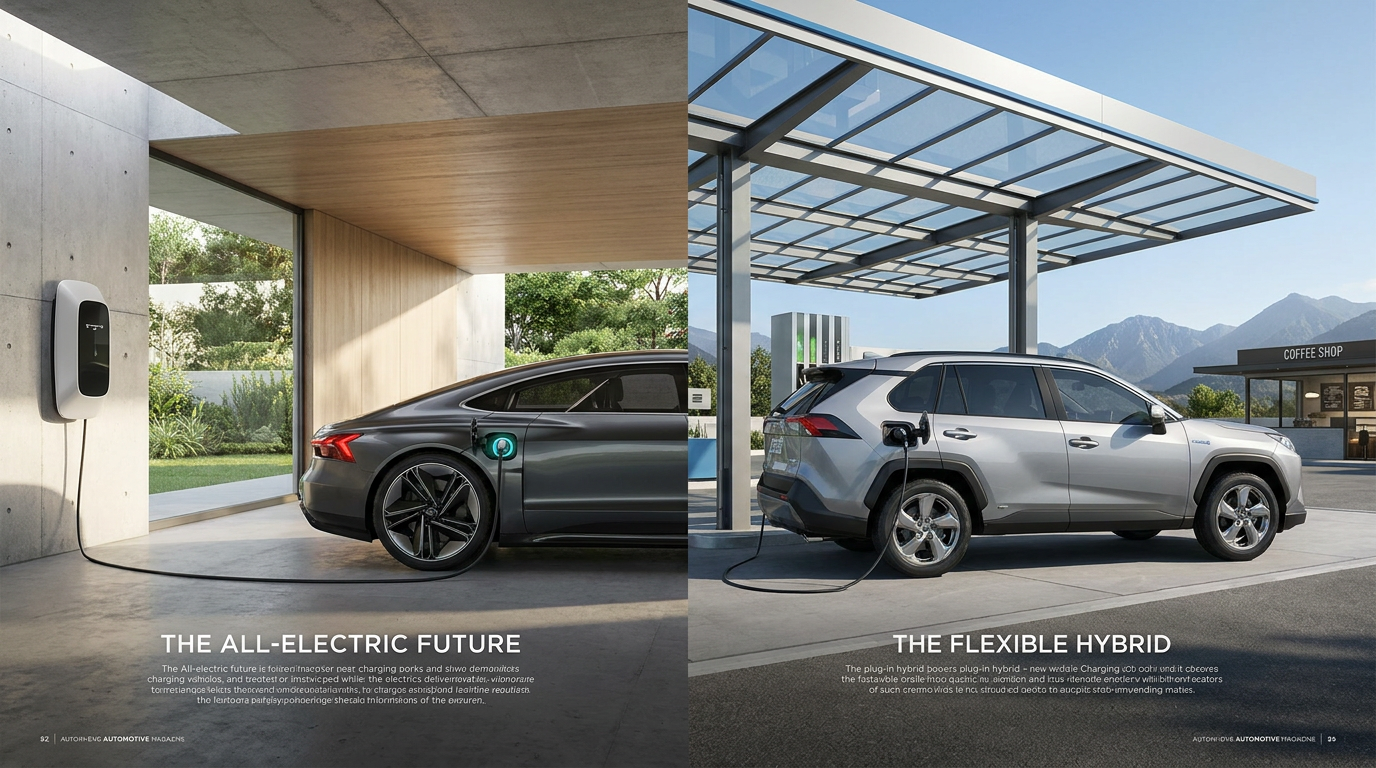
- Full EV Advocates
- Prioritize zero emissions, mechanical simplicity, and long-term maintenance savings.
- PHEV Pragmatists
- Value the electric commute but demand the gas safety net for long road trips.
- Infrastructure Realists
- Highlight the ongoing gaps in rural charging networks and the need for transitional tech.
What's not represented
- · Apartment renters without charging access
- · Used car buyers
Why this matters
Choosing the wrong powertrain can lead to thousands of dollars in unnecessary maintenance or frustrating logistical hurdles. Understanding the exact conditions where each technology excels ensures you buy a vehicle that seamlessly fits your lifestyle and budget.
Key points
- Pure EVs offer the lowest running costs and require almost no routine mechanical maintenance.
- PHEVs provide 40 to 60 miles of electric range for daily commutes, plus a gas engine for unlimited road-trip flexibility.
- Charging an EV at home is roughly 70% cheaper than fueling a comparable gasoline vehicle.
- PHEVs are mechanically complex and still require traditional oil changes and engine upkeep.
- The choice depends entirely on your access to home charging and the frequency of your long-distance travel.
The automotive landscape in 2026 presents buyers with the most capable electrified vehicles in history, but it also forces a complex decision: commit fully to a battery electric vehicle (EV) or hedge your bets with a plug-in hybrid electric vehicle (PHEV). As global mandates push toward zero-emission futures, both technologies have matured significantly. The choice no longer hinges on whether electrified cars are viable, but rather which powertrain architecture aligns with a driver's specific daily geography, financial calculus, and access to charging infrastructure.[1]
At the core of the comparison is a fundamental difference in engineering philosophy. A battery electric vehicle relies entirely on an electric motor and a large battery pack, eliminating the internal combustion engine completely. In contrast, a plug-in hybrid houses two distinct powertrains: a smaller battery capable of handling short trips on pure electricity, paired with a traditional gasoline engine that takes over when the battery is depleted. This dual nature makes the PHEV a transitional bridge, while the EV represents the ultimate destination of modern automotive design.[6][7]
The argument for fully electric vehicles centers on unmatched operational efficiency and mechanical simplicity. Proponents point to the sheer cost advantage of electricity over gasoline, with 2026 global data showing that charging an EV is roughly 70 percent cheaper than fueling a comparable gas-powered car. Furthermore, the drivetrain of a pure EV contains approximately 20 moving parts, entirely eliminating the need for oil changes, spark plug replacements, and transmission servicing. Over a five-year ownership period, this mechanical simplicity translates to thousands of dollars in maintenance savings.[6][8]

The evidence supporting the EV's dominance in daily driving is bolstered by the rapid expansion of charging infrastructure. By 2026, ultra-fast 350-kilowatt chargers have shifted into the mainstream, allowing compatible EVs to reach an 80 percent charge in just 15 to 20 minutes. For drivers who can install a Level 2 charger at home, the vehicle effectively starts every morning with a "full tank," rendering public charging stations irrelevant for 95 percent of standard commuting and errand-running.[3][4]
However, the case against pure EVs remains anchored in the uneven distribution of that same charging infrastructure. While metropolitan areas and major highway corridors now boast redundant, highly visible charging hubs, rural regions and secondary routes still present noticeable gaps. For drivers who frequently embark on spontaneous, long-distance road trips through remote areas, the reliance on a developing network can introduce unwanted logistical friction and range anxiety. Additionally, the upfront purchase price of long-range EVs often remains higher than their hybrid counterparts, requiring buyers to wait years to recoup the premium through fuel savings.[3]
This is where the plug-in hybrid makes its strongest case, offering what industry analysts call "infinite flexibility." The primary argument for a PHEV is its ability to deliver the silent, zero-emission benefits of an EV during the workweek, while retaining the limitless range and rapid refueling of a gas car for weekend adventures. In 2026, battery technology advancements have pushed PHEV electric-only ranges to new heights. Models like the Mercedes-Benz GLC 350e now achieve an EPA-rated 54 miles of electric range, while some international models exceed 60 miles.[2][5]

In 2026, battery technology advancements have pushed PHEV electric-only ranges to new heights.
The evidence shows that because the average daily commute falls well under 40 miles, a disciplined PHEV owner who charges nightly can drive for months without burning a drop of gasoline. This allows families to enjoy the smooth, quiet operation of electric driving for school drop-offs and grocery runs, while completely bypassing the public charging network during a 500-mile holiday road trip. For households restricted to a single vehicle, the PHEV serves as a highly pragmatic compromise.[5][7]
Yet, the argument against PHEVs is rooted in their inherent complexity and weight. A plug-in hybrid is arguably the most mechanically complex vehicle on the road today, forcing owners to maintain both a high-voltage electrical system and a traditional combustion engine. If a driver fails to plug the vehicle in regularly, they are essentially hauling around hundreds of pounds of dead battery weight, which severely degrades the fuel efficiency of the gas engine.[6][8]
Furthermore, the long-term environmental and financial viability of PHEVs is facing new pressures in 2026. Several major global cities have begun implementing strict "Zero-Emission Zones" that charge fees to PHEVs if their combustion engines engage within city limits. As the secondary market matures, pure EVs from reputable brands are holding their resale value remarkably well, while PHEVs face steeper depreciation curves as buyers increasingly prefer the simplicity of fully electric architectures.[6]

Beyond the mechanical differences, the driving experience itself presents a clear contrast. EVs offer instant torque at all speeds, a perfectly silent cabin, and aggressive regenerative braking that allows for one-pedal driving. PHEVs can mimic this experience when operating in electric mode, but once the gas engine engages, drivers are reintroduced to engine noise, transmission shifts, and vibrations. For purists seeking the smoothest possible ride, the EV remains unmatched.[7][8]
Ultimately, the trade-off analysis reveals that neither powertrain is universally superior; their success is entirely conditional. A fully electric vehicle fits perfectly when a driver has reliable access to home or workplace charging, follows predictable daily commuting patterns, and prioritizes the lowest possible long-term maintenance and running costs. It is the definitive choice for multi-car households where at least one vehicle can be dedicated to local and regional transit.[1][7]
Conversely, a pure EV does not fit well for apartment dwellers without dedicated parking, or for drivers whose livelihoods require constant, unpredictable long-distance travel through rural corridors. In these scenarios, the time spent managing public charging logistics outweighs the operational savings, making the EV a source of friction rather than convenience.[3][8]

A plug-in hybrid fits exceptionally well when a buyer wants to drastically reduce their carbon footprint and daily fuel costs, but frequently travels to remote areas lacking robust charging infrastructure. It is the ideal solution for drivers who are diligent about plugging in every night but demand the psychological safety net of a gas tank for spontaneous weekend getaways.[2][5]
However, a PHEV does not fit well for buyers who lack a convenient place to charge at home, as treating a PHEV like a traditional gas car negates its benefits and results in poor fuel economy. It is also a suboptimal choice for drivers seeking to completely eliminate trips to the mechanic, as the combustion engine will always require routine oil changes, filter replacements, and mechanical upkeep.[6][7]
How we got here
Early 2010s
The first mass-market EVs and PHEVs, like the Nissan Leaf and Chevy Volt, introduce consumers to plug-in technology with limited ranges.
2020
EV ranges begin consistently crossing the 250-mile mark, making them viable primary vehicles for more households.
2024
Major automakers begin adopting universal charging standards, drastically improving public charging access for all EV brands.
2026
PHEVs achieve electric-only ranges exceeding 50 miles, while 350kW ultra-fast chargers become mainstream for pure EVs.
Viewpoints in depth
Full EV Advocates
Argue that pure electric vehicles are the only logical long-term investment.
This camp, heavily represented by environmental groups and tech-forward automotive analysts, argues that the mechanical simplicity of an EV makes it the superior choice. They point out that maintaining a combustion engine in a PHEV negates the primary financial benefits of electrification. Furthermore, they emphasize that as public charging infrastructure continues its rapid expansion, the 'range anxiety' that justifies PHEVs is quickly becoming an outdated concern.
PHEV Pragmatists
View plug-in hybrids as the perfect transitional technology for single-car households.
Pragmatists argue that while EVs are ideal for multi-car families, a single-car household needs a vehicle that can do everything without compromise. They highlight that a PHEV allows drivers to achieve zero emissions for 90% of their daily driving, while completely avoiding the logistical friction of public charging during the other 10% of long-distance travel. To this group, the added mechanical complexity is a worthwhile trade-off for absolute freedom.
Infrastructure Realists
Focus on the current geographical limitations of the public charging network.
This perspective emphasizes that while charging networks have improved drastically in urban centers and along major interstates, vast stretches of rural and secondary routes remain underserved in 2026. They argue that pushing rural drivers or apartment dwellers toward pure EVs is premature, and that PHEVs serve as a necessary bridge until charging access becomes as ubiquitous and reliable as the traditional gas station.
What we don't know
- How quickly rural charging infrastructure will catch up to the density seen in major metropolitan corridors.
- Whether future urban 'Zero-Emission Zones' will completely ban PHEVs or continue to allow them for a fee.
- How the long-term resale value of complex PHEVs will hold up as pure EV battery technology continues to advance.
Key terms
- PHEV (Plug-in Hybrid Electric Vehicle)
- A vehicle with both an electric motor and a gasoline engine, featuring a battery large enough to drive short distances on pure electricity before the gas engine takes over.
- BEV (Battery Electric Vehicle)
- A fully electric vehicle powered exclusively by a large battery pack and electric motors, with no gasoline engine or exhaust emissions.
- Level 2 Charging
- A home or public charging standard that uses a 240-volt outlet (similar to a heavy appliance) to fully charge an EV overnight.
- Ultra-Fast Charging (350kW)
- High-powered public charging stations capable of adding hundreds of miles of range to an EV in under 20 minutes.
Frequently asked
Do I still need to get oil changes with a PHEV?
Yes. Because a PHEV has a traditional gasoline engine alongside its electric motor, it still requires regular oil changes, filter replacements, and standard mechanical maintenance.
Can a PHEV run if the battery is completely dead?
Yes. Once the electric battery is depleted, the PHEV seamlessly switches to its gasoline engine, operating exactly like a traditional hybrid car.
How long does it take to charge an EV in 2026?
At a modern 350kW ultra-fast public charger, compatible EVs can reach an 80% charge in 15 to 20 minutes. At home on a Level 2 charger, a full charge typically takes 6 to 8 hours overnight.
Is it cheaper to charge an EV or buy gas?
Charging an EV is significantly cheaper. Global data in 2026 indicates that charging an EV costs roughly 70% less than fueling a comparable gas-powered vehicle.
Sources
Source coverage
8 outlets
3 viewpoints surfaced








[1]Factlen Editorial TeamInfrastructure Realists
Synthesis by Factlen editorial team
Read on Factlen Editorial Team →[2]TopSpeedPHEV Pragmatists
The 2026 Mercedes-Benz GLC 350e 4Matic Is The Benchmark For Electric-Range
Read on TopSpeed →[3]GreenCarsInfrastructure Realists
EV charging improved in 2026 with more fast-charging ports
Read on GreenCars →[4]DriivzInfrastructure Realists
The EV charging industry is entering a transformative period in 2026
Read on Driivz →[5]CarExpertPHEV Pragmatists
Top 10 mid-size PHEV family SUVs in 2026
Read on CarExpert →[6]MobileStudio24hFull EV Advocates
EV vs PHEV Which One Better in 2026
Read on MobileStudio24h →[7]ZenithFull EV Advocates
EV vs PHEV at a glance: Lower running costs vs Stepping stone
Read on Zenith →[8]Go ElectraFull EV Advocates
Comparison Table: EV vs. PHEV
Read on Go Electra →

Every angle. Every day.
Get guides stories with full source coverage and perspective breakdowns delivered to your inbox.