
How NASA and DARPA’s Nuclear Rocket Will Cut Mars Travel Time in Half
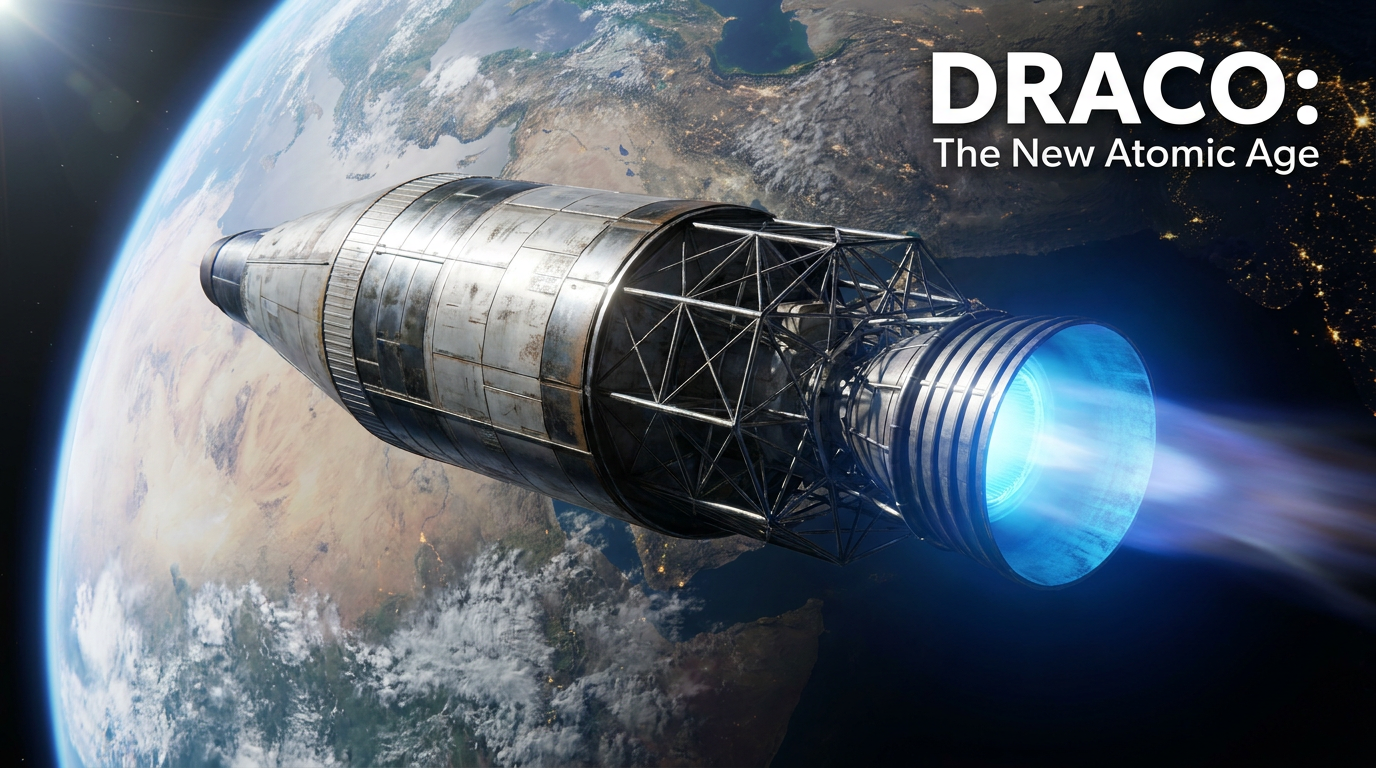
The DRACO program is preparing to test the first nuclear thermal propulsion system in orbit by 2026, promising a revolutionary leap in spaceflight efficiency and maneuverability.
By Factlen Editorial Team
- Deep Space Explorers
- Advocates for human exploration argue that nuclear propulsion is the only viable path to Mars.
- National Security Strategists
- Defense officials value the technology for its ability to provide unmatched maneuverability and tactical advantage in cislunar space.
- Nuclear Safety Advocates
- Watchdogs and engineers prioritize fail-safes to prevent radiological contamination during launch.
What's not represented
- · Environmental Organizations
Why this matters
Chemical rockets have reached their physical limits, restricting humanity's ability to explore deep space. Mastering nuclear thermal propulsion will drastically reduce travel times to Mars, protect astronauts from cosmic radiation, and open the entire solar system to rapid transit.
Key points
- NASA and DARPA plan to launch the DRACO nuclear thermal propulsion demonstrator in 2026.
- Nuclear thermal rockets use a fission reactor to heat liquid hydrogen, making them twice as efficient as chemical rockets.
- The technology could reduce travel time to Mars from nine months to just three or four months.
- To ensure safety, the reactor will launch completely dormant and will only activate once in a high, 300-year decay orbit.
For decades, humanity’s reach into the cosmos has been strictly governed by the tyranny of the rocket equation. Chemical propulsion—the process of burning a refined fuel and an oxidizer to create explosive thrust—has successfully taken astronauts to the Moon and sent robotic probes to the very edge of the solar system. However, this method is fundamentally limited by its chemical efficiency. To carry enough fuel to go fast, a rocket must become exponentially heavier, which in turn requires even more fuel just to lift the initial fuel off the launch pad. Breaking this cycle requires a complete paradigm shift in how we generate thrust in the vacuum of space.[6]
To push human presence deeper into the solar system and expand operational capabilities in high Earth orbit, space agencies need a propulsion system that breaks the chemical limit. Enter the Demonstration Rocket for Agile Cislunar Operations, universally known by its acronym, DRACO. Jointly funded and managed by NASA and the Defense Advanced Research Projects Agency (DARPA), the DRACO program is preparing to launch a groundbreaking in-space test of a nuclear thermal propulsion (NTP) system later this year. This ambitious initiative represents the culmination of years of research and development, aiming to revive and modernize a concept that was first explored during the Apollo era but ultimately shelved due to budget constraints and atmospheric testing bans.[1][4]
If successful, this $499 million joint initiative will mark the first time a nuclear fission reactor has been actively used to generate propulsive thrust in orbit. The project represents a massive technological leap, unlocking transit speeds and orbital capabilities that chemical rockets simply cannot match. The spacecraft is currently undergoing final integration, with Lockheed Martin serving as the prime contractor for the vehicle's chassis and BWX Technologies providing the specialized nuclear reactor that serves as the engine's beating heart. By splitting the financial and engineering responsibilities evenly between civilian space exploration and military research, NASA and DARPA have created a dual-use platform that serves two vastly different, yet equally demanding, strategic goals.[1][2]
The core mechanism of a nuclear thermal propulsion system is elegantly simple in its physics, even if it is fiendishly complex in its engineering execution. Unlike a traditional chemical rocket, which relies on the violent, explosive combustion of two highly reactive liquids, a nuclear thermal rocket uses a controlled fission reactor to generate intense, sustained heat. This reactor effectively replaces the traditional combustion chamber, eliminating the need to carry a heavy, volatile oxidizer like liquid oxygen. Instead, the system relies entirely on a single propellant, drastically simplifying the fluid dynamics of the engine while simultaneously maximizing the thermal energy transferred to the exhaust.[2][6]

In the DRACO engine, liquid hydrogen propellant—stored in heavily insulated tanks at extreme cryogenic temperatures—is pumped directly through the ultra-hot core of the nuclear reactor. The immense heat generated by the splitting of uranium atoms rapidly expands the liquid hydrogen, transforming it instantly into a high-pressure, superheated gas. This gas is then channeled and expelled through a traditional bell-shaped rocket nozzle to produce forward thrust. Because the system uses pure hydrogen, the exhaust is incredibly light and fast. The absence of heavy combustion byproducts, such as the carbon dioxide or water vapor produced by burning kerosene or methane, allows the exhaust gas to exit the nozzle at velocities that chemical engines can only dream of achieving.[2][6]
Because hydrogen is the lightest element in the universe, accelerating it to these extreme velocities translates directly to a massive increase in a metric known as specific impulse (Isp). Specific impulse is the standard measure of how efficiently a rocket uses its propellant—essentially the spaceflight equivalent of miles per gallon. While the most advanced chemical engines in operation today, such as SpaceX's methane-fueled Raptor engine, achieve a specific impulse of just under 400 seconds in a vacuum, DRACO’s nuclear thermal engine is designed to hit 800 seconds or more. This means the NTP system is at least twice as efficient as the absolute best chemical rockets currently flying, allowing a spacecraft to do twice as much maneuvering with the exact same mass of propellant.[2][5]
For NASA, this unprecedented leap in efficiency solves one of the most daunting logistical and physiological challenges of human deep-space exploration: the arduous journey to Mars. Using conventional chemical rockets and relying on optimal planetary alignments, a one-way transit to the Red Planet takes roughly seven to nine months. During this long coast through deep space, astronauts are subjected to a relentless bombardment of cosmic radiation and unpredictable solar flares, posing severe long-term risks to their health and cognitive function. Furthermore, a nine-month journey requires the spacecraft to carry massive stockpiles of food, water, and life-support consumables, eating into the valuable payload capacity that could otherwise be used for scientific equipment or habitat modules.[1][6]
A fully realized nuclear-powered spacecraft could cut that travel time down to just three or four months. This drastic reduction in transit time is considered vital for future crewed missions, as it significantly limits the crew's exposure to the harsh radiation environment of deep space. By arriving faster, astronauts would be healthier and more capable upon landing, and the mission architecture would require far fewer consumables. "Reducing transit time is vital for human missions to Mars to limit a crew's exposure to radiation," noted Lockheed Martin leadership during the project's development phase. The ability to power through the transit phase, rather than simply coasting on a ballistic trajectory, fundamentally changes the risk calculus of interplanetary colonization.[2][6]

A fully realized nuclear-powered spacecraft could cut that travel time down to just three or four months.
DARPA, meanwhile, is interested in the DRACO architecture for an entirely different reason: cislunar maneuverability. The vast volume of space between Earth and the Moon is becoming an increasingly contested and strategic domain. Current military and commercial satellites are severely limited in their ability to change orbits or evade threats because carrying extra chemical propellant is prohibitively heavy. Once a traditional satellite is placed in orbit, its ability to maneuver is strictly rationed over its lifespan. If a satellite needs to rapidly change its inclination or altitude to respond to an emerging situation, it risks burning through its limited fuel reserves and ending its operational life prematurely.[4][5]
An NTP-powered vehicle, with its high thrust-to-weight ratio and extreme fuel efficiency, shatters this limitation. A spacecraft equipped with a DRACO-style engine could rapidly and repeatedly maneuver across vast orbital distances, giving the United States a leap-ahead tactical advantage in space operations. DARPA envisions a future where space assets are no longer sitting ducks in predictable orbits, but agile platforms capable of dynamic repositioning. This agility is viewed as a core requirement for maintaining technological superiority and securing the cislunar environment against potential adversarial actions. The military applications of such a system are profound, offering the ability to inspect unidentified objects, reposition communication relays on demand, or rapidly deploy defensive countermeasures across thousands of miles of orbital space.[4][5]
Naturally, the prospect of launching a nuclear reactor into space raises immediate and intense safety concerns among the public and environmental watchdogs. The primary fear centers on the launch phase: what happens if the launch vehicle suffers a catastrophic failure and explodes in the atmosphere, or crashes back into the ocean? The DRACO engineering team has anticipated this exact scenario and engineered a strict, multi-layered safety protocol to ensure that a launch pad anomaly does not become a radiological disaster. Unlike the radioisotope thermoelectric generators (RTGs) used on rovers like Curiosity and Perseverance, which constantly emit heat from decaying plutonium, the DRACO reactor uses a fundamentally different and more controllable nuclear process.[1][3]
First and foremost, the DRACO spacecraft will not launch under its own nuclear power. It will be carried to space as a cold, inert payload tucked safely inside the aerodynamic fairing of a conventional chemical rocket, such as a SpaceX Falcon 9 or a United Launch Alliance Vulcan Centaur. During the violent and vibration-heavy ascent through Earth's atmosphere, the nuclear reactor remains completely dormant. It generates no power, produces no thrust, and poses no active radiation threat to the launch environment. The uranium fuel inside the reactor is in a stable, pre-fission state, meaning it is only mildly radioactive—safe enough to be handled by technicians with standard industrial precautions prior to integration.[2][5]

To physically guarantee that the reactor cannot accidentally turn on during launch, the system is equipped with a fail-safe mechanism known as a "poison wire." This specialized component is made of highly effective neutron-absorbing materials. Threaded directly into the reactor core, the poison wire acts much like the control rods in a terrestrial nuclear power plant. It aggressively absorbs any stray neutrons, making it physically impossible for the uranium fuel to achieve the critical mass necessary to initiate a sustained chain reaction. Even in the absolute worst-case scenario—a mid-air explosion that sends the reactor plummeting into the ocean—the poison wire ensures the core remains subcritical, preventing any nuclear yield or widespread radioactive contamination.[1][2]
The reactor will only be authorized for activation once the spacecraft has successfully separated from its launch vehicle and reached a designated "nuclear-safe orbit." For the DRACO mission, this safe zone is defined as a high Earth orbit situated between 700 and 2,000 kilometers (435 to 1,240 miles) above the planet's surface. At this extreme altitude, the spacecraft is far beyond the dense layers of the atmosphere that cause orbital drag and pull satellites back to Earth. Mission controllers will conduct extensive telemetry checks to verify the spacecraft's stable trajectory before sending the command to extract the poison wire and bring the reactor to life.[1][3]
Operating in this high orbit provides a critical safety buffer known as the 300-year rule. Because atmospheric drag at 2,000 kilometers is virtually nonexistent, it would take the DRACO spacecraft at least three centuries to naturally lose altitude and fall back into Earth's atmosphere. This extended timeline is a deliberate feature of the mission architecture. It ensures that even if the spacecraft becomes completely unresponsive after the test, all of its radioactive fission byproducts will have safely decayed to harmless background levels long before the hardware ever re-enters the atmosphere. By the time gravity finally reclaims the defunct demonstrator, it will pose no more radiological risk than a standard piece of inert space debris burning up on reentry.[1][5]

The specialized fuel powering this orbital experiment is known as High-Assay Low-Enriched Uranium, or HALEU. Developed and manufactured by BWX Technologies, HALEU is enriched to contain between 5% and 20% of the uranium-235 isotope. This enrichment level is higher than the fuel used in commercial civilian power plants, allowing the reactor to be incredibly compact and lightweight, yet it remains well below the threshold required for weapons-grade material. This careful balance of energy density and non-proliferation security is essential for scaling the technology, as it allows aerospace contractors to build powerful engines without triggering the severe regulatory hurdles associated with highly enriched uranium.[1][2]
When the DRACO demonstrator finally lights its nuclear engine in the vacuum of space later this year, it will not be carrying any scientific cameras or planetary sensors. Its sole mission is operational validation. The spacecraft is expected to operate in orbit for several months, conducting a series of engine burns to prove that a nuclear thermal system can throttle up, sustain high thrust, and safely shut down in the unforgiving environment of space. Engineers will closely monitor the reactor's thermal management, ensuring that the extreme temperature gradients between the cryogenic liquid hydrogen and the superheated uranium core do not stress the engine's materials beyond their breaking point.[1][4]
If this 2026 flight demonstration succeeds, it will fundamentally rewrite the rules of space transportation. The data gathered by DRACO will directly inform the design of larger, crew-rated nuclear engines capable of pushing massive habitats to Mars, as well as agile defense platforms patrolling cislunar space. After decades of relying on the explosive chemistry of the 20th century, humanity is finally poised to harness the power of the atom to conquer the vast, empty stretches of the solar system. The tyranny of the rocket equation may never be fully defeated, but with nuclear thermal propulsion, its boundaries are about to be pushed further than ever before.[6]
How we got here
1960s
NASA and the AEC develop the NERVA program, an early attempt at nuclear thermal rockets, which is later canceled.
April 2021
DARPA awards initial Phase 1 contracts for the DRACO program to explore modern nuclear propulsion.
July 2023
NASA and DARPA select Lockheed Martin and BWX Technologies to build the DRACO spacecraft and reactor.
2026
Target launch window for the DRACO in-space flight demonstration.
Viewpoints in depth
Deep Space Explorers
Advocates for human exploration argue that nuclear propulsion is the only viable path to Mars.
For NASA and planetary scientists, the primary enemy of deep space exploration is time. A nine-month transit to Mars exposes astronauts to severe cosmic radiation and requires massive logistical supply chains. This camp views NTP not just as an upgrade, but as a mandatory threshold technology that must be mastered before humans can safely colonize other planets.
National Security Strategists
Defense officials view extreme orbital maneuverability as a critical tactical advantage.
The Space Force and DARPA are focused on the strategic high ground of cislunar space. Because chemical satellites are effectively locked into their orbits by fuel constraints, they are vulnerable. This perspective argues that nuclear-powered spacecraft, capable of rapid and unpredictable maneuvers, are essential for inspecting threats and maintaining space superiority.
Nuclear Safety Advocates
Watchdogs and engineers prioritize fail-safes to prevent radiological contamination.
While acknowledging the benefits of NTP, this camp remains hyper-focused on the catastrophic risks of a launch failure. They emphasize that public support for nuclear spaceflight hinges entirely on the flawless execution of safety protocols, such as the poison wire and the strict adherence to activating the reactor only in a 300-year decay orbit.
What we don't know
- How the extreme temperature gradients between cryogenic hydrogen and the nuclear core will affect the engine's long-term durability in space.
- Whether the HALEU fuel supply chain can scale up to support a fleet of nuclear-powered spacecraft.
- The exact launch vehicle that will carry the DRACO demonstrator to its nuclear-safe orbit.
Key terms
- Nuclear Thermal Propulsion (NTP)
- A rocket engine that uses a nuclear fission reactor, rather than chemical combustion, to heat a propellant and generate thrust.
- Specific Impulse (Isp)
- A measure of rocket engine efficiency, indicating how effectively the engine converts propellant mass into forward thrust.
- HALEU
- High-Assay Low-Enriched Uranium; a specialized nuclear fuel enriched between 5% and 20%, providing high energy density without reaching weapons-grade levels.
- Poison Wire
- A safety mechanism made of neutron-absorbing material inserted into the reactor core to prevent an accidental nuclear chain reaction during launch.
- Cislunar Space
- The vast volume of space between the Earth and the Moon, increasingly viewed as a strategic domain for satellite operations.
Frequently asked
Will the nuclear reactor be turned on during the rocket launch?
No. The DRACO spacecraft will be launched into space using a standard chemical rocket, with the nuclear reactor completely dormant and physically prevented from activating.
What happens if the launch rocket explodes?
The reactor is equipped with a 'poison wire' that absorbs neutrons, ensuring the uranium fuel cannot achieve critical mass or cause a nuclear explosion even if it falls into the ocean.
Why is nuclear propulsion better than chemical rockets?
Nuclear thermal propulsion is at least twice as efficient as chemical rockets, allowing spacecraft to travel much faster and carry heavier payloads while using less propellant.
When will the DRACO spacecraft actually launch?
The in-space flight demonstration is currently targeted for late 2025 or 2026, pending final integration and safety reviews.
Sources
Source coverage
6 outlets
3 viewpoints surfaced






[1]Space.comDeep Space Explorers
NASA, DARPA to launch nuclear thermal rocket in 2026
Read on Space.com →[2]Payload SpaceNational Security Strategists
NASA and DARPA Select Lockheed Martin for DRACO
Read on Payload Space →[3]Universe MagazineNuclear Safety Advocates
DARPA prepares to launch a spacecraft with nuclear reactor
Read on Universe Magazine →[4]DARPANational Security Strategists
DRACO Program Advances Effort to Enable Time-Critical Missions in Cislunar Space
Read on DARPA →[5]eoPortalNational Security Strategists
DRACO (Demonstration Rocket for Agile Cislunar Operations)
Read on eoPortal →[6]NASADeep Space Explorers
Nuclear Thermal Propulsion: Deep Space Exploration
Read on NASA →
Every angle. Every day.
Get transportation stories with full source coverage and perspective breakdowns delivered to your inbox.