
How the PWHL's Innovative Rules Are Changing Professional Hockey
From the 'Jailbreak' penalty kill to the anti-tanking Gold Plan, the Professional Women's Hockey League is acting as a real-time innovation lab for the sport.
By Factlen Editorial Team
- Progressive Analysts
- Advocates for adopting PWHL rules in the NHL to increase scoring and excitement.
- Player Safety Advocates
- Supporters of the PWHL's balance between physical play and strict head-contact penalties.
- Anti-Tanking Proponents
- Champions of the Gold Plan as the ultimate solution to the integrity issues of draft lotteries.
- Hockey Traditionalists
- Fans and executives cautious about altering the fundamental mechanics of the sport.
What's not represented
- · NHL Rules Committee
- · Traditional Referees
Why this matters
By treating its rulebook as a living document, the PWHL is solving decades-old hockey problems like late-season tanking and penalty-kill complacency. Its successful experiments are now putting pressure on the NHL and NCAA to modernize their own rules.
Key points
- The PWHL's 'Jailbreak' rule allows a shorthanded goal to immediately end a minor penalty.
- The 'No Escape' rule forces players on the ice during a penalty call to stay out for the ensuing faceoff.
- The 3-2-1-0 point system rewards regulation wins with three points, discouraging late-game ties.
- The 'Gold Plan' eliminates draft tanking by awarding the top pick to the eliminated team that earns the most subsequent points.
The Professional Women's Hockey League (PWHL) recently concluded its third season and held its 2026 draft in Detroit, continuing a massive success story that has surpassed one million total fans.[1][7]
But beyond the sold-out NHL arenas and the influx of global talent, the league is quietly serving as a real-time innovation lab for the sport of hockey.[2]
Unburdened by a century of rigid tradition, the PWHL has rewritten the rulebook to prioritize offensive action, eliminate late-season tanking, and modernize player safety.[3][6]
The most famous of these innovations is the "Jailbreak" rule. In traditional hockey, a minor penalty lasts for two full minutes unless the team on the power play scores a goal.[1][6]
In the PWHL, if the shorthanded team scores a goal, the penalty immediately ends, and the offending player is released from the penalty box.[1]

This fundamentally changes the psychology of the penalty kill. Instead of merely surviving and icing the puck, defending teams are heavily incentivized to counterattack, turning a defensive disadvantage into a thrilling offensive opportunity.[3][4]
Building on that success, the league introduced the "No Escape" rule during its second season.[2][4]
When a team takes a penalty, the players on the ice for the offending team are not allowed to change lines until after the ensuing faceoff.[1][2]
This mirrors the traditional icing rule but applies it to penalties, forcing tired players—often offensive stars who are not accustomed to penalty killing—to stay on the ice and defend against a fresh power-play unit.[2][3]
The statistical impact has been stark. According to league analysis, the rate of power-play goals scored in the first 30 seconds of a penalty nearly doubled after the rule was introduced, as attacking units capitalized on exhausted defenders.[4]
The league has also re-engineered the standings. Instead of the NHL's system, which awards two points for any win, the PWHL uses a 3-2-1-0 point structure.[6][7]
Instead of the NHL's system, which awards two points for any win, the PWHL uses a 3-2-1-0 point structure.
A regulation win is worth three points, while an overtime or shootout win is worth two. This eliminates the "loser point" complacency where teams settle for a tie late in the third period, pushing them to compete for the full 60 minutes.[1][6]

But perhaps the most radical structural shift is the "Gold Plan" for the draft, which completely eliminates the incentive to lose on purpose.[5][7]
Once a team is mathematically eliminated from playoff contention, their point total resets. From that moment on, the points they earn in their remaining games count toward their draft position.[1][5]
The eliminated team that accumulates the most "Draft Order Points" earns the first overall pick, ensuring that the end of the regular season remains highly competitive and entertaining for fans.[5]
For example, the expansion Vancouver Goldeneyes secured the first overall pick in the 2026 draft—selecting superstar Caroline Harvey—by winning the Gold Plan standings.[7]

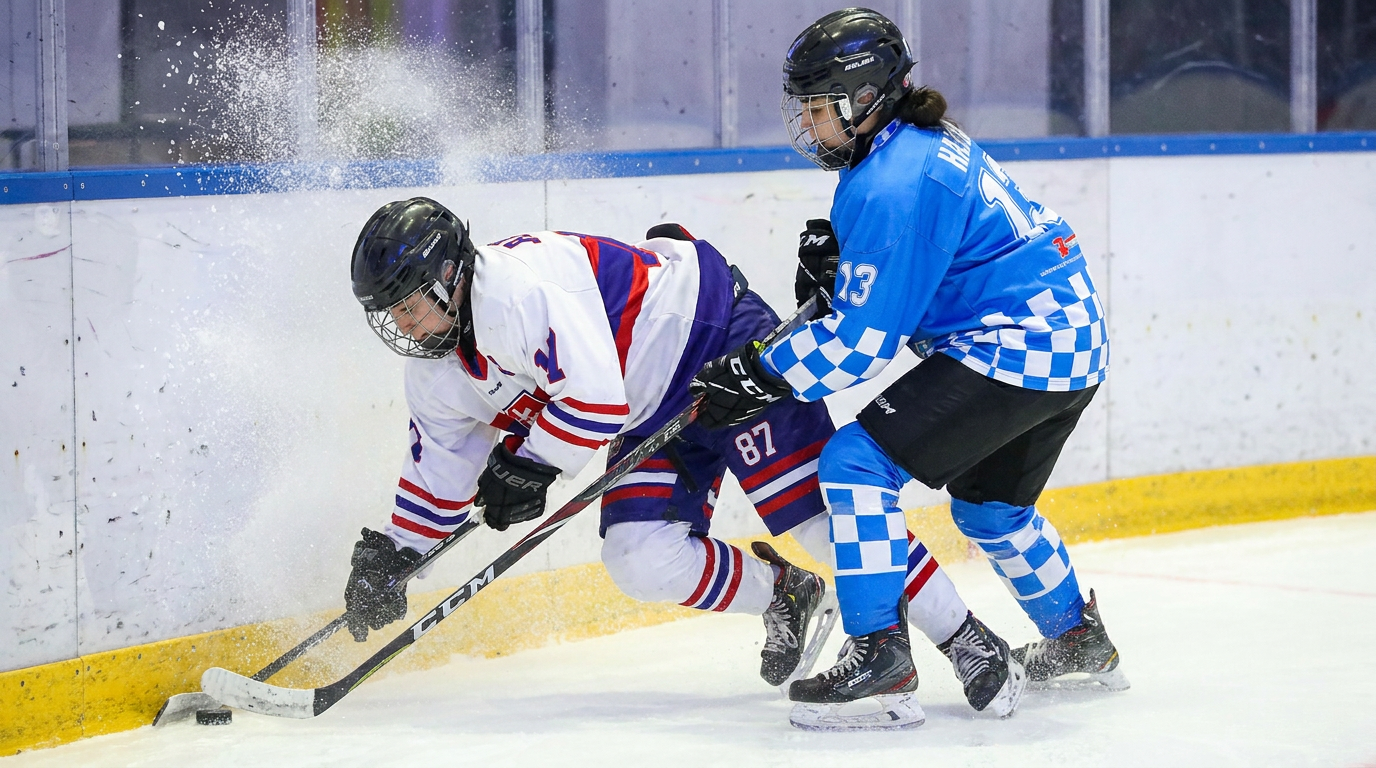
On the ice, the PWHL has also modernized physicality. Unlike traditional women's hockey, the league explicitly allows body checking when a player is making a clear play to gain possession of the puck.[6][8]
However, it pairs this increased physicality with strict safety mandates: any illegal check to the head results in an automatic major penalty and game misconduct, triggering a mandatory review by the central situation room.[1][2]

As the PWHL prepares to expand further, its rulebook is drawing intense scrutiny from the rest of the hockey world.[3]
How we got here
1992
The IIHF removes body checking from women's international hockey.
January 2024
The PWHL launches its inaugural season, introducing the Jailbreak rule and the 3-2-1-0 point system.
November 2024
The league implements the 'No Escape' rule for its second season to boost power-play scoring.
June 2026
The Vancouver Goldeneyes use the Gold Plan system to secure the first overall pick in the PWHL draft.
Viewpoints in depth
Progressive Analysts
Advocates for adopting PWHL rules in the NHL to increase scoring and excitement.
This camp argues that traditional hockey has become too stagnant, particularly during penalty kills and late-season games. They point to the PWHL's Jailbreak rule and Gold Plan as elegant solutions that naturally incentivize offensive effort and competitive integrity, urging the NHL to adopt them to attract younger fans.
Player Safety Advocates
Supporters of the PWHL's balance between physical play and strict head-contact penalties.
Safety advocates praise the league for reintroducing body checking to the women's game while simultaneously drawing a hard line on head injuries. By making any illegal check to the head an automatic major penalty and game misconduct, they believe the PWHL has created a safer blueprint for physical hockey than the NHL's current standard.
Hockey Traditionalists
Fans and executives cautious about altering the fundamental mechanics of the sport.
While many traditionalists appreciate the 3-2-1-0 standings system for rewarding regulation wins, they are hesitant about rules like the Jailbreak and No Escape. They argue that the NHL's penalty mechanics have worked for a century and that introducing 'gimmicks' could disrupt the historical balance between special teams.
What we don't know
- Whether the NHL or NCAA will officially adopt any of the PWHL's in-game mechanics.
- How the Gold Plan will scale as the PWHL continues to expand its number of franchises.
Key terms
- Jailbreak Goal
- A shorthanded goal that immediately terminates the offending team's minor penalty.
- No Escape Rule
- A regulation preventing line changes for the penalized team prior to the ensuing faceoff.
- Gold Plan
- A draft lottery alternative where eliminated teams compete for the first overall pick by accumulating points in their remaining games.
- 3-2-1-0 System
- A standings format that awards three points for a regulation win, heavily incentivizing teams to win before overtime.
- Shorthanded
- Playing with fewer skaters on the ice due to a penalty.
Frequently asked
What is the PWHL Jailbreak rule?
If a team scores a shorthanded goal while killing a minor penalty, the penalty immediately ends and the player is released from the box.
How does the Gold Plan stop tanking?
Draft order is determined by the most points earned after a team is mathematically eliminated from the playoffs, forcing teams to keep winning to get the first pick.
Is body checking allowed in the PWHL?
Yes, players can body check to separate an opponent from the puck, but open-ice hits and hits to the head are strictly penalized.
What is the No Escape rule?
Players on the ice when their team takes a penalty cannot change lines until after the ensuing faceoff, often forcing tired offensive players to defend the power play.
Sources
Source coverage
8 outlets
4 viewpoints surfaced








[1]PWHL OfficialPlayer Safety Advocates
PWHL Rulebook and Beginner's Guide
Read on PWHL Official →[2]CBC SportsAnti-Tanking Proponents
An attempt to jump-start scoring: A deeper look at the PWHL's new 'no escape' rule
Read on CBC Sports →[3]The Hockey WritersProgressive Analysts
The NHL Should Consider Adopting Some of the PWHL Rules
Read on The Hockey Writers →[4]The IX HockeyProgressive Analysts
The Impact of the No Escape Rule
Read on The IX Hockey →[5]PDub HockeyAnti-Tanking Proponents
The PWHL Gold Plan: How it Works, Pros and Cons, and the Numbers
Read on PDub Hockey →[6]FanSidedHockey Traditionalists
How are PWHL rules different from the NHL?
Read on FanSided →[7]WikipediaHockey Traditionalists
Professional Women's Hockey League
Read on Wikipedia →[8]Hockey IQPlayer Safety Advocates
The Future Of Body Contact In Women's Hockey
Read on Hockey IQ →
More in sports
See all 6 stories →Sports Tech
The End of Training Blind: How AR and AI are Rewiring Competitive Swimming
6 sources
Injury
Playing Through Pain: Alireza Firouzja Overcomes Ankle Injury to Shock Magnus Carlsen
6 sources
Standings
FIDE Circuit 2026-27 Standings: Abdusattorov Holds Narrow Lead as Sindarov Surges
6 sources
WNBA Records
Marina Mabrey Ties WNBA Record With 9 Three-Pointers in Historic Toronto Tempo Comeback
6 sources
Every angle. Every day.
Get sports stories with full source coverage and perspective breakdowns delivered to your inbox.