
The End of Training Blind: How AR and AI are Rewiring Competitive Swimming
For decades, swimmers have relied on the deck clock and their coach's eye for feedback. Now, augmented reality goggles and AI-powered biomechanical tracking are bringing real-time data directly into the water.
By Factlen Editorial Team
- Sports Technologists
- Advocates who believe real-time data and AI biomechanics are essential to shattering existing human performance limits.
- Traditional Coaches
- Veterans who value the new data but emphasize that 'feel for the water' and psychological rhythms cannot be quantified.
- Amateur Athletes
- Self-coached swimmers utilizing smart wearables to bridge the gap when they lack access to a dedicated on-deck coach.
What's not represented
- · FINA/World Aquatics Regulators
- · Sports Psychologists
Why this matters
By eliminating the feedback delay that has historically made swimming a data-poor sport, these technologies are democratizing elite-level training. Swimmers of all levels can now correct their stroke mechanics mid-lap, dramatically reducing injury risk and accelerating performance gains.
Key points
- Swimmers have historically lacked the real-time data feedback available to runners and cyclists.
- AR smart goggles now project pace, heart rate, and stroke rate directly into a swimmer's line of sight.
- AI pose estimation uses underwater cameras to segment strokes and identify biomechanical inefficiencies.
- Real-time data allows swimmers to correct fatigue-driven technique breakdowns mid-lap.
- While AI provides granular data, developers stress it is an assistant, not a replacement for human coaches.
There is a historical asymmetry in endurance sports. Runners have GPS watches that display their pace mid-stride, and cyclists have power meters mounted to their handlebars. Swimmers, however, have historically trained blind, checking their progress only when they touch the wall and glance at a deck clock.[1]
A swimmer's head is submerged, their vision obscured by splashing water, and their wrists are constantly in motion. This sensory deprivation has made swimming one of the most difficult sports to train with the kind of real-time data that has transformed running and cycling over the past decade.[1]
That era of information asymmetry is ending. A wave of augmented reality (AR) wearables and artificial intelligence platforms is rewiring how athletes interact with the water, bringing real-time biomechanical feedback directly into the pool.[6]

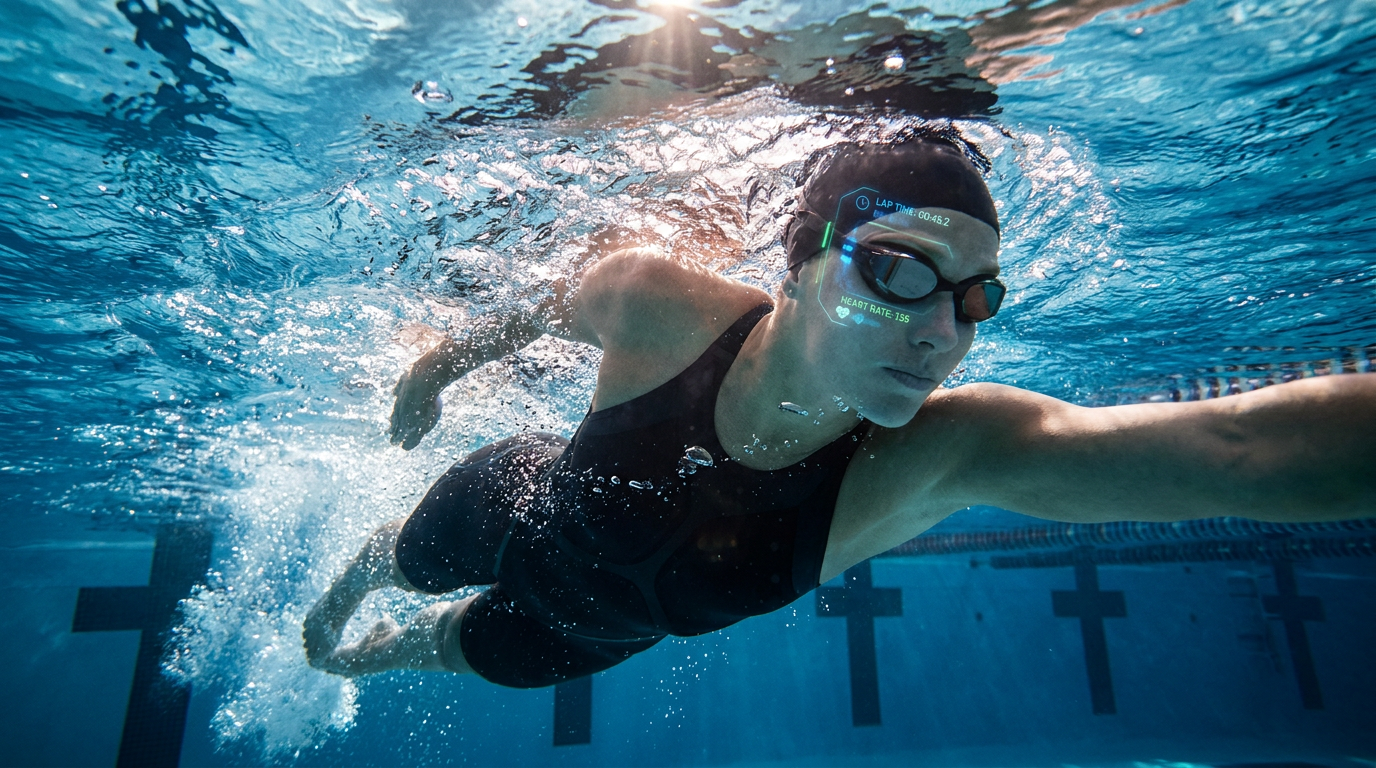
The most immediate paradigm shift comes from AR smart goggles. Devices like the FORM Smart Swim Goggles feature an integrated see-through display that projects metrics directly into the swimmer's line of sight without obstructing their view of the lane.[1][4]
Instead of waiting for a set to finish, swimmers can now see their pace, stroke rate, and heart rate during every length. This eliminates the feedback delay, enabling the same kind of real-time effort calibration that runners rely on to perfectly pace a marathon.[1]
Research in swimming science demonstrates that optimal stroke rate varies heavily by individual and event. Monitoring these metrics in real time allows swimmers to maintain technical discipline, catching fatigue-driven technique breakdowns before they become entrenched habits.[1]
But the technological revolution extends far beyond the swimmer's field of vision. On the pool deck, artificial intelligence is decoding the hidden rules of hydrodynamics through advanced pose estimation.[2]

In Malta, a comprehensive sports-tech initiative known as the DIVE project is capturing the full arc of what makes swimmers fast and efficient. Using accessible equipment like fixed underwater action cameras, researchers are feeding real-time motion data into learning algorithms.[2]
In Malta, a comprehensive sports-tech initiative known as the DIVE project is capturing the full arc of what makes swimmers fast and efficient.
The AI models go beyond simply identifying whether an athlete is swimming freestyle or breaststroke. They segment each stroke into its critical phases—the explosive start, the catch, the pull, the recovery, and the turn.[2]
By overlaying pose estimation data, the system analyzes the swimmer's technique in granular detail, from head alignment to hand entry angles. This allows coaches to identify micro-inefficiencies that the naked eye simply cannot catch in real-time.[2]
The data generated by these systems is vast, but it is often distilled into actionable metrics like SWOLF—a swimming efficiency score combining stroke count and time. If a swimmer reduces their stroke count while holding the same pace, their efficiency has objectively improved.[3][4]

Wearable sensors utilizing accelerometers and gyroscopes further track full-body kinematics and rotation. Small motion signals can identify lap patterns and stroke rhythm, providing a clear line of evidence that a technical adjustment is actually working.[4]
The impact on performance is highly measurable. Modern swim coaching that leverages sophisticated wearables and video analysis software can result in athletes improving specific skills two to three times faster than through traditional instruction alone.[3]
However, the real-world deployment of these technologies still faces physical and environmental hurdles. Waterproof sensor reliability remains a challenge, and integrating hardware smoothly into everyday training without creating hydrodynamic drag requires precise engineering.[4]
Furthermore, there is a consensus among researchers and developers that AI will never replace the human coach. The technology is designed as an intelligent assistant—an extra set of eyes that never blinks, but lacks human intuition.[2]

Coaches understand the emotional, psychological, and physical rhythms of each athlete. While an algorithm can flag a drop in stroke efficiency, a coach knows whether that drop is due to biomechanical failure or the lingering fatigue of a stressful week outside the pool.[2][6]
Yet, the democratization of this technology is undeniable. Electronic timing systems, digital management platforms, and wearable analytics are no longer reserved for Olympic training centers; they are increasingly deployed at the local club level.[5]
As the boundaries of human performance are continually pushed, swimming is no longer simply a contest of strength and endurance. It has become a showcase for materials science, digital analytics, and artificial intelligence, transforming the most traditional of sports into a laboratory of innovation.[5]
How we got here
Pre-2010s
Swimmers rely entirely on deck clocks and post-workout verbal feedback from coaches to gauge performance.
Mid-2010s
Waterproof fitness trackers emerge, but data is only accessible after the swim is completed.
2019
The first generation of AR smart swim goggles is introduced, projecting basic metrics into the swimmer's line of sight.
2024-2025
AI pose estimation projects begin using accessible underwater cameras to segment and analyze stroke biomechanics.
2026
Advanced AR goggles and AI coaching platforms become widely adopted at both the elite and amateur club levels.
Viewpoints in depth
Sports Technologists
Advocates for maximum data integration to push human limits.
This camp views the human body as an engine that can be optimized through continuous feedback loops. By eliminating the 'information asymmetry' that has historically plagued swimming, technologists argue that real-time AR displays and AI pose estimation will allow athletes to correct micro-inefficiencies mid-stroke. They believe that the next generation of world records will be broken not just by physical conditioning, but by algorithmic stroke optimization.
Traditional Coaches
Veterans who value intuition and 'feel for the water' alongside raw metrics.
While acknowledging the immense utility of AR and AI as diagnostic tools, traditionalists warn against 'paralysis by analysis.' They emphasize that swimming is highly sensory, and an over-reliance on projected metrics can distract an athlete from their natural rhythm. For this camp, technology is an assistant that flags fatigue or biomechanical drift, but it can never replace the intuitive eye of a coach who understands the psychological toll of a grueling training block.
Amateur Athletes
Self-coached swimmers utilizing tech to bridge the coaching gap.
For the millions of recreational and masters-level swimmers without access to a dedicated deck coach, AR goggles and AI apps act as a virtual mentor. This perspective celebrates the democratization of elite sports science. Instead of swimming 'blind' and guessing their pace, amateurs can now execute highly structured, data-driven interval workouts that were previously impossible without a professional support team.
What we don't know
- How the long-term reliance on AR pacing might affect a swimmer's natural, intuitive 'feel' for the water during unassisted races.
- Whether international governing bodies will eventually regulate or ban certain real-time feedback wearables in sanctioned competitions.
Key terms
- SWOLF
- A measure of swimming efficiency calculated by adding the time it takes to swim a pool length to the number of strokes taken.
- Pose Estimation
- An AI technique that detects and tracks the position of human joints in video footage to analyze biomechanics.
- Kinematics
- The branch of mechanics that describes the motion of points, bodies, and systems without considering the forces that cause them.
- Augmented Reality (AR)
- Technology that superimposes a computer-generated image or data onto a user's view of the real world.
Frequently asked
What is a SWOLF score in swimming?
SWOLF is a measure of swimming efficiency calculated by adding the time it takes to swim a pool length to the number of strokes taken. A lower score indicates greater efficiency.
How do AR swim goggles work underwater?
AR goggles feature an integrated see-through display that projects real-time metrics like pace and heart rate directly into the swimmer's line of sight, eliminating the need to look at a wall clock.
Can artificial intelligence replace a human swim coach?
No. Researchers and developers emphasize that AI acts as an intelligent assistant to flag biomechanical inefficiencies, but it cannot replace a coach's understanding of an athlete's emotional and psychological state.
Is this technology only for Olympic athletes?
While pioneered by elites, smart goggles and AI video analysis software are increasingly accessible and are now regularly deployed by self-coached amateurs and local swim clubs.
Sources
Source coverage
6 outlets
3 viewpoints surfaced






[1]Healthcare Discovery AISports Technologists
FORM Smart Swim Goggles: Heads-Up Display for Real-Time Swim Performance
Read on Healthcare Discovery AI →[2]Think MagazineTraditional Coaches
Diving In: How AI is decoding the biomechanics of swimming
Read on Think Magazine →[3]Inspired SwimAmateur Athletes
The Impact of Wearable Swim Technology on Modern Coaching
Read on Inspired Swim →[4]HoloSportSports Technologists
Making Data Accessible in the Water: AR, AI, and Headphones
Read on HoloSport →[5]Marks & ClerkAmateur Athletes
Technology and innovation in modern swimming
Read on Marks & Clerk →[6]Factlen Editorial TeamTraditional Coaches
Synthesis by Factlen editorial team
Read on Factlen Editorial Team →

Every angle. Every day.
Get sports stories with full source coverage and perspective breakdowns delivered to your inbox.