
Smart vs. Traditional Bassinets: The 2026 Trade-Off Analysis for New Parents
As smart bassinets become a registry staple, pediatric experts and parents weigh the benefits of automated soothing against the risks of sleep crutches and high price tags.
By Factlen Editorial Team
- Sleep Technologists
- Advocates for using responsive automation to maximize parental sleep and prevent rolling during the newborn phase.
- Pediatric Sleep Consultants
- Warns against over-reliance on mechanical soothing, emphasizing the need for babies to learn independent sleep skills.
- Practical Traditionalists
- Prioritizes budget, bedside ergonomics, and simple, firm sleep surfaces without the complication of apps or motors.
- Clinical Researchers
- Focuses on physiological data, comparing the efficacy of mechanical rocking against human touch and heart rate variability.
What's not represented
- · Pediatric Physical Therapists
- · Second-Time Parents
Why this matters
For new parents, sleep deprivation is a genuine health risk that impacts everything from postpartum recovery to family stability. Deciding whether to spend $1,500 on a robotic bassinet or $200 on a traditional sleeper dictates not only a family's budget, but how they will navigate the grueling first six months of their child's life.
Key points
- Smart bassinets use microphones and motors to automatically soothe crying babies back to sleep.
- Traditional bassinets offer superior bedside ergonomics, including drop-down sides for C-section recovery.
- Clinical studies show smart bassinets can add up to two hours of uninterrupted nighttime sleep.
- Pediatric sleep consultants warn that mechanical rocking can become a sleep crutch.
- Smart bassinets cost upwards of $1,000, while traditional models average $100 to $300.
- Rental programs have made smart bassinets more accessible at roughly $159 per month.
When preparing for a newborn, few decisions carry as much weight—or as much financial anxiety—as choosing a sleep space. In 2026, the baby gear market is dominated by a high-stakes question: should parents invest in a high-tech smart bassinet, or stick to a reliable, traditional bedside sleeper? For exhausted new parents, the promise of a robotic night nurse is incredibly alluring, but pediatric experts and budget-conscious families are increasingly debating the long-term value of the technology.[1][2]
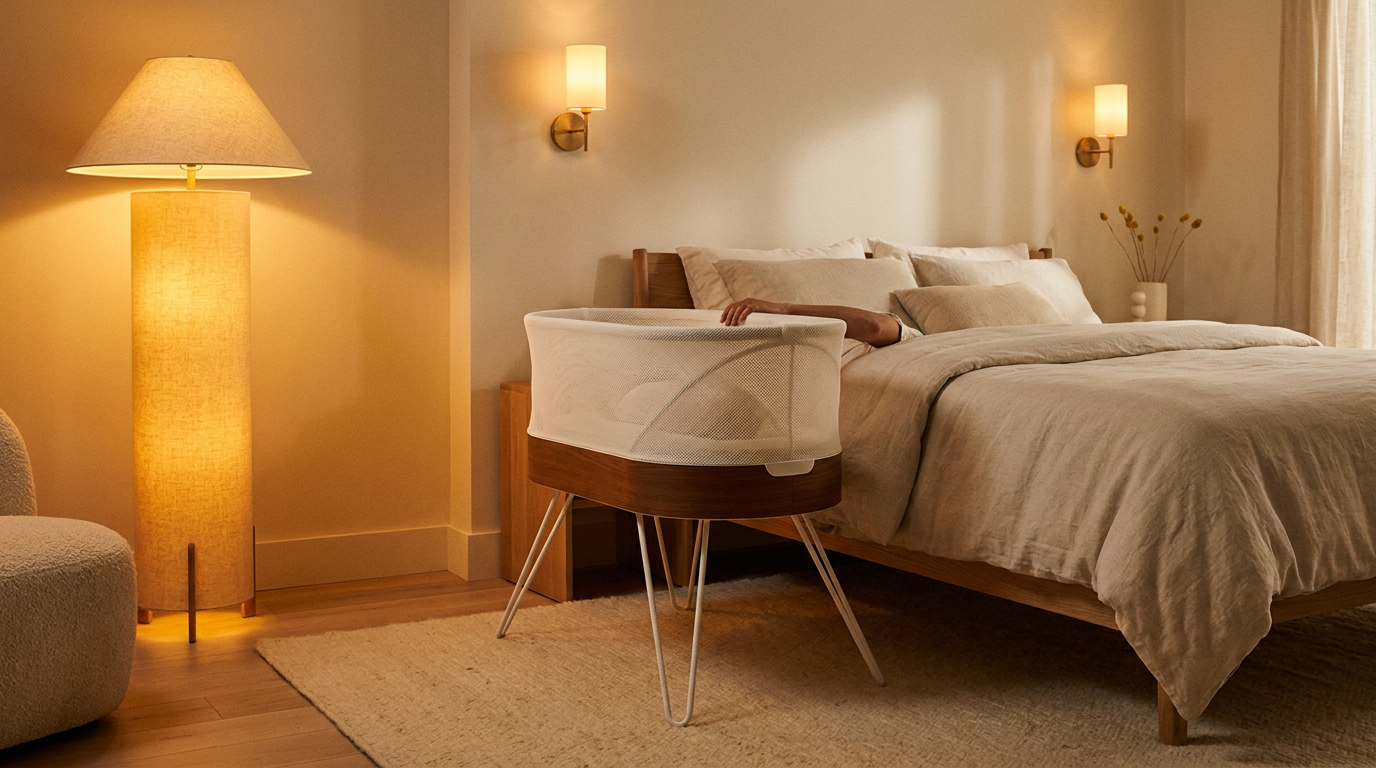
The contenders fall into two distinct categories. Traditional bassinets, such as the Halo BassiNest or Newton Baby Essential, are manual, stationary beds designed to provide a safe, flat, and breathable sleep surface. Smart bassinets, pioneered by the Happiest Baby SNOO and joined by newer models like the Cradlewise and Maxi-Cosi Starling, incorporate microphones, motors, and Wi-Fi to automatically detect a baby's cries and respond with escalating rocking motions and white noise.[1][2][7]
When evaluating automated soothing, the case for smart bassinets centers on parental sleep recovery. Proponents describe the technology as an "extra set of hands" during the grueling fourth trimester. By mimicking the continuous motion and sound of the womb, these devices can often soothe a fussing infant back to sleep without requiring the parent to get out of bed, preserving crucial maternal mental health during the most demanding weeks of early parenthood.[6][7]
The case against automated soothing focuses heavily on the development of sleep crutches. Pediatric sleep consultants warn that while robotic rocking provides short-term relief, it prevents infants from learning how to connect their sleep cycles independently. When a baby inevitably outgrows the smart bassinet around five or six months of age, parents frequently face a difficult transition period, as the child must suddenly learn to sleep in a stationary crib without their accustomed mechanical intervention.[3][4]

The clinical evidence on sleep duration quantifies this divide. Studies published by the National Institutes of Health show that responsive smart bassinets successfully induce a calming response, adding between 42 minutes and two hours to an infant's longest uninterrupted nighttime sleep period. However, the same research notes that hands-on parental soothing actually produces higher heart rate variability in the infant, indicating a deeper, more natural physiological calming effect than mechanical rocking.[5]
When examining bedside ergonomics, the case for traditional bassinets heavily favors physical accessibility. Models like the Halo BassiNest feature 360-degree swivels and drop-down side walls. For mothers recovering from C-sections or dealing with postpartum mobility issues, the ability to effortlessly pull the baby onto the adult bed for nighttime feeding is a massive ergonomic advantage over rigid, high-walled smart cribs.[1][8]
When examining bedside ergonomics, the case for traditional bassinets heavily favors physical accessibility.
The case against traditional bassinets is that the parent remains the sole engine of soothing. If a baby wakes at 3:00 AM needing a gentle sway to settle back down, the caregiver must physically lean over the bed to manually rock the basket or lift the infant entirely. This manual intervention fully wakes the parent, fracturing their own sleep architecture and exacerbating daytime exhaustion.[6]
The evidence regarding sleep safety presents a complex picture for both categories. Smart bassinets like the SNOO utilize proprietary built-in swaddles that clip into the mattress, physically preventing the infant from rolling onto their stomach—a feature that provides immense peace of mind regarding SIDS risks. However, the American Academy of Pediatrics recommends dropping all swaddles at eight weeks of age, creating friction for parents who rely on a smart bassinet's restrictive sack for months three through six. Meanwhile, traditional models focus on safety through simplicity, utilizing highly breathable mattresses without the complication of straps or motors.[4][8]

When weighing the financial investment versus usable lifespan, the case for traditional bassinets is overwhelmingly economic. High-quality manual options cost between $100 and $300, making them an accessible, low-risk choice for a piece of furniture that a baby will definitively outgrow in less than half a year.[1][2]
The case against the smart bassinet price tag is steep, with premium models ranging from $1,000 to $1,700. However, the evidence shows that the consumer market is actively adapting to this barrier. Rental programs now offer flagship smart bassinets for approximately $159 per month. For families who only need the device for a four-month window, renting alters the math significantly, transforming a luxury purchase into a manageable monthly utility bill.[3][7]
Ultimately, choosing between a smart and traditional bassinet comes down to a family's specific support system, budget, and medical needs. There is no universal winner in the nursery, only the right tool for a specific set of conditions.[1][2]

A smart bassinet fits well when parents lack a nighttime support system or family help, when maternal mental health is heavily impacted by severe sleep deprivation, or when families have the budget to rent a device for a few short months. It does not fit well when parents are highly anxious about digital privacy and Wi-Fi in the nursery, when they prefer hands-on settling, or when they want to avoid the hurdle of weaning a baby off mechanical motion later on.[3][6]
Conversely, a traditional bassinet fits well when a mother is recovering from a C-section and requires a drop-down side for easy access, when the family is on a strict budget, or when parents plan to transition the baby to a standard crib early to build independent sleep habits. It does not fit well when caregivers are facing dangerous levels of exhaustion, have a highly fussy infant who startles easily, and desperately need an automated intervention to secure an extra hour of uninterrupted rest.[1][4]
How we got here
2016
The SNOO Smart Sleeper launches, introducing the concept of the robotic, auto-responsive bassinet to the consumer market.
2020
Clinical studies begin quantifying the impact of responsive bassinets, noting an average reduction of one night waking per infant.
2022
The American Academy of Pediatrics updates safe sleep guidelines, emphasizing the removal of swaddles at eight weeks.
2025
Competitors like Cradlewise and Maxi-Cosi expand the smart bassinet market with AI cry-detection and longer-lasting crib conversions.
Viewpoints in depth
Sleep Technologists
Advocates for using responsive automation to maximize parental sleep.
This camp views the newborn phase as a survival period where parental sleep deprivation poses a genuine health risk. They argue that smart bassinets act as a necessary 'extra set of hands,' safely mimicking the womb's motion and sound to keep babies asleep longer. For these advocates, the technology is a justifiable investment in maternal mental health and family stability.
Pediatric Sleep Consultants
Warns against over-reliance on mechanical soothing.
Sleep experts focus on long-term developmental habits rather than short-term parental relief. They caution that while a robotic bassinet might buy an extra hour of sleep at two months old, it often creates a severe 'sleep crutch.' When the baby inevitably outgrows the bassinet at six months, parents frequently face a grueling transition period because the child never learned to self-soothe in a stationary environment.
Practical Traditionalists
Prioritizes budget, bedside ergonomics, and simple sleep surfaces.
This perspective argues that the fundamentals of infant sleep do not require a Wi-Fi connection. They highlight that traditional bassinets offer superior physical ergonomics—such as 360-degree swivels and drop-down sides—which are crucial for mothers recovering from abdominal surgery. They view the $1,500 price tag of smart models as an unnecessary luxury for a piece of furniture that becomes obsolete in less than half a year.
What we don't know
- Whether long-term reliance on AI-driven sleep technology impacts a child's natural self-soothing development in the toddler years.
- How upcoming regulatory changes regarding digital privacy might affect bassinets equipped with Wi-Fi and microphones.
Key terms
- Smart Bassinet
- An infant bed equipped with microphones, motors, and Wi-Fi that automatically responds to a baby's cries with escalating motion and white noise.
- Traditional Bassinet
- A manual, stationary infant bed designed for safe, flat sleep, often featuring mesh sides and adjustable heights for bedside access.
- Sleep Crutch
- An external dependency, such as rocking or feeding, that a baby relies on to fall asleep and stay asleep.
- Heart Rate Variability (HRV)
- A physiological metric used in clinical studies to measure how deeply an infant is calmed by different soothing methods.
Frequently asked
Do smart bassinets actually help babies sleep longer?
Yes. Clinical studies indicate that responsive bassinets can add between 42 minutes and two hours to a newborn's longest uninterrupted sleep period by automatically soothing them when they stir.
Are smart bassinets safe for newborns?
Yes, they meet standard safety requirements for a firm, flat sleep surface. However, pediatricians caution parents about using built-in swaddles past eight weeks of age, as it conflicts with standard rolling guidelines.
Can I rent a smart bassinet instead of buying one?
Yes. Because babies outgrow bassinets in five to six months, many manufacturers now offer rental programs averaging $159 per month, making the technology more accessible.
Why do sleep consultants warn against smart bassinets?
Experts note that constant mechanical rocking can become a sleep crutch. Babies may struggle to transition to a stationary crib at four to six months because they haven't learned to connect sleep cycles independently.
Sources
Source coverage
8 outlets
4 viewpoints surfaced








[1]BabylistPractical Traditionalists
Choosing the Best Bassinet: Smart vs. Traditional
Read on Babylist →[2]ForbesSleep Technologists
Best Bassinets Of 2026: Smart And Traditional Picks
Read on Forbes →[3]Snooze CluesPediatric Sleep Consultants
Is the SNOO Bassinet Worth It? A Sleep Consultant's Review
Read on Snooze Clues →[4]Sleepwise ConsultingPediatric Sleep Consultants
The SNOO: A Pediatric Sleep Expert's Honest Review
Read on Sleepwise Consulting →[5]National Institutes of HealthClinical Researchers
Infant Crying and the Calming Response: Mechanical Soothing vs. Parental Soothing
Read on National Institutes of Health →[6]MaydollySleep Technologists
Are Smart Bassinets Worth It for Baby Sleep?
Read on Maydolly →[7]Macklem'sSleep Technologists
Maxi-Cosi Starling Smart Bassinet Review 2026
Read on Macklem's →[8]BabyRestPractical Traditionalists
Smart vs. Traditional Bassinets: Where the Mattress Matters Most
Read on BabyRest →
Every angle. Every day.
Get shopping stories with full source coverage and perspective breakdowns delivered to your inbox.