
The Rise of Build-to-Rent: Why the American Dream is Shifting from Owning to Leasing
As homeownership remains financially out of reach for many, purpose-built single-family rental communities are offering a compelling alternative that combines the privacy of a house with the perks of a luxury apartment.
By Factlen Editorial Team
- Renters & Lifestyle Advocates
- Values the flexibility, space, and maintenance-free living that purpose-built rentals provide without the burden of a mortgage.
- Institutional Investors & Developers
- Views the sector as a highly stable, long-term asset class driven by undeniable demographic shifts and housing shortages.
- Housing Market Analysts
- Monitors the macroeconomic impact of the trend, noting the stabilization of rents and the shift in pricing power.
What's not represented
- · First-time homebuyers competing for land
- · Local zoning boards managing suburban sprawl
Why this matters
With high interest rates and soaring property values locking millions out of the housing market, Build-to-Rent communities offer a high-quality, dignified alternative. Understanding this trend empowers renters to find housing that provides the space and privacy of a house without the financial trap of a mortgage.
Key points
- Build-to-Rent (BTR) communities offer single-family homes designed exclusively for long-term leasing.
- These neighborhoods feature private yards and garages alongside luxury apartment amenities like pools and gyms.
- BTR developments now account for 7.2% of all single-family housing starts in the United States.
- The model appeals to Millennials and Gen Z seeking space and flexibility without the financial burden of a mortgage.
- Occupancy rates remain high at 95%, though rent growth has stabilized as the market matures.
The traditional American Dream—anchored by a white picket fence, a two-car garage, and a 30-year fixed-rate mortgage—is undergoing a profound transformation. For decades, homeownership was the undisputed benchmark of financial arrival. However, a punishing combination of elevated interest rates, soaring property values, and a chronic shortage of entry-level housing has effectively locked millions of prospective buyers out of the market. Yet, the desire for the space and privacy that a single-family home provides has not diminished. Instead of abandoning their ideal living situation, a growing demographic of Americans is simply changing how they finance it, shifting their focus from purchasing to leasing. This structural shift in consumer behavior has given rise to one of the most dynamic and rapidly expanding sectors in the modern real estate landscape.[8]
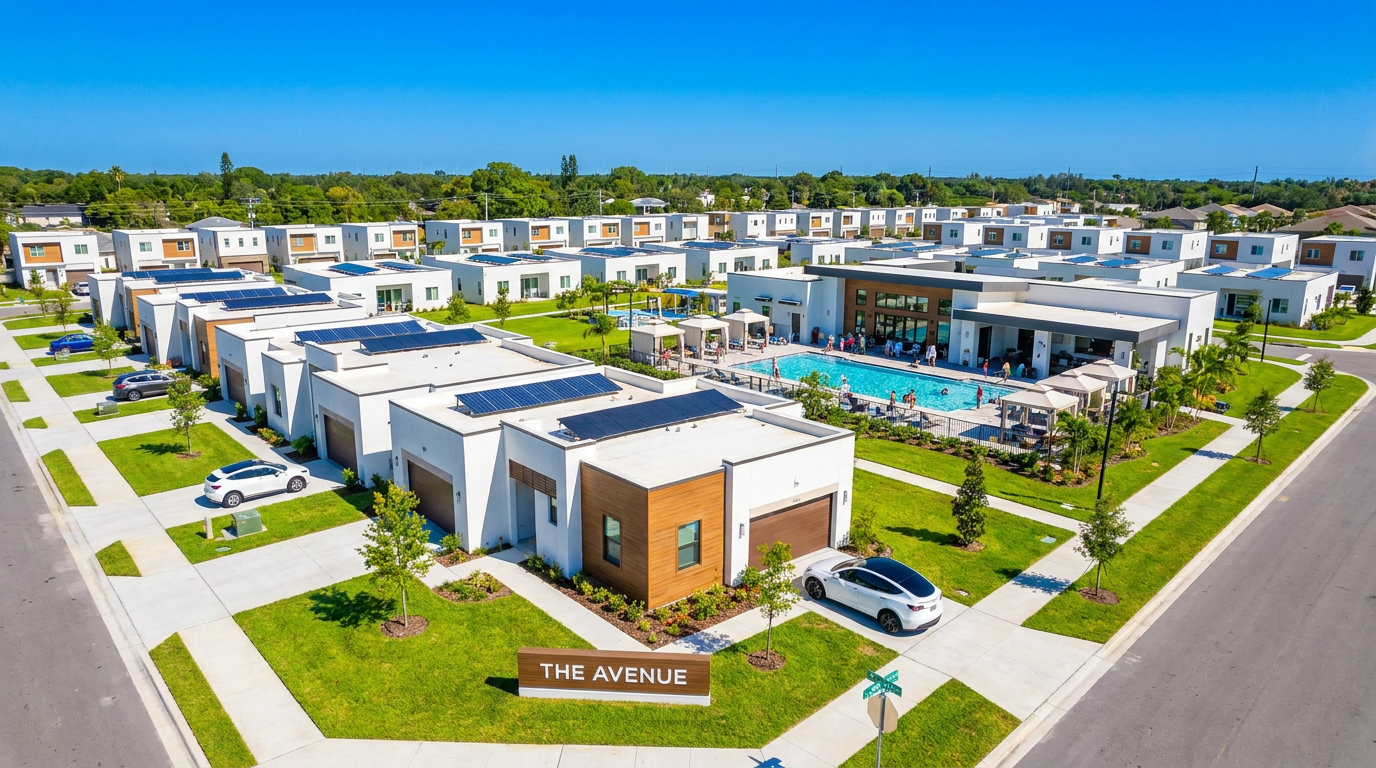
Enter the "Build-to-Rent" (BTR) community, a housing model that is fundamentally bridging the gap between the flexibility of an apartment and the footprint of a traditional house. In a BTR development, entire neighborhoods of single-family homes are constructed exclusively for long-term leasing rather than for individual sale. Unlike the scattered, one-off rental houses historically managed by mom-and-pop landlords, these communities are master-planned from the ground up by institutional developers. They offer residents the privacy of detached walls, private backyards, and personal garages, all while maintaining the unified, professionally managed structure of a luxury apartment complex. It is a hybrid approach that strips away the financial liabilities of homeownership while preserving its most coveted lifestyle benefits.[8]
The scale of the Build-to-Rent boom is staggering, transitioning rapidly from a niche real estate experiment to a core component of the national housing supply. According to data from Arbor Realty Trust and Chandan Economics, BTR developments accounted for a remarkable 7.2 percent of all single-family housing starts in the United States by late 2025. This represents a significant elevation from historical norms, where purpose-built rentals rarely eclipsed the 6 percent mark before the post-pandemic housing squeeze. Developers have recognized that purpose-built rental communities are efficiently absorbing the immense demand from households seeking suburban space without the crushing financial commitment of a down payment.[2]
The construction pipeline reflects a massive influx of institutional capital betting on the long-term viability of this model. Industry analysis from Matthews Real Estate Investment Services indicates that more than 64,000 Build-to-Rent homes are currently under construction nationwide, with deliveries scheduled to roll out through late 2027. Furthermore, an additional 139,000 units remain in various planning and pre-development stages. While the broader single-family construction market has faced headwinds from legislative uncertainties and fluctuating material costs, the BTR sector continues to push forward, meaningfully adding to the rental housing supply in high-growth regions where traditional multifamily apartment development has begun to slow.[1]

What exactly makes a Build-to-Rent neighborhood so appealing to the modern renter? The answer lies in the meticulous, tenant-first design of the communities. Because the developers intend to hold and manage the properties for decades, the homes are built with durability and modern aesthetics in mind. Tenants step into brand-new constructions featuring open-concept floor plans, sleek modern kitchens, and ample storage space. More importantly, they offer a blank slate for families to settle into without the anxiety of a private landlord suddenly deciding to sell the property out from under them, providing a level of housing stability that traditional single-family rentals often lack.[6]
Beyond the four walls of the house, BTR communities differentiate themselves by offering resort-style amenities that rival high-end urban apartment buildings. NewHomeSource highlights that these neighborhoods are frequently equipped with community swimming pools, state-of-the-art fitness centers, co-working spaces, and dedicated dog parks. For a family or a remote worker, this setup is highly attractive: they gain the quiet and space of a suburban street, but they do not have to sacrifice the social infrastructure and convenience that typically make apartment living so appealing. It is a curated lifestyle package that is entirely maintained by on-site professional property management.[6][7]
The demographic engine driving this trend is primarily composed of Millennials and older Generation Z cohorts who are entering their prime family-forming years. Market research from Accio emphasizes that these generations are facing a unique set of economic pressures. They require more square footage than a dense urban apartment can provide—especially as remote and hybrid work models remain entrenched in the corporate landscape—but they are confronting the worst housing affordability crisis in a generation. For many, a BTR community is not just a fallback option; it is the most logical and comfortable way to accommodate a growing family or a home office requirement.[3]
The demographic engine driving this trend is primarily composed of Millennials and older Generation Z cohorts who are entering their prime family-forming years.
However, affordability is not the only catalyst; there is a distinct cultural shift toward valuing flexibility over permanence. Accio notes that modern renters increasingly prefer the mobility that a lease provides. Whether they anticipate a career relocation, a change in family size, or simply do not want to be geographically tethered to one city for a decade, renting offers an exit strategy that a mortgage does not. The Build-to-Rent model caters perfectly to this desire for a "lock-and-leave" lifestyle, allowing residents to enjoy the perks of a suburban home while retaining the freedom to pack up and move when their lease expires.[3][8]

The financial mechanics of living in a BTR community also eliminate the hidden, often crippling costs associated with traditional homeownership. As Renters Warehouse points out, residents in these purpose-built communities are entirely shielded from property taxes, homeowners association (HOA) fees, and the unpredictable expenses of home maintenance. If an HVAC system fails in the middle of summer, or a roof develops a leak, the financial burden and the logistical headache of fixing it fall squarely on the institutional property manager, not the tenant. This predictability in monthly housing costs is a massive draw for budget-conscious families.[7]
Energy efficiency serves as another major financial and environmental benefit for BTR tenants. Because these homes are brand-new constructions, they are built to contemporary environmental standards that older, scattered-site rental homes simply cannot match. According to NewHomeSource, BTR properties are typically outfitted with superior insulation, double-glazed windows, and Energy Star-certified appliances. These green-friendly integrations translate directly into significantly lower monthly utility bills for the renter, while also appealing to a younger demographic that prioritizes sustainable living and reducing their overall carbon footprint.[6]
From an industry perspective, the Build-to-Rent sector is currently transitioning from a phase of explosive, unchecked growth into a period of healthy maturation and stabilization. The National Apartment Association (NAA) reports that while the market fundamentals remain incredibly stable, the dynamics of growth are moderating. The initial frenzy of the early 2020s has given way to a more recalibrated market, shaped by affordability constraints and a maturing development pipeline. Investors are no longer relying on skyrocketing rent increases to generate returns; instead, they are focusing on long-term, income-oriented stability.[5]
Despite the massive influx of new supply hitting the market, tenant demand has proven remarkably resilient. Data from AFIRE indicates that national occupancy rates for Build-to-Rent communities remain exceptionally strong, hovering around 95 percent. This high occupancy rate demonstrates that the market is successfully absorbing the wave of new construction. The relative oversupply of homes has been largely concentrated in a handful of Sun Belt metro areas that experienced abnormal pandemic-era population booms, but the broader national market remains fundamentally sound with robust long-term demand drivers.[4]

While demand is holding steady, the pricing power of landlords has undeniably peaked. The NAA observes that operators are encountering increasing resistance to further rent hikes, signaling that the market has reached an affordability ceiling. To maintain high occupancy rates and keep leasing velocity strong, property managers are increasingly relying on concessions—such as offering one month of free rent or waiving administrative fees. This dynamic has effectively suppressed nominal rent growth, creating a more favorable and balanced negotiating environment for prospective tenants signing new leases.[5]
As the sector matures, the competitive landscape behind the scenes is tightening. Matthews Real Estate highlights a clear trend of consolidation at the top of the market. While hundreds of developers have active projects, pipeline activity is increasingly concentrated among a small number of dominant, well-capitalized operators like Empire Group and Taylor Morrison. These larger institutional platforms are better equipped to secure premium land sites, finance massive developments, and navigate the complexities of tighter capital markets, ensuring that the BTR communities of the future will be managed by highly professionalized corporate entities.[1]

Ultimately, the rise of Build-to-Rent is reshaping the American housing landscape by offering a dignified, high-quality alternative to the binary choice of a cramped apartment or an unaffordable mortgage. It acknowledges the reality that homeownership is no longer the only valid path to a comfortable, secure, and community-oriented life. By providing professionally managed, amenity-rich homes that cater to the evolving needs of modern families and remote workers, the BTR sector is empowering a new generation of renters to live on their own terms, proving that the American Dream doesn't have to be owned—it can be leased.[8]
How we got here
2012
The UK government introduces the Montague Review, sparking early institutional interest in purpose-built rentals globally.
2020–2022
Pandemic-driven demand for suburban space accelerates BTR development as remote work becomes mainstream.
2024
The BTR construction pipeline hits an all-time high of 92,000 rolling annual starts.
2025–2026
The market stabilizes with high occupancy, though rent growth cools as operators use concessions to maintain leasing velocity.
Viewpoints in depth
Renters & Lifestyle Advocates
Values the flexibility, space, and maintenance-free living that purpose-built rentals provide.
For this demographic, the traditional American Dream of homeownership has been replaced by a desire for flexibility and convenience. They argue that being tied to a 30-year mortgage limits career mobility and drains savings through unpredictable maintenance costs. By choosing BTR communities, they gain the lifestyle benefits of a suburban home—such as a backyard for a dog and a quiet office for remote work—without sacrificing the professional management and resort-style amenities typically found in luxury apartments.
Institutional Investors & Developers
Views the sector as a highly stable, long-term asset class driven by undeniable demographic shifts.
Capital allocators and developers see BTR as a structural evolution in real estate rather than a passing fad. They point to the chronic national housing shortage and the massive wave of Millennials entering family-forming years as permanent demand drivers. While the initial frenzy of development has cooled, these stakeholders argue that the sector's 95% occupancy rates prove its resilience. They are increasingly focused on consolidating operations and achieving economies of scale to weather tighter capital markets.
Housing Market Analysts
Monitors the macroeconomic impact of the trend, noting the stabilization of rents and the shift in pricing power.
Market researchers take a data-driven view of the BTR boom, emphasizing that the sector is currently entering a phase of healthy maturation. They highlight that while demand remains robust, the pricing power has shifted slightly back to the consumer. Analysts note that the influx of new supply has forced operators to rely on concessions to maintain leasing velocity, effectively capping rent growth. They view this stabilization as a positive sign that the market is finding an equilibrium after years of rapid expansion.
What we don't know
- How the long-term maintenance costs of aging BTR communities will impact institutional investor yields over the next decade.
- Whether future legislative changes or zoning restrictions will limit the expansion of BTR developments in highly sought-after suburban markets.
Key terms
- Build-to-Rent (BTR)
- Entire communities of single-family homes constructed specifically for long-term leasing rather than individual sale.
- Single-Family Rental (SFR)
- A standalone, detached residential property that is rented out, which can include both scattered older homes and new BTR units.
- Concessions
- Incentives offered by landlords, such as a month of free rent or waived fees, to attract and retain tenants without lowering the official rental rate.
- Institutional Investor
- Large-scale financial organizations or corporate entities that pool capital to fund and manage massive real estate developments.
Frequently asked
What is the difference between BTR and a regular rental house?
BTR homes are brand-new, located in master-planned communities with apartment-style amenities, and managed by professional corporate entities rather than individual mom-and-pop landlords.
Are Build-to-Rent homes more expensive than apartments?
They typically command a premium over standard apartments due to the increased square footage, private yards, and detached privacy, but they eliminate the hidden costs of homeownership.
Do BTR communities allow pets?
Yes, most BTR communities are highly pet-friendly, often featuring built-in dog parks and private fenced backyards that make them ideal for pet owners.
Who actually owns these communities?
They are owned by large institutional investors, real estate investment trusts (REITs), and corporate developers who hold and manage the entire neighborhood as a single asset.
Sources
Source coverage
8 outlets
3 viewpoints surfaced








[1]Matthews Real Estate Investment ServicesInstitutional Investors & Developers
The Build-to-Rent Sector: Consolidation and Market Impact in 2026
Read on Matthews Real Estate Investment Services →[2]Arbor Realty TrustInstitutional Investors & Developers
SFR/BTR Construction Activity Normalizes Amid Robust Demand
Read on Arbor Realty Trust →[3]AccioHousing Market Analysts
Build-to-Rent Market Overview: Scale, Growth, and Demand Drivers
Read on Accio →[4]AFIREInstitutional Investors & Developers
Reshaping the Landscape: Market Fundamentals and Outlook for BTR
Read on AFIRE →[5]National Apartment AssociationHousing Market Analysts
Demand Is Holding, but Pricing Power Has Peaked in the BTR Sector
Read on National Apartment Association →[6]NewHomeSourceRenters & Lifestyle Advocates
8 Key Benefits of Buying a Brand-New Home as Your Rental Property
Read on NewHomeSource →[7]Renters WarehouseInstitutional Investors & Developers
Benefits of Build-to-Rent SFR Investments for Investors and Renters
Read on Renters Warehouse →[8]Factlen Editorial TeamRenters & Lifestyle Advocates
Synthesis by Factlen editorial team
Read on Factlen Editorial Team →
Every angle. Every day.
Get real estate stories with full source coverage and perspective breakdowns delivered to your inbox.