
The Science of Dealcoholized Wine: How Technology is Saving the Zero-Proof Pour
As the non-alcoholic wine market surges past $2.5 billion, winemakers are deploying advanced technologies like spinning cone columns and reverse osmosis to remove alcohol without destroying complex flavors.
By Factlen Editorial Team
- Beverage Technologists
- Focus on the engineering challenge of removing ethanol while preserving volatile aroma compounds.
- Market Analysts
- Track the commercial surge, noting that NA wine is capturing volume lost by traditional alcohol sales.
- Traditional Vintners
- Emphasize that quality NA wine must start with premium fermented grapes and traditional winemaking before extraction.
What's not represented
- · Small-scale independent winemakers who cannot afford multi-million dollar dealcoholization equipment.
- · Sommeliers and fine-dining beverage directors tasked with pairing zero-proof wines with tasting menus.
Why this matters
With global alcohol consumption declining and consumers increasingly seeking healthier options, mastering the science of zero-proof wine is becoming crucial for the traditional beverage industry's survival. These technological leaps mean consumers no longer have to choose between their wellness goals and the culinary ritual of a great glass of wine.
Key points
- The global non-alcoholic wine market is projected to reach $5.3 billion by 2033, driven by health-conscious consumers.
- Premium zero-proof wines begin as fully fermented traditional wines before undergoing mechanical dealcoholization.
- Vacuum distillation lowers the boiling point of alcohol to roughly 35°C, preventing the wine's flavors from cooking.
- Advanced spinning cone columns use a two-pass system to extract delicate aroma compounds before removing the alcohol.
- Winemakers restore the lost mouthfeel of ethanol by blending in specialized tannins and yeast-derived mannoproteins.
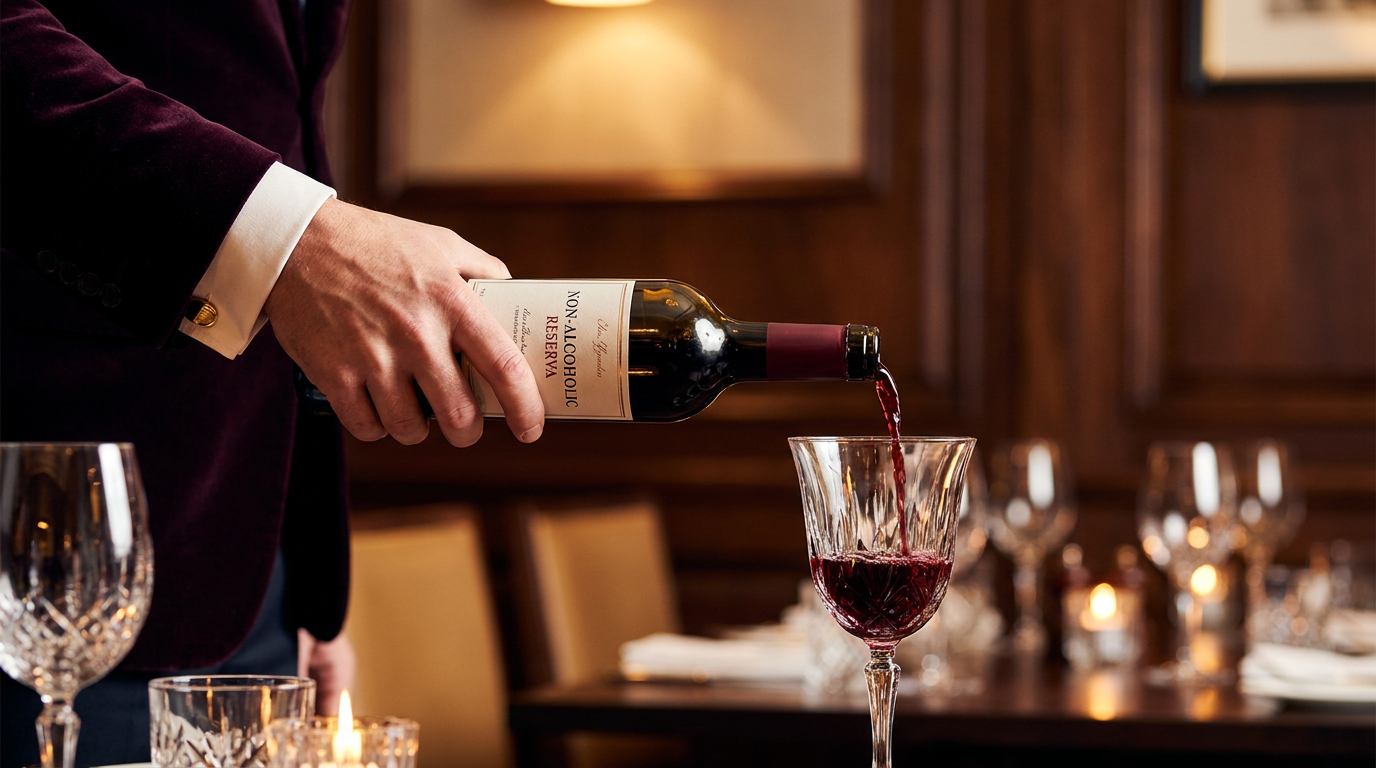
For decades, the non-alcoholic wine section was a dusty afterthought, populated by bottles that tasted more like overly sweet grape juice than sophisticated adult beverages. But as the sober-curious movement transitions from a temporary "Dry January" challenge into a permanent lifestyle shift, the dinner table is changing. Today, zero-proof wine is no longer a compromise—it is one of the most impressive feats of modern food science, relying on space-age technology to separate alcohol from flavor.[6]
The commercial stakes for mastering this science have never been higher. The global non-alcoholic wine market reached a valuation of $2.5 billion in 2025 and is projected to surge to $5.3 billion by 2033, growing at a compound annual rate of 10 percent. Meanwhile, traditional wine volumes are softening, falling by roughly 2 percent in the United States last year. For the beverage industry, zero-proof alternatives represent a critical growth vector.[1][2][5]

Crucially, the demographic driving this boom is not composed entirely of teetotalers. Market data indicates that 92 percent of non-alcoholic beverage buyers also purchase traditional alcohol. Consumers are increasingly engaging in "zebra striping"—alternating between alcoholic and non-alcoholic drinks throughout an evening to moderate their intake without sacrificing the ritual of a poured glass.[1][5]
To satisfy this discerning palate, producers had to abandon the "grape juice" approach. The fundamental rule of modern dealcoholized wine is that it must begin its life as real, traditional wine. Unlike sparkling cider or unfermented must, premium zero-proof wine undergoes the exact same initial vinification process as its alcoholic counterparts.[4][6]
Grapes are harvested, crushed, and fermented using natural yeasts. It is during this fermentation phase that the deep, complex flavor compounds, structural tannins, and crisp acidity that define a wine's character are developed. Only after the wine is fully realized does the intervention begin.[4][6]
Removing the alcohol without destroying the wine is a monumental engineering challenge. Ethanol is not merely an intoxicant; it acts as a chemical solvent that holds volatile aroma compounds—the delicate esters and terpenes that give wine its bouquet. Furthermore, alcohol provides a distinct textural weight and a subtle "burn" on the palate that contributes to the wine's overall mouthfeel.[3][4]
Simply boiling the wine to evaporate the alcohol is out of the question, as high heat would "cook" the liquid, destroying its delicate flavors and leaving behind a flat, jammy residue. To solve this, beverage technologists have adapted three primary methods of gentle extraction, the oldest of which is vacuum distillation.[3][4][6]
To solve this, beverage technologists have adapted three primary methods of gentle extraction, the oldest of which is vacuum distillation.
Vacuum distillation relies on the principle of atmospheric pressure. By placing the fermented wine inside a sealed vacuum chamber, the atmospheric pressure is drastically reduced. Under these conditions, the boiling point of ethanol drops from its normal 78 degrees Celsius down to a gentle 35 to 48 degrees Celsius.[3][4]

This lower temperature allows the alcohol to evaporate and be whisked away by a condenser without subjecting the wine to flavor-destroying heat. While highly effective and widely used, vacuum distillation can still result in the loss of some of the lightest, most ethereal aromatic compounds.[3][6]
A completely different approach is reverse osmosis, a method that relies on ultra-fine membrane filtration rather than temperature manipulation. In this process, the wine is forced at high pressure against a semi-permeable membrane with microscopic pores.[4][6]
The membrane separates the liquid into two distinct streams. The water and alcohol molecules, which are small enough to pass through the pores, form one stream. The larger molecules—comprising the wine's color, tannins, and flavor compounds—are left behind as a dense, aromatic syrup. The alcohol is then distilled out of the water stream, and the purified water is blended back into the flavor concentrate.[4][6]
For premium non-alcoholic wines, the current gold standard is the spinning cone column. This highly advanced system utilizes centrifugal force and steam within a stainless steel column filled with alternating rotating and stationary cones.[3][4]

The spinning cone process typically involves two passes. The first pass operates at a very low temperature, using centrifugal force to strip away and safely store the wine's ultra-light volatile aroma compounds—often referred to as the "essence." The second pass operates at a slightly higher temperature to remove the alcohol. Finally, the preserved essence is reunited with the dealcoholized liquid, ensuring the winemaker's intended bouquet remains intact.[3][4]
Even with near-perfect extraction, the absence of ethanol leaves a textural void. To rebuild the wine's body, producers engage in a meticulous blending phase. Winemakers often introduce specialized tannins, mannoproteins extracted from yeast cell walls, and trace amounts of unfermented grape must to restore the weight and structure that the alcohol took with it.[4][6]
The regulatory framework surrounding these beverages requires careful labeling. In both the United States and the European Union, a beverage labeled as "dealcoholized" can legally contain up to 0.5 percent alcohol by volume. This trace amount is roughly equivalent to the alcohol naturally found in a ripe banana or a glass of kombucha, though some brands utilize extra filtration to achieve a verified 0.0 percent ABV for strict abstainers.[6]

The technology continues to evolve rapidly. Beverage engineers are currently testing single-step dealcoholization systems, such as the GoLo method, which promise to separate 100 percent of volatile compounds while stripping alcohol down to 0.05 percent in one fluid motion. Other innovations include resinous aroma recovery, which uses specialized columns to capture and reintroduce flavors with unprecedented fidelity.[3][6]
How we got here
1908
Carl Jung patents the first vacuum distillation process for dealcoholizing wine in Germany.
2019
A new wave of premium non-alcoholic wine brands launches, shifting the focus from mass-market alternatives to high-fidelity flavor replication.
2023
The European Union updates its regulations, officially allowing denominations to integrate dealcoholized wine into their legal frameworks.
2025
The global non-alcoholic wine market reaches a valuation of $2.5 billion, driven by wellness trends and improvements in extraction technology.
2026
Advanced single-step dealcoholization systems, like BevZero's GoLo, begin commercial trials, promising near-total retention of original wine flavors.
Viewpoints in depth
Beverage Technologists
Focus on the engineering challenge of removing ethanol while preserving volatile aroma compounds.
For food scientists and beverage technologists, alcohol is not just an intoxicant; it is a crucial chemical solvent. Ethanol carries the volatile esters and terpenes that define a wine's bouquet, and it provides a distinct textural weight on the palate. This camp views dealcoholization as a problem of molecular separation. They advocate for multi-pass systems like the spinning cone column, which treats aroma extraction and alcohol removal as separate mechanical steps, ensuring the delicate chemical architecture of the wine survives the process.
Market Analysts
Track the commercial surge, noting that NA wine is capturing volume lost by traditional alcohol sales.
Industry analysts view the rise of non-alcoholic wine through the lens of shifting consumer demographics and declining traditional alcohol volumes. With global wine sales softening, this camp notes that the zero-proof sector is one of the few reliable growth vectors in the beverage industry. They emphasize that the target demographic is not strict teetotalers, but rather 'flex-drinkers' who purchase both alcoholic and non-alcoholic products, making premium NA wine a necessary portfolio addition for legacy brands.
Traditional Vintners
Emphasize that quality NA wine must start with premium fermented grapes and traditional winemaking before extraction.
For traditional winemakers, the technology of extraction is secondary to the quality of the base agriculture. This perspective argues that no amount of reverse osmosis or vacuum distillation can save a poorly made wine. They insist that premium non-alcoholic wine must begin with high-quality grapes, careful fermentation, and proper aging. To this camp, dealcoholization is simply an additional step at the end of a classical winemaking journey, rather than an industrial shortcut.
What we don't know
- Whether the cost of advanced dealcoholization equipment will eventually decrease enough to allow small, independent vineyards to produce their own zero-proof lines.
- How long-term aging affects dealcoholized wines, as the absence of ethanol fundamentally changes the chemical preservation process in the bottle.
- If regulatory bodies will eventually create stricter, tiered labeling distinctions between 0.5% ABV 'dealcoholized' wines and absolute 0.0% ABV products.
Key terms
- Dealcoholization
- The process of removing ethanol from a fully fermented beverage while attempting to preserve its original flavor profile.
- Vacuum Distillation
- A technique that lowers the atmospheric pressure around a liquid, allowing alcohol to evaporate at much lower temperatures to prevent "cooking" the wine.
- Reverse Osmosis
- A filtration method that forces wine through an ultra-fine membrane, separating water and alcohol from larger flavor and color molecules.
- Spinning Cone Column
- A multi-stage extraction system using centrifugal force and steam to gently separate volatile aroma compounds and alcohol from wine.
- Volatile Aroma Compounds
- The delicate, easily evaporated chemical compounds (like esters and terpenes) that give wine its complex smell and taste.
- Mannoproteins
- Proteins extracted from yeast cell walls used by winemakers to restore texture and mouthfeel to dealcoholized wine.
Frequently asked
Is non-alcoholic wine just grape juice?
No. Dealcoholized wine is made by fully fermenting grapes into traditional wine, then mechanically removing the alcohol. Grape juice is never fermented.
Does non-alcoholic wine contain any alcohol?
Legally, "dealcoholized" wine in the US and EU can contain up to 0.5% ABV. However, some brands use advanced filtration to achieve a verified 0.0% ABV.
Why is non-alcoholic wine sometimes more expensive?
It requires all the traditional steps of winemaking, plus the highly technical, equipment-intensive step of dealcoholization, making production more costly.
How do winemakers replace the "burn" of alcohol?
While the exact burn of ethanol is hard to replicate, winemakers use specialized tannins, mannoproteins, and trace amounts of unfermented must to restore the wine's body and mouthfeel.
Sources
Source coverage
6 outlets
3 viewpoints surfaced






[1]ForbesMarket Analysts
Why Non-Alcoholic Wine Is Booming As Traditional Wine Sales Decline
Read on Forbes →[2]Grand View ResearchMarket Analysts
Non-Alcoholic Wine Market Size, Share & Trends Analysis Report, 2026 - 2033
Read on Grand View Research →[3]SevenFifty DailyBeverage Technologists
The Science Behind Non-Alcoholic Beer and Wine Production
Read on SevenFifty Daily →[4]Smithsonian MagazineBeverage Technologists
The Science Behind Nonalcoholic Wine
Read on Smithsonian Magazine →[5]Good Culture IngredientsMarket Analysts
Non-Alcoholic Beverage Market Trends 2026: A $46.5bn Opportunity
Read on Good Culture Ingredients →[6]Factlen Editorial TeamTraditional Vintners
Synthesis by Factlen editorial team
Read on Factlen Editorial Team →
Every angle. Every day.
Get food drink stories with full source coverage and perspective breakdowns delivered to your inbox.