
Quantum Error Correction Crosses the Threshold: The Dawn of Fault-Tolerant Computing
Recent breakthroughs in quantum error correction have successfully bundled fragile physical qubits into reliable 'logical' qubits, shifting quantum computing from a theoretical physics challenge to a scalable engineering discipline.
By Factlen Editorial Team
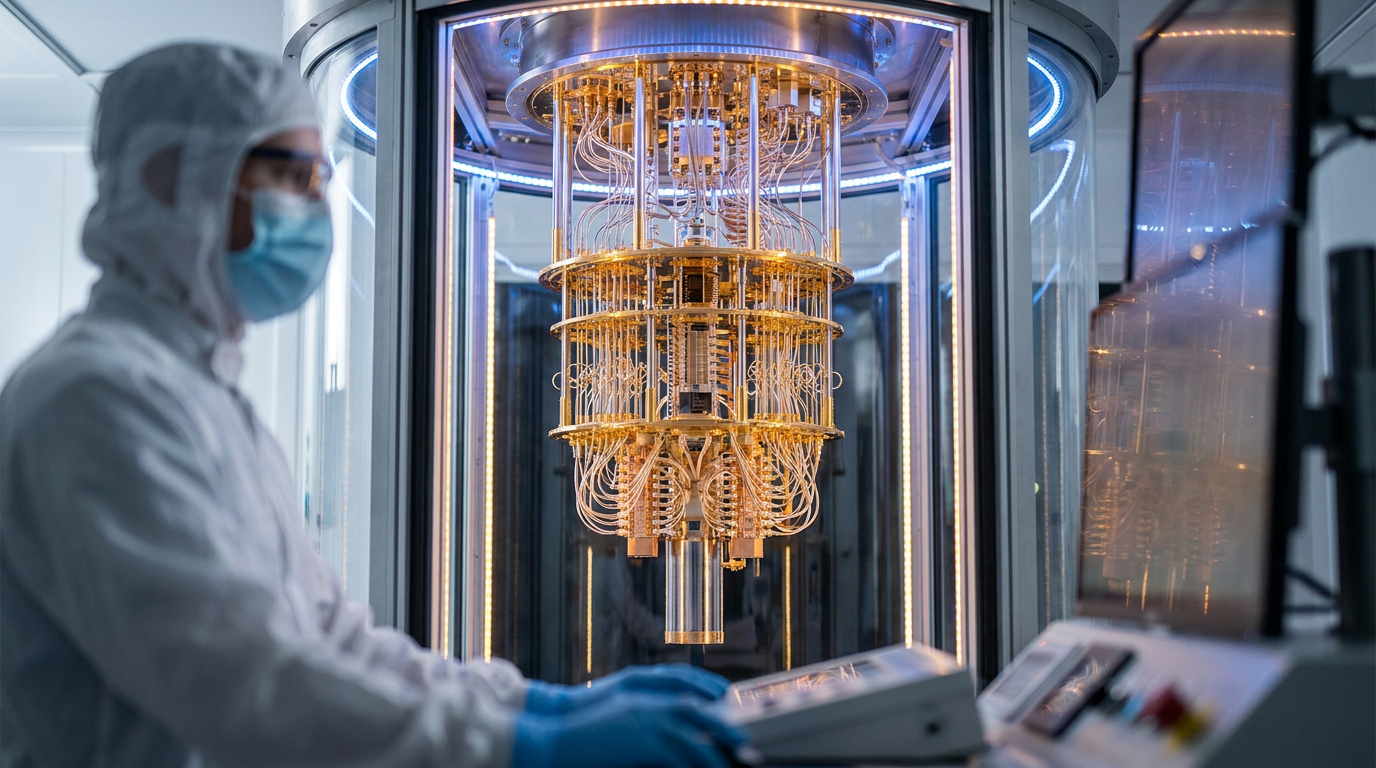
- Hardware Architects
- Focuses on the physical fidelity of qubits and the engineering trade-offs between superconducting circuits, ion traps, and neutral atoms.
- Quantum Information Theorists
- Prioritizes the mathematical efficiency of error-correcting codes, such as surface codes and qLDPC, to reduce hardware overhead.
- Enterprise Adopters
- Evaluates the timeline for commercial viability, focusing on when fault-tolerant systems will be ready for molecular simulation and cryptographic challenges.
What's not represented
- · Classical Supercomputing Advocates
- · Post-Quantum Cryptography Regulators
Why this matters
By proving that quantum computers can reliably correct their own errors, the industry has removed the final scientific roadblock to building machines capable of simulating complex molecules, accelerating drug discovery, and revolutionizing materials science.
Key points
- Quantum computers have historically struggled with decoherence, where environmental noise destroys fragile quantum calculations.
- Microsoft and Quantinuum achieved an 800-fold improvement in logical error rates, running 14,000 error-free operations.
- Google's Willow chip proved that adding more physical qubits to a logical qubit exponentially suppresses errors.
- Harvard, MIT, and QuEra used neutral atoms to achieve a 2:1 physical-to-logical ratio, drastically reducing hardware overhead.
- These milestones shift quantum computing from theoretical physics to a scalable engineering discipline.
Quantum computers have long been sold on a promise that borders on magic: the ability to simulate molecular structures in minutes that would take classical supercomputers millennia. But for decades, the field has been trapped in a frustrating paradox. The very properties that give quantum bits, or "qubits," their immense computational power also make them exquisitely fragile. The slightest environmental disturbance—a stray photon, a microscopic fluctuation in temperature, or even the electromagnetic hum of the control wires—can cause a qubit to lose its quantum state. This phenomenon, known as decoherence, has been the single greatest barrier to realizing useful quantum computing.[6]
In classical computing, the solution to data corruption is simple: redundancy. If you want to ensure a bit of information isn't lost, you copy it multiple times. If an error flips a 1 to a 0, the system checks the backup copies, takes a majority vote, and corrects the mistake. But the fundamental laws of quantum mechanics strictly forbid this. A principle known as the "no-cloning theorem" dictates that it is physically impossible to create an identical copy of an unknown quantum state. You cannot back up a qubit.[3][6]
Without the ability to copy data, physicists had to invent an entirely new way to protect information. In 1995, mathematician Peter Shor proposed a theoretical workaround: quantum error correction. Instead of copying a single qubit, Shor demonstrated mathematically that you could spread the quantum information of one "logical" qubit across a highly entangled web of many "physical" qubits. By carefully measuring the relationships between these physical qubits—without ever measuring the core information itself—a system could detect and correct errors on the fly.[6]
It was an elegant mathematical triumph, but building it in hardware proved brutally difficult. For thirty years, quantum error correction suffered from a compounding problem: the physical qubits were so noisy that the complex circuitry required to perform the error correction introduced more errors than it fixed. Adding more physical qubits to the system simply made the overall reliability worse. The field was stuck above what physicists call the "fault-tolerance threshold."[3][6]

That era is now definitively over. Over the past two years, culminating in a series of landmark demonstrations in 2026, the quantum computing industry has crossed the fault-tolerance threshold. Multiple teams, using entirely different hardware architectures, have proven that quantum error correction works in reality, not just on paper. The field has officially transitioned from a theoretical physics project into a scalable engineering discipline.[6]
The first major shockwave came from a collaboration between Microsoft and Quantinuum. By applying Microsoft's highly advanced qubit-virtualization software to Quantinuum's H2 ion-trap quantum processor, the joint team achieved an unprecedented milestone. They successfully bundled 30 physical qubits into four highly reliable logical qubits, demonstrating an 800-fold improvement in the logical error rate compared to the raw physical error rate.[1][2]
To prove the system's resilience, the Microsoft and Quantinuum team ran 14,000 independent instances of a quantum circuit. The result was flawless: not a single uncorrected error occurred during the entire run. This was achieved through active "syndrome extraction," a process where the system continuously diagnoses and corrects errors in real-time without collapsing the delicate quantum state of the logical qubits.[1][2]
While Quantinuum utilized trapped ions—individual charged atoms suspended in electromagnetic fields—Google's Quantum AI team tackled the problem using superconducting circuits. Google's "Willow" processor, a 105-qubit chip, was designed to prove a critical scaling law. They needed to show that as they increased the size of their error-correcting grid, known as a surface code, the logical error rate would drop exponentially.[3]
Google succeeded, demonstrating what is known as "below-threshold" error correction. They proved that a logical qubit encoded across a larger number of physical qubits was significantly more reliable than one encoded across fewer. This was the hardware-scale proof the industry had been waiting for: the math of fault tolerance holds up in the messy reality of a superconducting chip. The more qubits you add, the cleaner the computation becomes.[3]

Google succeeded, demonstrating what is known as "below-threshold" error correction.
But a looming challenge remained: the overhead ratio. Early surface code architectures suggested that building a single reliable logical qubit might require anywhere from 1,000 to 10,000 physical qubits. If a useful quantum algorithm requires 1,000 logical qubits, the underlying hardware would need millions of physical qubits—a scale that remains decades away due to the immense cooling and control wiring required.[4][6]
This is where a third major breakthrough fundamentally altered the timeline. A research consortium comprising Harvard University, MIT, and Boston-based QuEra Computing demonstrated a radically more efficient approach using neutral-atom arrays. Instead of fixing qubits in place on a static chip, the QuEra system uses tightly focused lasers—optical tweezers—to hold and dynamically move individual rubidium atoms in a vacuum.[4]
By moving the atoms around during the computation, the Harvard and QuEra team could connect qubits that were far apart, bypassing the strict nearest-neighbor limitations of superconducting chips. This high connectivity allowed them to implement a highly advanced mathematical framework known as quantum Low-Density Parity-Check (qLDPC) codes.[4]
The results of the qLDPC implementation were staggering. Instead of needing thousands of physical qubits to create one logical qubit, the team demonstrated an encoding rate exceeding 50 percent. They achieved a physical-to-logical qubit ratio of approximately 2:1. By drastically reducing the physical overhead, this architecture shrinks the size of a commercially useful quantum computer from millions of qubits down to tens of thousands.[4]
The neutral-atom teams didn't stop at efficient storage. To run complex algorithms, a quantum computer must perform operations between these logical qubits. Building on earlier work that demonstrated 48 logical qubits executing hundreds of entangling operations, the teams pushed their systems to handle up to 96 logical qubits, demonstrating continuous operation while actively mitigating atom loss.[4][6]

Furthermore, the QuEra and MIT researchers successfully demonstrated "magic state distillation" entirely at the logical level. Magic states are specialized quantum resources required to perform non-Clifford gates—the complex operations necessary for universal quantum computation. Distilling these states with low error rates was long considered one of the most resource-intensive bottlenecks in fault-tolerant design.[5]
With these combined breakthroughs in error suppression, efficient coding, and logical gate operations, the industry is now entering what engineers call the "Teraquop" regime. This benchmark represents a system capable of executing one trillion logical operations before encountering a single uncorrected error. At this level of reliability, quantum computers cease to be experimental novelties and become industrial workhorses.[4][6]
The implications for materials science and pharmacology are profound. A fault-tolerant quantum computer operating in the Teraquop regime can simulate the exact quantum mechanical behavior of complex molecules. This capability allows researchers to computationally design new battery catalysts, optimize nitrogen fixation for fertilizers, and model protein folding with an accuracy that classical supercomputers simply cannot achieve.[6]
The breakthroughs also accelerate the timeline for cryptographic transitions. The ability to sustain long, deep quantum circuits without decoherence is the exact requirement for running Shor's algorithm at scale—the mathematical tool that can break current RSA encryption. Consequently, cybersecurity agencies have aggressively accelerated their deadlines for enterprise migration to post-quantum cryptography.[6]

Moving forward, the quantum computing landscape will not be a standalone replacement for classical infrastructure. Instead, these fault-tolerant logical processors will operate as specialized cloud co-processors. An enterprise AI agent will hand off massive combinatorial optimization or molecular simulation tasks to a quantum backend, receive the verified output, and continue its classical workflow.[6]
For three decades, skeptics argued that the sheer complexity of the universe's microscopic noise would prevent quantum computers from ever scaling. The milestones of the past two years have decisively answered that skepticism. By proving that errors can be identified and corrected faster than they accumulate, scientists have tamed quantum decoherence. The era of noisy, experimental quantum hardware is fading; the era of reliable, fault-tolerant quantum engineering has arrived.[6]
How we got here
1995
Mathematician Peter Shor proposes the first theoretical framework for quantum error correction.
Late 2023
Harvard and QuEra demonstrate 48 logical qubits executing hundreds of entangling operations on a neutral-atom array.
April 2024
Microsoft and Quantinuum demonstrate four highly reliable logical qubits with an 800-fold reduction in error rates.
July 2025
QuEra, Harvard, and MIT successfully demonstrate magic state distillation entirely at the logical qubit level.
Early 2026
Google Quantum AI publishes results from its Willow chip, proving exponential error suppression as code distance increases.
April 2026
Harvard, MIT, and QuEra achieve a 2:1 physical-to-logical qubit ratio using advanced qLDPC codes.
Viewpoints in depth
Hardware Architects
Focuses on the physical fidelity of qubits and the engineering trade-offs between different architectures.
For hardware engineers, the race to fault tolerance is a battle of physical mediums. Teams building superconducting circuits, like Google and IBM, emphasize the blazing fast gate speeds of their chips, arguing that rapid operations are essential for scaling. Conversely, teams utilizing ion traps (Quantinuum) or neutral atoms (QuEra) point to their naturally longer coherence times and the ability to dynamically move qubits during computation. These architects argue that high connectivity and baseline fidelity ultimately reduce the massive overhead required for error correction, making their path to commercial viability shorter despite slower individual gate speeds.
Quantum Information Theorists
Prioritizes the mathematical efficiency of error-correcting codes to reduce hardware overhead.
Theorists view the hardware as merely a substrate for the mathematics of error correction. Their primary focus is on developing more efficient encoding schemes. For years, the industry standard was the 'surface code,' which required thousands of physical qubits to protect a single logical one. Recently, theorists have championed quantum Low-Density Parity-Check (qLDPC) codes, which can achieve the same level of protection with a fraction of the physical qubits. For this camp, the true breakthrough of 2026 wasn't just better hardware, but the successful implementation of these high-rate mathematical codes in physical systems, proving that the theoretical shortcuts actually work.
Enterprise Adopters
Evaluates the timeline for commercial viability and practical applications.
For enterprise end-users in pharmaceuticals, finance, and defense, the physics debates are secondary to the timeline. This camp tracks the 'Teraquop' metric—the ability to run a trillion operations without an error. They view the recent milestones as the starting gun for integrating quantum co-processors into classical cloud workflows. Their immediate concerns are avoiding vendor lock-in as different hardware architectures mature, and preparing their organizational cybersecurity for the inevitable moment when fault-tolerant systems become capable of breaking current RSA encryption standards.
What we don't know
- Whether superconducting circuits or neutral-atom arrays will ultimately become the dominant architecture for commercial scale.
- Exactly how long it will take to scale these prototype logical systems into machines with thousands of logical qubits.
- Which specific commercial application will be the first to achieve definitive, economically valuable 'quantum advantage' over classical supercomputers.
Key terms
- Qubit
- The fundamental unit of quantum information, capable of existing in multiple states simultaneously, unlike classical bits which are strictly 0 or 1.
- Decoherence
- The process by which a qubit loses its delicate quantum state due to interaction with its surrounding environment, resulting in computational errors.
- Syndrome Measurement
- A technique in quantum error correction where the system checks for errors by measuring the relationships between qubits without observing the core data itself.
- Fault Tolerance
- The ability of a quantum computer to continue operating reliably even when individual physical components experience errors.
- Magic State Distillation
- A resource-intensive quantum protocol used to prepare highly purified quantum states, which are necessary to perform complex, universal quantum logic gates.
Frequently asked
Why can't we just copy quantum data to back it up?
The fundamental laws of quantum mechanics, specifically the 'no-cloning theorem,' make it physically impossible to create an identical copy of an unknown quantum state without destroying the original.
What is the difference between a physical and a logical qubit?
A physical qubit is the actual hardware component (like an atom or a superconducting circuit) that holds quantum information but is prone to errors. A logical qubit is a highly reliable virtual qubit created by grouping many physical qubits together using error-correcting software.
When will quantum computers replace regular computers?
They likely never will. Quantum computers are designed to be specialized co-processors for specific, highly complex tasks like molecular simulation and cryptography, while classical computers will continue to handle everyday processing.
Sources
Source coverage
6 outlets
3 viewpoints surfaced






[1]MicrosoftHardware Architects
Advancing science: Microsoft and Quantinuum demonstrate the most reliable logical qubits on record
Read on Microsoft →[2]QuantinuumHardware Architects
Quantinuum and Microsoft achieve breakthrough in fault-tolerant quantum computing
Read on Quantinuum →[3]Google Quantum AIHardware Architects
Suppressing quantum errors by scaling a surface code logical qubit
Read on Google Quantum AI →[4]QuEra ComputingQuantum Information Theorists
QuEra, Harvard, and MIT Demonstrate 2:1 Physical-to-Logical Qubit Ratio
Read on QuEra Computing →[5]NatureQuantum Information Theorists
Experimental Demonstration of Logical Magic State Distillation
Read on Nature →[6]Factlen Editorial TeamEnterprise Adopters
Synthesis by Factlen editorial team
Read on Factlen Editorial Team →

Every angle. Every day.
Get technology stories with full source coverage and perspective breakdowns delivered to your inbox.