
Open-Source AI Reaches Frontier Parity With MiniMax M3 and GLM-5.2 Releases
A wave of June 2026 releases from global AI labs has pushed open-weight models to frontier-level performance, offering developers unprecedented access to advanced capabilities without API restrictions.
By Factlen Editorial Team
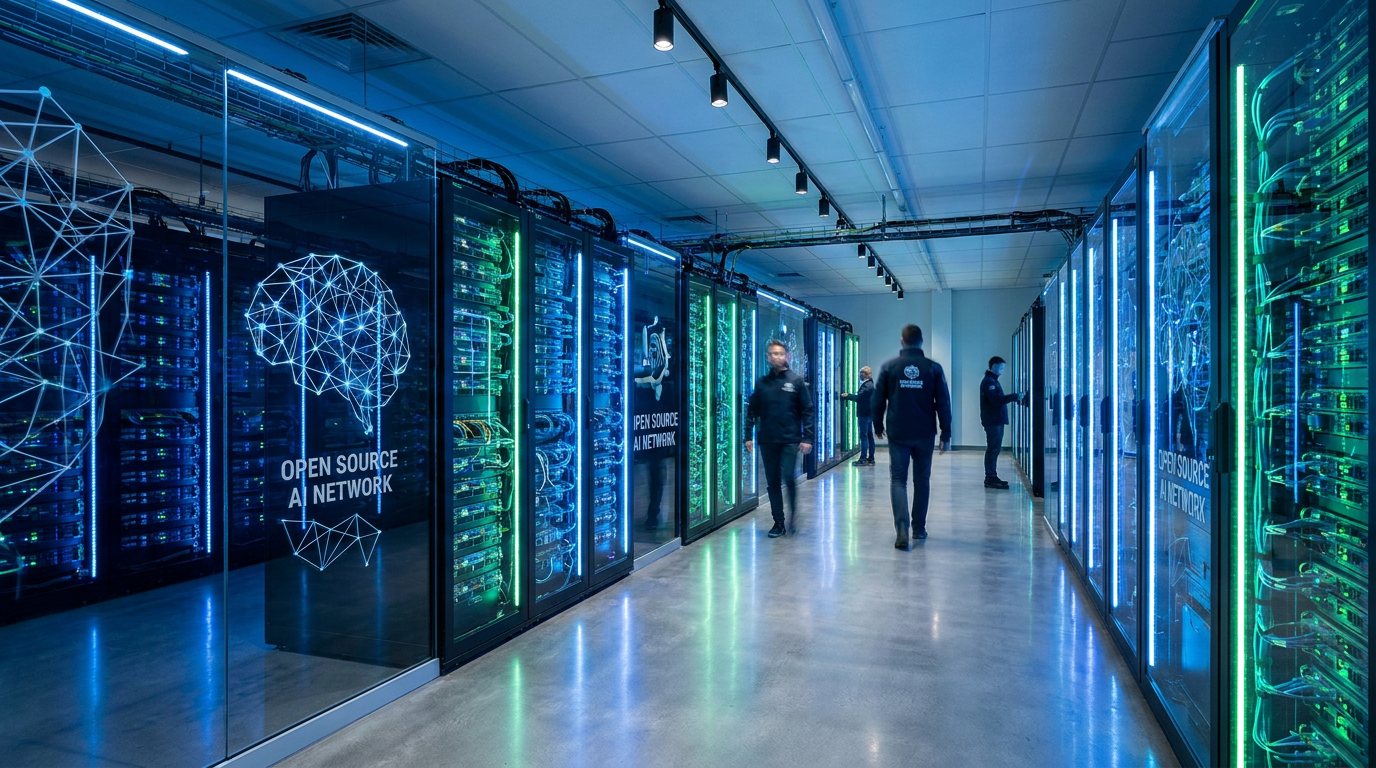
- Open-Source Advocates
- Argue that permissive licenses and local deployment democratize AI, breaking the monopoly of major cloud providers.
- Enterprise Architects
- Value open-weight models for their ability to be deployed securely on-premises, protecting sensitive corporate data from third-party APIs.
- Market Analysts
- View the rapid release cycle of open-source models as a commercial threat to proprietary labs, forcing a reevaluation of API pricing and moats.
What's not represented
- · Hardware manufacturers producing the local chips required to run these models
- · Regulatory bodies monitoring the safety implications of open-source frontier AI
Why this matters
By matching the performance of closed-source giants like GPT-5.5, these open-weight models allow developers and businesses to run state-of-the-art AI locally. This eliminates expensive API fees, protects sensitive corporate data, and democratizes access to advanced technology worldwide.
Key points
- MiniMax M3 achieved a 59.0% on SWE-Bench Pro, surpassing several closed-source frontier models.
- GLM-5.2 was released under a pure MIT license, removing all regional deployment restrictions.
- Both models feature a massive one-million-token context window powered by sparse attention architectures.
- The availability of these open-weight models allows enterprises to run advanced AI securely on local hardware.
The landscape of artificial intelligence shifted dramatically in June 2026 as a rapid succession of open-weight model releases proved that open-source AI can now match the performance of closed-source giants. For the first time in the generative AI boom, the global developer community has access to frontier-level capabilities without being tethered to proprietary APIs or expensive cloud subscriptions. This wave of releases marks a highly transformative phase for the industry, characterized by a rapid migration toward architectural diversification and localized execution networks. As the technology matures, the gap between the heavily funded proprietary labs and the open-source community has effectively vanished, democratizing access to the kind of computational reasoning that was previously locked behind corporate firewalls.[1][5]
Leading the charge in this open-source renaissance is MiniMax M3, released on June 1, which quickly became the first open-weight model to combine advanced software engineering capabilities with a massive one-million-token context window. Built entirely on a novel sparse attention architecture, the model introduced native multimodal computer use, allowing it to process dense streams of video and image inputs while directly interacting with operating system interfaces. This means the model can not only write code but also visually navigate desktop environments to test and deploy that code autonomously. By offering these capabilities as open weights, MiniMax has provided researchers and developers with a foundational tool that rivals the most sophisticated enterprise systems currently on the market.[1][2][4]
According to benchmark evaluations that sent ripples through the developer community, MiniMax M3 achieved a staggering 59.0% score on the rigorous SWE-Bench Pro. This milestone effectively places the open-source model ahead of several premium proprietary offerings, including GPT-5.5 and Gemini 3.1 Pro, in autonomous coding and software engineering tasks. The Artificial Analysis Intelligence Index immediately ranked MiniMax M3 at the top of its open-weight leaderboard, tying it with other highly efficient models. For independent developers, this benchmark confirms that they no longer need to compromise on quality when choosing open-source alternatives for complex, multi-step programming challenges.[1][2][4]

The momentum continued to build on June 13 when Z.ai—formerly known as Zhipu, one of the leading AI labs in Asia—released GLM-5.2, a flagship model featuring a new sparse attention architecture and flexible "thinking-effort" levels. The model inherits a massive 744-billion parameter architecture but activates only 40 billion of those parameters per token, maximizing computational efficiency without sacrificing reasoning depth. By allowing users to toggle between "High" and "Max" thinking efforts, GLM-5.2 gives developers granular control over the trade-off between inference speed and complex problem-solving, a feature previously popularized by closed-source reasoning models.[3][4]
What makes GLM-5.2 particularly notable for the global ecosystem is its pure MIT open-source license, which ships with absolutely zero regional restrictions. Z.ai has explicitly framed this release as "technical access without borders," allowing developers worldwide to deploy the model without facing the geographic access walls often imposed by major Western cloud providers. This aggressive strategy of building global developer mindshare mirrors the playbook that originally made open-source frameworks ubiquitous in traditional software engineering, ensuring that the next generation of AI applications can be built anywhere in the world without fear of sudden API revocations.[3]
What makes GLM-5.2 particularly notable for the global ecosystem is its pure MIT open-source license, which ships with absolutely zero regional restrictions.
Moonshot AI also entered the fray during this unprecedented month with Kimi K2.7 Code, a highly token-efficient model released in mid-June. Built on a one-trillion parameter architecture, it activates 32 billion parameters per token, delivering faster reasoning for complex programming challenges while reducing token overhead by roughly 30% compared to its predecessors. This focus on token efficiency is critical for developers running autonomous agents, as it drastically reduces the computational cost of long-running tasks where the AI must continuously read and write extensive codebases to solve intricate software bugs.[4]
These June releases highlight a monumental shift away from standard dense transformer configurations toward advanced sparse attention mechanisms. By optimizing how models process information—activating only the specific neural pathways needed for a given prompt—these architectures allow massive neural networks to run far more efficiently on consumer-grade or local enterprise hardware. This architectural evolution is the technical breakthrough that has made the one-million-token context window viable for open-source models, allowing them to ingest entire libraries of documentation, extensive code repositories, and hours of video without overwhelming the host system's memory.[1][2]

For the global developer community, this technological leap translates directly into a migration toward localized execution networks. Businesses and independent developers are increasingly bypassing traditional API dependencies, opting instead for complete deployment control to ensure data privacy and reduce recurring computational costs. By utilizing frameworks that support local-first system integration alongside these new open-weight models, organizations can deploy highly secure, context-aware, and physically grounded AI agents entirely within their own infrastructure, insulated from the pricing changes and service outages of major cloud providers.[1][6]
Hardware manufacturers are simultaneously rising to the occasion to support this burgeoning local-first ecosystem. New consumer workstation laptops equipped with advanced AI superchips can now deliver up to one petaflop of compute directly to a developer's desk, featuring massive unified memory pools capable of holding these large open-weight models. This convergence of highly optimized sparse AI architectures and increasingly powerful consumer hardware means that the barrier to entry for running frontier-level artificial intelligence is shifting from massive data center budgets to a one-time hardware purchase.[1]
The decentralization of AI capabilities empowers startups and researchers in regions that previously lacked access to top-tier cloud infrastructure. By utilizing open models from global labs across Asia, Europe, and the United States, the international community is actively leveling the playing field for technological innovation. Developers in emerging markets can now build world-class applications, conduct advanced biomedical research, and automate complex workflows using the exact same foundational models as well-funded Silicon Valley startups, fostering a more equitable global tech landscape.[2][3]

Enterprise architects are actively testing these open-weight configurations to build secure, context-aware systems entirely within their own corporate firewalls. This localized approach is a critical requirement for highly regulated industries like finance, defense, and healthcare, which handle sensitive data that simply cannot be transmitted to external APIs. With models like MiniMax M3 and GLM-5.2 offering frontier-level reasoning, these enterprises no longer have to choose between maintaining strict data compliance and leveraging the latest advancements in artificial intelligence.[1][6]
While proprietary AI labs continue to push the boundaries of massive scale and integrated cloud ecosystems, the June 2026 open-source wave proves that the barrier to entry for frontier-level artificial intelligence has permanently fallen. The rapid release cycle of these highly capable, permissively licensed models signals that the future of AI development is increasingly open, distributed, and accessible. As the technology continues to decentralize, the power to build and deploy intelligent systems is shifting firmly into the hands of the developers and organizations that actually use them.[3][5]
How we got here
May 2026
Proprietary models like GPT-5.5 and Claude Opus 4.8 dominate autonomous coding benchmarks.
June 1, 2026
MiniMax releases M3, achieving a 59.0% on SWE-Bench Pro with a 1-million token context window.
June 12, 2026
Moonshot AI launches Kimi K2.7 Code, introducing highly efficient 32-billion parameter activation.
June 13, 2026
Z.ai drops GLM-5.2 under a pure MIT license, removing all regional deployment restrictions.
Viewpoints in depth
Open-Source Developer Community
Advocates for the democratization of AI through permissive licenses and local deployment.
This camp views the June 2026 releases as a watershed moment that breaks the monopoly of major cloud providers. By offering pure MIT licenses and open weights, labs are allowing developers to build without fear of sudden API deprecations or regional lockouts. They argue that local deployment is the only way to ensure true innovation and data sovereignty.
Enterprise IT Leaders
Focuses on the security and cost benefits of deploying frontier models on-premises.
For corporate IT and security teams, the primary value of models like MiniMax M3 and GLM-5.2 is data privacy. Because these models can be run entirely within a company's own firewall, sensitive financial or healthcare data never has to be transmitted to a third-party API. This camp is aggressively testing these open-weight models to replace expensive, recurring cloud AI subscriptions with fixed hardware investments.
Proprietary AI Labs
Maintains that closed-source models still offer superior safety guardrails and managed infrastructure.
While acknowledging the impressive benchmarks of open-source models, proprietary labs emphasize the hidden costs of local deployment, such as hardware maintenance and security patching. They argue that closed-source APIs provide essential safety guardrails, continuous updates, and the massive integrated infrastructure required for enterprise-scale applications that open-source models cannot easily replicate out of the box.
What we don't know
- How proprietary AI labs will adjust their API pricing in response to the availability of free, frontier-level open-source models.
- Whether independent developers will be able to afford the specialized hardware required to run these massive models at their maximum context windows.
Key terms
- Open-weight model
- An AI model where the underlying parameters are publicly released, allowing anyone to download and run it locally.
- Context window
- The amount of text, code, or data an AI model can hold in its memory and process at one time.
- Sparse attention
- An architectural design that allows an AI model to process massive amounts of data efficiently by only focusing on the most relevant parts of the input.
- SWE-Bench Pro
- A rigorous industry benchmark that tests an AI model's ability to autonomously solve real-world software engineering problems.
Frequently asked
Can I run these new models on my own computer?
Yes, but they require significant hardware. While smaller quantized versions can run on high-end consumer GPUs, the full models require enterprise-grade servers or specialized AI superchips.
How do these models compare to GPT-5.5?
Benchmarks indicate that models like MiniMax M3 are highly competitive, scoring 59.0% on autonomous coding tests, which slightly edges out several closed-source frontier models.
Are there any regional restrictions on using GLM-5.2?
No. GLM-5.2 was released under a pure MIT open-source license, meaning developers anywhere in the world can use, modify, and deploy it without geographic limitations.
Sources
Source coverage
6 outlets
3 viewpoints surfaced





[1]DevFlokersOpen-Source Advocates
Open-Source AI Projects, New Model Releases & Research Papers: June 2026 Roundup
Read on DevFlokers →[2]Kilo AIOpen-Source Advocates
MiniMax M3 and the Best Open-Source Coding Models in 2026
Read on Kilo AI →[3]AlphaMatchMarket Analysts
Z.ai Drops GLM-5.2: A Generational Leap with MIT License
Read on AlphaMatch →[4]Build Fast With AIEnterprise Architects
What is the best open-source AI model in June 2026?
Read on Build Fast With AI →[5]LLM StatsMarket Analysts
Track AI model updates and LLM releases in real time
Read on LLM Stats →[6]AI Startup EdgeEnterprise Architects
The Biggest AI Trends Defining June 2026
Read on AI Startup Edge →


Every angle. Every day.
Get ai stories with full source coverage and perspective breakdowns delivered to your inbox.