
New Startup 'Artist Included' Uses AI to Help Legacy Musicians Reclaim Their Master Recordings
A newly launched music technology startup is using AI-assisted vocal processing to help legendary artists like Boy George re-record their classic hits, bypassing old contracts to create new, artist-owned masters.
By Factlen Editorial Team
- Artist Advocates
- Argues that AI should be used to correct historical industry imbalances and return ownership to creators.
- Music Tech Innovators
- Focuses on the ethical, consent-based application of artificial intelligence as a collaborative instrument.
- Traditional Rightsholders
- Views the re-recording movement as a direct challenge to the historical value of label-owned music catalogs.
What's not represented
- · Advertising & Sync Executives
- · Music Purists & Audiophiles
Why this matters
For decades, legacy recording contracts have locked musicians out of the massive profits generated by their own classic hits. By using AI as a tool for artist empowerment rather than replacement, this model could fundamentally shift the balance of power and wealth in the music industry back to the creators.
Key points
- Los Angeles-based startup Artist Included has launched to help legacy musicians re-record their classic hits using AI-assisted vocal technology.
- The company's first release is a new version of Culture Club's 1983 hit 'Karma Chameleon,' featuring new vocals by Boy George.
- The startup aims to create new, artist-owned master recordings that bypass legacy record contracts, allowing creators to directly monetize their work.
- Rather than generating synthetic voices, the company uses AI to process new studio vocals, matching the tonal qualities of the artist's original historical performance.
For the past two years, the music industry has viewed artificial intelligence primarily as an existential threat—a technology capable of cloning voices and diluting royalties. But a newly launched Los Angeles startup is attempting to flip that narrative, using AI not to replace musicians, but to help legacy artists reclaim control of their most valuable assets. The company, named Artist Included, officially launched this week with a mission to help legendary musicians re-record their classic hits using AI-assisted vocal technology, creating new master recordings that the artists actually own.[2][4]
The startup’s flagship release is a newly minted version of Culture Club’s 1983 global smash "Karma Chameleon," featuring original frontman Boy George. Timed to coincide with the singer’s 65th birthday, the release serves as a proof-of-concept for the company’s broader business model. Artist Included was co-founded by entrepreneur Paul "PK" Kemsley, who manages Boy George, alongside entertainment attorney and film producer Jeremy Rosen.[1][2]
The financial mechanics driving the startup address a decades-old grievance in the music business: predatory legacy contracts. Many artists from the 1960s through the 2000s signed deals that granted their record labels perpetual ownership of their master recordings. As a result, when those classic tracks are licensed for films, television shows, or lucrative commercials, the original creators often see little to no financial return.[1][3]

Kemsley highlighted the stark reality of this dynamic, noting that the original "Karma Chameleon" master—owned by Virgin Records—recently secured a massive licensing placement. "Four million dollars changed hands," Kemsley explained. "George didn't get anything at all." By creating a new, sonically identical master recording, Artist Included allows musicians to bypass their old labels and directly monetize their own history.[3]
Re-recording back catalogs is not a new strategy—Taylor Swift famously popularized the tactic to regain control of her music. However, most legacy artists struggle to perfectly recreate the distinct vocal tone and youthful energy of a track they recorded decades ago, making the new versions less appealing to music supervisors and fans. This is where Artist Included’s technological intervention comes into play.[2][3][6]
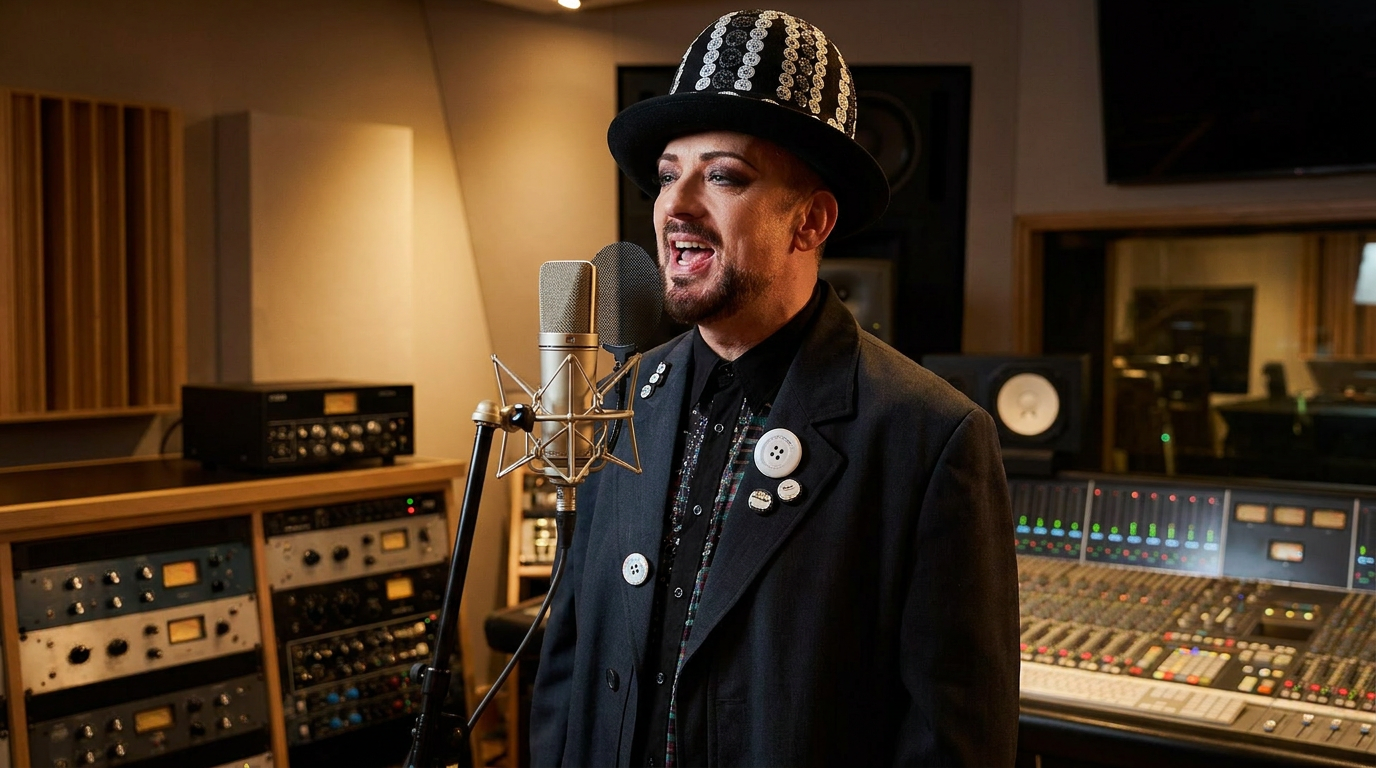
The company is adamant that its process does not rely on fully synthetic, generative AI—a crucial distinction in an industry currently battling unauthorized voice cloning. Instead, Boy George went into a physical recording studio and performed entirely new vocal takes for the track. The startup’s technology partner, Syntiant, then applied a specialized, artist-approved vocal AI platform to process the new human recording.[1][2]
Instead, Boy George went into a physical recording studio and performed entirely new vocal takes for the track.
Syntiant’s AI was trained on the original 1983 demos and isolated vocal stems, which were provided with the consent of the song’s original producer, Steve Levine. The software gently nudged Boy George’s modern performance back toward the precise tonal qualities and emotional resonance of the 1983 master, bridging the 40-year gap in vocal aging while keeping every note authentically human.[1][4]

"The goal was never to replace the original—it was to celebrate it and let the song keep evolving for new audiences," Boy George stated regarding the project. The startup emphasizes that its model is built entirely on consent, transparency, and rights clearance, positioning itself as an ethical alternative to the unauthorized deepfakes that have plagued the industry.[2][3]
The venture has already attracted significant institutional backing. Seed investors include Red Light Management—one of the world’s largest independent artist management firms—as well as Mike Walsh, an early investor in Uber and Salesforce, and Doug Raetz of Cresset Sports and Entertainment. Planet Hollywood founder Robert Earl has also joined as Chairman of the Board, signaling serious commercial ambitions.[2][3]
For advertising agencies and film studios, licensing a classic track often involves navigating a labyrinth of approvals from multiple rightsholders, sometimes facing exorbitant fees. Artist Included offers a streamlined alternative: a one-stop shop for a sonically faithful master, with the added public relations benefit of directly compensating the original artist. Robert Earl noted that when a track is placed in a sync deal under this new model, the artist feels personally involved and motivated to promote it, rather than watching it drift by as lost income.[1][2]

Looking ahead, Artist Included plans to roll out a deep slate of releases featuring legendary artists spanning four decades, from the 1960s through the 2000s. The company aims to unlock fresh commercial opportunities for these newly minted masters across streaming platforms, sync licensing, brand partnerships, and even foreign-language versions and video game integrations, creating a sprawling new ecosystem of artist-owned media.[2][5]
The launch arrives at a critical inflection point for the music business, as rightsholders and technologists battle over the future economics of the medium. While traditional record labels are likely to view the startup as a direct threat to their lucrative catalog revenues, Artist Included is betting that fans and brands will eagerly support a model that finally puts the original creators back in the driver's seat.[2][3]
As the music industry continues to litigate the boundaries of artificial intelligence, Artist Included offers a compelling counter-narrative. By transforming AI from a tool of extraction into an instrument of empowerment, the startup is providing legacy musicians with a high-tech pathway to finally reclaim the soundtracks of our lives.[1][4]
How we got here
1983
Culture Club releases 'Karma Chameleon,' which becomes a massive global hit, though the master recording is owned by Virgin Records.
2019-2023
Taylor Swift popularizes the strategy of re-recording back catalogs to regain ownership of master rights.
2023-2025
Generative AI voice cloning sparks widespread panic and legal battles within the music industry.
June 2026
Artist Included launches, releasing an AI-assisted re-recording of 'Karma Chameleon' to give Boy George ownership of a new master.
Viewpoints in depth
Artist Advocates
Argues that AI should be used to correct historical industry imbalances and return ownership to creators.
This camp, which includes artist managers and creator rights organizations, views legacy record contracts as inherently predatory. They argue that artists who generated millions of dollars for their labels decades ago have been unfairly locked out of the modern sync and streaming boom. For these advocates, AI is not a threat but a long-overdue tool for financial liberation, allowing musicians to bypass the labels that own their original masters and offer a sonically identical, artist-owned alternative to the market.
Music Tech Innovators
Focuses on the ethical, consent-based application of artificial intelligence as a collaborative instrument.
Technologists and AI developers in this space are eager to distance themselves from the controversies of unauthorized deepfakes and voice cloning. They emphasize that models like Artist Included rely entirely on opt-in participation, where the AI serves as a post-production enhancement rather than a generative replacement. By training models exclusively on authorized stems and using them to support a real human performance, they argue that AI can safely push the boundaries of audio engineering without violating copyright or artistic integrity.
Traditional Rightsholders
Views the re-recording movement as a direct challenge to the historical value of label-owned music catalogs.
Major record labels and music investment funds have spent billions acquiring the rights to classic song catalogs, banking on a steady stream of licensing and streaming revenue. While they rarely speak out publicly against artist empowerment initiatives, industry analysts note that rightsholders view AI-assisted re-recordings as a significant threat. If advertising agencies and film studios begin defaulting to cheaper, artist-owned masters, the valuation of legacy catalogs held by the major labels could face downward pressure.
What we don't know
- It remains unclear how aggressively traditional record labels might challenge these AI-assisted re-recordings through legal or contractual avenues.
- It is not yet known whether advertising agencies and film studios will widely adopt the new artist-owned masters over the familiar originals.
Key terms
- Master Recording
- The official, finalized original recording of a song, from which all copies are made and which generates the bulk of licensing revenue.
- Sync Licensing
- The process of obtaining permission to synchronize a piece of music with visual media, such as a film, television show, or commercial.
- Vocal AI
- Artificial intelligence technology trained on audio data to replicate, modify, or enhance the tonal qualities of a human singing voice.
Frequently asked
Is the new song fully generated by AI?
No. Boy George recorded entirely new vocals in a studio. The AI was only used to process those vocals to match the specific tonal qualities of his 1983 performance.
Why do legacy artists need to re-record their music?
Many artists signed contracts decades ago that gave record labels permanent ownership of their master recordings, meaning the artists miss out on lucrative licensing deals for commercials and films.
Does this replace the original version of the song?
No. The original label-owned master still exists. This creates a second, artist-owned version that can compete for streaming and licensing opportunities.
Sources
Source coverage
6 outlets
3 viewpoints surfaced






[1]ForbesArtist Advocates
Boy George Isn’t Afraid Of AI; A Reborn ‘Karma Chameleon’ Proves Why
Read on Forbes →[2]Music Business WorldwideMusic Tech Innovators
Tech startup Artist Included launches with plan to re-record classic songs using AI
Read on Music Business Worldwide →[3]Interspace MusicTraditional Rightsholders
Startup Artist Included has used AI to rework Culture Club's 'Karma Chameleon'
Read on Interspace Music →[4]SongAIArtist Advocates
Boy George Reimagines 'Karma Chameleon' with AI Assistance
Read on SongAI →[5]Mixing.co.krMusic Tech Innovators
AI Re-recording Startup 'Artist Included' Launches with Boy George's 'Karma Chameleon'
Read on Mixing.co.kr →[6]WikipediaTraditional Rightsholders
Taylor Swift masters controversy
Read on Wikipedia →


Every angle. Every day.
Get business stories with full source coverage and perspective breakdowns delivered to your inbox.