
The Science of Digital Weight: How Smart Resistance Machines Are Rewriting the Rules of Strength Training
Electromagnetic motors and AI algorithms are replacing traditional cast iron, offering dynamic eccentric overload and constant tension that fundamentally changes how muscles grow.
By Factlen Editorial Team
- Digital Resistance Advocates
- Argue that algorithmic weight is superior for safety, efficiency, and data tracking.
- Sports Science Researchers
- Focus on the physiological benefits of eccentric overload and time under tension.
- Traditional Iron Purists
- Maintain that free weights build superior real-world stability and skill.
What's not represented
- · Commercial Gym Owners
- · Budget-Conscious Consumers
Why this matters
Understanding the biomechanics of digital weight allows consumers to make informed decisions about their fitness investments, potentially unlocking safer and more efficient pathways to building strength without the need for a massive home gym.
Key points
- Digital weight machines use electromagnetic motors to generate resistance, completely eliminating the momentum found in traditional free weights.
- Because of constant tension, 50 pounds of digital resistance often feels equivalent to 60 or 65 pounds of cast iron.
- Smart machines can automatically add weight during the lowering phase of a lift, a scientifically proven method for accelerating muscle growth.
- AI spotters monitor bar velocity and instantly reduce weight if a user fails a rep, allowing for safe solo training.
For over a century, the pursuit of physical strength has been defined by a single, unchanging force: gravity. The clanking of cast-iron plates, the chalk dust, and the heavy thud of dropped barbells have served as the universal soundtrack of resistance training. But a quiet revolution is currently sweeping through the fitness industry, replacing gravity with algorithms and iron with electromagnetic motors. Smart resistance machines—often referred to as digital weight—are fundamentally altering the biomechanics of how humans build muscle. By utilizing advanced robotics to generate force, these systems are offering a level of precision and adaptability that traditional free weights simply cannot match.[9]
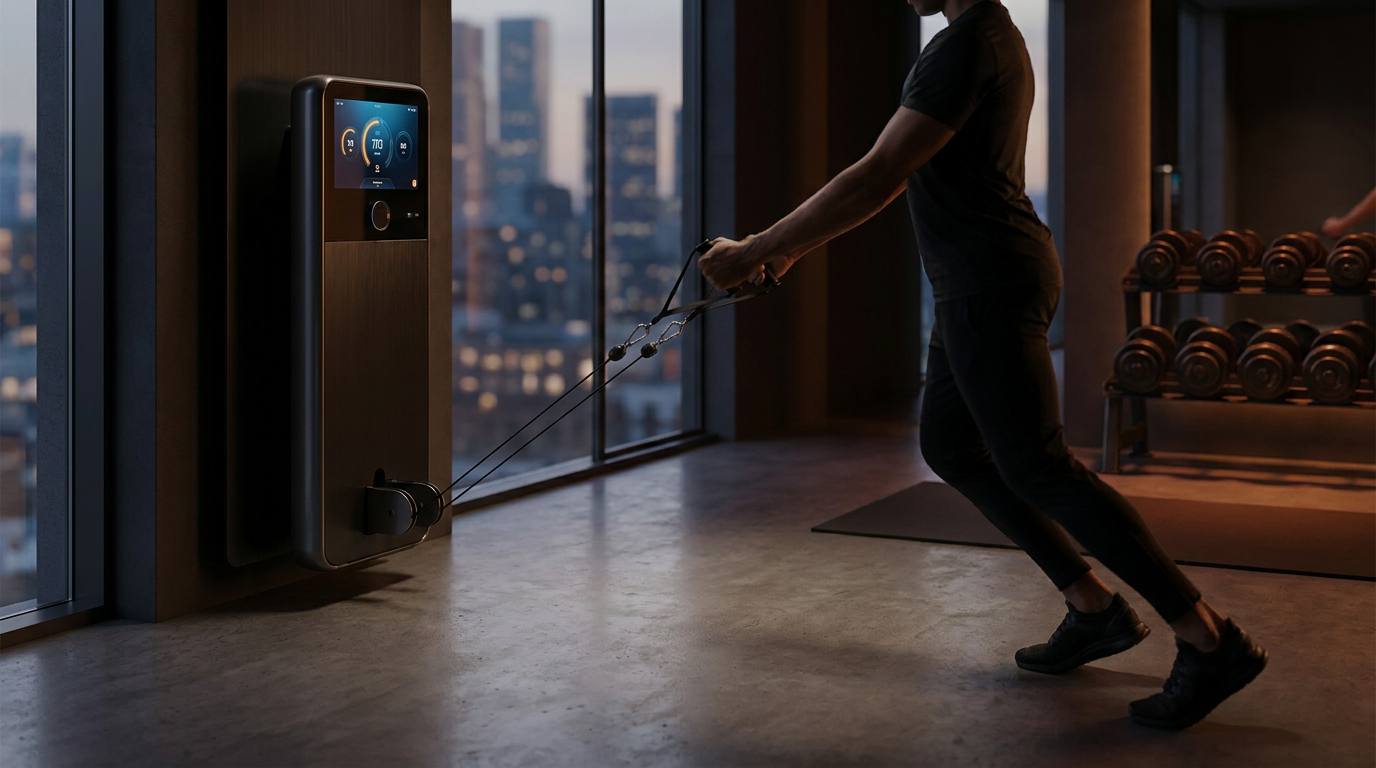
At the core of this technological shift is the replacement of physical mass with direct-drive motors. Instead of loading a barbell with 45-pound plates, users interact with a system that simulates resistance electronically. When a user pulls a cable on a machine like a Tonal or a Speediance, they are actually fighting against a high-torque motor that is programmed to pull back with a specific amount of force. This digital approach allows for instant, micro-adjustments in load without the need to manually strip or add physical plates, streamlining the workout process and keeping the heart rate elevated between sets.[7]
The most immediate physical sensation users experience when transitioning to digital weight is a profound lack of momentum. In a traditional barbell lift, a lifter can use a slight swing or "body English" to get the weight moving. Once the iron is in motion, inertia helps carry it through the most difficult part of the lift, known as the sticking point. Digital weight systems completely eliminate this mechanical advantage. If the user stops pushing, the tension remains exactly the same. The resistance is constant and relentless, forcing the muscle to work at maximum capacity through the entire range of motion.[5]

Because of this constant tension and zero-inertia environment, digital weight feels significantly heavier than its cast-iron equivalent. Fitness experts and biomechanics researchers frequently note that a 50-pound setting on a digital machine often feels more like 60 to 65 pounds of traditional free weights. The muscle is never allowed a fraction of a second to "float" or rest at the top of a movement. This increased time under tension is a primary driver of muscular hypertrophy, explaining why users often achieve deep muscle fatigue with seemingly lighter numerical loads.[6][8]
Beyond the elimination of momentum, the true physiological holy grail of digital weight lies in its ability to manipulate the eccentric phase of a lift. Every lifting movement consists of two parts: the concentric phase, where the muscle shortens as it lifts the weight, and the eccentric phase, where the muscle lengthens as it lowers the weight. Human muscles are inherently stronger during the eccentric phase; you can slowly lower a much heavier weight than you can actively press upward.[4]
Traditional free weights are fundamentally limited by this biological reality. Because gravity dictates that a 100-pound dumbbell weighs exactly 100 pounds in both directions, a lifter is bottlenecked by their concentric strength. They cannot safely overload the eccentric portion of the lift without a team of spotters manually pushing down on the barbell during the lowering phase and then releasing it for the upward push—a logistical nightmare for the average gym-goer.[4]

Traditional free weights are fundamentally limited by this biological reality.
Connected Adaptive Resistance Exercise (CARE) technology solves this problem instantly. Smart machines can be programmed to recognize the exact moment a user transitions from lifting to lowering. In a fraction of a second, the motor can automatically add 20 to 30 percent more weight for the eccentric phase, and then seamlessly strip that extra weight away the moment the user begins to push back up. This "eccentric overload" taxes the muscle fibers more thoroughly than a static weight ever could, stimulating muscle-building pathways that traditional training often leaves dormant.[3][4]
The clinical evidence supporting this dynamic loading is becoming increasingly robust. A recent study published in the Scientific Journal of Sport and Performance examined the efficacy of supramaximal eccentric overload using a CARE device during bench press training. Over a four-week period, participants utilizing digital eccentric overload saw their one-rep maximum strength increase by an average of 7.3 kilograms. The researchers noted that the adaptive electro-magnetic motor provided a unique stimulus for muscle growth and gross power output that conventional flat bench pressing could not replicate.[2]
These benefits extend far beyond stationary pressing movements, showing immense promise for explosive athletic performance. Another recent study focused on collegiate basketball players who incorporated digital CARE training into their lower-body regimens. The athletes who trained with adaptive eccentric overload demonstrated significant, outsized improvements in jump height, lower-body peak power, and overall muscle strength compared to control groups using traditional methods. The ability of the AI to safely push athletes past their normal mechanical limits is proving to be a game-changer for elite sports conditioning.[3]

Furthermore, digital resistance is aligning perfectly with emerging research on the "minimal effective dose" for fitness. Data from the National Institutes of Health highlights that low-volume, eccentric-focused resistance exercise can yield substantial improvements in muscle strength and health outcomes. Because digital machines can isolate and overload the eccentric phase so efficiently, users can theoretically achieve the same or better hypertrophic results in significantly shorter workout sessions, making it an ideal solution for time-strapped professionals.[1]
Safety is another arena where digital weight heavily outpaces traditional iron. Pushing a muscle to absolute failure—the point where it can no longer complete a repetition—is highly effective for growth, but incredibly dangerous when lying under a heavy barbell alone. Smart machines feature automatic spotter protocols that monitor bar velocity in real-time. If the system detects that the cable has stopped moving or is traveling backward during a concentric push, it instantly reduces the weight or turns the motor off entirely, preventing the user from being crushed.[5][7]
From a practical standpoint, the spatial efficiency of these systems is driving their massive popularity in the home fitness market. A comprehensive traditional home gym requires a squat rack, a bench, a full set of dumbbells, and hundreds of pounds of iron plates—easily consuming an entire garage or spare bedroom. Digital cable systems condense that entire ecosystem into a sleek, wall-mounted screen or a low-profile floor platform that occupies less than 10 square feet, democratizing heavy strength training for apartment dwellers.[8]

Despite the technological marvels, traditional iron purists maintain valid criticisms of the digital shift. The most prominent argument is the loss of stabilizer muscle engagement. While digital cables offer free motion, they lack the visceral, chaotic feedback of balancing a live, heavy barbell on one's back. Additionally, the financial barrier to entry is steep; these machines require thousands of dollars in upfront hardware costs, invariably tethered to mandatory monthly subscription fees required to unlock the AI spotting and eccentric overload features.[5][6]
Ultimately, the rise of digital weight does not render the traditional dumbbell obsolete, but it does represent the most significant evolution in strength training equipment in decades. By decoupling resistance from gravity and placing it under algorithmic control, fitness technology has unlocked safer, faster, and more scientifically optimized pathways to human strength. For those willing to embrace the hum of a motor over the clank of iron, the future of muscle building has never looked more precise.[9]
How we got here
2015
Tonal is founded, pioneering the concept of electromagnetic resistance for consumer home gyms.
2020
The global pandemic accelerates the adoption of at-home smart fitness equipment as traditional gyms close.
2022
Vitruvian launches the Trainer+, introducing heavy-load Connected Adaptive Resistance Exercise (CARE) without wall mounting.
2025
Peer-reviewed studies confirm that digital eccentric overload can produce superior strength gains compared to traditional free weights.
Viewpoints in depth
Digital Resistance Advocates
Argue that algorithmic weight is superior for safety and efficiency.
Proponents emphasize that digital weight eliminates the dangerous variables of traditional lifting. By utilizing AI spotters and constant tension, users can train to absolute failure safely in their own homes. They point to the ability to micro-adjust weight and track every metric as the ultimate tool for guaranteed progressive overload, arguing that technology has finally optimized the inefficient process of manual weightlifting.
Sports Science Researchers
Focus on the physiological benefits of eccentric overload and time under tension.
The academic community is highly interested in the hypertrophic potential of Connected Adaptive Resistance Exercise (CARE). Researchers highlight that because digital motors can dynamically add weight during the eccentric (lowering) phase, they trigger muscle-building pathways that static free weights cannot reach. This effectively lowers the minimum effective dose required for strength gains, allowing athletes to achieve better results in less time.
Traditional Iron Purists
Maintain that free weights build superior real-world stability and skill.
Critics of the digital shift argue that lifting is a skill, not just a math equation. They contend that balancing a live barbell forces the central nervous system and stabilizer muscles to work in a chaotic, real-world environment that smooth digital cables cannot replicate. Furthermore, they object to the high upfront costs and mandatory monthly subscriptions required to access basic workout functions, preferring the one-time investment of cast iron.
What we don't know
- The long-term durability and repair costs of consumer-grade electromagnetic direct-drive motors after a decade of heavy use.
- Whether the lack of true barbell stabilization in digital training translates to a higher injury risk when users eventually attempt to lift heavy physical objects in the real world.
Key terms
- Concentric phase
- The portion of an exercise where the muscle shortens while contracting, such as lifting the dumbbell during a bicep curl.
- Eccentric phase
- The portion of an exercise where the muscle lengthens under tension, such as slowly lowering the dumbbell.
- Hypertrophy
- The increase and growth of muscle cells, typically achieved through consistent resistance training.
- Time under tension
- The total duration a muscle is actively working and under strain during a set, which is a key driver of muscle growth.
- Connected Adaptive Resistance Exercise (CARE)
- Smart machines that use algorithms and motors to adjust weight dynamically in real-time based on the user's output.
Frequently asked
Does digital weight build muscle as effectively as free weights?
Yes. Muscles respond to mechanical tension, not the source of the weight. Studies show digital resistance can even accelerate hypertrophy by maximizing time under tension and eliminating momentum.
Why does digital weight feel heavier than iron?
Digital motors eliminate the momentum and inertia present in traditional lifting, forcing the user to pull the exact weight through every millimeter of the movement without any mechanical breaks.
Can I use these machines without a monthly subscription?
Most smart resistance machines require a subscription to access data tracking, AI spotting, and dynamic modes like eccentric overload, though some offer a basic manual mode if the subscription lapses.
What happens if I fail a rep while lifting alone?
Smart machines feature automatic spotters that detect when the bar speed drops or stops, instantly reducing or removing the weight to prevent injury.
Sources
Source coverage
9 outlets
3 viewpoints surfaced









[1]National Institutes of HealthSports Science Researchers
Minimal Dose Resistance Exercise Strategies
Read on National Institutes of Health →[2]Scientific Journal of Sport and PerformanceSports Science Researchers
Eccentrically overloaded bench press training
Read on Scientific Journal of Sport and Performance →[3]What's New In FitnessDigital Resistance Advocates
New Study Highlights Benefits of Eccentric Training
Read on What's New In Fitness →[4]TonalDigital Resistance Advocates
The Science of Eccentric Training
Read on Tonal →[5]GXMMATTraditional Iron Purists
Digital Weight Machines vs. Free Weights
Read on GXMMAT →[6]Goimu FitnessTraditional Iron Purists
Digital Weight vs Free Weight: The Eccentric Trap
Read on Goimu Fitness →[7]All SimilesDigital Resistance Advocates
Smart Resistance Systems vs Traditional Weights
Read on All Similes →[8]AEKEDigital Resistance Advocates
Digital Resistance vs Traditional Equipment
Read on AEKE →[9]Factlen Editorial Team
Synthesis by Factlen editorial team
Read on Factlen Editorial Team →

More in fitness
See all 7 stories →Tendon Health
The 'Repair Stack': How Athletes Are Using Collagen and Vitamin C to Rebuild Tendons
6 sources

Longevity Science
The Science of Rucking: Why Weighted Walking is 2026's Most Practical Longevity Trend
8 sources

Mobility Science
The Science of Stretching: Why Flexibility is About Training the Brain, Not Lengthening Muscles
7 sources

Hypertrophy Science
The New Science of Muscle Growth: Why Proximity to Failure Matters More Than Rep Ranges
7 sources

Every angle. Every day.
Get fitness stories with full source coverage and perspective breakdowns delivered to your inbox.