
Meta Quest 3 vs. Apple Vision Pro: The 2026 Mixed Reality Buyer's Guide
A comprehensive side-by-side analysis of the $499 Meta Quest 3 and the $3,499 Apple Vision Pro, detailing the trade-offs between VR gaming dominance and premium spatial productivity.
By Factlen Editorial Team
- VR Gaming Enthusiasts
- Users prioritizing interactive content, tactile feedback, and standalone freedom.
- Spatial Computing Purists
- Advocates for high-fidelity, ecosystem-integrated productivity.
- Enterprise Deployers
- Organizations balancing hardware costs against collaborative utility.
What's not represented
- · Budget-conscious consumers who find even the $499 Quest 3 too expensive for casual entertainment.
- · Traditional PC gamers who prefer tethered, PC-only headsets over standalone mixed reality devices.
Why this matters
Choosing the right headset dictates not just how much money you spend, but what software ecosystem you lock into for the next several years. Understanding the concrete trade-offs between gaming capabilities and spatial productivity ensures buyers invest in hardware that actually matches their daily workflow.
Key points
- The Apple Vision Pro costs $3,499 and focuses on high-fidelity spatial productivity and media consumption.
- The Meta Quest 3 costs $499 and dominates the market for standalone VR gaming and fitness.
- Vision Pro utilizes 23-million-pixel micro-OLED displays, offering unmatched text clarity for virtual workspaces.
- Quest 3 relies on Touch Plus controllers, providing the tactile feedback necessary for fast-paced interactive applications.
- Enterprise buyers increasingly use Vision Pro for premium client demos and Quest 3 for scaled team collaboration.
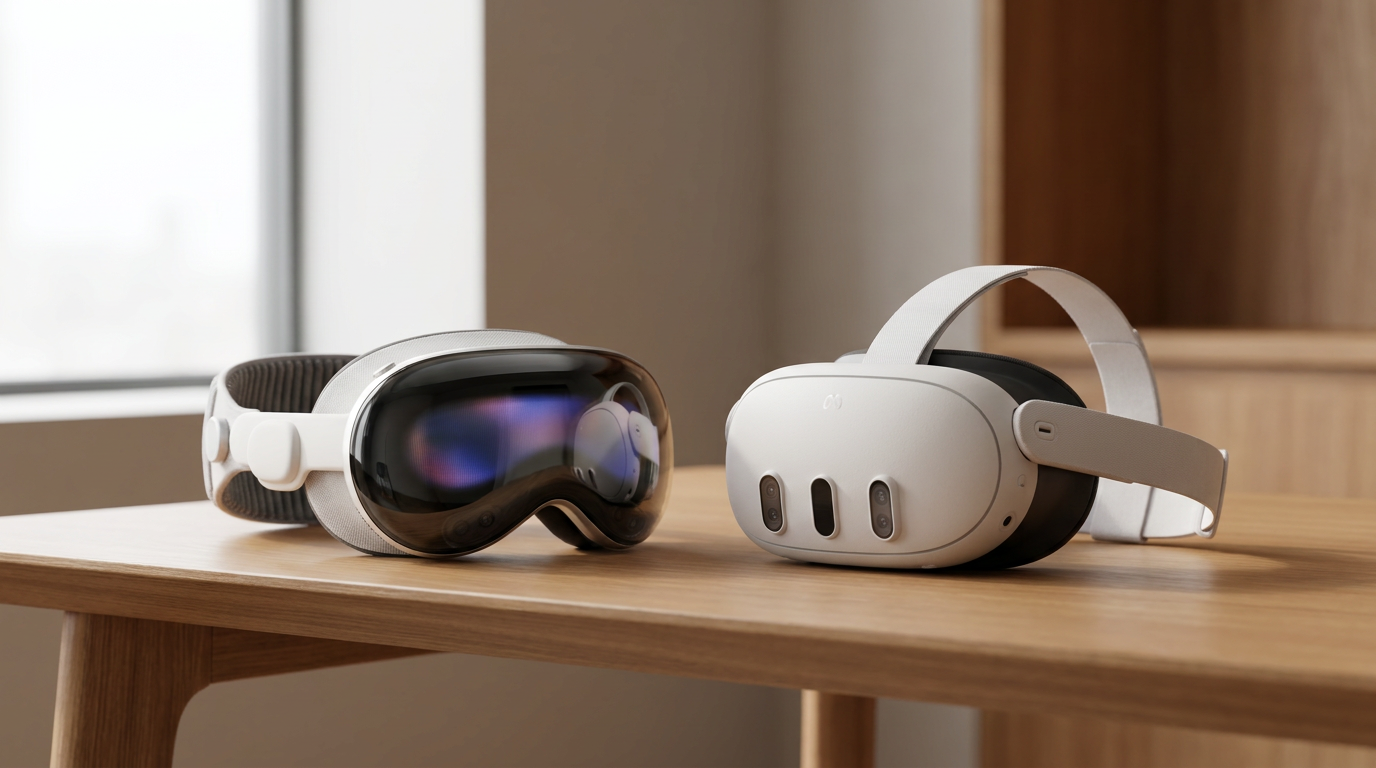
The mixed reality landscape in 2026 has matured into a tale of two distinct philosophies. On one side sits the Apple Vision Pro, a premium spatial computer designed to seamlessly blend high-fidelity digital workspaces with the physical world. On the other is the Meta Quest 3, a mass-market virtual reality powerhouse that dominates gaming and interactive media. For consumers and enterprise buyers alike, choosing between them is no longer a guessing game about future potential; it is a concrete hardware decision based on specific daily needs, budget constraints, and ecosystem loyalty. The market has clearly bifurcated, leaving buyers to decide whether they want a wearable laptop replacement or an accessible entertainment console.[1][2]
The price gap immediately defines the trade-off. At $3,499, the Apple Vision Pro costs roughly seven times as much as the $499 Meta Quest 3. This is not merely a brand premium; it reflects fundamentally different hardware architectures. The Quest 3 is built as an accessible, standalone gaming and social platform, utilizing LCD panels and plastic construction to keep costs down and durability high. The Vision Pro is engineered as a high-end computer you wear on your face, utilizing premium aluminum, glass, and dual micro-OLED displays to deliver an uncompromising visual experience. You can buy almost six Quest 3 headsets for the price of one Vision Pro, making the financial barrier the first and most significant filter for any prospective buyer.[1][2][3]
When evaluating the Apple Vision Pro, the primary argument for the device is its unmatched display clarity and seamless ecosystem integration. The evidence is found in its 23-million-pixel micro-OLED panels, which render text crisp enough for all-day reading and virtual monitors that rival physical 4K displays. Against the Vision Pro, users consistently cite its heavy 600-to-650-gram weight, the cumbersome tethered battery pack, and a lack of dedicated VR gaming titles. It relies entirely on eye and hand tracking, which feels magical for navigating menus and browsing the web, but falls short for fast-paced, tactile interactions where physical buttons are necessary.[3][5]

Conversely, the case for the Meta Quest 3 centers on its massive library of interactive content, reliable controller-based input, and standalone freedom. The evidence for its dominance lies in its deep catalog of dedicated VR games, fitness applications, and social platforms. Against the Quest 3, critics point to its lower-resolution LCD pancake lenses and grainier color passthrough, which introduce visible distortion and depth errors when reading small text or viewing fine details in the real world. Its internal battery also limits sessions to roughly two hours without an external strap, though it remains the most impressive mixed reality device available at its price point.[1][2][6]
The technical gap matters most in passthrough fidelity—the ability to see the real world through the headset's cameras. Apple Vision Pro renders the physical environment at roughly 6.5 milliseconds of latency, creating an experience that feels like looking through clear glass. Meta Quest 3's passthrough is highly functional but noticeably digital, often struggling with noise in low-light conditions. For high-end enterprise applications, such as luxury real estate walkthroughs, developers note that Apple's passthrough is required to sell the illusion of a $1.5 million condominium, whereas the Quest 3 is better suited for mid-market visualization where photorealism is less critical.[1][3][5]
The technical gap matters most in passthrough fidelity—the ability to see the real world through the headset's cameras.
Ecosystem lock-in plays a crucial role in the 2026 buyer's journey. The Vision Pro requires an Apple ID and thrives when paired with a Mac, allowing users to effortlessly mirror their laptop screens, utilize keyboards, and interact via FaceTime. The Quest 3 requires a Meta account and leans heavily on Meta's social graph and cross-platform VR multiplayer infrastructure. Furthermore, the input methods dictate the software: Apple's controller-free approach pushes developers toward productivity apps and spatial media, while Meta's Touch Plus controllers remain the gold standard for precise aiming, slicing, and grabbing in virtual environments.[1][2]

Academic institutions and enterprise teams are increasingly deploying both headsets for different tiers of work. Researchers highlight that while the Vision Pro's eye-tracking precision justifies its cost for specialized medical training and high-end design, the Quest 3 is the practical choice for scaling collaborative platforms across remote teams. The Quest 3 supports powerful 3D modeling tools and AR workflows at a fraction of the cost, allowing companies to outfit entire departments rather than just the executive suite. This dynamic has turned the Quest 3 into the default hardware for broad corporate training programs.[3][4]
Comfort remains a highly subjective but critical metric for both devices. The Vision Pro's external battery pack removes the battery weight from the user's head, which some find more comfortable for seated, 30-minute productivity sessions. However, the headset's front-heavy glass and aluminum build can still cause neck fatigue during extended use. The Quest 3, weighing 515 grams with an internal battery, places more pressure on the temples but feels significantly more balanced for active movement, standing workouts, and room-scale gaming. Both headsets require users to manage their physical endurance, as neither has completely solved the friction of wearing a computer on your face.[3][5]

Ultimately, the Apple Vision Pro fits perfectly when the user is deeply entrenched in the Apple ecosystem, requires multiple high-resolution virtual monitors for daily productivity, or wants the absolute best private cinema experience available. It is the definitive choice for developers building the next generation of spatial computing apps, luxury enterprise deployments, and early adopters who prioritize visual fidelity above all else. It does not fit when the primary goal is playing active VR games, outfitting a large team on a budget, or engaging in high-intensity fitness routines where a tethered battery would be a hazard.[1][2][5]
The Meta Quest 3 fits perfectly when the user wants a versatile, all-in-one entertainment system for gaming, socializing, and casual mixed reality. It is the ideal entry point for families, fitness enthusiasts, and budget-conscious professionals who need reliable VR capabilities without a massive financial commitment. It does not fit when the user needs to read fine text for eight hours a day, demands photorealistic passthrough, or expects a seamless extension of their macOS desktop environment. For the vast majority of consumers in 2026, the Quest 3 remains the smartest investment, while the Vision Pro stands as the ultimate luxury computing peripheral.[1][2][6]
How we got here
October 2023
Meta officially launches the Quest 3, introducing full-color passthrough to the mass market.
February 2024
Apple releases the Vision Pro in the United States, establishing the premium spatial computing category.
Mid 2025
Both platforms receive major OS updates, expanding enterprise device management and spatial video support.
Spring 2026
The mixed reality market stabilizes into two distinct tiers: premium productivity and accessible gaming.
Viewpoints in depth
Spatial Computing Purists
Advocates for high-fidelity, ecosystem-integrated productivity.
This camp, primarily composed of developers, designers, and Apple ecosystem power users, argues that the Vision Pro's $3,499 price tag is justified by its micro-OLED displays and M2 processor. They view the headset not as a gaming console, but as a legitimate replacement for a multi-monitor Mac setup. For these users, the seamless integration with iOS and macOS, combined with near-zero latency passthrough, represents the only viable path forward for professional mixed reality.
VR Gaming Enthusiasts
Users prioritizing interactive content, tactile feedback, and standalone freedom.
This perspective champions the Meta Quest 3 as the definitive headset for the masses. They argue that spatial computing is irrelevant without a deep library of interactive applications, and point to Meta's massive catalog of VR games and fitness apps as the true killer use case. This camp heavily favors the Touch Plus controllers over Apple's hand-tracking, noting that tactile feedback and precise physical inputs are non-negotiable for fast-paced gaming and room-scale virtual reality.
Enterprise & Academic Deployers
Organizations balancing hardware costs against collaborative utility.
For institutional buyers, the debate centers on return on investment and deployment scale. While they acknowledge the Vision Pro's superiority for high-stakes simulations—such as luxury real estate walkthroughs or advanced medical imaging—they often favor the Quest 3 for broad deployment. This camp emphasizes that outfitting a 20-person remote team with Quest 3s costs less than purchasing three Vision Pros, making Meta's hardware the pragmatic choice for everyday 3D collaboration and virtual training.
What we don't know
- Whether Apple will release a cheaper, non-Pro Vision headset to compete directly with Meta's pricing.
- How quickly third-party developers will port dedicated productivity applications to the Quest ecosystem.
- If future software updates can significantly improve the Vision Pro's hand-tracking latency for gaming.
Key terms
- Spatial Computing
- A technology model where digital content blends seamlessly with the physical world, allowing users to interact with virtual interfaces in their actual environment.
- Passthrough
- The feature that uses exterior cameras on a headset to display the real world on the internal screens, enabling mixed reality.
- Micro-OLED
- An advanced display technology used in the Vision Pro that packs millions of pixels into a tiny area, resulting in extreme sharpness and contrast.
- Pancake Lenses
- A type of optical lens used in modern headsets like the Quest 3 that folds light to allow for a thinner, lighter headset design.
Frequently asked
Can I play VR games on the Apple Vision Pro?
While the Vision Pro supports some spatial games and iPad titles, it lacks the dedicated VR gaming library and motion controllers found on the Meta Quest 3.
Does the Meta Quest 3 require a PC to work?
No, the Quest 3 is a standalone device that runs apps directly on the headset, though it can connect to a PC wirelessly to play high-end PC VR games.
Which headset is better for working from home?
The Apple Vision Pro is significantly better for productivity due to its high-resolution displays that make text readable and its seamless integration with Mac computers.
How long do the batteries last?
Both headsets offer roughly 2 to 2.5 hours of battery life under normal use, though both can be extended with external battery packs or by remaining plugged in.
Sources
Source coverage
6 outlets
3 viewpoints surfaced






[1]Reality AtlasVR Gaming Enthusiasts
Meta Quest 3 vs Apple Vision Pro: 2026 Comparison
Read on Reality Atlas →[2]VR.orgVR Gaming Enthusiasts
Quest 3 vs Apple Vision Pro: Is the Vision Pro Worth 6x the Price?
Read on VR.org →[3]R2USpatial Computing Purists
Apple Vision Pro vs Meta Quest for Real Estate (2026)
Read on R2U →[4]Rice UniversityEnterprise Deployers
Apple Vision Pro Vs Meta Quest 3: What U.S. Users Need to Know in 2025
Read on Rice University →[5]Tech VibesSpatial Computing Purists
Apple Vision Pro vs Meta Quest 3 | Full Comparison, Price, Features & Performance
Read on Tech Vibes →[6]CNETEnterprise Deployers
Best VR Headsets of 2026: My Favorite Hardware Right Now
Read on CNET →
Every angle. Every day.
Get meta stories with full source coverage and perspective breakdowns delivered to your inbox.