
How Enhanced Geothermal Systems Are Unlocking Limitless Clean Energy
By adapting drilling techniques from the oil and gas industry, engineers are creating artificial underground reservoirs to extract clean, 24/7 baseload power from hot dry rock.
By Factlen Editorial Team
- Geothermal Developers
- Focus on rapid scaling, technology transfer, and commercial viability.
- Energy Policymakers
- Focus on grid stability, decarbonization, and regulatory frameworks.
- Environmental & Safety Watchdogs
- Focus on mitigating induced seismicity and managing water usage.
What's not represented
- · Local communities near drilling sites concerned about industrialization and water rights
- · Fossil fuel workers transitioning into the geothermal sector
Why this matters
As the world races to decarbonize, the electrical grid desperately needs power sources that run 24/7 when the sun isn't shining and the wind isn't blowing. Enhanced Geothermal Systems could unlock a nearly limitless supply of firm, clean energy anywhere on the planet, fundamentally solving the hardest problem of the climate transition.
Key points
- Enhanced Geothermal Systems (EGS) create artificial underground reservoirs to extract heat from dry rock.
- The technology adapts horizontal drilling and hydraulic fracturing techniques from the oil and gas industry.
- Unlike traditional geothermal, EGS can theoretically be deployed anywhere in the world.
- Fervo Energy's Cape Station in Utah is scaling to 500 MW, proving commercial viability.
- The IEA projects next-generation geothermal could meet 15% of global electricity demand growth by 2050.
- Challenges include high drilling costs, water consumption, and managing induced seismicity.
The global energy transition has a "firm power" problem. While solar and wind capacity has exploded over the last decade, these resources are inherently intermittent—they only generate electricity when the sun shines or the wind blows. To maintain a stable electrical grid, operators need baseload power that can run twenty-four hours a day, seven days a week.[2]
Historically, that baseload reliability has been provided by coal, natural gas, and nuclear power. Traditional geothermal energy also offers firm, carbon-free power, but it comes with a severe geographic limitation. It requires a rare geological trifecta: underground heat, naturally occurring fluid, and permeable rock. Consequently, conventional geothermal plants are largely confined to volcanic hotspots and tectonic boundaries, such as Iceland, New Zealand, or the geysers of Northern California.[1]
A breakthrough technology known as Enhanced Geothermal Systems (EGS) is fundamentally rewriting those geographic rules. The core premise of EGS is simple but revolutionary: the Earth's crust is universally hot if you drill deep enough. If a location has the heat but lacks the natural fluid and permeability, engineers can artificially create the missing ingredients.[1]
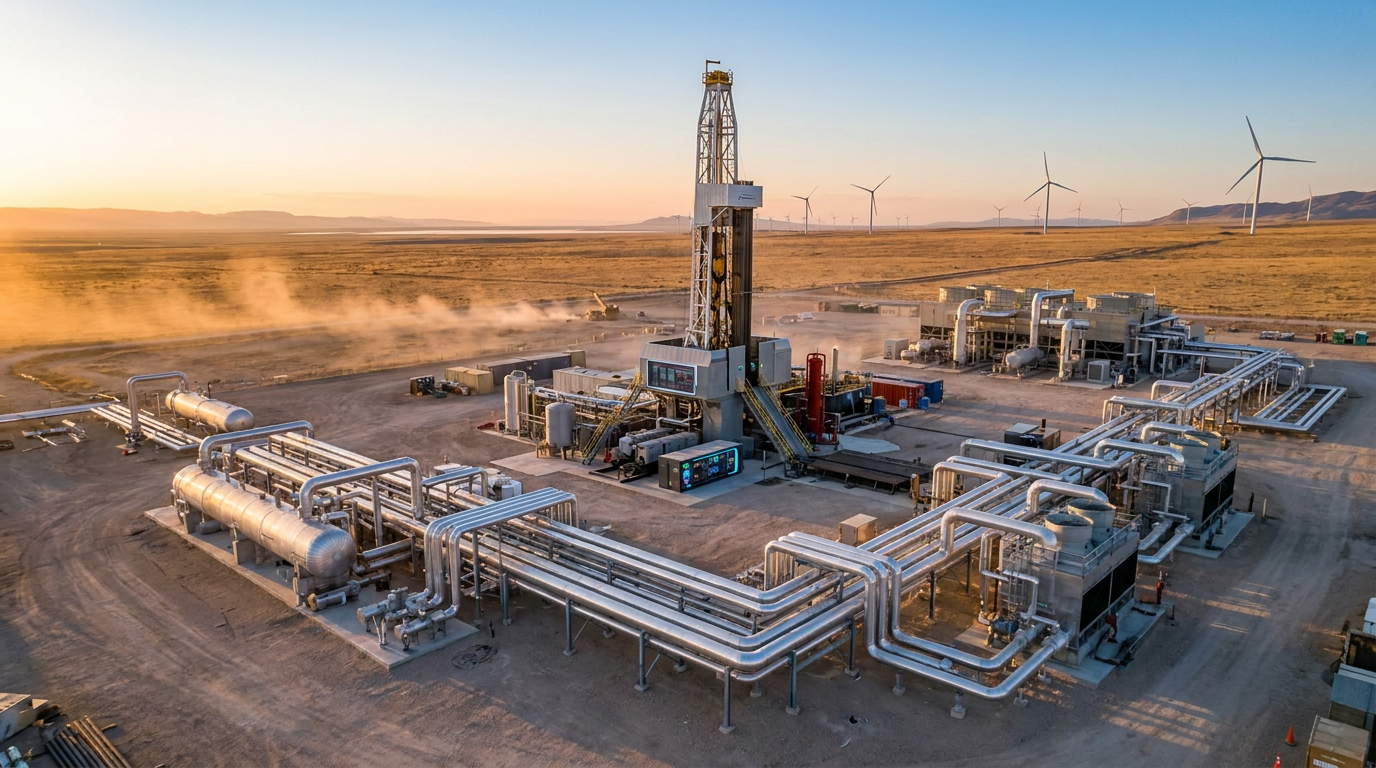
The process begins with advanced drilling. Using horizontal drilling techniques perfected over the last two decades by the shale oil and gas industry, engineers drill vertically for thousands of feet before turning the drill bit horizontally through the hot, dry, crystalline basement rock.[3]
Once the wells are drilled, the rock must be made permeable. Operators use hydraulic stimulation—injecting water under carefully controlled high pressure—to pry open pre-existing, millimeter-thick fractures in the deep rock. This creates a vast, interconnected web of tiny fissures, effectively turning the solid rock into a massive underground radiator.[1][5]

With the artificial reservoir established, the system operates as a closed loop. Cold water is pumped down an injection well and forced through the newly created fracture network. As the water travels through the hot rock, it absorbs the Earth's thermal energy. The superheated fluid is then drawn up through a separate production well to the surface, where its heat is transferred to a working fluid that spins a turbine and generates electricity.[1]
After years of pilot testing, EGS is now moving from the laboratory to commercial reality. The vanguard of this shift is Fervo Energy, a Texas-based developer currently constructing Cape Station in Beaver County, Utah. Scheduled to begin delivering power to the grid in late 2026, Cape Station is designed to eventually reach 500 megawatts of capacity—enough to power hundreds of thousands of homes.[3]
After years of pilot testing, EGS is now moving from the laboratory to commercial reality.
The rapid maturation of EGS is largely a story of technology transfer. The geothermal industry is actively absorbing the workforce, supply chains, and innovations of the fossil fuel sector. The same directional drilling, fiber-optic well monitoring, and hydraulic fracturing techniques that unlocked vast reserves of shale gas are now being repurposed to extract clean, inexhaustible heat.[3][6]
Beyond standard EGS, researchers are already pushing toward the next frontier: superhot rock (SHR) geothermal. While current EGS projects target rock temperatures around 200°C (392°F), SHR initiatives aim for depths where temperatures exceed 375°C (707°F).[4]
At these extreme temperatures, water enters a "supercritical" state, behaving as both a liquid and a gas. Supercritical fluid can carry exponentially more thermal energy than standard hot water. In early 2026, startups achieved record temperatures of 331°C at test sites in Oregon, backed by U.S. government funding, signaling that commercial superhot geothermal may be viable within the decade.[4]
The economic implications of unlocking geothermal energy at a global scale are staggering. According to a 2026 report by the International Energy Agency (IEA), next-generation geothermal technologies could meet up to 15% of the growth in global electricity demand by 2050.[2]

Investors are taking notice. The IEA tracks that $2.2 billion was invested in new-generation geothermal energy in 2025 alone, an 80% increase from the previous year. If costs continue to fall, EGS could eventually become highly competitive with solar and wind paired with battery storage, while requiring a fraction of the surface land area.[2][6]
Despite the momentum, EGS faces formidable technical and environmental hurdles. The primary barrier is cost. Drilling into hard, abrasive igneous rock at extreme temperatures degrades drill bits rapidly and fries delicate downhole electronics, making well construction heavily capital-intensive.[5]

Environmentally, the hydraulic stimulation process carries the risk of induced seismicity. Injecting high-pressure fluids into the subsurface can alter the stress on dormant fault lines, occasionally triggering small earthquakes. While most induced seismic events are micro-earthquakes imperceptible at the surface, projects require rigorous geological surveying and real-time seismic monitoring to safely manage the risk.[5]
Water consumption presents another localized challenge. EGS reservoirs require millions of gallons of water for the initial stimulation phase, and the closed-loop systems inevitably lose a small percentage of their circulating fluid over time. Because many prime EGS sites are located in arid regions like the American Southwest, developers must secure sustainable water rights or innovate with alternative working fluids.[5][6]
Ultimately, Enhanced Geothermal Systems offer a tantalizing prize for the climate transition. By decoupling geothermal energy from volcanic geography, EGS has the potential to provide the holy grail of modern power grids: the 24/7 reliability of a fossil fuel plant, powered entirely by the heat beneath our feet.[1][6]
How we got here
1977
The first experimental hot dry rock geothermal project is implemented at Fenton Hill, New Mexico.
2021
The U.S. Department of Energy launches the Enhanced Geothermal Shot to dramatically reduce the cost of EGS.
2023
Fervo Energy successfully completes Project Red in Nevada, proving the commercial viability of horizontal drilling for geothermal.
2025
Global investment in next-generation geothermal surges to $2.2 billion.
Early 2026
Startups achieve record temperatures exceeding 330°C in superhot rock testing.
Late 2026
Fervo Energy's Cape Station in Utah is scheduled to begin delivering its first power to the grid.
Viewpoints in depth
Geothermal Developers
Focus on rapid scaling, technology transfer from the oil and gas sector, and achieving commercial viability.
Developers argue that the fastest way to scale clean baseload power is to leverage the existing expertise of the fossil fuel industry. By adapting horizontal drilling and hydraulic fracturing techniques, they believe EGS can rapidly move down the cost curve. They emphasize that the technology is no longer theoretical, pointing to successful multi-megawatt pilot plants and massive greenfield projects currently under construction as proof that geothermal is ready for grid-scale deployment.
Energy Policymakers
Focus on grid stability, deep decarbonization, and establishing supportive regulatory frameworks.
For policymakers and international energy agencies, EGS is the missing puzzle piece in the energy transition. They view firm, dispatchable clean energy as essential to backing up intermittent renewables like solar and wind. Their primary focus is on de-risking early-stage projects through government grants, streamlining the notoriously slow permitting process for drilling on public lands, and ensuring that electricity markets properly value 24/7 reliability.
Environmental & Safety Watchdogs
Focus on mitigating induced seismicity, managing water usage, and ensuring long-term reservoir sustainability.
While generally supportive of carbon-free energy, environmental watchdogs caution that EGS must be scaled responsibly. They point to historical instances where deep fluid injection triggered noticeable earthquakes, arguing for strict seismic monitoring and transparent community engagement. Additionally, they highlight the tension of requiring millions of gallons of water for hydraulic stimulation in arid, drought-prone regions, urging developers to prioritize water recycling and alternative working fluids.
What we don't know
- Whether drilling costs can be reduced enough to make EGS cost-competitive with solar and wind in all markets.
- How long artificially created fracture networks will remain open and productive before requiring re-stimulation.
- If superhot rock (SHR) geothermal can overcome the extreme material science challenges of operating above 375°C.
Key terms
- Enhanced Geothermal Systems (EGS)
- A technology that generates geothermal electricity by creating artificial reservoirs in hot, dry rock where natural permeability is lacking.
- Baseload Power
- The minimum amount of electric power needed to be supplied to the electrical grid at any given time, requiring power plants that can run 24/7.
- Hydraulic Stimulation
- The process of injecting high-pressure fluid into rock formations to create or widen fractures, increasing permeability.
- Superhot Rock Geothermal
- An advanced form of EGS that targets rock temperatures above 375°C, where water reaches a supercritical state, yielding exponentially more energy.
- Permeability
- The ability of a rock formation to allow fluids to pass through its pores and fractures.
- Induced Seismicity
- Minor earthquakes and tremors that are caused by human activity, such as fluid injection or extraction from the earth's crust.
Frequently asked
What is the difference between traditional geothermal and EGS?
Traditional geothermal relies on naturally occurring underground hot water reservoirs. EGS creates artificial reservoirs in hot, dry rock by injecting water and creating fractures.
Is EGS the same as fracking for oil and gas?
It uses similar hydraulic stimulation techniques, but instead of extracting hydrocarbons, it circulates water in a closed loop to extract heat. It also uses significantly fewer chemical additives.
Can EGS cause earthquakes?
Yes, the fluid injection process can cause "induced seismicity"—typically micro-earthquakes. Projects use advanced seismic monitoring to manage and mitigate this risk.
Where can EGS be built?
Unlike traditional geothermal, which is limited to tectonic hotspots, EGS can theoretically be built anywhere in the world if developers drill deep enough to reach hot rock.
Sources
Source coverage
6 outlets
3 viewpoints surfaced






[1]U.S. Department of EnergyEnergy Policymakers
What is an Enhanced Geothermal System (EGS)?
Read on U.S. Department of Energy →[2]International Energy AgencyEnergy Policymakers
The Future of Geothermal Energy
Read on International Energy Agency →[3]Fervo EnergyGeothermal Developers
Cape Station: Ushering in a New Era for Enhanced Geothermal
Read on Fervo Energy →[4]Clean Air Task ForceEnvironmental & Safety Watchdogs
IEA's State of Energy Innovation 2026 Report Highlights Superhot Rock Geothermal
Read on Clean Air Task Force →[5]Stanford UniversityEnvironmental & Safety Watchdogs
JASON Review of Enhanced Geothermal Systems
Read on Stanford University →[6]Factlen Editorial TeamEnvironmental & Safety Watchdogs
Synthesis by Factlen editorial team
Read on Factlen Editorial Team →

Every angle. Every day.
Get guides stories with full source coverage and perspective breakdowns delivered to your inbox.