
NHL and IIHF Mandate Neck Guards for New Players Starting in 2026
Under a new collective bargaining agreement, the NHL will require all incoming players to wear cut-resistant neck guards beginning in the 2026-2027 season, while the IIHF has confirmed a blanket mandate for the 2026 Winter Olympics.

The National Hockey League and the NHL Players' Association have reached a landmark agreement in their latest collective bargaining negotiations, officially mandating the use of cut-resistant neck guards for all new players entering the league. Starting in the 2026-2027 season, the protective gear will transition from an optional accessory to a strictly enforced requirement for incoming rookies.
This policy shift represents one of the most significant generational changes to hockey equipment standards in the modern era, closing a critical vulnerability in player safety. By embedding the mandate within the collective bargaining agreement, the league has ensured that the next generation of professional athletes will be universally protected against catastrophic skate lacerations.
While the mandate establishes a new baseline for safety, a significant grandfather clause is built into the agreement to accommodate current professionals. Under the newly negotiated terms, any player who has logged at least one regular-season NHL game prior to the start of the 2026-2027 campaign will be entirely exempt from the requirement.
For these established veterans, the decision to wear a laceration protector will remain a matter of personal discretion rather than league policy. This compromise mirrors the NHL's historical approach to implementing major equipment changes, balancing the urgent push for improved occupational safety with the deeply ingrained preferences of veteran athletes who have spent decades playing without the gear.[3]
The catalyst for this sweeping safety reform was the tragic death of 29-year-old American forward Adam Johnson in October 2023. While playing for the Nottingham Panthers in the United Kingdom's Elite Ice Hockey League, Johnson suffered a fatal skate laceration to his throat during a high-speed, on-ice collision.
The devastating nature of the incident, which occurred in front of thousands of spectators, sent immediate shockwaves through the global hockey community. It served as a grim wake-up call that the speed, power, and physicality of modern hockey had fundamentally outpaced traditional equipment standards, leaving players exposed to rare but life-threatening injuries.
In the immediate aftermath of Johnson's death, a cascade of safety mandates swept through the lower levels of the sport. Within months, the Canadian Hockey League's three major junior branches—the Western Hockey League, the Ontario Hockey League, and the Quebec Maritimes Junior Hockey League—instituted strict neck guard requirements for all players.
The American Hockey League and the United States Hockey League quickly followed suit, ensuring that the primary developmental pipelines for the NHL were fully compliant. The NHL itself remained the last major holdout, heavily constrained by the rigid legal terms of its existing collective bargaining agreement, which prevented the league from unilaterally forcing equipment changes on its unionized workforce.
While the NHL navigated its complex labor negotiations, the International Ice Hockey Federation (IIHF) moved decisively to close any remaining loopholes in international competition. The global governing body recently confirmed that laceration neck protectors will be strictly mandatory for all players participating in the 2026 Winter Olympics in Milan-Cortina.
This sweeping directive applies to all levels of IIHF competition, including the men's and women's senior tournaments, ensuring that the world's most prestigious international stage will feature universal compliance. The IIHF's proactive stance effectively forces the hand of many professional players who might otherwise have avoided the gear.[1][2]
Crucially, the IIHF's Olympic mandate applies universally, meaning there are no grandfather clauses for veteran superstars. Even NHL players who are legally exempt from wearing neck guards during the domestic 2026-2027 season will be forced to don the protective equipment if they wish to represent their respective countries in Italy.
This creates a unique dynamic where the world's top athletes will have to adapt to the gear mid-season to chase a gold medal. For many national team executives, the Olympic rule serves as a convenient bridge, exposing stubborn veterans to modern protective technology in a high-stakes environment where compliance is non-negotiable.[1]
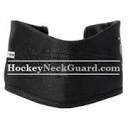
The mechanism and design of modern neck protection have evolved dramatically from the bulky, restrictive foam collars worn by youth players in the 1990s. Today's laceration protectors are highly engineered garments woven from advanced, cut-resistant synthetic fibers. Materials such as Kevlar, Dyneema, and Spectra are utilized for their extraordinary tensile strength, which is specifically designed to withstand the razor-sharp edge of a stainless-steel skate blade traveling at high velocity. These high-performance polymers offer elite puncture and slice resistance while remaining incredibly lightweight, addressing the primary functional requirements of professional athletes.[3]
To combat longstanding player complaints regarding heat retention and restricted mobility, equipment manufacturers have integrated these cut-resistant materials directly into moisture-wicking base layers. Rather than wearing a separate, detached collar that can shift or chafe during play, modern players wear seamless turtlenecks that anchor the protective fabric securely over the carotid artery and jugular vein.
This integrated design ensures that the player's range of motion—particularly their ability to quickly swivel their head to track the puck—remains entirely uninhibited. The breathable fabrics also help regulate body temperature, eliminating the suffocating feeling that caused previous generations of players to reject the gear.[3]
Despite these significant technological advancements, voluntary adoption among current NHL veterans remains highly polarized. A subset of players, led by vocal advocates like veteran forward T.J. Oshie, immediately embraced the gear following the 2023 tragedy, prioritizing long-term safety and setting an example for younger athletes. Oshie even launched his own line of cut-resistant apparel to help normalize the equipment.
However, a substantial portion of the league's older demographic has actively resisted the transition. These traditionalists argue that hockey is an inherently dangerous profession, and they prefer to assume the statistical risk of a laceration rather than alter their established physical routines and comfort levels on the ice.
The NHL's reliance on a grandfather clause to implement this mandate directly mirrors the league's historical approach to phasing in controversial safety equipment. In 1979, the league mandated helmets for all incoming players while allowing established veterans to continue playing bareheaded—a transition that took nearly two decades to complete before the last helmetless player retired.
Similarly, mandatory visors were introduced in 2013 exclusively for new players, slowly phasing out the unprotected face over the subsequent decade. By forcing the neck guard requirement only on incoming rookies, the league avoids a contentious labor battle while guaranteeing that the sport will eventually achieve universal compliance.
Because today's incoming rookies have already been subjected to neck guard mandates throughout their junior and minor league careers, the transition to the NHL level is expected to be entirely seamless for the next generation.
These young athletes have spent their formative developmental years wearing cut-resistant turtlenecks, rendering the equipment as normal and unquestioned as shin guards or shoulder pads. As the current crop of grandfathered veterans gradually ages out of the sport, the sight of an unprotected neck on an NHL broadcast will become increasingly rare, eventually fading into a historical footnote.
Ultimately, the simultaneous mandates from the NHL and the IIHF represent the final, definitive victory for player safety advocates in the laceration protection debate. While it took a devastating tragedy to accelerate the timeline, the global hockey infrastructure has successfully aligned to protect its athletes from one of the sport's most gruesome risks.
As the 2026-2027 season approaches, the focus will shift from debating the necessity of the gear to refining its design, ensuring that the fastest game on ice remains as safe as technologically possible without sacrificing the speed and skill that define it.[1]
Key points
- The NHL will mandate cut-resistant neck guards for all new players starting in the 2026-2027 season.
- Players with at least one NHL game prior to the 2026-27 season are exempt under a grandfather clause.
- The IIHF has confirmed a strict neck guard mandate for all players at the 2026 Winter Olympics in Milan-Cortina.
- The global push for neck protection was catalyzed by the fatal skate laceration suffered by Adam Johnson in 2023.
- Modern neck guards utilize advanced synthetic fibers integrated into base layers to maximize comfort and mobility.
How we got here
Oct 2023
Former NHL player Adam Johnson suffers a fatal skate laceration during an EIHL game in the UK.
Nov 2023
The WHL, OHL, and QMJHL institute mandatory neck guard policies for all junior players.
Aug 2024
The American Hockey League (AHL) mandates neck protection for the 2024-25 season.
Nov 2025
The IIHF confirms neck guards will be mandatory for the 2026 Winter Olympics.
Jun 2026
The NHL and NHLPA agree to mandate neck guards for incoming players starting in 2026-27.
- Player Safety Advocates
- Argue that universal mandates are a moral imperative to prevent catastrophic injuries.
- Player Autonomy Proponents
- Believe veteran players should have the right to choose their own equipment based on comfort.
- Equipment Innovators
- Focus on engineering lightweight, cut-resistant fabrics to make the gear imperceptible.
Perspectives this story doesn't cover
- Minor league and youth hockey administrators managing the supply chain for cut-resistant gear.
- Medical trauma staff who treat on-ice lacerations.
Sources
Source coverage
3 outlets
3 viewpoints surfaced


- [1]SportsnetPlayer Safety Advocates
Report: IIHF says neck guards will be mandatory at 2026 Winter Olympics
Read on Sportsnet → - [2]Inside The GamesPlayer Autonomy Proponents
Ice Hockey: Winter Games to feature extra protective gear
Read on Inside The Games → - [3]HockeyNeckGuardEquipment Innovators
Neck Guards will be Mandatory for all New NHL Players Beginning in 2026/27 Season
Read on HockeyNeckGuard →
More in Sports
See all →Standings
Frölunda Stays Perfect, But Färjestad's Defense Defines the Early SHL Race
5 sources
Player Retirements
Alex Ovechkin Announces 2026-27 Season Will Be His Last in the NHL
5 sources

Storyline
From Birthday Goals to Debut Laps: The 2026 NHL Rookie Class Arrives
6 sources
Preview
Flames and Canucks clash in Vancouver as 2024 draft picks Parekh and Buium meet
3 sources

Comments
Every angle. Every day.
Get Sports stories with full source coverage and perspective breakdowns, free every day.