
The Science of Emulsification: How to Master Pan Sauces and Vinaigrettes
Understanding the fluid dynamics and molecular biology behind culinary emulsions can turn unpredictable kitchen tasks into foolproof science. From the sheer power of an egg yolk to modern immersion blender hacks, mastering emulsions frees home cooks from store-bought dressings.
By Factlen Editorial Team
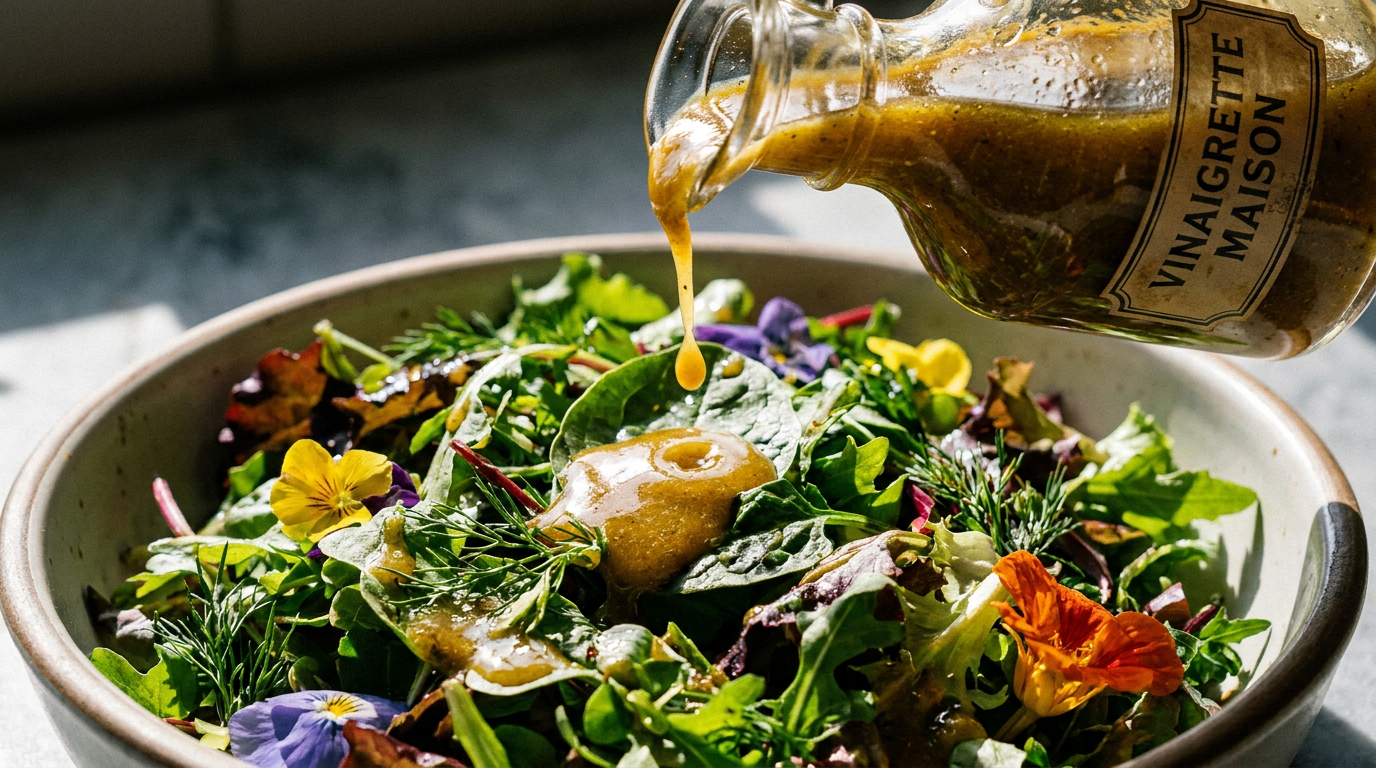
- Culinary Scientists
- Focus on the molecular interactions, fluid dynamics, and physical forces that govern food.
- Practical Home Cooks
- Focus on foolproof methods, shortcuts, and reliable kitchen techniques.
- Food Science Educators
- Focus on empowering readers to understand the underlying physics to improve everyday cooking.
What's not represented
- · Commercial Food Manufacturers
Why this matters
Mastering emulsions is the secret difference between amateur cooking and restaurant-quality food. By understanding the simple physics of oil and water, you can stop buying processed bottled dressings and confidently create healthier, better-tasting sauces from basic pantry staples in minutes.
Key points
- Emulsions force naturally repellent liquids, like oil and water, to permanently mix by breaking one into microscopic droplets.
- Emulsifiers, such as the lecithin found in egg yolks, coat these droplets with an electrical charge that prevents them from merging back together.
- A single egg yolk possesses enough emulsifying power to theoretically stabilize up to 100 cups of oil.
- Adding a half-teaspoon of mayonnaise to a standard vinaigrette provides enough lecithin to keep the dressing perfectly mixed for days.
The transformation that occurs in a mixing bowl feels remarkably like culinary alchemy. You begin with a pool of sharp, watery vinegar and a slick of dense, heavy oil—two liquids that fundamentally refuse to mix due to their opposing chemical natures. Yet, with a few vigorous flicks of a wire whisk or the whir of a blender blade, they miraculously bind together. They transform from a separated, greasy puddle into a thick, creamy, unified sauce that clings perfectly to a piece of crisp lettuce or a roasted vegetable. This is the magic of an emulsion, a process that sits at the very heart of classical cooking and modern culinary science alike.[4]
Whether it is a classic French vinaigrette dressing a delicate salad, a glossy homemade mayonnaise spread across a sandwich, or a rich, savory pan sauce mounted with cold butter to finish a seared steak, emulsions form the structural backbone of savory cooking. But behind the rhythmic whisking lies a fascinating, invisible world of fluid dynamics and molecular biology. Understanding the underlying science of how these complex sauces come together—and exactly why they sometimes disastrously fall apart—can elevate a home cook's repertoire from unpredictable guesswork to foolproof mastery. It transforms the kitchen into a laboratory where the cook has total control over the final texture.[4]
The core problem that every cook faces when making a dressing is chemical incompatibility. Water molecules—which make up the bulk of vinegar, lemon juice, and wine—are polar, meaning they possess a slight electrical charge that makes them highly attracted to one another. Oil molecules, on the other hand, are non-polar and carry no such electrical charge. When the two liquids are poured into the same container, the water molecules aggressively seek each other out, bonding tightly and physically squeezing the oil molecules out of the way. Left to their own devices, the two liquids will always separate into distinct, impenetrable layers, with the lighter oil floating stubbornly on top.[2]
To force these warring liquids to coexist peacefully, a cook must create an emulsion: a specialized mixture in which one liquid is violently broken apart into microscopic droplets and permanently suspended throughout the other. In the language of food science, the liquid that is broken apart is known as the "dispersed phase," while the liquid that surrounds and suspends it is called the "continuous phase." In a classic mayonnaise, for example, liquid oil acts as the dispersed phase, suspended within a continuous phase of water provided by the egg yolks and lemon juice. The continuous phase dictates how the sauce feels on the tongue, which is why a properly made mayonnaise feels creamy rather than greasy.[1]

Creating these microscopic droplets requires the application of sheer mechanical force to physically shatter the oil. When a cook vigorously whisks oil into a bowl of vinegar or egg yolks, the physical shearing action of the metal tines tears the oil apart into smaller and smaller microscopic spheres. The scale of this physical transformation is staggering. According to the renowned food scientist Harold McGee, beating just one single tablespoon of oil into a batch of mayonnaise breaks that small dollop of fat into roughly 30 billion individual droplets. This massive multiplication of surface area is what causes the liquid oil to suddenly behave like a thick, semi-solid gel.[2]
However, mechanical force alone is only a temporary fix for the problem of separation. If you vigorously shake a jar of oil and vinegar, it will look cloudy and unified for a few minutes, but without chemical intervention, those 30 billion microscopic droplets will eventually bump into each other. When they collide, they merge back together, coalescing until the mixture separates completely into a greasy puddle. To keep the droplets permanently suspended and prevent them from finding one another, the mixture requires a chemical mediator known as an emulsifier to stand between them.[2]
Emulsifiers are fascinating molecules that possess a split personality, allowing them to bridge the gap between oil and water. One end of the emulsifier molecule is hydrophilic, meaning it is strongly attracted to water, while the opposite end is hydrophobic, meaning it repels water but eagerly bonds with oil. When introduced into a vigorously whisked sauce, these molecules race to the microscopic boundaries between the shattered oil droplets and the surrounding water. They bury their hydrophobic tails deep into the oil droplets, leaving their hydrophilic heads facing outward into the watery continuous phase.[1]
Emulsifiers are fascinating molecules that possess a split personality, allowing them to bridge the gap between oil and water.
This molecular arrangement creates a highly protective, electrically charged shield around every single microscopic drop of oil in the bowl. Because the outward-facing hydrophilic heads all carry the exact same electrical charge, the coated oil droplets actively repel each other, much like the opposing poles of two magnets. No matter how closely they are packed together in the sauce, they can no longer merge. The emulsion becomes completely stable, locking the oil and water together in a smooth, creamy matrix that can hold its shape for days or even weeks without separating.[1]
In the culinary world, the undisputed king of natural emulsifiers is the humble egg yolk. Yolks are densely packed with lecithin and complex low-density lipoprotein (LDL) particles, both of which are incredibly potent emulsifying agents designed by nature to keep the fat and water inside the egg perfectly mixed. McGee's laboratory experiments revealed that the emulsifying power of a single egg yolk is so vast that it can theoretically stabilize up to 100 cups of oil. The only catch is that the cook must continuously add small amounts of water to the bowl to maintain enough volume in the continuous phase to house all those coated oil droplets.[2]

Vinaigrettes, however, rarely contain egg yolks, which makes them inherently much less stable than mayonnaise or hollandaise. The traditional French method for stabilizing a vinaigrette relies heavily on Dijon mustard. Mustard seeds contain mucilage—a complex carbohydrate that thickens the water phase of the dressing and provides mild emulsifying properties. But while mustard helps, it is often not strong enough to hold a vinaigrette together for more than a few hours before the oil begins to pool at the edges of the salad bowl, leaving the greens unevenly dressed.[1]
To solve this persistent kitchen problem, the culinary researchers at America's Test Kitchen conducted extensive stability tests on various dressing formulations. They discovered a brilliant, foolproof shortcut: while mustard adds crucial flavor, adding just a half-teaspoon of store-bought mayonnaise to a standard vinaigrette recipe introduces enough egg-yolk lecithin to lock the dressing together permanently. The tiny amount of mayonnaise is completely undetectable on the palate, but its chemical power is enough to keep the vinaigrette perfectly emulsified in the refrigerator for days, ensuring a flawless coating on every leaf of lettuce.[1]
Beyond chemical hacks, modern kitchen technology has also revolutionized the physical act of emulsifying sauces. For generations, making a proper mayonnaise required the cook to slowly drip oil into a bowl drop by agonizing drop while whisking frantically by hand—a tedious process that was highly prone to failure if the oil was added even a fraction too quickly. Today, the "immersion blender method," popularized by culinary outlets like Serious Eats, has completely bypassed the need for manual whisking, making the process practically foolproof and incredibly fast.[3]

The immersion blender technique relies on simple gravity and fluid dynamics to do the hard work. The cook places an egg, an acid like lemon juice, and a dab of mustard at the very bottom of a narrow, cylindrical jar, and then pours a full cup of oil directly on top. Because the oil is less dense than the water-based ingredients, it floats cleanly on the surface. When the immersion blender is activated at the very bottom of the jar, its rapidly spinning blades create a powerful vortex that slowly pulls the floating oil down into the blades drop by drop, perfectly regulating the flow and creating a thick, stable mayonnaise in under two minutes.[3]
Despite all these chemical tricks and technological shortcuts, emulsions can still occasionally "break" if the cook pushes the science too far. A sauce breaks when oil is added faster than the whisk can shatter it, or if the mixture gets too hot, causing the proteins to denature and drop their protective shields. When a sauce breaks, the oil rapidly pools into an unappetizing, greasy slick. Fortunately, science offers a reliable rescue mission: a broken emulsion can almost always be fixed by placing a small amount of water or a fresh egg yolk in a clean bowl, and slowly whisking the broken sauce into it, re-establishing the dispersed phase from scratch.[2]

Mastering the science of emulsification is one of the most empowering skills a home cook can acquire, freeing them entirely from the grocery store aisle of bottled dressings and processed sauces. Armed with a basic understanding of hydrophilic bonds, mechanical shear, and the sheer chemical power of an egg yolk, anyone can take control of their ingredients. It allows cooks to turn basic pantry staples into restaurant-quality vinaigrettes, velvety pan sauces, and perfect mayonnaise on demand, proving that the best cooking is just delicious applied science.[4]
Viewpoints in depth
Culinary Scientists
Focus on the molecular interactions and physical forces that govern food.
For food scientists and researchers, cooking is applied chemistry and physics. They view an emulsion not just as a sauce, but as a complex colloidal suspension governed by fluid dynamics and molecular charges. By studying the exact behavior of phospholipids like lecithin and measuring the surface area of dispersed droplets, they can calculate the theoretical limits of ingredients—such as Harold McGee's discovery that a single egg yolk can stabilize 100 cups of oil.
Practical Home Cooks
Focus on foolproof methods, shortcuts, and reliable kitchen techniques.
Test kitchens and recipe developers prioritize reliability over theoretical limits. While they rely on the science of emulsification, their goal is to translate that science into foolproof techniques for the home kitchen. This camp champions innovations like the immersion blender method for mayonnaise or adding a dab of store-bought mayo to a vinaigrette—hacks that bypass the tedious classical methods and guarantee a stable sauce every time.
Commercial Food Manufacturers
Focus on long-term shelf stability and industrial-scale production.
While home cooks rely on egg yolks and mustard, industrial food producers must ensure that bottled dressings remain emulsified on supermarket shelves for months or years. This perspective relies on powerful commercial stabilizers and thickeners, such as xanthan gum, polysorbates, and modified food starches, which lock the dispersed phase in place far longer than natural culinary emulsifiers ever could.
What we don't know
- While we know LDL particles in egg yolks are powerful emulsifiers, the exact mechanism of how they break down at the oil-water interface is still an active area of molecular study.
- The precise mathematical threshold where mechanical shear force begins to damage or denature delicate culinary proteins remains difficult to calculate for home kitchens.
Key terms
- Emulsion
- A stable mixture of two liquids that normally do not mix, such as oil and water.
- Emulsifier
- A molecule with a water-loving end and an oil-loving end that prevents oil droplets from merging.
- Dispersed Phase
- The liquid that is broken apart into microscopic droplets within an emulsion.
- Continuous Phase
- The liquid that surrounds and suspends the microscopic droplets in an emulsion.
- Hydrophilic
- Having a strong chemical attraction to water.
Frequently asked
Why did my mayonnaise break?
Mayonnaise breaks when oil is added faster than it can be broken into droplets and coated by emulsifiers, causing the oil to pool together into a greasy slick.
Can I fix a broken emulsion?
Yes. Place a teaspoon of water or a fresh egg yolk in a clean bowl, and slowly whisk the broken sauce into it drop by drop to re-establish the suspension.
Does mustard actually emulsify vinaigrettes?
Mustard contains mucilage, which thickens the water phase and provides mild stability, but adding a tiny dab of mayonnaise works much better for long-term stability.
Why use an immersion blender for mayo?
In a narrow jar, an immersion blender creates a vortex that pulls floating oil down drop by drop, perfectly regulating the emulsification process without manual whisking.
Sources
Source coverage
4 outlets
3 viewpoints surfaced




[1]America's Test KitchenPractical Home Cooks
The Science of Emulsions and Foolproof Vinaigrettes
Read on America's Test Kitchen →[2]On Food and CookingCulinary Scientists
On Food and Cooking: The Science and Lore of the Kitchen
Read on On Food and Cooking →[3]Serious EatsPractical Home Cooks
Two-Minute Mayonnaise Recipe
Read on Serious Eats →[4]Factlen Editorial TeamFood Science Educators
Synthesis by Factlen editorial team
Read on Factlen Editorial Team →
Every angle. Every day.
Get food drink stories with full source coverage and perspective breakdowns delivered to your inbox.