
How C2PA and SynthID Are Solving the AI Deepfake Problem
As synthetic media threatens digital trust, a new architecture combining cryptographic metadata and invisible watermarking is proving the authenticity of online content.
By Factlen Editorial Team
- Provenance Standard Advocates
- Focus on cryptographic metadata to establish a verifiable chain of custody for digital media.
- Algorithmic Watermarking Pioneers
- Focus on embedding resilient, imperceptible signals directly into the content to survive metadata stripping.
- Policy & Security Regulators
- Focus on mandatory transparency and standardized labeling to protect public trust.
- Industry Forecasters
- Analyze the scale of synthetic media adoption and the market impact of new trust architectures.
What's not represented
- · Independent Creators
- · Open-Source Model Developers
Why this matters
As AI makes synthetic media visually indistinguishable from reality, the internet is losing its shared baseline of truth. The widespread adoption of C2PA and SynthID represents the internet's new immune system—giving you the tools to verify whether a breaking news photo, a viral video, or a political statement is authentic or algorithmically generated.
Key points
- Deepfake incidents surged 900% between 2023 and 2025, prompting a shift from detection to cryptographic provenance.
- C2PA acts as a digital 'nutrition label,' embedding a secure history of who created a file and how it was edited.
- Google's SynthID embeds imperceptible watermarks directly into AI-generated text and images, surviving screenshots and compression.
- Major hardware manufacturers are now embedding C2PA signing keys directly into camera silicon to ensure authenticity at capture.
- The EU AI Act makes machine-readable marking for AI-generated content mandatory starting in August 2026.
The visual internet is no longer implicitly trustworthy. Generative AI has advanced to a point where synthetic media is visually and audibly indistinguishable from authentic recordings. The consequences have been immediate and measurable: global deepfake incidents surged by 900% between 2023 and 2025, scaling from roughly 500,000 cases to over 8 million. As synthetic content threatens to overwhelm digital platforms, the technology industry has realized that the traditional approach to combating misinformation—building AI classifiers to detect fakes after the fact—is a losing battle.[7][8]
Detection models are inherently reactive. Every time a new classifier learns to spot the artifacts of a deepfake, generative models are updated to smooth those artifacts out. In response, the cybersecurity and AI industries have engineered a massive paradigm shift. Instead of trying to detect what is fake, the new architecture focuses on mathematically proving what is real.[6][8]

This new trust layer relies on two distinct but complementary technologies that have reached critical mass in 2026: C2PA, which acts as a secure container for media, and SynthID, which weaves a hidden signature directly into the content itself. Together, they form the foundation of a verifiable internet.[1][3]
The Coalition for Content Provenance and Authenticity (C2PA) is an open technical standard that functions like a digital nutrition label for media. Founded by a consortium that now includes over 6,000 organizations, C2PA embeds a cryptographically signed manifest directly inside a photo, video, or audio file. This manifest records the file's complete history: the device that captured it, the software used to edit it, and whether any AI tools were involved in its creation.[1][2]
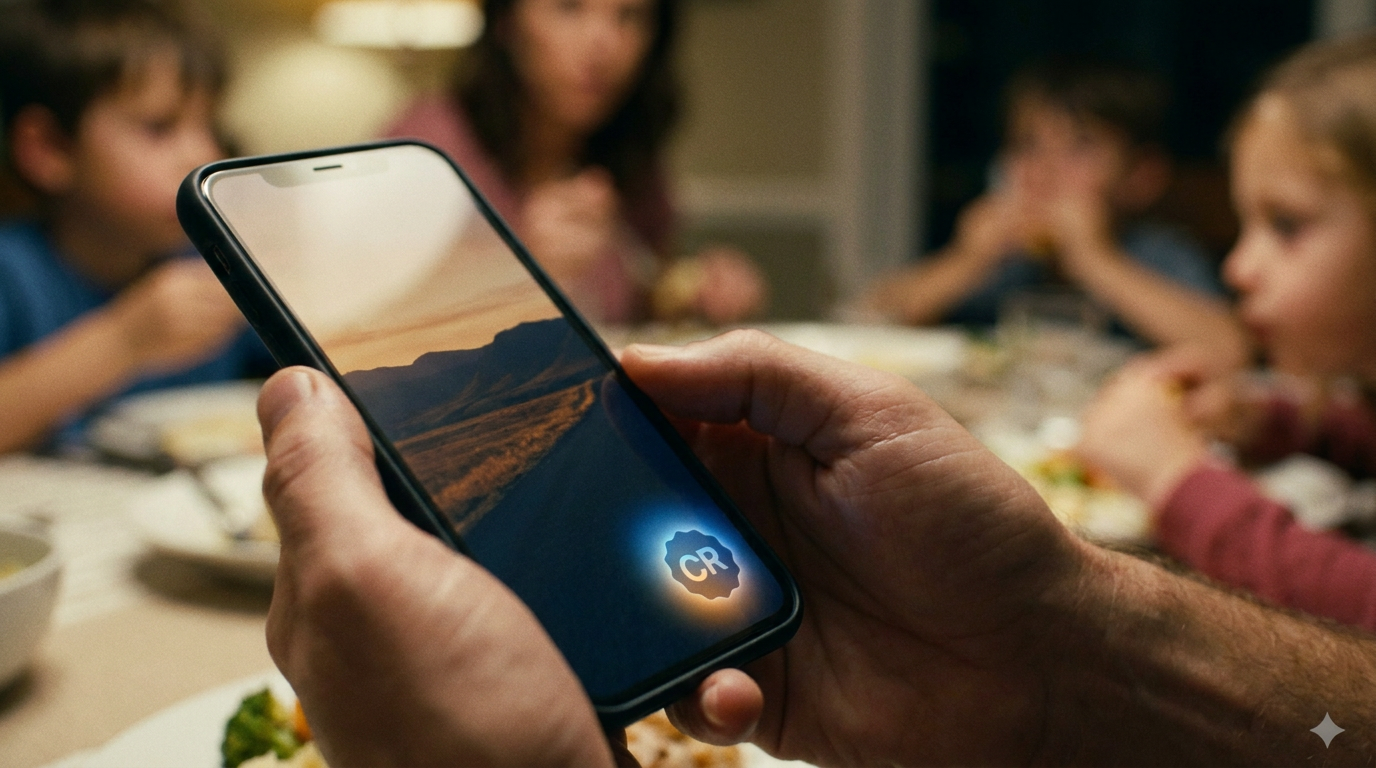
Crucially, C2PA does not rely on a central database or an internet connection to verify a file. The cryptographic signature travels with the media. If a user alters the image using a compliant editing tool, a new assertion is added to the manifest, creating a transparent chain of custody. When viewed on a supported platform, this provenance data is accessible via a 'CR' (Content Credentials) icon in the corner of the image.[1][2]
By 2026, C2PA has moved out of software and into silicon. Major camera manufacturers, including Leica and Sony, have integrated C2PA directly into their hardware. When a photograph is taken, a dedicated security chip signs the image file at the exact moment of capture. Mobile devices have followed suit, with modern smartphones utilizing on-device timestamping authorities and hardware-backed keys to sign photos by default, ensuring the chain of trust begins the millisecond light hits the sensor.[8]
However, metadata has a fundamental vulnerability: it can be stripped. If a user takes a screenshot of a C2PA-signed photograph, or copies text into a new document, the cryptographic manifest is left behind. To solve this, AI developers needed a way to embed provenance directly into the content itself, surviving format changes, compression, and copy-pasting.[3][8]

However, metadata has a fundamental vulnerability: it can be stripped.
This is where algorithmic watermarking technologies like Google DeepMind's SynthID come in. Unlike traditional watermarks, which overlay a visible logo, SynthID embeds imperceptible mathematical signals into the structure of the media at the moment of generation. By mid-2026, over 10 billion pieces of AI-generated content have been watermarked using this framework.[3][8]
SynthID's approach to text watermarking is particularly elegant. It operates by modifying the fundamental token generation loop of a large language model. When an AI writes a sentence, it predicts each subsequent word—or token—based on a probability distribution. SynthID introduces a pseudorandom algorithm, known as a g-function, that subtly adjusts these probability scores.[3][4]
This technique, often referred to as tournament sampling, does not leave any visible markers or unnatural phrasing. Instead, it encodes a statistical signature into the AI's word choices. Even if a user copies the text, paraphrases a few sentences, or pastes it into a different application, the underlying statistical pattern remains intact and can be reliably identified by a specialized detector.[4][8]

For images and video, SynthID operates at the pixel level. It injects a cryptographic pattern into the visual data that is invisible to the human eye but highly resilient to digital manipulation. The watermark survives aggressive JPEG compression, color correction, resizing, and cropping, ensuring that AI-generated visuals remain identifiable even when heavily edited or shared across platforms that strip metadata.[3]
The adoption of these technologies is no longer purely voluntary. Regulatory pressure has transformed content provenance from an industry best practice into a legal mandate. The European Union's AI Act, which enforces its Article 50 transparency obligations starting in August 2026, requires that AI-generated text, audio, images, and video be marked in a machine-readable format.[5]
In the United States, the push for provenance has been driven by national security concerns. The Cybersecurity and Infrastructure Security Agency (CISA) has explicitly endorsed content credentials as a vital countermeasure against synthetic media, recommending their adoption across government agencies and critical infrastructure operators.[6]
Despite this momentum, the new trust architecture faces significant technical limitations. While C2PA provides robust proof of authenticity, its absence does not automatically mean a file is fake—it simply means the origin is unverified. This creates a transitional period where the vast majority of legacy internet content will lack credentials, requiring consumers to recalibrate their baseline skepticism.[1][8]
Algorithmic watermarking also has boundaries. SynthID's text watermarking is less effective on highly factual responses, such as code generation or historical dates, where altering the model's token probabilities would decrease the accuracy of the output. Furthermore, if watermarked text is thoroughly rewritten by a human or translated into another language, the detector's confidence scores drop significantly.[3][4]
There is also an ongoing tension within the open-source AI community. While DeepMind has open-sourced the SynthID text watermarking tools for developers, enforcing their use on open-weight models remains difficult. Users with technical expertise can modify the generation pipeline to bypass the logits processor, generating unmarked text.[8]
Ultimately, the success of C2PA and SynthID will depend on a fundamental shift in media literacy. Just as internet users in the 2010s learned to look for the HTTPS padlock in their browser to verify a secure connection, the internet of 2026 is training users to look for the Content Credentials icon. By combining cryptographic metadata with resilient watermarking, the technology industry is slowly rebuilding the internet's capacity for truth.[2][8]
How we got here
Nov 2019
Adobe, The New York Times, and Twitter launch the Content Authenticity Initiative (CAI).
Feb 2021
The Coalition for Content Provenance and Authenticity (C2PA) is founded to create an open technical standard.
Aug 2023
Google DeepMind launches SynthID for image watermarking.
Oct 2024
DeepMind open-sources SynthID Text, making text watermarking available to the broader developer community.
May 2025
C2PA releases version 2.2 of its specification, expanding support for video streaming and cloud manifests.
Aug 2026
The EU AI Act's Article 50 transparency obligations for AI-generated content take legal effect.
Viewpoints in depth
Provenance Standard Advocates
Focus on cryptographic metadata to establish a verifiable chain of custody for digital media.
This camp, led by the C2PA coalition and the Content Authenticity Initiative, argues that the internet needs a fundamental 'nutrition label' for media. Rather than playing a cat-and-mouse game of detecting fakes, they advocate for a system where authentic content cryptographically proves its origin. They emphasize hardware integration—such as embedding signing keys directly into camera silicon—to ensure the chain of trust begins the moment light hits a sensor.
Algorithmic Watermarking Pioneers
Focus on embedding resilient, imperceptible signals directly into the content to survive metadata stripping.
Researchers at labs like Google DeepMind argue that metadata alone is insufficient because it is easily stripped by screenshots, copy-pasting, or basic file compression. Their solution is to weave the proof of origin into the content itself. By altering the statistical distribution of generated text or the pixel values of an image, they create a signature that survives real-world distortion, ensuring that AI-generated content remains identifiable even when divorced from its original file container.
Policy & Security Regulators
Focus on mandatory transparency and standardized labeling to protect public trust.
Government bodies and security agencies view content provenance as a critical infrastructure issue. With the EU AI Act mandating machine-readable marking for synthetic content by August 2026, regulators are shifting these technologies from voluntary industry best practices to legal requirements. They prioritize interoperability and consumer protection, arguing that citizens have a fundamental right to know whether the media they consume was generated by a human or an algorithm.
What we don't know
- How effectively open-source AI models will enforce watermarking, given that users can modify the code to disable the logits processors.
- Whether social media platforms will universally adopt and display Content Credentials in their main feeds without degrading user experience.
- How the system will handle 'mixed media' at scale, such as an authentic photograph that has been subtly color-corrected by an AI tool.
Key terms
- C2PA
- An open technical standard that embeds cryptographically signed metadata into media files to prove their origin and editing history.
- SynthID
- A watermarking technology developed by Google DeepMind that embeds imperceptible, resilient signals directly into AI-generated text, images, audio, and video.
- Tournament Sampling
- A technique used in text watermarking where the AI subtly adjusts the probability of its word choices to encode a hidden statistical signature.
- Content Credentials
- The consumer-facing 'nutrition label' for digital media, often represented by a 'CR' icon, which displays a file's C2PA provenance data.
- Logits
- The raw mathematical scores a language model assigns to potential next words before converting them into probabilities.
Frequently asked
Does C2PA detect if an image is a deepfake?
No. C2PA does not scan content to guess if it is fake. Instead, it acts as a digital certificate that proves where the content originated and how it was edited.
Can SynthID watermarks be removed by screenshotting an image?
No. Unlike metadata, SynthID embeds its signal directly into the pixels or text structure, allowing it to survive screenshots, cropping, and compression.
Is text watermarking visible to the reader?
No. Text watermarking works by subtly altering the probability of which words the AI chooses during generation, creating a statistical pattern that only a software detector can recognize.
Will older photos be flagged as fake?
No. The absence of C2PA credentials simply means the origin is unverified, much like an unverified account on social media. It does not automatically label older content as synthetic.
Sources
Source coverage
8 outlets
4 viewpoints surfaced








[1]C2PAProvenance Standard Advocates
C2PA Technical Specification v2.2
Read on C2PA →[2]Content Authenticity InitiativeProvenance Standard Advocates
5-Year Anniversary of the Content Authenticity Initiative
Read on Content Authenticity Initiative →[3]Google DeepMindAlgorithmic Watermarking Pioneers
SynthID: Tools for watermarking and detecting AI-generated content
Read on Google DeepMind →[4]NatureAlgorithmic Watermarking Pioneers
Scalable watermarking for identifying large language model outputs
Read on Nature →[5]European UnionPolicy & Security Regulators
EU AI Act: Article 50 - Transparency Obligations
Read on European Union →[6]Cybersecurity and Infrastructure Security AgencyPolicy & Security Regulators
Strengthening Multimedia Integrity in the Generative AI Era
Read on Cybersecurity and Infrastructure Security Agency →[7]DeloitteIndustry Forecasters
Technology, Media and Telecom Predictions 2025
Read on Deloitte →[8]Factlen Editorial TeamIndustry Forecasters
Synthesis by Factlen editorial team
Read on Factlen Editorial Team →


Every angle. Every day.
Get ai stories with full source coverage and perspective breakdowns delivered to your inbox.