
The Resurgence of European Sleeper Trains: Routes, Costs, and the Climate Math for 2026
As travelers increasingly prioritize sustainability and comfort over budget flights, Europe's night train network is expanding rapidly in 2026, featuring revived iconic routes and new cross-border connections.
By Factlen Editorial Team
- Sustainable Travel Advocates
- Environmental groups arguing that rail is the only responsible choice for intra-European travel.
- Rail Operators & Cooperatives
- The companies building the network, focused on logistical and financial hurdles.
- Budget-Conscious Travelers
- Passengers pointing out that despite environmental benefits, low-cost airlines still frequently undercut train fares.
- Aviation Industry
- Airlines and regulators betting on technological improvements to lower flight emissions.
What's not represented
- · Business travelers prioritizing speed and schedule flexibility over environmental impact.
- · Residents of peripheral or island nations where rail connections are physically impossible.
Why this matters
Choosing a sleeper train over a short-haul flight can reduce your travel carbon footprint by up to 90%, while saving you a night's hotel cost and the stress of navigating modern airport security.
Key points
- Europe's night train network is undergoing a massive expansion in 2026, driven by climate consciousness and the desire for slower, more comfortable travel.
- European Sleeper revived the iconic Paris-to-Berlin route in March 2026 and is launching a new Brussels-to-Milan corridor in September.
- Taking an electric train instead of a short-haul flight reduces passenger carbon emissions by 73% to 91% on popular European routes.
- While budget flights appear cheaper, sleeper trains often win on value by eliminating hidden airline fees and saving the cost of a hotel night.
The golden age of rail is returning to Europe. After decades of decline fueled by the rise of ultra-low-cost airlines, sleeper trains are experiencing a massive renaissance in 2026. Travelers are increasingly trading cramped middle seats and airport security queues for the romance and practicality of waking up in a new city.[7]
This resurgence is not merely an exercise in nostalgia; it is a pragmatic shift driven by climate consciousness and the growing friction of modern air travel. With the introduction of the EU's New Entry/Exit System (EES) adding biometric checks to airport routines, the appeal of seamless, city-center-to-city-center rail travel has never been stronger.[4]
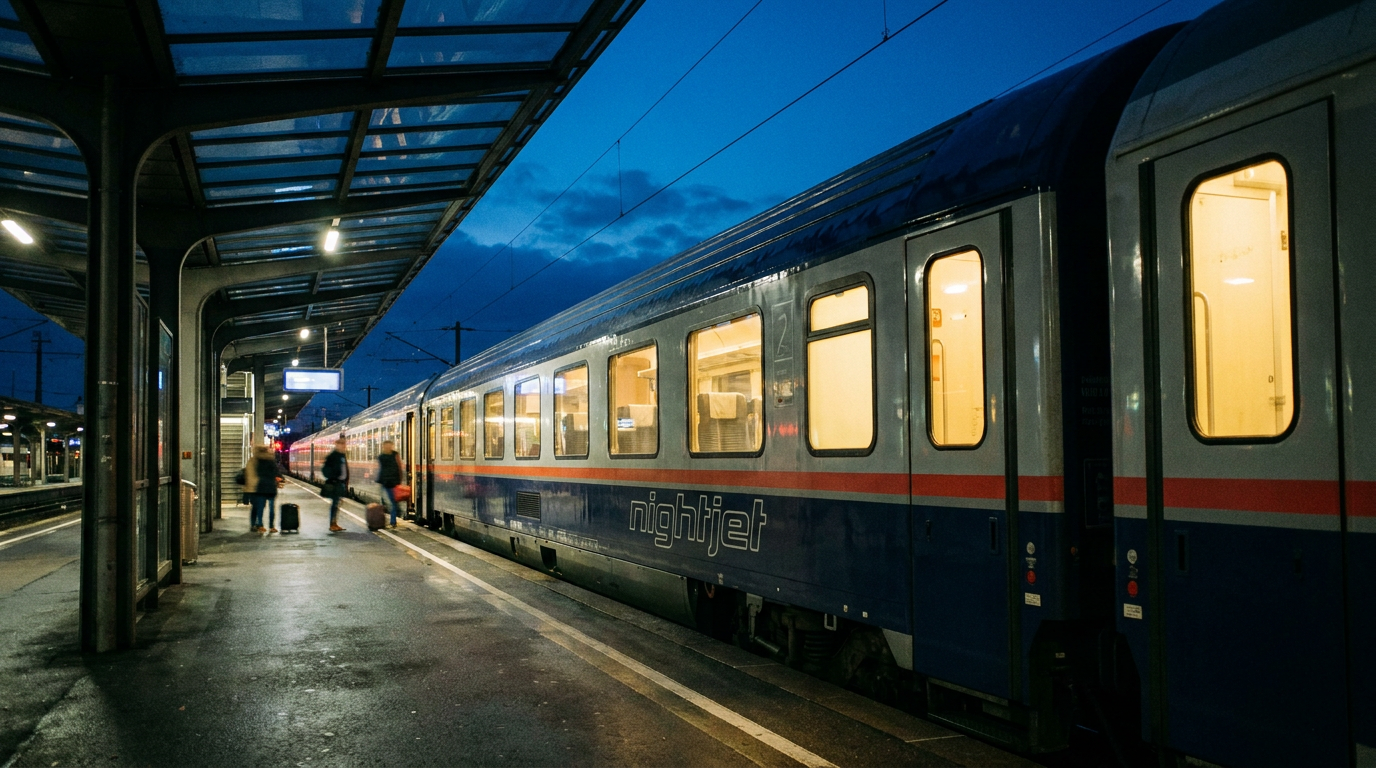
The 2026 calendar marks a watershed moment for the night train revival, with several major routes launching or returning to service. Leading the charge is European Sleeper, a Belgian-Dutch cooperative that operates as an open-access rail company.[5]
In March 2026, European Sleeper successfully revived the iconic Paris-to-Berlin overnight route. The service had faced cancellation when Austria's state-backed ÖBB Nightjet dropped it, but the cooperative stepped in to maintain the vital link between the French and German capitals, running three times a week.[6]

The expansion continues into the fall. In September 2026, European Sleeper will launch a highly anticipated north-south corridor connecting Brussels to Milan. The route will wind through Cologne, Germany, and Zurich, Switzerland, laying the groundwork for a broader network linking the Benelux countries directly to Italy.[5]
Other operators are also expanding their footprints. In April 2026, the Swiss Federal Railways (SBB), in partnership with Germany's RDC, launched a new 16-hour overnight service connecting Basel, Switzerland, to Copenhagen, Denmark, and terminating in Malmö, Sweden.[6]
The primary catalyst for this shift is the stark environmental math. Short-haul flights—those under 1,864 miles—account for nearly half of total aviation carbon emissions in Europe. Because planes burn the most fuel during takeoff and climb, short flights are highly carbon-intensive per passenger-mile.[4]
The primary catalyst for this shift is the stark environmental math.
By contrast, the vast majority of Europe's high-speed and night train networks are electrified. According to data from the European Environment Agency and the UK's DEFRA, aircraft produce approximately 285 grams of CO₂ per passenger-kilometer. Electric trains average just 41 grams, and highly efficient operators like Eurostar emit as little as 6 grams.[1]
The total carbon savings are staggering. A journey from London to Paris by train produces around 22 kilograms of CO₂, compared to 244 kilograms by plane. Across popular European routes, opting for rail over air travel reduces passenger emissions by 73% to 91%.[1][2]

Furthermore, the climate impact of flying extends beyond basic CO₂ output. Emissions released at cruising altitudes cause between 1.27 and 2.5 times more atmospheric warming than ground-level emissions—a phenomenon known as the "radiative forcing" effect.[1]
Despite the environmental benefits, the choice between train and plane often comes down to cost and time. At first glance, a $25 budget flight that takes 90 minutes seems to easily beat a 14-hour overnight train journey.[4]
However, the true cost of budget air travel is heavily obscured. Low-cost airlines generate roughly 40% of their revenue from add-on fees for seat selection, cabin baggage, and fast-track boarding. Furthermore, airlines benefit from paying no kerosene tax or VAT on international flights, keeping their base fares artificially low.[3][4]
Time calculations are similarly deceptive. A "one-hour" flight requires traveling to an out-of-town airport, arriving two hours early for security, and waiting for luggage upon arrival. A journey from London to Paris by budget airline often takes over six hours door-to-door, compared to four hours on a high-speed train.[4]

For night trains, the time equation is even more favorable. Because the bulk of the journey occurs while the passenger is sleeping, the usable daytime lost to travel is effectively zero. Additionally, the cost of the train ticket offsets the price of a night's hotel accommodation, making sleeper trains highly competitive for budget-conscious travelers.[5][7]
Modern sleeper trains cater to a variety of budgets and comfort levels. A standard European Sleeper train offers three tiers: basic seating cars for the most frugal travelers, couchettes featuring shared bunks for four to six people, and private "Comfort Plus" sleeping cars equipped with washbasins and lockable doors.[5]

Operating these routes is not without significant challenges. Unlike state-backed national railways, cooperatives like European Sleeper must survive without permanent government subsidies. They face high track access tolls across different countries and complex bureaucratic hurdles, such as securing approvals to operate on the French rail network.[3][5]
Nevertheless, the momentum is undeniably on the side of rail. With Austria's ÖBB deploying 33 new custom-built Siemens carriages and startups planning luxury routes across the continent, the night train is no longer a relic of the past. It is rapidly becoming the backbone of sustainable, comfortable travel in Europe.[6][7]
How we got here
May 2023
European Sleeper launches its first route connecting Brussels to Berlin.
March 2026
The iconic Paris-to-Berlin overnight route is revived by European Sleeper after being dropped by ÖBB.
April 2026
A new 16-hour overnight service launches connecting Basel, Switzerland, to Malmö, Sweden.
July 2026
The Paris-Brussels-Berlin night train extends its service to include a stop in Hamburg.
September 2026
A new north-south corridor launches, connecting Brussels to Milan via Cologne and Zurich.
Viewpoints in depth
Sustainable Travel Advocates
Environmental groups arguing that rail is the only responsible choice for intra-European travel.
Advocates point to the staggering 70% to 90% reduction in carbon emissions as proof that short-haul flights are an unjustifiable luxury in a warming world. Organizations like Greenpeace argue that the current market is artificially skewed, as airlines pay no kerosene tax or VAT on international flights, while train operators are burdened with high track access tolls and energy taxes. They advocate for policy interventions, such as banning short-haul flights where a rail alternative under four hours exists, to force a shift toward sustainable transit.
Rail Operators & Cooperatives
The companies building the network, focused on logistical and financial hurdles.
For operators like European Sleeper, the primary focus is proving that a cooperative, non-subsidized business model can survive in a landscape dominated by state-backed giants. They emphasize the immense logistical challenges of running cross-border night trains, from coordinating timetables across multiple national networks to securing affordable track access. Their goal is to build a reliable, comfortable alternative to flying, but they caution that without fairer taxation across the transport sector, competing on price alone remains difficult.
The Aviation Industry
Airlines and regulators betting on technological improvements to lower flight emissions.
Airlines argue that while trains are excellent for specific corridors, flying remains essential for cross-continent travel, island hopping, and connecting peripheral regions. Rather than abandoning short-haul flights, the industry is heavily investing in Sustainable Aviation Fuel (SAF), which can reduce lifecycle CO₂ emissions by up to 80%. They also point to incoming improvements in air traffic management—allowing for smoother climbs and more direct routing—and the long-term development of hybrid-electric aircraft as the ultimate solution for sustainable regional travel.
What we don't know
- Whether open-access cooperatives like European Sleeper can achieve long-term profitability without the permanent government subsidies enjoyed by national rail operators.
- How quickly the European Union will move to standardize track access charges and simplify cross-border ticketing to further incentivize rail travel.
Key terms
- Couchette
- A shared sleeping compartment on a train, typically featuring four to six fold-out bunk beds.
- Radiative forcing
- The phenomenon where emissions released at high altitudes cause significantly more atmospheric warming than the same emissions at ground level.
- Open-access operator
- A private railway company that runs services on state-owned tracks without government subsidies, paying tolls for track usage.
- Track access charges
- Fees paid by train operators to the national infrastructure managers for the right to run trains on their rail networks.
Frequently asked
Are sleeper trains cheaper than flying in Europe?
Base fares for budget flights are often cheaper, but trains become highly competitive when factoring in hidden airline fees, airport transfer costs, and the savings of a night's hotel accommodation.
Do European sleeper trains have showers?
Most standard sleeper trains and couchettes have shared toilets and washbasins in the corridor. Only premium or luxury private cabins typically feature en-suite showers.
How much carbon does taking the train save?
Taking an electric train instead of a short-haul flight in Europe reduces carbon emissions by 73% to 91% per passenger, depending on the specific route and energy mix.
Sources
Source coverage
7 outlets
4 viewpoints surfaced







[1]CarbonClickSustainable Travel Advocates
Train tourism carbon savings compared to flights
Read on CarbonClick →[2]Seat61
CO2 emissions for train vs flying
Read on Seat61 →[3]Greenpeace UKSustainable Travel Advocates
Planes emit on average 4.84 times more greenhouse gas emissions than trains
Read on Greenpeace UK →[4]InsurteBudget-Conscious Travelers
Trains or Planes If Sustainability Is A Deciding Factor
Read on Insurte →[5]HourrailRail Operators & Cooperatives
The European Sleeper network in 2026: an overview
Read on Hourrail →[6]ForbesAviation Industry
These 4 European Night Trains Are Debuting In 2026
Read on Forbes →[7]Factlen Editorial Team
Synthesis by Factlen editorial team
Read on Factlen Editorial Team →

Every angle. Every day.
Get travel stories with full source coverage and perspective breakdowns delivered to your inbox.