
The Great Green Wall of Africa: How an 8,000-Kilometer Forest Evolved Into a Climate Mosaic
Originally envisioned as a literal wall of trees to hold back the Sahara, Africa's most ambitious environmental project has transformed into a complex network of sustainable farming and water harvesting.
By Factlen Editorial Team
- Ecological Restoration Advocates
- Focus on the sheer scale of carbon capture and biodiversity return as a global climate victory.
- Community Development Agencies
- Emphasize that planting trees fails if locals cannot eat, prioritizing agroforestry and job creation.
- Policy & Implementation Critics
- Point out the massive gap between international pledges and on-the-ground funding.
What's not represented
- · Nomadic pastoralists whose grazing routes intersect with restored lands
- · Private sector agricultural investors
Why this matters
The Sahel is one of the most climate-vulnerable regions on Earth. The success or failure of this massive restoration effort will determine the food security and economic stability of millions, offering a blueprint for how humanity can reverse desertification globally.
Key points
- The Great Green Wall aims to restore 100 million hectares of degraded land across the Sahel by 2030.
- The project has evolved from a continuous wall of trees into a mosaic of sustainable agriculture and water harvesting.
- Ethiopia and Senegal have reported significant progress, though overall completion estimates range from 4% to 15%.
- The initiative seeks to create 10 million rural jobs and capture 250 million tonnes of carbon dioxide.
The Sahara Desert is moving. For decades, the creeping sands have threatened the Sahel—the vast, semi-arid belt stretching across Africa from the Atlantic Ocean to the Red Sea. As climate change accelerates and unsustainable farming depletes the soil, desertification has swallowed arable land, displacing communities and deepening food insecurity across the region. In response to this existential threat, African leaders conceived one of the most audacious environmental engineering projects in human history: a living barrier to hold back the desert and restore the ecological balance of an entire continent.[4][5]
When the African Union officially launched the Great Green Wall initiative in 2007, the vision was startlingly literal and unprecedented in scale. Planners envisioned a continuous, 15-kilometer-wide band of drought-resistant trees spanning 8,000 kilometers from Dakar, Senegal, to Djibouti City, Djibouti. It was pitched to the world as the largest living structure on Earth—three times the size of the Great Barrier Reef—designed to physically block the encroaching Sahara. The sheer ambition of the project captured global imagination, promising a green ribbon across the continent that would halt the desert in its tracks.[3][4]
But nature rarely adheres to straight lines drawn on a map, and the realities of the Sahel quickly forced a reckoning. Within a few years, ecologists and local governments realized that simply planting millions of trees in arid soil was a recipe for failure. Saplings withered without sustained watering, and impoverished communities had little incentive to protect forests that did not provide immediate sustenance or economic value. 'Just planting trees is not enough,' noted Oblé Neya, a climate coordinator for the Belgian development agency Enabel, reflecting a growing consensus that the project needed a radical, community-centered redesign.[3]
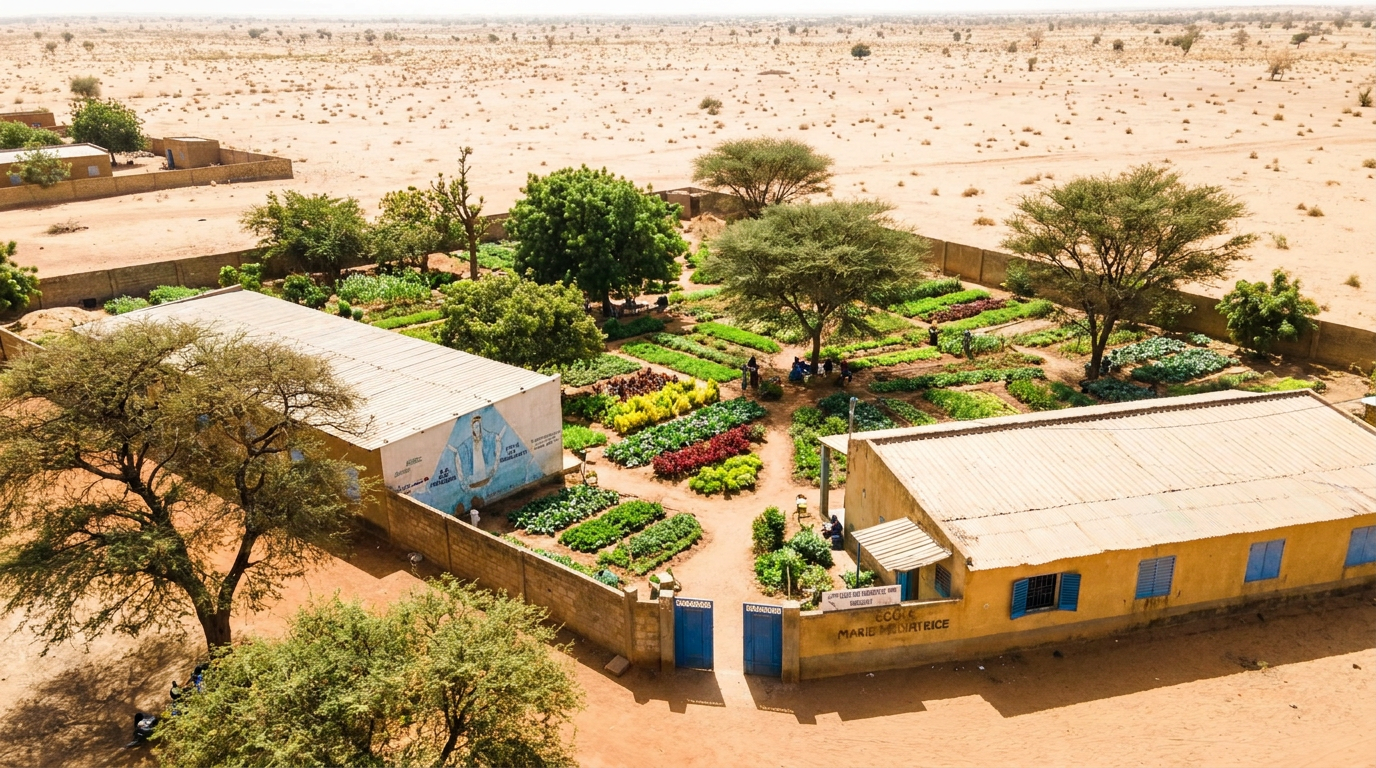
By 2013, the Great Green Wall had quietly evolved from a monolithic timber fortress into something far more complex and resilient. Today, it is best understood as a 'mosaic' of green and productive landscapes rather than a literal wall. Instead of a single unbroken forest, the initiative promotes a patchwork of community gardens, restored grasslands, and agroforestry. The focus shifted from merely fighting sand to capturing water, regenerating soil, and empowering the people who live on the land, recognizing that ecological restoration is impossible without human development.[3][4][5]

Despite this strategic pivot, the revised ambition remains staggering in its scope. By 2030, the initiative aims to restore 100 million hectares of degraded land—an area roughly the size of Egypt. If successful, this vast mosaic will sequester 250 million metric tons of carbon dioxide and create 10 million rural jobs. It is a holistic approach that treats desertification not just as an ecological crisis, but as a severe economic one that drives outward migration, exacerbates poverty, and fuels regional instability across the Sahel.[2][4][5]
The mechanics of this regreening rely heavily on traditional, low-tech water harvesting rather than expensive modern irrigation. Farmers across the Sahel are utilizing indigenous techniques like 'Zai pits' and half-moon terraces—small earthen ridges that catch and hold scarce rainfall, allowing it to percolate into the soil rather than washing away across the hardpan. When combined with the deep root systems of native Acacia and Baobab trees, these methods cool the local microclimate, reduce evaporation, and slowly restore the soil's fertility, creating pockets of arable land in otherwise hostile environments.[1][4]
The mechanics of this regreening rely heavily on traditional, low-tech water harvesting rather than expensive modern irrigation.
Progress across the 11 core nations has been highly uneven, with Ethiopia emerging as the most aggressive implementer of the vision. Driven by a deep-rooted cultural reverence for trees and massive state mobilization, Ethiopia claimed to have restored 12 million hectares by 2020. In a series of highly publicized campaigns, the country reported planting billions of seedlings, including a single-day record where millions of citizens mobilized to plant over 500 million trees. While the exact survival rate of these seedlings is debated, the sheer scale of civic participation has set a benchmark for the region.[4][5]
Senegal, anchoring the western edge of the wall, has often been hailed as the project's model pupil. The country has planted over 11 million trees and successfully established multi-purpose community gardens that provide local women with fresh produce and independent income. However, a recent comprehensive study published in the journal Land Use Policy revealed a complicated reality: while Senegal has achieved encouraging social and economic milestones, the purely ecological benefits have fallen short of the massive scale promised, highlighting the difficulty of translating international pledges into sweeping environmental change.[2][5]
This discrepancy highlights a persistent challenge in measuring the Great Green Wall's ultimate success. If graded against the original 2007 vision of an unbroken forest, the project is arguably failing, with estimates suggesting only 4% to 15% of the geographic corridor is complete. But when measured by the new metric of 'land degradation neutrality'—stabilizing the soil and improving agricultural yields—the localized victories are profound. These green pockets may not look like a continuous wall from a satellite, but they represent a lifeline for the communities that rely on them.[3][4][5]

The economic ripple effects of these localized green zones are already transforming rural life in profound ways. Restored landscapes provide vital fodder for livestock and sustainable fuelwood for cooking, significantly reducing the daily labor burden on women and girls. Furthermore, the revitalization of the soil has spurred investments in adjacent agricultural sectors, such as poultry farming and agribusiness, which rely on the newly stabilized environment to operate profitably and provide a bulwark against the chronic food insecurity that has long plagued the region.[1]
Yet, the grand vision is continually bottlenecked by funding shortfalls and bureaucratic friction. At the 2021 One Planet Summit, international partners pledged $14.3 billion to launch the Great Green Wall Accelerator, aiming to unblock financial pipelines and speed up restoration. Despite these headline-grabbing commitments, African officials and researchers consistently report that only a fraction of the promised capital actually reaches the grassroots organizations doing the digging and planting, leaving many local initiatives starved of the resources needed to scale their operations.[2][4][5]
To attract more reliable capital and ensure long-term viability, the Great Green Wall is increasingly being bundled with other pan-African infrastructure mega-projects. For instance, the African Development Bank is currently developing the world’s largest solar energy zone in the Sahel. By explicitly tying renewable energy expansion to the Great Green Wall, planners hope to create a symbiotic environment where clean power drives water pumps for irrigation, and restored vegetation protects the delicate solar panels from damaging dust storms.[4]

As the 2030 deadline approaches, the Great Green Wall stands as a testament to the messy, non-linear reality of climate adaptation. It is no longer a simplistic story of humanity building a physical wall to fight the desert. Instead, it is a sprawling, decentralized effort to fundamentally change how people interact with one of the harshest environments on Earth. The ultimate success of the initiative will not be measured by the length of a forest, but by the resilience, prosperity, and survival of the communities thriving within its mosaic.[1][3][6]
How we got here
2007
The African Union officially launches the Great Green Wall initiative as a continuous band of trees.
2013
The strategy shifts from a literal wall of trees to a mosaic of sustainable land-use practices.
2021
The Great Green Wall Accelerator is launched with $14.3 billion in pledges to revitalize the lagging project.
2026
Ethiopia reports billions of seedlings planted, while studies in Senegal highlight the need for better ecological monitoring.
Viewpoints in depth
Ecological Restoration Advocates
Focus on the sheer scale of carbon capture and biodiversity return as a global climate victory.
This camp views the Great Green Wall primarily as a weapon against global climate change. They argue that even if the project falls short of its 100-million-hectare goal, the millions of trees already planted represent a massive victory for carbon sequestration. For these advocates, the priority remains scaling up reforestation efforts and protecting the biodiversity that returns to the stabilized soil.
Community Development Agencies
Emphasize that planting trees fails if locals cannot eat, prioritizing agroforestry and job creation.
Development experts argue that the original 'wall of trees' concept was fundamentally flawed because it ignored human needs. This camp prioritizes agroforestry, water access, and job creation over raw tree counts. They point out that a forest will only survive if the local community has an economic incentive to protect it, making community gardens and sustainable agriculture the true heart of the initiative.
Policy & Implementation Critics
Point out the massive gap between international pledges and on-the-ground funding.
While supportive of the goal, pragmatic researchers and local officials frequently criticize the initiative's execution. They highlight that despite billions of dollars pledged at international summits, bureaucratic friction prevents the majority of those funds from reaching grassroots organizations. They also caution against relying on inflated tree-planting statistics, noting that without long-term care, the survival rate of seedlings in the Sahel is notoriously low.
What we don't know
- The exact survival rate of the billions of seedlings planted over the last decade remains difficult to verify.
- It is unclear how much of the $14.3 billion pledged in 2021 has successfully reached grassroots organizations.
- The long-term impact of accelerating climate change on the newly restored microclimates is still being studied.
Key terms
- Sahel
- A vast semi-arid region of Africa separating the Sahara Desert to the north and tropical savannas to the south.
- Desertification
- The process by which fertile land becomes desert, typically as a result of drought, deforestation, or inappropriate agriculture.
- Land Degradation Neutrality
- A state where the amount and quality of land resources necessary to support ecosystem functions and food security remains stable or increases.
- Agroforestry
- A land-use management system in which trees or shrubs are grown around or among crops to improve soil health and crop yields.
Frequently asked
Is the Great Green Wall an actual wall of trees?
No. While originally envisioned in 2007 as a continuous 15-kilometer-wide band of trees, it has since evolved into a 'mosaic' of sustainable farming, water harvesting, and restored landscapes.
How much of the wall is finished?
Estimates vary widely, typically between 4% and 15%, depending on whether one measures continuous forest cover or overall restored land across the intervention zones.
Who is paying for the Great Green Wall?
Funding comes from a mix of African governments, the World Bank, the African Development Bank, and international donors, though disbursement to local projects has been slower than promised.
Sources
Source coverage
6 outlets
3 viewpoints surfaced






[1]AgriFocus AfricaCommunity Development Agencies
The Great Green Wall: The Latest on Progress and Impact
Read on AgriFocus Africa →[2]MongabayPolicy & Implementation Critics
Progress is slow on Africa's Great Green Wall, but some bright spots bloom
Read on Mongabay →[3]EnabelCommunity Development Agencies
What progress has been made on the Great Green Wall in the Sahel?
Read on Enabel →[4]American ScientistEcological Restoration Advocates
The Great Green Wall of Africa
Read on American Scientist →[5]WikipediaEcological Restoration Advocates
Great Green Wall (Africa)
Read on Wikipedia →[6]Factlen Editorial TeamPolicy & Implementation Critics
Synthesis by Factlen editorial team
Read on Factlen Editorial Team →
Every angle. Every day.
Get world stories with full source coverage and perspective breakdowns delivered to your inbox.