
The Science of Tangzhong and Yudane: How Water Roux Transforms Bread
By pre-cooking a small portion of flour and water, bakers can fundamentally alter wheat chemistry to create softer, longer-lasting bread. The technique relies on starch gelatinization to trap moisture without making the dough unmanageable.
By Factlen Editorial Team
- Home Bakers & Educators
- Values the accessibility and dramatic textural improvements of the tangzhong method.
- Baking Scientists
- Focuses on the molecular mechanics of starch gelatinization and enzyme activity.
- Commercial Bakeries
- Prioritizes the scalability, cost-reduction, and shelf-life benefits of the yudane method.
What's not represented
- · Gluten-free bakers adapting the method
- · Nutritionists analyzing the glycemic impact of pre-gelatinized starches
Why this matters
Understanding the chemistry of water roux methods allows home bakers to achieve bakery-quality, preservative-free bread that stays fresh for days. It offers a simple, natural alternative to chemical dough conditioners and expensive fats.
Key points
- Water roux methods involve pre-cooking a small portion of flour and liquid to alter the wheat's chemistry.
- Heating the mixture to 65°C causes starch gelatinization, allowing the flour to absorb up to 20 times its weight in water.
- The trapped moisture allows for higher hydration doughs without making them sticky or unmanageable.
- Pre-gelatinized starches resist retrogradation, keeping the bread fresh and soft for up to a week.
- Tangzhong uses a 1:5 ratio cooked on a stove, while yudane uses a 1:1 ratio scalded with boiling water.
- Using too much roux can inhibit gluten formation, causing the bread to collapse.
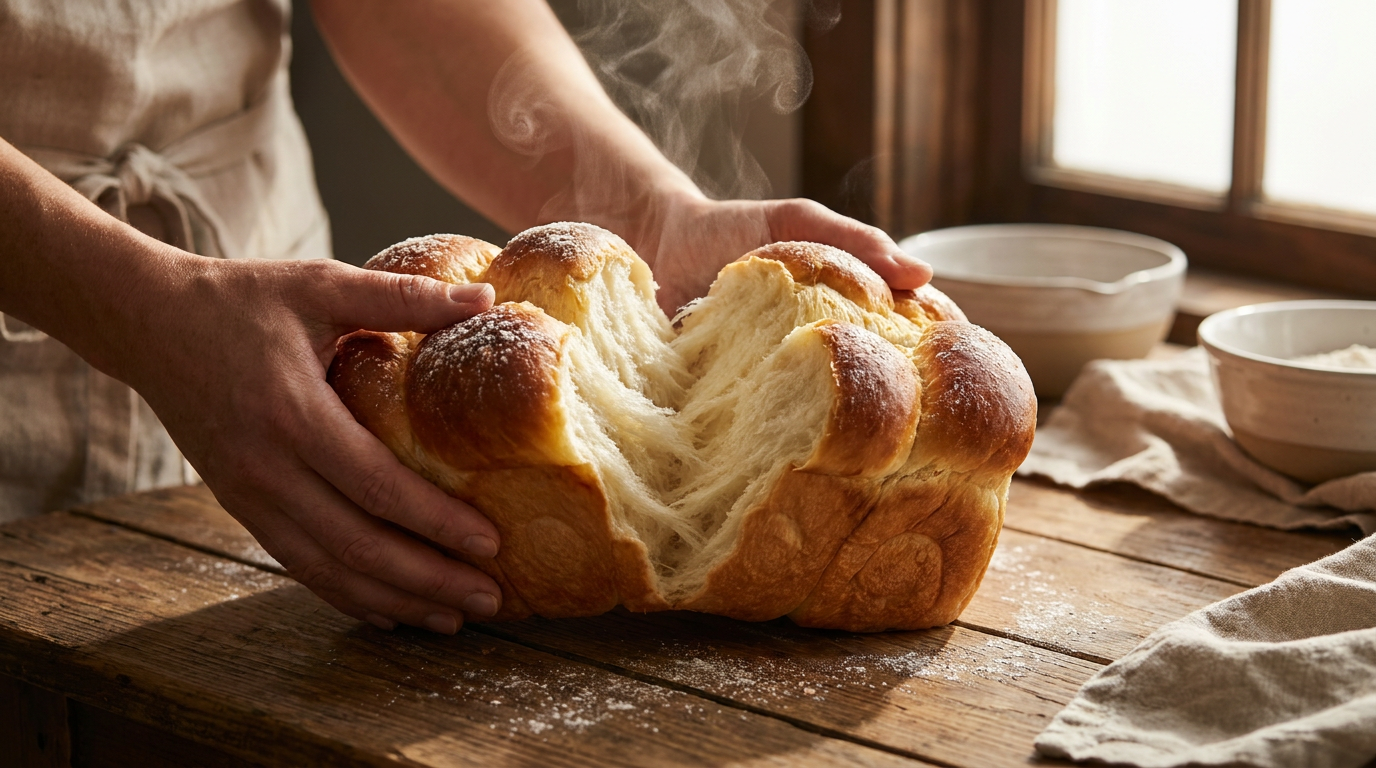
The holy grail of bread baking isn't just flavor—it's texture. For generations, European bakers chased the perfect shatter-crisp crust, while Asian baking traditions pursued the opposite: a crumb so impossibly soft, feathery, and pillowy that it practically melts in the mouth. The pinnacle of this pursuit is Japanese milk bread, or shokupan, a staple of bakeries and convenience stores across Asia. Its signature cloud-like texture and remarkable ability to stay fresh for days without chemical preservatives have made it a global phenomenon.[1][7]
The secret behind this bread isn't a specialized commercial dough conditioner or a rare strain of yeast. It relies on a simple, pre-baking chemistry trick known as a water roux. By cooking a small fraction of the recipe's flour and water together before mixing the final dough, bakers fundamentally alter the molecular structure of the wheat. This technique, while seemingly modern, has roots in post-war cultural exchanges between European and Japanese bakers in the Hokkaido region. The Japanese developed a method called yudane, which involves scalding flour with boiling water to lock in moisture.[1][3]
However, the concept exploded in global popularity in 2007 when Taiwanese pastry chef Yvonne Chen published her cookbook, 65°C Bread Doctor. Chen adapted the technique, calling it tangzhong—a Chinese term translating to 'hot water seed'—and standardized the stovetop cooking method that home bakers widely use today. Since then, the tangzhong method has migrated from Asian bakeries to Western kitchens, becoming a viral sensation among food bloggers and culinary educators who use it to upgrade everything from sandwich loaves to cinnamon rolls.[1][5]
To understand why cooking flour transforms bread, one must look at the microscopic structure of wheat. Raw flour contains hard, crystalline starch granules. When mixed with cold or room-temperature water during a standard kneading process, these granules remain completely intact. They absorb only a limited amount of liquid, which means the hydration of the dough is strictly capped. If a baker adds too much water to a traditional dough, it simply becomes a sticky, unmanageable puddle that cannot hold its shape.[1][4]

But when heat is introduced, the chemistry of the flour shifts dramatically. As the flour-water slurry reaches approximately 65°C (149°F), a process called starch gelatinization occurs. The thermal energy disrupts the tight crystalline structure of the starch granules, allowing water molecules to penetrate their outer walls. This is the exact temperature threshold where the magic of the water roux begins, fundamentally changing how the flour interacts with moisture for the remainder of the baking process and ensuring a softer final product.[2][4]
Once the 65°C threshold is crossed, the starch granules swell massively, absorbing up to twenty times their dry mass in water. As they expand to their physical limits, they eventually burst open, leaching a specific starch component called amylose into the surrounding liquid. This rapid release of amylose creates a highly viscous, pudding-like gel that permanently traps the moisture within its matrix. The flour and water are no longer separate entities; they have fused into a stable, hydrated paste.[4][7]
This gelatinized paste acts as a powerful hydration vehicle for the final bread. In traditional baking, adding excess water to a dough makes it impossibly sticky and difficult to knead. But because the water in a tangzhong or yudane is already tightly bound within the starch gel, it doesn't turn the main dough slack. The gel holds the water in suspension, allowing the baker to incorporate significantly more liquid into the recipe without ruining the dough's structural integrity or making it a nightmare to handle on the workbench.[4][5]
As a result of this bound moisture, bakers can push the overall hydration of their bread to 70% or even 80% while maintaining a dough that is smooth, elastic, and easy to shape. During the baking process, this trapped water is subjected to the intense heat of the oven and converts to steam. The steam pushes the dough upward from the inside, creating an exceptionally high, airy rise and a crumb structure that is remarkably open, feathery, and light on the palate.[3][4]

The benefits of the water roux extend far beyond the oven, solving one of the oldest problems in baking: staling. The primary reason bread goes stale is not actually moisture loss, but a chemical process called retrogradation. Over a period of days, the starches in baked bread naturally attempt to recrystallize and return to their hard, pre-baked state. This crystallization is what gives day-old bread its tough, crumbly, and unappetizing texture, regardless of how tightly it is wrapped or stored on the kitchen counter.[4][7]
The benefits of the water roux extend far beyond the oven, solving one of the oldest problems in baking: staling.
The pre-gelatinized starches in tangzhong and yudane actively resist this recrystallization process. By holding onto their bound water so fiercely, they act as a structural barrier that prevents the starch molecules from realigning into hard crystals. This keeps the crumb tender, moist, and springy for up to a week at room temperature—a feat of preservation that normally requires the addition of commercial chemical additives, artificial dough conditioners, or heavy amounts of preservatives found in supermarket aisles.[1][4]
While tangzhong and yudane operate on the exact same scientific principle of starch gelatinization, they are executed differently and yield slightly different textural results. Tangzhong involves whisking flour and liquid—usually milk or water—at a 1:5 ratio over a stove until it thickens into a paste. The baker must stir constantly to prevent lumps and carefully monitor the temperature to ensure it hits the 65°C mark without boiling over, burning the delicate starches, or evaporating too much of the necessary liquid.[1][6]
Yudane, by contrast, uses a much simpler 1:1 ratio of flour to boiling water. Instead of cooking the mixture on a stovetop, the baker simply pours the boiling water directly over the raw flour and stirs it into a thick, dough-like clump. This scalded mixture is then tightly covered and left to cool and hydrate, often resting overnight in the refrigerator to allow the starches to fully swell and absorb the liquid before being mixed into the final dough the next day.[2][6]

The textural outcomes of the baked bread reflect these distinct preparation methods. Tangzhong, with its higher liquid content and smooth, cooked paste, produces a bread that is exceptionally fluffy, delicate, and easily shreddable. It is the ideal choice for soft dinner rolls, sweet buns, and classic milk bread where a cloud-like texture is the primary goal. The crumb is so tender that it practically dissolves when eaten, making it a favorite for enriched doughs that demand a luxurious, melt-in-the-mouth quality.[6][7]
Yudane, which scalds the flour more aggressively with boiling water, yields a crumb that is slightly denser, moister, and possesses a chewy, almost mochi-like resilience. Because the boiling water rapidly activates endogenous amylase enzymes in the flour, the yudane method breaks down complex starches into simple sugars more effectively. This enzymatic activity adds a distinct, natural sweetness to the loaf without requiring the baker to add extra refined sugar to the recipe, creating a more complex and satisfying flavor profile.[6][7]
Commercial bakeries often prefer the yudane method because it is significantly easier to scale for mass production. Pouring boiling water over flour in a massive industrial mixer is far less labor-intensive than cooking a delicate slurry on a stove for hundreds of loaves. The yudane method provides the same shelf-life extension and moisture retention as tangzhong, but with a streamlined workflow that fits perfectly into the demanding schedules and tight profit margins of high-volume professional baking operations.[6][7]
Despite their almost magical properties, water roux methods do come with specific trade-offs that bakers must navigate. The gelatinized starch, while excellent for holding water, loses its ability to form gluten. If a baker uses too much roux—typically exceeding 10% to 20% of the total flour weight—it can severely inhibit the dough's gluten network. Without enough strong gluten structure to trap the expanding gases during fermentation and baking, the loaf will struggle to hold its shape, resulting in a dense, collapsed brick rather than a soaring, airy loaf.[6][7]

Furthermore, the tangzhong method requires a degree of precision that can trip up novice bakers. Cooking the slurry on a stovetop inevitably causes some water evaporation, which can throw off the meticulous hydration math of a recipe if the baker does not account for the lost moisture. If the paste is heated past 70°C (158°F), the proteins in the flour denature entirely, rendering the roux ineffective and leaving the baker with a stiff, rubbery, and unusable paste that will ruin the final dough.[2][6]
Temperature control is also critical when incorporating the roux into the main dough. If a freshly cooked tangzhong or a recently scalded yudane is added to the mixing bowl while still hot, the residual heat will instantly kill the commercial yeast. Bakers must exercise patience, allowing the gelatinized mixture to cool completely to room temperature—or chilling it in the refrigerator—before it comes into contact with the delicate yeast cells that power the bread's crucial fermentation and rise.[2][7]
Yet, when executed correctly, the water roux stands as a triumph of accessible culinary science. It empowers bakers to reduce the amount of expensive tenderizing fats, like butter, oil, and eggs, relying instead on the structural power of water and heat to achieve a soft crumb. This not only lowers the overall cost of baking but also allows the pure, clean flavor of the wheat to shine through without being masked by heavy dairy enrichments or artificial dough conditioners.[2][7]
Whether utilizing the stovetop tangzhong or the boiling-water yudane, this technique has thoroughly democratized bakery-quality bread. By mastering the simple chemistry of starch gelatinization, anyone with flour, water, and a reliable thermometer can pull a perfectly pillowy, long-lasting loaf from their home oven. It is a testament to how a deep understanding of food science can elevate the humblest of ingredients into something truly extraordinary, transforming the daily ritual of baking into a precise, rewarding, and delicious art form.[1][6]
How we got here
Post-WWII
Japanese bakers develop the yudane method to create softer, longer-lasting bread.
2001
The Pasco Shikishima Corporation is granted a patent in Japan for making bread using the yudane method.
2007
Taiwanese pastry chef Yvonne Chen publishes '65°C Bread Doctor', popularizing the tangzhong method across Asia.
2010s
The tangzhong technique goes viral among Western home bakers and food bloggers, transforming modern bread recipes.
Viewpoints in depth
Baking Scientists' view
Focuses on the molecular mechanics of starch gelatinization and enzyme activity.
Food scientists view water roux methods primarily as a mechanism for manipulating starch behavior. By pre-gelatinizing a portion of the flour, bakers irreversibly alter the crystalline structure of the starch granules, allowing them to bind significantly more free water. Researchers also highlight how the heat from yudane activates endogenous amylase enzymes, which break down complex carbohydrates into simple sugars, naturally sweetening the bread without added sugar.
Home Bakers' view
Values the accessibility and dramatic textural improvements of the tangzhong method.
For home bakers and culinary educators, tangzhong is celebrated as an accessible magic trick. It allows amateur bakers to achieve the feathery, shreddable texture of commercial milk bread without needing industrial dough conditioners or chemical preservatives. The stovetop method is highly visual and easy to control, making it a favorite technique for upgrading everything from cinnamon rolls to sandwich loaves.
Commercial Bakeries' view
Prioritizes the scalability, cost-reduction, and shelf-life benefits of the yudane method.
Industrial and commercial bakers lean heavily toward the yudane method. Pouring boiling water over flour in a massive industrial mixer is far more scalable than cooking a slurry on a stove. Furthermore, the pre-gelatinized starches extend the bread's shelf life by delaying retrogradation, which reduces food waste. The technique also allows bakeries to achieve a rich, tender crumb while reducing the amount of expensive fats like butter and eggs.
What we don't know
- The exact long-term glycemic index differences between bread baked with tangzhong versus traditional methods.
- Whether the technique can be perfectly replicated using non-wheat, gluten-free flours that possess different starch structures.
Key terms
- Water Roux
- A paste made by cooking flour and liquid together, used as a dough improver.
- Starch Gelatinization
- The process where starch granules swell and absorb water when heated, forming a viscous gel.
- Retrogradation
- The natural recrystallization of starches in baked bread over time, which causes the crumb to go stale.
- Amylose
- A component of starch that leaches out during gelatinization, helping to trap water within the gel.
- Endogenous Amylase
- Natural enzymes in flour that break down complex starches into simple sugars, adding sweetness to the dough.
Frequently asked
Can I use whole wheat flour for tangzhong?
Yes, but the resulting bread won't be quite as pillowy soft as it would be with white bread flour due to the bran content.
Can I make the water roux ahead of time?
Yes, both tangzhong and yudane can be made a day or two in advance and stored in the refrigerator until needed.
Why did my tangzhong bread collapse?
Using too much roux can inhibit gluten formation. Additionally, adding the paste while it is still hot can kill the yeast.
What is the main difference between tangzhong and yudane?
Tangzhong is cooked on a stove at a 1:5 ratio, while yudane is scalded with boiling water at a 1:1 ratio.
Sources
Source coverage
7 outlets
3 viewpoints surfaced







[1]King Arthur BakingHome Bakers & Educators
A closer look at tangzhong
Read on King Arthur Baking →[2]ChainBakerHome Bakers & Educators
Tangzhong & Yudane Explained, Bread Improvers
Read on ChainBaker →[3]American Society of BakingBaking Scientists
Tangzhong Method
Read on American Society of Baking →[4]GrokipediaBaking Scientists
Tangzhong
Read on Grokipedia →[5]New Gen BakerHome Bakers & Educators
The Starter Guide to Baking Tangzhong Bread
Read on New Gen Baker →[6]Carter's BakeshopCommercial Bakeries
Yudane & Tangzhong
Read on Carter's Bakeshop →[7]Factlen Editorial TeamCommercial Bakeries
Synthesis by Factlen editorial team
Read on Factlen Editorial Team →

Every angle. Every day.
Get food drink stories with full source coverage and perspective breakdowns delivered to your inbox.