
The Rise of the 'Cozy Web': How Algorithmic Fatigue is Driving the Internet Indoors
Exhausted by performative feeds and AI-generated content, millions of users are abandoning the public internet for gated, intimate digital communities.
By Factlen Editorial Team
- Digital Sociologists
- View the retreat to private spaces as a necessary psychological defense mechanism against the hostility and surveillance of the public web.
- Brand Strategists
- Focus on the 'attribution crisis' and the urgent need to transition from public broadcasting to nurturing genuine, niche communities.
- Privacy Advocates
- Celebrate the Cozy Web as a reclamation of data sovereignty and a rejection of the algorithmic monetization of human attention.
What's not represented
- · Open Web Advocates who worry that gated communities fragment society into isolated echo chambers.
- · Platform Executives trying to re-engineer public feeds to win back user trust.
Why this matters
Understanding the shift toward private digital spaces explains why public social media feels increasingly hollow, and offers a roadmap for finding genuine human connection online without the anxiety of algorithmic performance.
Key points
- Millions of users are 'quiet quitting' public social media due to algorithmic fatigue and performative pressure.
- People are migrating to the 'Cozy Web'—private group chats, Discord servers, and gated communities.
- The public internet is increasingly viewed as a 'Dark Forest' where visibility invites hostility and surveillance.
- Private digital spaces foster 'thick culture' and depressurized conversation by removing the invisible audience.
- This shift creates an attribution crisis for brands, as word-of-mouth moves into untrackable 'dark social' channels.
- AI generation is expected to accelerate this trend by flooding the public web with synthetic content.
For over a decade, the dominant promise of the consumer internet was hyper-connectivity. Success was measured in billions of active users, viral reach, and the construction of a massive, global town square. But a fundamental shift in user behavior is quietly underway. Instead of broadcasting their lives to public feeds, millions of people are retreating from major social media platforms. They are not necessarily deleting their accounts, but they are logging off mentally—ceasing to post, comment, or engage in public spaces.[4]
This phenomenon is being driven by what digital sociologists call "algorithmic fatigue." As platforms evolved from chronological feeds of friends into recommendation engines optimized for screen time, the public web became exhausting. Users are increasingly served a diet of sensationalized content, repetitive trends, and, more recently, a flood of AI-generated "slop." The active user base of legacy platforms has begun to decline, and the era of the mega-platform is fracturing.[2][4]
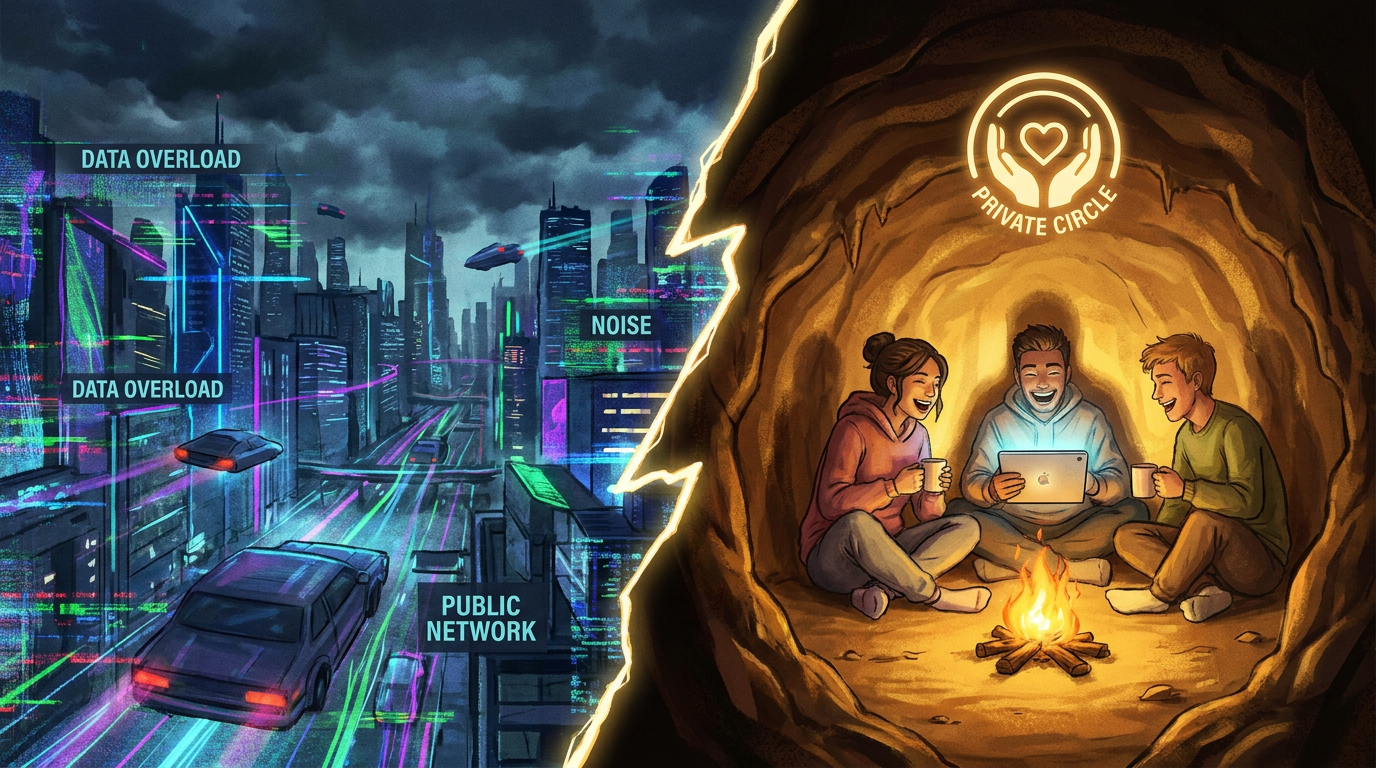
To understand this migration, theorists point to two dominant metaphors: the "Dark Forest" and the "Cozy Web." The Dark Forest theory, adapted from science fiction by Kickstarter co-founder Yancey Strickler, posits that the public internet has become a hostile environment. Like a forest at night, prey creatures hide in the trees, while predators—trolls, bots, data scrapers, and cancel culture—lurk in wait. In this environment, making noise is dangerous. A bad joke on a public feed can end a career; an awkward phase is permanently archived.[3]
In response, users are fleeing to the "Cozy Web," a term coined by Venkatesh Rao and visualized by designer Maggie Appleton. If the public web is a dangerous forest, the Cozy Web represents the underground burrows where users seek warmth and shelter. It is a loose archipelago of private group chats, Discord servers, locked subreddits, niche Substacks, and WhatsApp groups.[1][3]

The defining characteristic of the Cozy Web is friction. Unlike the open internet, which rewards frictionless virality and scale, the Cozy Web is built on gatekeeping. Access requires invite links, phone numbers, or subscription fees. The content is not indexed by Google, and it cannot be easily shared outside the group. This friction is not a bug; it is the entire point. It filters out the noise and ensures that the people in the room actually want to be there.[3][5]
This friction creates a profound psychological shift: it enables "depressurized conversation." In the Cozy Web, the stakes are lower. A poorly phrased thought in a WhatsApp group of ten friends dies instantly, allowing users to experiment, debate, and be vulnerable without the paralyzing fear of a permanent public record. Generation Z, having grown up entirely in the digital panopticon, is leading this charge, with surveys showing that 72% are actively taking steps to reduce their public online footprint in favor of encrypted, intimate spaces.[3][6]
This friction creates a profound psychological shift: it enables "depressurized conversation." In the Cozy Web, the stakes are lower.
The safety of these digital burrows is fundamentally changing how internet culture is created. For decades, the open web was governed by the "1% Rule" (or the 90-9-1 principle), which stated that 90% of users lurk, 9% contribute occasionally, and 1% create all the content. But in the Cozy Web, this ratio breaks down. When the invisible audience of strangers is removed, the inhibition to participate vanishes. In active Discord servers or Slack communities, participation rates frequently soar to 20% or 30%.[3]

This high-participation environment allows for the incubation of what cultural analysts call "thick culture." The old internet rewarded specificity—memes born of deep, niche context. The new algorithmic internet rewards "thin culture"—saying the right, easily digestible thing about a 24-hour trend. The Cozy Web restores the shared history, inside jokes, and complex norms that make human communication meaningful. Because the participants share so much context, they can communicate vast amounts of meaning in very few words.[5]
However, this mass migration underground is creating an "attribution crisis" for the modern economy. For years, marketers and cultural analysts have relied on public metrics—likes, shares, and retweets—to measure sentiment. But as conversations move into private channels, they become "dark social." When a user copies a link and pastes it into an iMessage or WhatsApp group, analytics software strips the referral data, misclassifying it as "Direct" traffic.[3]
Recent granular studies reveal that the vast majority of true word-of-mouth influence is now digital but entirely untrackable. Up to 84% of actual sentiment formation and purchasing decisions happen in these submerged, private networks. Brands that continue to optimize for visible, public engagement are fighting over the tip of the iceberg, completely blind to the massive cultural shifts happening beneath the surface.[1][3]
To survive in this new landscape, organizations are realizing that the traditional playbook of buying broad programmatic ads or attempting to "go viral" yields diminishing returns. The new model requires shifting from broadcasting to community building. Success depends less on follower counts and more on the emotional texture of the spaces a brand can nurture. People are no longer shopping for products; they are shopping for belonging and shared identity.[4]

The rapid advancement of artificial intelligence is expected to accelerate this trend. As AI models become capable of generating infinite amounts of highly optimized text, images, and video, the public web will become increasingly saturated with synthetic media. This will further diminish the possibility of genuine human connection in public spaces, driving even more users to seek out verified, human-only enclaves.[2][3]
Yet, AI may also play a unique role within the Cozy Web itself. Rather than acting as a broadcaster of generic content, AI agents could be integrated into private communities to act as localized librarians or facilitators—answering questions and summarizing discussions while adhering strictly to the specific idioms, ethics, and epistemic norms of that particular group.[3]
Ultimately, the "quiet quitting" of public social media is not the death of the internet; it is a maturation. After a two-decade experiment in living our entire lives on a brightly lit global stage, humanity is remembering the value of interiority, privacy, and the "right to secrets." The internet is simply moving indoors, trading the exhausting scale of the stadium for the warmth of the campfire.[1][5]
How we got here
Early 2010s
The era of the 'global town square' peaks, with users freely broadcasting personal lives on open platforms.
Late 2010s
Platforms shift from chronological feeds to algorithmic recommendation engines, prioritizing engagement over connection.
2019
Yancey Strickler popularizes the 'Dark Forest' theory of the internet, and Venkatesh Rao coins the 'Cozy Web'.
2022
Time spent on traditional public social media platforms peaks and begins to plateau or decline.
2024–2025
The proliferation of generative AI floods public feeds with synthetic content, accelerating user fatigue.
2026
The migration to micro-communities and 'dark social' becomes a dominant, measurable force in digital culture.
Viewpoints in depth
Digital Sociologists
View the retreat to private spaces as a necessary psychological defense mechanism.
Sociologists and digital theorists argue that the human brain was not built to perform for an audience of millions, nor to withstand the constant context collapse of the public internet. By retreating to the Cozy Web, users are reclaiming their 'right to secrets' and the psychological safety required for genuine identity formation. They view the friction of gatekeeping not as exclusionary, but as a necessary boundary that allows for vulnerability and the incubation of authentic culture.
Brand Strategists
Focus on the 'attribution crisis' and the urgent need to transition from public broadcasting to community building.
For the marketing and business world, the Cozy Web represents a terrifying loss of visibility. Because platforms strip referral data from links shared in private messaging apps, brands are suffering from the 'direct traffic illusion'—believing users are organically visiting their sites when, in reality, they are being driven by untrackable dark social recommendations. Strategists argue that companies must abandon the pursuit of viral public metrics and instead learn to infiltrate and nurture niche, high-trust communities by providing genuine value rather than traditional advertising.
Privacy Advocates
Celebrate the Cozy Web as a reclamation of data sovereignty and a rejection of algorithmic monetization.
Privacy advocates see the migration away from legacy platforms as a massive victory for consumer awareness. For years, users passively accepted that their data, preferences, and social graphs would be harvested to train algorithms and sell ads. The active choice to move conversations to encrypted apps and decentralized servers is viewed as a grassroots rebellion against the surveillance capitalism model, prioritizing user agency over corporate profit.
What we don't know
- Whether legacy social media platforms can successfully pivot their architectures to capture the demand for private, intimate connection.
- How the fragmentation of the internet into private burrows will impact broader societal cohesion and the spread of shared, objective information.
- To what extent AI agents will be welcomed into or rejected by these high-trust, human-centric micro-communities.
Key terms
- Algorithmic Fatigue
- The exhaustion users feel from consuming repetitive, rapidly cycling, and highly optimized content served by recommendation engines.
- Dark Social
- Web traffic and social sharing that occurs through private channels (like email or messaging apps) and cannot be accurately tracked by analytics software.
- The 1% Rule
- A traditional internet culture principle stating that 90% of users only view content, 9% edit or contribute occasionally, and 1% create the vast majority of new content.
- Thick Culture
- Deeply contextual, nuanced internet culture built on shared history and inside jokes, typically found in small, tight-knit communities.
Frequently asked
What is the 'Cozy Web'?
The Cozy Web refers to private, gated, and non-indexed digital spaces—like group chats, Discord servers, and private forums—where people communicate away from the public eye.
What is the 'Dark Forest' theory of the internet?
It is a metaphor suggesting the public internet has become a hostile place filled with trolls, bots, and permanent records, causing users to hide their true selves to avoid being targeted.
Why is 'dark social' a problem for marketers?
Because conversations and link-sharing happen in private, encrypted apps, analytics tools cannot track them, making it appear as though traffic is coming directly to a site rather than through word-of-mouth.
How does the Cozy Web change online participation?
In public spaces, 90% of users typically lurk. In the high-trust environment of the Cozy Web, the fear of public judgment is removed, leading to participation rates of 20% to 30%.
Sources
Source coverage
6 outlets
3 viewpoints surfaced






[1]Factlen Editorial Team
Synthesis by Factlen editorial team
Read on Factlen Editorial Team →[2]The GuardianPrivacy Advocates
The splintering of the internet: How algorithmic fatigue is changing our digital lives
Read on The Guardian →[3]MediumDigital Sociologists
The Dark Forest and the Cozy Web: A Psychological Retreat
Read on Medium →[4]XeoCultureBrand Strategists
'Quiet Quitting' of the Internet: Why We Are Leaving Big Social Media for Micro-Communities
Read on XeoCulture →[5]Harnidh.xyzDigital Sociologists
How Culture Survives the Internet: The Cozy Web
Read on Harnidh.xyz →[6]Event AnywherePrivacy Advocates
Gen Z and The Cozy Web: Taking Conversations Underground
Read on Event Anywhere →

Every angle. Every day.
Get culture stories with full source coverage and perspective breakdowns delivered to your inbox.