
How Solid-State Batteries Work and Why They Are the Future of EVs
Solid-state batteries replace flammable liquid electrolytes with solid materials, promising to double electric vehicle range, slash charging times, and eliminate fire risks. As major automakers prepare for mass production in 2026, the technology is poised to reshape the global energy landscape.
By Factlen Editorial Team
- Automotive Industry Leaders
- Focuses on the commercialization timeline, range extension, and consumer adoption of solid-state technology.
- Materials Scientists
- Prioritizes the fundamental chemical mechanisms, energy density breakthroughs, and thermal stability of solid electrolytes.
- Manufacturing Engineers
- Emphasizes the immense technical hurdles of scaling production, improving yield rates, and solving interface stability.
What's not represented
- · Raw material mining sector
- · End-of-life battery recyclers
Why this matters
By doubling energy density and drastically reducing charging times, solid-state batteries remove the final hurdles to mass electric vehicle adoption. For consumers, this means EVs that can travel over 600 miles on a single charge and recharge in under 15 minutes, fundamentally changing how we drive.
Key points
- Solid-state batteries replace flammable liquid electrolytes with solid materials like ceramics or polymers.
- The technology allows for lithium metal anodes, potentially doubling the energy density of current EV batteries.
- Solid-state cells significantly reduce fire risks, with thermal runaway thresholds nearly three times higher than lithium-ion.
- Major automakers and battery startups are targeting 2026 and 2027 for the first waves of mass production.
- Manufacturing challenges, including preventing lithium dendrite growth and ensuring perfect internal contact, remain the primary hurdles to cheap scaling.
For the past three decades, the lithium-ion battery has been the undisputed workhorse of the consumer electronics and electric vehicle revolutions. It is the technology that untethered our phones from the wall and made zero-emission highway driving a reality. Yet, as automakers push for longer ranges and faster charging times, traditional lithium-ion chemistry is brushing up against its fundamental physical limits. Packing more energy into liquid-based cells increases the risk of thermal instability, while faster charging accelerates degradation. To truly replace the internal combustion engine on a global scale, the automotive industry requires a paradigm shift in energy storage.[1]
That shift is arriving in the form of the solid-state battery. Long considered the "holy grail" of energy storage, solid-state technology replaces the liquid components of a traditional battery with advanced solid materials. By fundamentally altering the internal architecture of the cell, solid-state batteries promise to double the driving range of electric vehicles, slash charging times to a matter of minutes, and virtually eliminate the fire risks that have occasionally plagued modern EVs. After years of being confined to laboratory experiments and small-scale medical devices, 2026 has emerged as the watershed year where this technology finally transitions onto the road.[7]
To understand why solid-state batteries are so revolutionary, it is necessary to look inside a conventional lithium-ion cell. A traditional battery consists of four main components: a positive electrode (the cathode), a negative electrode (the anode), a liquid electrolyte, and a porous plastic separator. When the battery charges or discharges, lithium ions swim back and forth between the cathode and the anode. The liquid electrolyte acts as the pool in which these ions swim, while the physical separator ensures that the two electrodes never touch, which would cause a catastrophic short circuit.[2]
A solid-state battery elegantly simplifies this architecture. It completely removes both the liquid electrolyte and the plastic separator, replacing them with a single piece of solid material—typically an advanced ceramic, glass, or sulfide-based polymer. This solid electrolyte performs double duty: it allows lithium ions to pass through it freely, just like the liquid did, while simultaneously acting as an impenetrable physical barrier that keeps the cathode and anode separated. This structural change might sound minor, but it unlocks a cascade of chemical advantages that are impossible to achieve with liquids.[2]

The most significant of these advantages is the ability to change the material used for the anode. In traditional lithium-ion batteries, the anode is almost always made of graphite, a form of carbon. Graphite is stable and reliable, but it is also bulky and heavy; it acts as a sponge, holding lithium ions within its structure. Because a solid electrolyte is physically rigid, battery engineers can discard the heavy graphite sponge entirely and use an anode made of pure, metallic lithium.[2]
Transitioning to a lithium metal anode yields a massive leap in energy density—the metric that dictates how much power a battery can hold relative to its weight. Today's best lithium-ion batteries max out at an energy density of roughly 250 watt-hours per kilogram (Wh/kg). By utilizing pure lithium metal, solid-state batteries are currently targeting commercial energy densities between 400 and 500 Wh/kg, with theoretical limits pushing even higher. This means an automaker can pack twice as much energy into a battery pack of the exact same size and weight.[7]
For the consumer, this leap in energy density translates directly into the eradication of range anxiety. In late 2025, a prototype Mercedes-Benz EQS equipped with early solid-state cells successfully drove 1,205 kilometers (roughly 750 miles) across three European countries on a single charge. Because the batteries hold vastly more energy without adding weight, automakers can either build ultra-long-range vehicles or choose to use smaller, lighter battery packs to make cheaper, more efficient commuter cars that still offer excellent range.[5]
Beyond range, the transition to solid materials fundamentally rewrites the safety profile of electric vehicles. The liquid electrolytes used in traditional batteries are composed of organic solvents that are highly volatile and flammable. If a conventional battery is punctured in a severe crash, or if a manufacturing defect causes a short circuit, this liquid can ignite, leading to a dangerous chain reaction known as thermal runaway. Solid electrolytes, by contrast, are inherently non-flammable and highly resistant to heat.[3]
Beyond range, the transition to solid materials fundamentally rewrites the safety profile of electric vehicles.
Comparative testing demonstrates a stark difference in thermal stability. Traditional lithium-ion cells can begin to experience thermal runaway at temperatures as low as 90 degrees Celsius (194 degrees Fahrenheit). Solid-state systems, however, do not exhibit thermal events until they reach approximately 247 degrees Celsius (476 degrees Fahrenheit). Even if a solid-state cell is subjected to extreme heat, crushing forces, or direct puncture, the lack of flammable liquid means the battery will simply fail safely rather than erupting into an uncontrollable chemical fire.[3]

This immense thermal stability also solves one of the most frustrating aspects of EV ownership: charging times. When you force electricity into a traditional battery at high speeds, the cell generates significant heat, forcing the vehicle's software to throttle the charging speed to prevent damage or fire. Because solid-state batteries can safely withstand much higher temperatures, they can accept massive amounts of electrical current without degrading. Commercial solid-state prototypes are currently demonstrating the ability to charge from 10% to 80% in just 10 to 15 minutes, mirroring the time it takes to fill a car with gasoline.[7]
Furthermore, solid-state batteries offer vastly superior performance in extreme weather conditions. EV owners in cold climates are well aware that freezing temperatures can severely reduce a vehicle's range and charging speed, as the liquid electrolyte becomes sluggish and viscous. Because a solid electrolyte cannot freeze, the internal resistance of the battery remains relatively stable regardless of the outside temperature, ensuring reliable power delivery and fast charging even in the depths of winter.[2]
The timeline for this technology has rapidly accelerated from a distant promise to imminent reality. At the 2026 Consumer Electronics Show (CES) in Las Vegas, multiple energy companies unveiled production-ready solid-state technologies. Innovators like Taiwan's ProLogium showcased superfluidized all-inorganic solid-state lithium ceramic batteries, announcing partnerships to deploy the cells in light vehicles and electric bicycles as a stepping stone to full-scale automotive integration.[6]
The push toward mass production is particularly aggressive in Asia. In early 2026, Greater Bay Technology (GBT), a battery manufacturer backed by China's GAC Group, announced that its A-sample all-solid-state battery cells had successfully rolled off the production line. Having passed rigorous thermal shock and needle penetration tests, GBT is targeting gigawatt-hour-level mass production for in-vehicle use by the end of the year, backed by substantial government support to cement regional dominance in next-generation energy storage.[4]

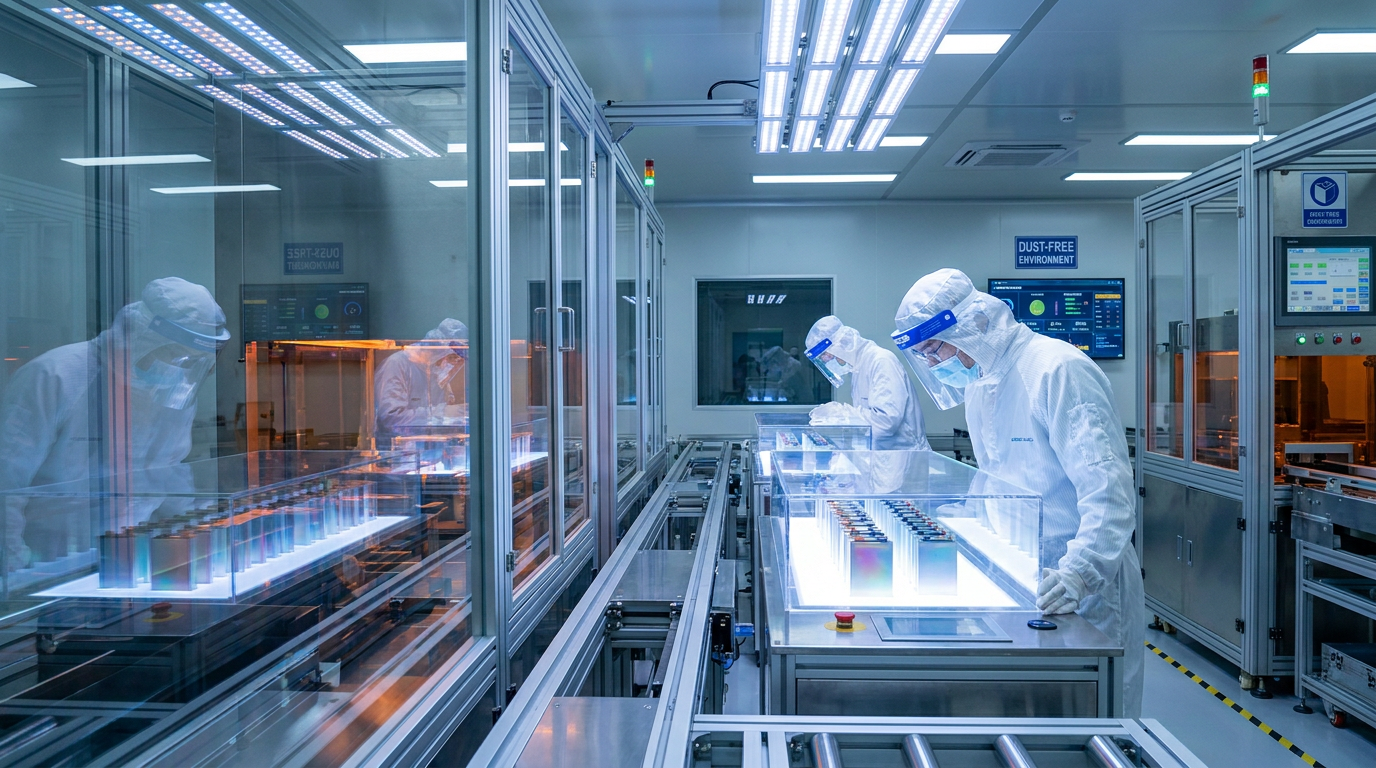
Despite these breakthroughs, the transition from successful laboratory prototypes to millions of affordable vehicles is fraught with immense manufacturing challenges. Building a solid-state battery requires entirely new production paradigms. The solid electrolyte layer can be as thin as 20 microns, requiring microscopic precision in high-volume manufacturing environments. Any physical defect, material impurity, or uneven topography during production can ruin the cell, making high yield rates incredibly difficult to achieve.[8]
The most notorious engineering hurdle is the formation of lithium dendrites. When a battery with a lithium metal anode is charged, the lithium ions do not always deposit themselves perfectly flat. Instead, they can form microscopic, needle-like metallic structures called dendrites. Over repeated charging cycles, these rigid dendrites can grow and physically pierce through the solid electrolyte, eventually reaching the cathode and causing a short circuit. Engineering solid electrolytes that are mechanically tough enough to suppress dendrite growth remains a primary focus of materials scientists.[8]
Additionally, engineers must solve the "solid-to-solid interface" problem. In a traditional battery, the liquid electrolyte flows into every microscopic crevice of the electrodes, ensuring perfect electrical contact. In a solid-state battery, two rigid solids are pressed against each other. As the battery charges and discharges, the electrodes physically expand and contract—essentially "breathing." Maintaining perfect, unbroken contact between these solid layers over thousands of cycles without the materials cracking or delaminating is a monumental physics challenge.[3]
To maintain this crucial internal contact, many early solid-state designs require high "stack pressure"—meaning the battery cells must be physically squeezed together with significant force inside the vehicle's battery pack. This requires heavy, specialized mechanical casings that can eat into the weight savings provided by the advanced chemistry. Overcoming these integration hurdles requires automakers to completely redesign how battery packs are built into the chassis of the car.[3]

Because scaling up pristine cleanroom manufacturing for solid-state cells is incredibly expensive, the technology will initially be reserved for luxury vehicles and high-performance sports cars. In the interim, the industry is relying on transitional technologies. Silicon-anode batteries, which blend silicon into traditional graphite to boost capacity, are already hitting the market to provide faster charging today. Meanwhile, cheap sodium-ion batteries are being deployed in budget-friendly commuter cars, creating a bifurcated market where different chemistries serve different price points.[5]
Ultimately, however, the trajectory of the automotive industry points definitively toward a solid-state future. The fundamental advantages in energy density, safety, and charging speed are simply too vast to ignore. As manufacturing yields improve and economies of scale drive down production costs over the next decade, solid-state batteries are poised to become the standard for global transportation, finally fulfilling the promise of an electric vehicle that outperforms its fossil-fuel predecessors in every conceivable metric.[1]
How we got here
1990s-2010s
Solid-state batteries remain largely confined to laboratory research and small-scale medical devices.
2022
Major automakers announce multi-billion dollar investments into solid-state battery startups.
August 2025
A Mercedes-Benz EQS prototype drives 1,205 km across Europe on a single charge using solid-state cells.
January 2026
Multiple companies unveil production-ready solid-state tech for mobility at CES in Las Vegas.
April 2026
Chinese manufacturer Greater Bay Technology announces successful A-sample tests and targets mass production by year-end.
Viewpoints in depth
Automotive Manufacturers
Eager to integrate the technology to eliminate range anxiety and differentiate premium models.
For the world's largest automakers, solid-state batteries represent the ultimate competitive moat. Companies like Mercedes-Benz, Toyota, and GAC Group are investing billions to be the first to market, viewing the technology as the key to winning over consumers who are still hesitant about EV range and charging times. Their primary focus is on accelerating the timeline from laboratory prototypes to gigawatt-hour mass production, even if it means absorbing higher initial costs.
Materials Scientists
Focused on optimizing the chemical composition of solid electrolytes to maximize performance.
Researchers in academia and specialized startups are less concerned with immediate mass production and more focused on solving fundamental physics problems. They are actively debating which solid electrolyte material—sulfide, oxide, or polymer—will ultimately offer the best balance of ionic conductivity and mechanical strength. Their goal is to completely eliminate dendrite growth and ensure that the solid-to-solid interfaces remain stable over thousands of charging cycles.
Manufacturing Engineers
Tasked with the daunting challenge of building solid-state cells at scale without defects.
For process engineers, the excitement around solid-state chemistry is tempered by the reality of factory floors. Building a solid-state battery requires unprecedented levels of precision, as even microscopic impurities or variations in the 20-micron-thick electrolyte layer can ruin a cell. This camp emphasizes that the true bottleneck is not the science, but the engineering required to achieve high yield rates in cleanroom environments, which is essential for bringing costs down to parity with traditional lithium-ion batteries.
What we don't know
- How quickly manufacturing yields can improve to bring solid-state battery costs down to parity with lithium-ion.
- Which solid electrolyte material—sulfide, oxide, or polymer—will ultimately dominate the mass market.
- How solid-state cells will perform over a decade of real-world wear and tear in consumer vehicles.
Key terms
- Electrolyte
- The medium inside a battery that allows ions to flow between the cathode and anode during charging and discharging.
- Anode
- The negative electrode of a battery, traditionally made of graphite in lithium-ion cells, but often made of pure lithium metal in solid-state designs.
- Dendrites
- Microscopic, needle-like metallic structures that can grow inside a battery, potentially piercing components and causing short circuits.
- Energy Density
- The amount of energy a battery can store relative to its weight or volume, typically measured in watt-hours per kilogram (Wh/kg).
- Thermal Runaway
- A dangerous chain reaction where a battery cell overheats, often leading to a fire or explosion in traditional liquid-electrolyte batteries.
Frequently asked
Will solid-state batteries make electric vehicles cheaper?
Initially, they will be more expensive due to complex manufacturing and will likely be reserved for premium vehicles. However, as production scales up over the next decade, prices are expected to drop significantly.
Can I put a solid-state battery in my current electric car?
No. Solid-state batteries require entirely different thermal management systems and structural integration, meaning they will only be available in newly designed vehicles.
Are solid-state batteries completely fireproof?
While not entirely fireproof, they are vastly safer than lithium-ion batteries. Their solid electrolytes are non-flammable and can withstand much higher temperatures before failing safely.
Sources
Source coverage
8 outlets
3 viewpoints surfaced








[1]Factlen Editorial TeamAutomotive Industry Leaders
Synthesis by Factlen editorial team
Read on Factlen Editorial Team →[2]American Chemical SocietyMaterials Scientists
Working Principle and Challenges of Solid-State Batteries
Read on American Chemical Society →[3]ExponentManufacturing Engineers
Navigating the Safety and Manufacturing Complexities of Solid-State Batteries
Read on Exponent →[4]ElectrekAutomotive Industry Leaders
China ramps up solid-state EV battery production with new breakthrough
Read on Electrek →[5]EleportAutomotive Industry Leaders
New battery technologies 2026 delivered: Solid-state hits the road
Read on Eleport →[6]The American Ceramic SocietyManufacturing Engineers
Solid-state battery breakthroughs take center stage at CES 2026
Read on The American Ceramic Society →[7]LaseraxMaterials Scientists
Solid-State Battery vs Lithium-Ion: Energy Density and Charging Time
Read on Laserax →[8]KLA CorporationManufacturing Engineers
Solid-State Batteries' Manufacturing Challenges
Read on KLA Corporation →


Every angle. Every day.
Get guides stories with full source coverage and perspective breakdowns delivered to your inbox.