
How the Human Brain Builds a Sentence, Neuron by Neuron
New high-resolution microelectrode recordings from awake patients reveal exactly how individual neurons encode the meaning, sound, and structure of words during conversation.
By Factlen Editorial Team
- Cognitive Neuroscientists
- Focus on decoding the fundamental biological algorithms of language, syntax, and semantic representation.
- Clinical Neurologists
- Focus on mapping these networks to preserve language function during surgery and develop targeted neurorehabilitation for aphasia.
- Neural Engineers
- Focus on leveraging single-neuron language data to build highly accurate brain-computer interfaces for paralyzed patients.
What's not represented
- · Patients living with chronic aphasia or locked-in syndrome who are the ultimate beneficiaries of this research.
- · Bioethicists examining the privacy implications of decoding internal speech and semantic thought directly from the brain.
Why this matters
For decades, language was mapped to broad brain regions, leaving the actual biological computation a mystery. Tracking language at the single-cell level not only rewrites neuroscience textbooks, but provides the exact electrical blueprints needed to build brain-computer interfaces that could restore conversational speech for paralyzed patients.
Key points
- Neuroscientists are using microelectrode arrays in awake patients to track language processing at the single-neuron level.
- Data reveals a strict division of labor: some neurons respond only to written letters, while others respond exclusively to spoken sounds.
- Higher-order 'concept cells' in the prefrontal cortex encode the abstract meaning of a word, regardless of whether it is read or heard.
- Recent 2026 recordings show the brain's right hemisphere also possesses latent single-neuron language capabilities.
- This cellular mapping is accelerating the development of brain-computer interfaces designed to restore speech for people with severe paralysis.
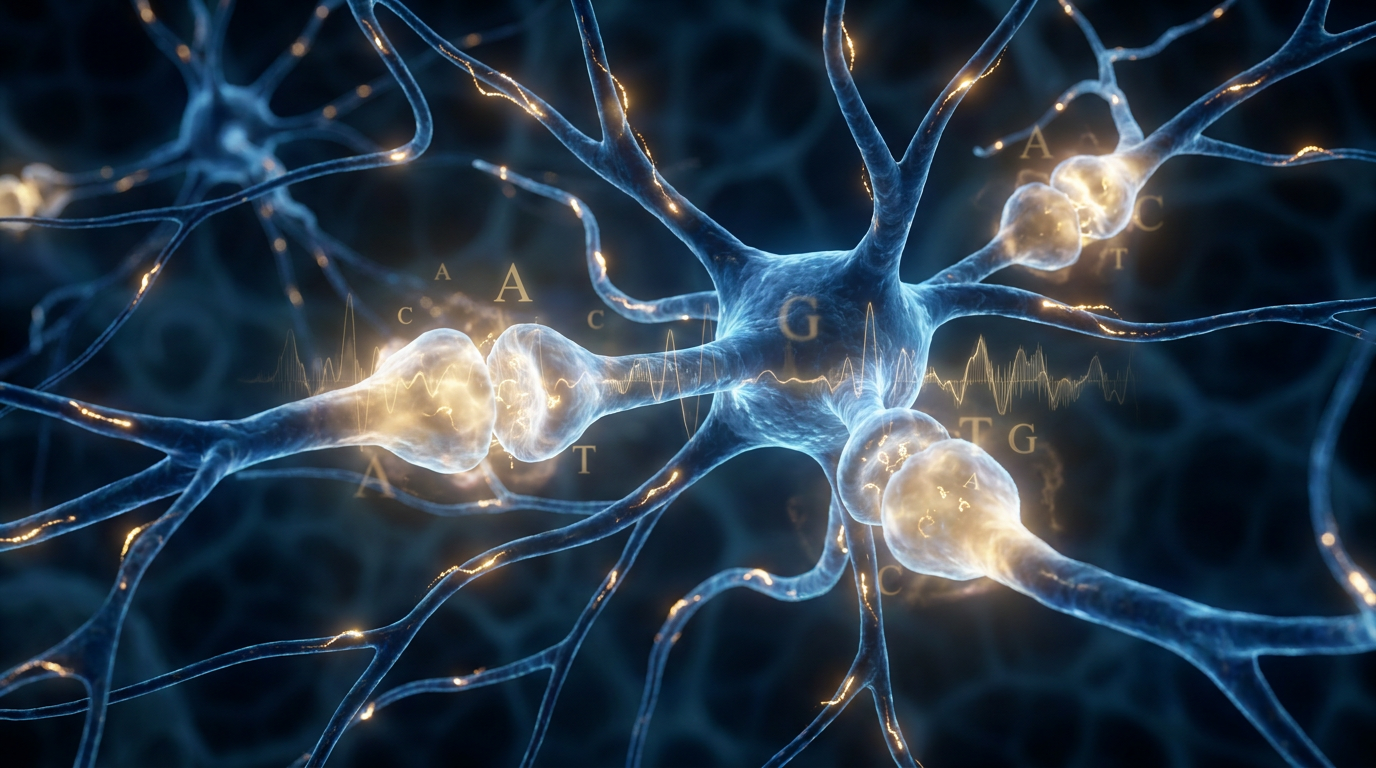
For more than a century, our understanding of how the human brain processes language has relied on a macro-level map. Textbooks point to broad territories like Broca’s and Wernicke’s areas—regions containing billions of individual cells—as the primary engines of speech production and comprehension. But this zoomed-out view obscures the actual biological algorithms at work, akin to trying to understand how a computer software program functions by simply looking at the motherboard. Now, a wave of high-resolution intracranial research is allowing neuroscientists to track language computation at the cellular level, revealing exactly how the brain builds a sentence neuron by neuron.[1][6]
The primary obstacle to achieving this microscopic view has always been physical access to the living human brain. Non-invasive imaging tools like functional MRI track blood flow over a period of seconds, which is far too slow to capture the millisecond-by-millisecond firing of neural circuits during a rapid conversation. To bridge this technological gap, researchers have turned to a unique and highly specialized clinical opportunity: awake neurosurgical patients who have temporary microelectrode arrays implanted in their cortex to map seizure networks prior to undergoing epilepsy surgery.[2][6]
By asking these volunteer patients to read words on a screen, listen to spoken sentences, and articulate responses while their neural activity is continuously recorded, scientists are systematically building a dictionary of the brain's electrical impulses. Recent large-scale studies have successfully captured the simultaneous firing responses of over 1,000 individual neurons, providing an unprecedented, high-definition look at how linguistic features are distributed across the human cortex. This evidence pack examines the core claims emerging from this cellular-level mapping and what it means for the future of neurology.[2]
The first major claim supported by this recent wave of data is that individual neurons exhibit extreme, modality-specific specialization for the fundamental building blocks of language. Researchers have identified a striking double dissociation in how the brain processes the raw sensory inputs of reading versus listening. Neurons located in the ventral occipito-temporal cortex respond exclusively to written letters and orthographic features, remaining entirely silent when the exact same words are spoken aloud to the patient.[2]

Conversely, the brain's auditory processing centers show profound and highly specific tuning to the sounds of human speech. A landmark 2024 study mapping the depth of the human cortex demonstrated that distinct layers of the superior temporal gyrus are tuned to specific phonetic features, such as the hard consonant burst of a "P" or the sustained vocal resonance of an "O". The evidence for this low-level sensory specialization is robust, having been replicated across multiple patients and various recording sites throughout the temporal lobe.[4]
The second major claim is that as language moves higher into the brain's processing hierarchy, single neurons transition from encoding raw sensory inputs to encoding abstract semantic meaning. This phenomenon, known as semantic encoding, represents the brain's ability to extract the core concept of a word. A pivotal study published in the journal Nature demonstrated that individual neurons in the prefrontal cortex and hippocampus fire in direct response to the specific meaning of a word, effectively acting as dedicated "concept cells".[3]
This phenomenon, known as semantic encoding, represents the brain's ability to extract the core concept of a word.
The evidence supporting this semantic abstraction is highly compelling. When patients were presented with words either visually or auditorily, these higher-order neurons fired consistently for the concept itself, regardless of the sensory modality used to deliver it. For instance, a specific neuron tuned to the concept of an animal would spike with equal intensity whether the patient read the word "dog" on a monitor or heard the audio of a barking dog, proving that the brain extracts amodal meaning from diverse sensory streams.[2][3]
The third claim fundamentally reshapes our understanding of brain injury and neurological recovery: the right hemisphere possesses a latent, single-neuron capacity for language processing. Medical textbooks traditionally relegate language almost entirely to the left hemisphere in the vast majority of adults. However, 2026 microelectrode recordings taken from an individual living with stroke-induced chronic aphasia directly challenge this absolute lateralization model. This discovery opens up entirely new avenues for understanding how the brain adapts to catastrophic injury.[5]

The newly published data revealed that single neurons in the right prefrontal and parietal cortices actively encoded both the semantic meaning and the phonological structure of words during comprehension and retrieval tasks. While the evidence is currently limited to a small number of chronic aphasia cases, it strongly suggests that right-hemispheric circuits—which are homotopic to the dominant left language network—can support complex language processing when the primary network is severely damaged.[5][6]
These cellular discoveries are not merely academic curiosities; they form the foundational evidence required for the next generation of neuroprosthetics. By understanding exactly how single neurons encode speech sounds, syllables, and semantic concepts, neural engineers are developing highly accurate brain-computer interfaces (BCIs). These advanced devices aim to decode the intended speech of patients suffering from locked-in syndrome, ALS, or severe paralysis, translating their neural spikes directly into synthesized voice or text on a screen.[1][6]
To achieve this ambitious goal, researchers are increasingly pairing high-density single-neuron recordings with artificial large language models (LLMs). Recent analyses show that the temporally coordinated population dynamics of human neurons can be accurately predicted by the semantic and phonological embeddings derived from artificial neural networks. This remarkable alignment between biological brain activity and artificial language processing is rapidly accelerating the development of real-time, highly conversational speech decoders.[5][6]

Despite these monumental breakthroughs, transparent uncertainty remains regarding the highest levels of human language computation. While scientists can now reliably identify neurons that encode specific phonetic sounds and isolated semantic concepts, the mechanism of "binding"—how the brain dynamically links these individual concepts together using complex syntax and grammar to form a coherent, entirely novel sentence—remains largely opaque to current recording techniques.[6]
Furthermore, it is not yet clear exactly how context shifts a single neuron's tuning on the fly during a fast-paced conversation. A word like "bank" has entirely different meanings depending on whether it is situated next to a river or a financial vault, and how single neurons rapidly update their semantic encoding based on surrounding contextual words is an active area of intense investigation. As recording technologies continue to scale, capturing thousands of neurons simultaneously, the complete biological algorithm of human language is finally coming into focus.[3][6]
How we got here
2014-2019
Early intracranial studies begin identifying specific regions of the superior temporal gyrus tuned to distinct speech sounds.
Early 2024
Landmark papers in Nature demonstrate that single neurons in the human cortex encode both phonetic structure and abstract semantic meaning.
March 2026
Researchers publish the first single-neuron recordings of the right hemisphere's language network in a patient with chronic aphasia.
June 2026
A comprehensive study of 21 patients reveals a double dissociation between neurons that process written letters and those that process spoken phonemes.
Viewpoints in depth
Cognitive Neuroscientists
Seeking the biological algorithms of human language.
For cognitive neuroscientists, the ability to record single neurons is akin to finally having a microscope for linguistics. Rather than relying on theoretical models of how words are stored and retrieved, they can directly observe the brain's physical vocabulary. Their primary focus is understanding 'binding'—the still-mysterious process by which the brain stitches isolated semantic concepts together using syntax to create entirely novel sentences on the fly.
Clinical Neurologists
Mapping the brain to protect and restore communication.
Clinicians view this high-resolution data as a roadmap for preserving and restoring function. By precisely mapping where specific linguistic features are encoded, surgeons can better avoid critical language hubs during tumor or epilepsy resections. Furthermore, the discovery that the right hemisphere harbors latent single-neuron language capabilities offers a promising new target for neurorehabilitation, potentially allowing therapies to 'wake up' these backup circuits in patients with severe aphasia.
Neural Engineers
Translating neural spikes into synthetic speech.
For engineers building brain-computer interfaces, single-neuron language data is the ultimate training set. By feeding these precise electrical patterns into large language models, they are developing algorithms capable of predicting the exact word a paralyzed patient is attempting to say. Their goal is to move beyond slow, letter-by-letter typing interfaces and achieve real-time, conversational speech synthesis driven entirely by thought.
What we don't know
- How the brain binds individual semantic concepts together using complex syntax and grammar to form novel sentences.
- How context dynamically shifts a single neuron's tuning in real-time (e.g., distinguishing 'bank' as a river edge versus a financial institution).
- The exact mechanisms by which the right hemisphere can be stimulated to take over language functions after a left-hemisphere stroke.
Key terms
- Single-neuron recording
- A technique using microscopic electrodes to measure the electrical action potentials (spikes) of individual brain cells.
- Semantic encoding
- The process by which neurons fire in response to the abstract meaning or concept of a word, rather than its sound or spelling.
- Aphasia
- A language disorder, often caused by stroke or brain injury, that impairs a person's ability to communicate or understand speech.
- Double dissociation
- A neuroscientific principle where two related mental processes are shown to function independently of each other, handled by different neural circuits.
- Brain-computer interface (BCI)
- A system that translates neural electrical activity into commands for external devices, such as a computer cursor or speech synthesizer.
Frequently asked
How do researchers record single neurons in humans?
Scientists partner with neurosurgical patients who have temporary microelectrodes implanted in their brains for clinical reasons, such as mapping seizure activity before epilepsy surgery.
Is language only processed in the left side of the brain?
While the left hemisphere is the primary engine for language in most people, recent single-neuron recordings show that the right hemisphere also actively encodes word meanings and sounds, which could aid in stroke recovery.
Do specific neurons only understand specific words?
Some neurons act as 'concept cells' that fire for specific categories or meanings (like animals or actions), regardless of whether the word is spoken aloud or read on a screen.
How does this research help paralyzed patients?
By understanding the exact electrical vocabulary the brain uses to build sentences, engineers can train computer models to decode intended speech from paralyzed patients and translate it into synthesized voice.
Sources
Source coverage
6 outlets
3 viewpoints surfaced




[1]Nature Daily BriefingClinical Neurologists
Daily briefing: The brain builds a sentence neuron by neuron
Read on Nature Daily Briefing →[2]eLifeCognitive Neuroscientists
Modality-Specific and Amodal Language Processing by Single Neurons
Read on eLife →Semantic encoding during language comprehension at single-cell resolution
Read on Nature →Large-scale single-neuron speech sound encoding across the depth of human cortex
Read on Nature →[5]bioRxivClinical Neurologists
A right-hemispheric language network at single-neuron resolution
Read on bioRxiv →[6]Factlen Editorial TeamNeural Engineers
Synthesis by Factlen editorial team
Read on Factlen Editorial Team →
More in science
See all 5 stories →Stem Cell Therapy
Donor Stem Cells Halt Severe Autoimmune Disease for 15 Years in Landmark Study
7 sources
Cellular Therapy
Donor Stem Cells Banish Severe Autoimmune Disease for 15 Years in Landmark Study
5 sources
Stem Cell Tech
Stem Cell Transplant Banishes Severe Autoimmune Disease for 15 Years in Medical First
7 sources
Every angle. Every day.
Get science stories with full source coverage and perspective breakdowns delivered to your inbox.