
IMAX with Laser vs. Dolby Cinema: Which Premium Format is Worth Your Money in 2026?
As premium theater tickets push past $25, the choice between IMAX's towering scale and Dolby Cinema's flawless contrast dictates how you experience the year's biggest blockbusters.
By Factlen Editorial Team
- Scale & Spectacle Seekers
- Argue that the theatrical experience is fundamentally about feeling dwarfed by the image, favoring IMAX's massive screens and expanded aspect ratios.
- Fidelity & Precision Purists
- Value perfect black levels, vibrant HDR colors, and pinpoint spatial audio over sheer physical size, strongly favoring Dolby Cinema.
- Comfort-First Moviegoers
- Prioritize luxury recliners, reserved seating, and premium amenities over technical projection specifications.
What's not represented
- · Independent theater owners
- · Standard format moviegoers
Why this matters
Premium format tickets now routinely cost up to $8 more than standard screenings. Understanding the technical differences ensures you don't waste money on the wrong format for the specific movie you want to see.
Key points
- IMAX focuses on massive scale, utilizing floor-to-ceiling screens and expanded aspect ratios to immerse the viewer.
- Dolby Cinema prioritizes visual precision, using Dolby Vision HDR to achieve perfect black levels and vibrant colors.
- Films shot specifically with IMAX cameras will show up to 40% more picture in an IMAX theater.
- Dolby Cinema universally offers luxury reclining seats with haptic feedback, while IMAX typically uses standard stadium seating.
- Dolby's dual-projector system provides a brighter, ghost-free 3D experience compared to traditional polarized setups.
- Both formats carry a similar ticket surcharge, meaning the choice should be dictated by the specific film being viewed.
Walking up to a cinema box office in the summer of 2026 presents moviegoers with a baffling and expensive dilemma. As streaming services offer increasingly sophisticated 4K home setups, theatrical chains have doubled down on premium formats to provide an experience that simply cannot be replicated in a living room. Tickets for these upgraded auditoriums routinely carry a surcharge of five to eight dollars, pushing the cost of a weekend outing to new highs. Yet, for major blockbuster releases, audiences are overwhelmingly choosing to pay the premium. The question is no longer whether to upgrade, but which upgrade actually delivers on its promise. Two dominant heavyweights have emerged at the top of the theatrical food chain: IMAX with Laser and Dolby Cinema. While both guarantee a superior night out, they achieve their magic through fundamentally different philosophies of what makes a movie immersive.[3][7]
The modern premium format war is a battle between overwhelming scale and surgical precision. For decades, the theatrical upgrade path was simple: find the biggest screen possible and sit in the dark. Today, the calculus involves contrast ratios, object-based audio rendering, and proprietary camera workflows. Directors themselves are increasingly vocal about how their films should be consumed, with auteurs like Christopher Nolan championing the towering heights of IMAX, while others like James Cameron and Guillermo del Toro often lean into the vibrant high-dynamic-range capabilities of Dolby Cinema. Understanding the technical trade-offs between these two formats is the only way to ensure that your premium ticket price is actually buying the experience the filmmaker intended.[1][2]
Introducing the contenders requires looking past the marketing jargon to the actual hardware illuminating the auditorium. IMAX has spent the last few years aggressively upgrading its fleet to "IMAX with Laser," replacing aging digital projectors with dual 4K laser engines that drastically improve brightness and eliminate the dreaded "screen door" pixel effect. Dolby Cinema, meanwhile, was built from the ground up as a bespoke marriage of Dolby Vision projection and Dolby Atmos sound, housed exclusively in custom-designed auditoriums. Both formats utilize dual-laser projection, but they deploy that light to achieve completely different visual goals. The choice between them dictates not just how big the explosions look, but what color the fire is and exactly where the shrapnel sounds like it is landing.[2][4]

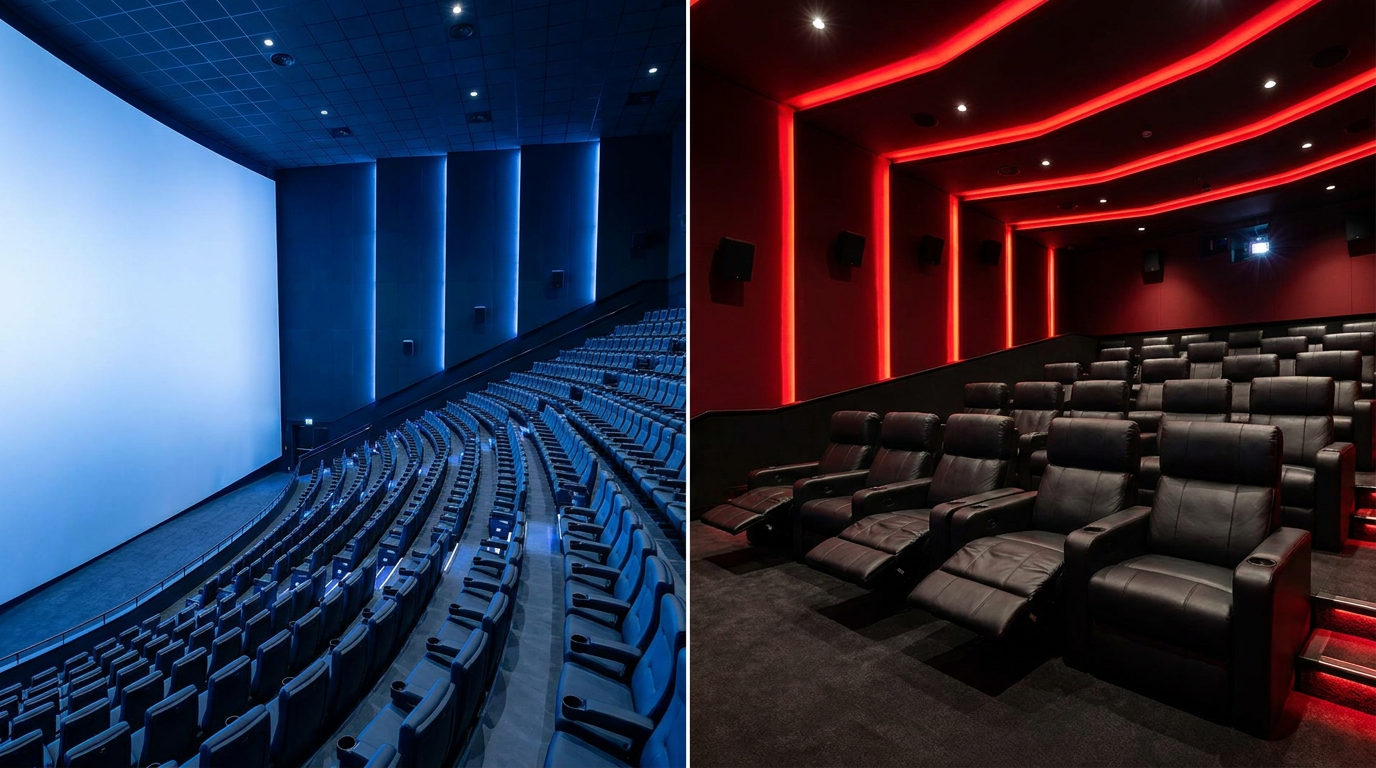
For IMAX, the argument rests entirely on scale and vertical immersion. The format is designed to swallow the viewer whole, utilizing floor-to-ceiling, wall-to-wall screens that fill the entirety of human peripheral vision. When a film is explicitly shot with IMAX-certified cameras, the director can utilize an expanded aspect ratio that opens up the top and bottom of the frame. In a standard theater, this extra visual information is simply cropped out to fit a traditional widescreen rectangle. In a true IMAX auditorium, the image expands vertically during major action sequences or sweeping establishing shots, creating a towering sense of vertigo and grandeur that no other format can physically accommodate.[1][4]
Against IMAX, the primary complaint is inconsistency across its sprawling global footprint. Because the company has aggressively expanded by retrofitting existing multiplex auditoriums, not all IMAX screens are created equal. Cinema enthusiasts frequently use the derogatory term "LieMAX" to describe these smaller, mall-based screens that carry the IMAX branding but lack the massive, multi-story physical dimensions of purpose-built Grand Theaters. Furthermore, IMAX auditoriums traditionally utilize steep stadium seating with standard rocking chairs to maximize capacity and sightlines. For viewers accustomed to the luxury recliners that have become standard in many modern cinemas, the rigid seating of an IMAX hall can feel like a step backward in comfort for a premium-priced ticket.[3][6]
The evidence for IMAX's dominance in scale is quantifiable and visually striking. True IMAX Grand Theater screens expand to a towering 1.43:1 aspect ratio, while their standard laser retrofits open up to 1.90:1. This translates to audiences seeing between 26 and 40 percent more picture on the screen compared to a standard 2.39:1 widescreen presentation. When a massive sci-fi epic or a sweeping historical drama utilizes this extra real estate, the visual impact is undeniable. The format's proprietary audio system also relies on brute force, utilizing a custom, uncompressed channel-based surround system that is laser-aligned to deliver thunderous, seat-shaking bass that physically reverberates through the audience during high-impact scenes.[2][4]

The evidence for IMAX's dominance in scale is quantifiable and visually striking.
For Dolby Cinema, the argument champions technical precision and absolute visual fidelity over sheer physical footprint. The format's crown jewel is Dolby Vision, a proprietary High Dynamic Range (HDR) technology that fundamentally changes how light and color are rendered on screen. Standard cinema projectors struggle to display true black, often rendering dark scenes as a muddy, washed-out gray. Dolby's dual-laser system completely shuts off light to the darkest parts of the image, achieving inky, perfect blacks while simultaneously pushing the bright highlights to dazzling levels. Combined with Dolby Atmos audio, which treats individual sounds as 3D objects moving through space rather than assigning them to fixed speakers, the format promises a surgically precise sensory environment.[1][4]
Against Dolby Cinema, the trade-off is a noticeable reduction in sheer physical scale. Because Dolby auditoriums are typically retrofitted into existing multiplex footprints and prioritize luxury spacing, the screens are almost always smaller than their IMAX counterparts. More importantly, Dolby Cinema screens utilize standard widescreen aspect ratios. If a movie was specifically filmed with IMAX cameras to feature expanded vertical footage, that extra picture will be permanently cropped out in a Dolby Cinema presentation. For viewers who equate a premium ticket strictly with the largest possible image, walking into a Dolby auditorium and seeing a relatively standard-sized screen can initially feel underwhelming until the lights actually go down.[2][6]
The evidence for Dolby's visual and auditory superiority lies in the staggering math of its projection technology. Dolby Cinema boasts a contrast ratio of 1,000,000:1, which absolutely dwarfs the roughly 2,500:1 contrast ratio found in even the newest IMAX with Laser setups. This means colors are exponentially more vibrant, and the separation between light and shadow is flawlessly defined. Furthermore, the Dolby Atmos system utilizes dozens of individual speakers, including overhead arrays, allowing sound designers to pinpoint a helicopter flying exactly over a specific row of seats. The auditoriums also universally feature premium leather recliners equipped with haptic transducers, meaning the seats subtly vibrate in perfect synchronization with the low-frequency bass of the film's audio mix.[4][7]

The 3D factor has also become a crucial battleground in 2026, particularly with the release of visually dense spectacles like the latest Avatar installments. Because Dolby Cinema utilizes dual projectors simultaneously, it eliminates the alternate-eye flickering that plagues standard 3D presentations. The format uses sophisticated color-filter technology in its 3D glasses rather than standard circular polarization, resulting in zero ghosting and almost no noticeable loss in brightness. While IMAX 3D remains a massive, immersive experience, viewers often note that the image becomes visibly dimmer and the colors slightly muted the moment the polarized glasses go on, giving Dolby a distinct edge in maintaining visual pop during three-dimensional screenings.[5][6]
From a pure value perspective, the pricing between the two formats is remarkably similar, making the choice entirely about preference rather than budget. Both IMAX and Dolby Cinema tickets typically carry a surcharge of four to eight dollars over a standard digital screening, depending on the local market and the specific theater chain. Because the financial investment is identical, the decision should be driven entirely by the specific film being shown. Paying the IMAX premium for a quiet, dialogue-driven comedy offers almost zero return on investment, just as paying for Dolby Cinema might feel like a missed opportunity if a film features 40 minutes of expanded IMAX-exclusive footage that you are completely missing out on.[2][3]
Navigating the ticketing apps requires a bit of savvy consumer research to ensure you are getting the exact experience you are paying for. When booking IMAX, enthusiasts recommend checking community databases or theater specifications to see if the location features a true 1.43:1 Grand Theater screen or a smaller 1.90:1 retrofit. Look for the "IMAX with Laser" designation, which guarantees the newer, brighter projection system over the aging digital Xenon bulbs. For Dolby Cinema, the experience is far more standardized; because Dolby tightly controls the build-out of every single auditorium bearing its name, you are virtually guaranteed the exact same high-contrast projection, Atmos audio, and reclining seats regardless of which multiplex you visit.[6][7]

Ultimately, Dolby Cinema fits well when viewers are watching visually rich dramas, horror films, animated features, or standard-release blockbusters that were not explicitly filmed for IMAX. The format is the undisputed champion for films that rely on deep shadows, vibrant color palettes, and intricate sound design. It is also the superior choice for moviegoers who prioritize physical comfort, as the guaranteed luxury recliners and haptic feedback provide a highly relaxed, intimate viewing environment. If the film's aspect ratio is standard widescreen and the director has not specifically utilized IMAX cameras, Dolby Cinema will almost always provide the most beautiful, technically perfect presentation of the material.[1][4]
Conversely, IMAX fits well when the film was explicitly shot with IMAX cameras and the marketing heavily promotes the expanded aspect ratio. For massive sci-fi epics, sprawling action movies, and sweeping historical dramas, the sheer scale of a true IMAX screen cannot be replicated by Dolby's superior contrast. It is the format of choice for viewers who want to feel dwarfed by the spectacle and are willing to sacrifice a bit of seating comfort for overwhelming visual immersion. When a director intends for a spacecraft to tower over the audience or a cityscape to fill their entire peripheral vision, seeking out an IMAX with Laser auditorium remains the most visceral way to experience the magic of the movies.[2][4]
How we got here
2014
IMAX introduces its dual 4K laser projection system to replace 70mm film in select flagship venues.
2015
Dolby Cinema launches, combining Dolby Vision HDR and Atmos audio in custom-built luxury auditoriums.
2020
IMAX accelerates its 'IMAX with Laser' rollout to upgrade smaller multiplex retrofits from aging digital projectors.
2025
Major blockbusters increasingly release in both formats simultaneously, sparking intense debate over the definitive viewing experience.
Viewpoints in depth
Scale & Spectacle Seekers
Argue that the theatrical experience is fundamentally about feeling dwarfed by the image.
This camp believes that the primary reason to leave the house and pay a premium ticket price is to experience something physically impossible to replicate at home. They argue that IMAX's towering 1.43:1 or 1.90:1 aspect ratios provide a sense of vertigo and immersion that perfect contrast ratios simply cannot match. For these viewers, the slight loss in black levels or the lack of a reclining seat is a fair trade for having their entire peripheral vision filled by a massive sci-fi landscape or a sweeping action sequence.
Fidelity & Precision Purists
Value perfect black levels, vibrant HDR colors, and pinpoint spatial audio over sheer physical size.
Precision purists argue that size is irrelevant if the image quality is compromised. They champion Dolby Cinema for its 1,000,000:1 contrast ratio, pointing out that standard projectors render space scenes and shadows as a muddy gray, whereas Dolby Vision achieves true, inky black. This camp also heavily favors Dolby Atmos audio, noting that object-based sound design—where a specific noise can be tracked moving directly over a viewer's head—creates a more convincing and technically impressive sensory environment than IMAX's louder, channel-based brute force.
Comfort-First Moviegoers
Prioritize luxury recliners, reserved seating, and premium amenities over technical projection specifications.
For this segment of the audience, a premium ticket price must guarantee a premium physical experience. They argue that sitting in a rigid, upright stadium seat for a three-hour blockbuster is unacceptable when paying $25 or more. This camp universally favors Dolby Cinema due to its strict standardization of luxury leather recliners with ample legroom and built-in haptic transducers. To them, the technical specs of the projector are secondary to the ability to comfortably relax in an intimate, uncrowded auditorium.
What we don't know
- Whether IMAX will eventually adopt HDR technology to compete with Dolby Vision's contrast ratios.
- If theater chains will continue to raise the premium surcharge as standard digital ticket sales decline.
- How the rise of ultra-large home MicroLED screens will impact the long-term viability of premium theatrical formats.
Key terms
- Aspect Ratio
- The proportional relationship between a screen's width and height, dictating how much vertical image is visible to the audience.
- Dolby Vision
- A proprietary High Dynamic Range (HDR) format that delivers ultra-high contrast, allowing for true black levels and exceptionally vibrant colors.
- Dolby Atmos
- An object-based audio system that places sounds in a 360-degree 3D space, including overhead, rather than assigning them to specific left or right channels.
- Dual 4K Laser
- A projection system using two separate laser light engines to dramatically increase brightness, sharpness, and 3D performance compared to older digital bulbs.
- Contrast Ratio
- The measurement of the difference in light intensity between the brightest white and the darkest black a projector can produce.
Frequently asked
What does 'Filmed for IMAX' actually mean?
It indicates the movie was shot using IMAX-certified digital cameras or film. This allows the image to expand vertically during key scenes, showing up to 40% more picture in IMAX theaters compared to standard screens.
Do Dolby Cinema theaters show movies in 3D?
Yes, and they utilize a dual-projector system that eliminates the flickering and dimness often associated with standard 3D presentations, resulting in a brighter, clearer image.
Why do some IMAX screens seem smaller than others?
Many multiplexes retrofitted standard auditoriums with IMAX technology. While they feature upgraded sound and projection, they lack the massive, multi-story screens of purpose-built IMAX Grand Theaters.
Are Dolby Cinema seats better than IMAX seats?
Generally, yes. Dolby Cinema universally features luxury leather recliners with ample legroom and haptic vibration, while most IMAX theaters use traditional, steeper stadium seating to maximize capacity.
Sources
Source coverage
7 outlets
3 viewpoints surfaced







[1]EngadgetFidelity & Precision Purists
What's the difference between Dolby Cinema and IMAX?
Read on Engadget →[2]AWOL VisionComfort-First Moviegoers
Dolby Cinema vs. IMAX — How to Choose Right Now
Read on AWOL Vision →[3]Tickets UKScale & Spectacle Seekers
Premium Cinema Formats Explained: Are They Worth It?
Read on Tickets UK →[4]All Your ChoiceComfort-First Moviegoers
Dolby Cinema vs IMAX: Which is the Best Theatre in 2026?
Read on All Your Choice →[5]Shrey Tyagi ReviewsFidelity & Precision Purists
Dolby Cinema 3D vs IMAX with Laser: A Visual Breakdown
Read on Shrey Tyagi Reviews →[6]r/imax CommunityScale & Spectacle Seekers
Avatar: Fire and Ash in IMAX with Laser 3D vs Dolby
Read on r/imax Community →[7]Factlen Editorial Team
Synthesis by Factlen editorial team
Read on Factlen Editorial Team →
Every angle. Every day.
Get entertainment stories with full source coverage and perspective breakdowns delivered to your inbox.