
Solid-State Batteries Are Finally Hitting the Road in 2026—But Only in Six-Figure Luxury EVs
After a decade of laboratory promises, solid-state battery technology is making its real-world debut in flagship electric vehicles from Mercedes-Benz and Porsche. While the breakthrough promises 700-mile ranges and 12-minute charge times, manufacturing costs mean the technology will remain exclusive to the ultra-luxury market for years.
By Factlen Editorial Team
- Solid-State Pioneers
- Argue that the technology is ready for real-world deployment now, focusing on premium segments to absorb early manufacturing costs.
- Volume Automakers
- Prioritize multi-powertrain flexibility and hybrid technology while waiting for solid-state manufacturing to become economically viable.
- Pragmatic Skeptics
- Caution that the leap from pilot lines to mass-market gigawatt-scale production will take at least another decade.
What's not represented
- · Environmental advocates assessing the mining impact of pure lithium-metal anodes
- · Independent repair shops evaluating the serviceability of solid-state architectures
Why this matters
Solid-state batteries represent the largest leap in automotive technology since the invention of the lithium-ion cell, promising to eliminate range anxiety and battery fires entirely. While currently restricted to the wealthiest buyers, this 2026 rollout proves the chemistry works, setting the stage for a dramatic transformation of the mass-market auto industry over the next decade.
Key points
- Mercedes-Benz successfully drove an EQS equipped with a solid-state battery 749 miles on a single charge.
- QuantumScape has opened its 'Eagle Line' facility to produce solid-state cells for Volkswagen Group prototypes.
- Solid-state technology replaces flammable liquid electrolytes with rigid ceramics, eliminating fire risks.
- The new chemistry allows for charging from 10% to 80% in roughly 12 to 18 minutes.
- High manufacturing costs mean early solid-state EVs will likely cost upwards of $150,000.
- Mass-market adoption is expected to take another decade as automakers scale production techniques.
For the past decade, the solid-state battery has been the automotive industry's holy grail—a mythical technology promising to cure range anxiety, eliminate battery fires, and charge as fast as a gas tank fills. In 2026, the myth has finally materialized into reality.
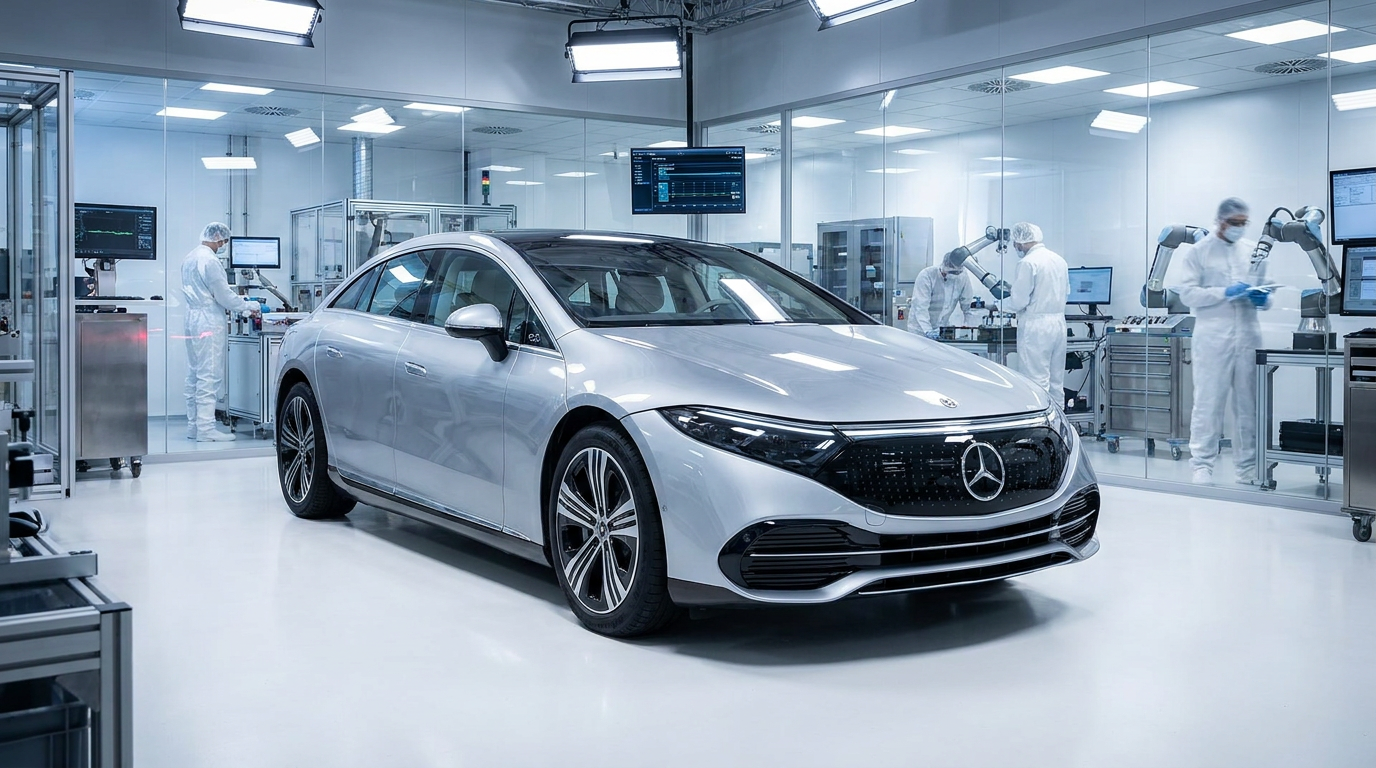
The watershed moment arrived when Mercedes-Benz quietly completed a 749-mile (1,205-kilometer) real-world test drive across three countries. A modified EQS sedan, equipped with solid-state cells from U.S. manufacturer Factorial Energy, drove from Stuttgart, Germany, to Malmö, Sweden, on a single charge—and arrived with 85 miles of range to spare.[1][2]
Across the globe in San Jose, California, Volkswagen-backed QuantumScape inaugurated its "Eagle Line" pilot facility in early 2026. The plant is now churning out advanced "B-sample" solid-state cells destined for Porsche and Audi prototypes, proving that the technology has officially graduated from the laboratory bench to the assembly line.[3][4]
But this revolution comes with a steep admission price. Because the manufacturing processes are still in their infancy, the first wave of solid-state electric vehicles will be strictly confined to the ultra-luxury segment. For the next several years, the technology will be the exclusive domain of six-figure flagship sedans and high-performance sports cars.[5]

To understand why automakers are willing to pay exorbitant premiums for these early cells, one must understand the mechanism that makes them so revolutionary. Traditional lithium-ion batteries rely on a liquid electrolyte—a chemical soup that shuttles ions back and forth between the anode and cathode during charging and discharging.
That liquid is the Achilles' heel of modern EVs. It is heavy, it degrades over time, it performs poorly in freezing temperatures, and crucially, it is highly flammable. If a traditional battery is punctured or severely overheated, the liquid electrolyte can ignite, causing the thermal runaway fires that have plagued early EV adoption.[2]
Solid-state batteries replace that volatile liquid with a solid material—typically a specialized ceramic, polymer, or sulfide glass. This seemingly simple swap unlocks a cascade of engineering breakthroughs. Because the solid separator is physically rigid and non-flammable, it virtually eliminates the risk of thermal runaway.[2][5]
More importantly, the rigid solid electrolyte allows engineers to use a pure lithium-metal anode instead of the bulky graphite used in today's cars. This fundamentally changes the math of energy density. QuantumScape's QSE-5 cells, for example, boast an energy density of 844 watt-hours per liter—allowing automakers to pack nearly double the energy into the same physical footprint.[3][4]

More importantly, the rigid solid electrolyte allows engineers to use a pure lithium-metal anode instead of the bulky graphite used in today's cars.
For luxury automakers, this solves a critical design paradox. Until now, building a 500-mile EV required a massive, heavy battery pack that compromised handling and interior space. With solid-state technology, a brand like Porsche can maintain the low-slung, lightweight proportions of a sports car while delivering track-ready sustained power and massive range.[3]
The charging speeds are equally transformative, addressing the final hurdle for luxury buyers accustomed to the convenience of gasoline. Because solid electrolytes do not suffer from the same chemical bottlenecks as liquids, they can absorb energy at staggering rates. QuantumScape's cells can charge from 10% to 80% in just 12.2 minutes, while Factorial's "Solstice" battery achieves a 15% to 90% charge in 18 minutes.[2][4]
Furthermore, these solid architectures are remarkably resilient to extreme climates. Factorial's cells maintain stability at operating temperatures over 194 degrees Fahrenheit (90°C) while also functioning seamlessly in sub-zero Arctic conditions. This thermal stability allows automakers to strip out the heavy, expensive liquid cooling systems currently required to keep EV batteries from overheating.[2]
Despite these monumental leaps, the path to mass-market adoption remains fraught with manufacturing hurdles. Making a perfect solid-state cell in a pristine laboratory is one thing; manufacturing millions of them at a gigawatt-hour scale without microscopic defects is an entirely different challenge.[5][8]
QuantumScape spent roughly $40 million to $60 million in capital expenditures in 2026 alone just to get its Eagle Line operational. The company had to invent an entirely new manufacturing technique, dubbed the "Cobra" process, just to produce the delicate ceramic separators at speed.[3][8]

Because of these immense capital costs and low initial yields, early solid-state cells are vastly more expensive than the ubiquitous Lithium Iron Phosphate (LFP) batteries powering standard EVs. Industry analysts project that the first commercial solid-state vehicles will easily exceed $150,000, effectively pricing out the vast majority of consumers.[5]
This economic reality has created a stark divide in the automotive industry. While premium brands like Mercedes and Porsche race ahead, volume automakers are hitting the brakes. General Motors executives recently cautioned that mass-market solid-state adoption is "still years away," while Chinese battery experts estimate it could take a decade for the technology to capture just 1% of the global market.[6]
Even Toyota, long considered the loudest champion of solid-state technology, has quietly adjusted its roadmap. While the Japanese giant is building a pilot line, its target for "limited commercial availability" has shifted to 2027 or 2028. Furthermore, Lexus recently canceled its dedicated LF-ZC electric sedan project, opting instead for flexible platforms that can accommodate hybrids alongside future solid-state EVs.[5][7]

For the average consumer, the wait will be long, but the trajectory is familiar. Automotive innovations—from anti-lock brakes and airbags to radar cruise control—have always debuted in the Mercedes S-Class before trickling down to the mass market.
The 2026 milestones achieved by Factorial and QuantumScape prove that the fundamental science of solid-state energy is sound. The engineering challenge has officially shifted from chemistry to scale. As production lines mature and costs inevitably fall, the technology currently reserved for six-figure luxury flagships will eventually rewrite the rules for every vehicle on the road.[1][3][8]
How we got here
2010s
Startups like QuantumScape and Factorial Energy are founded to research solid-state chemistry in university labs.
2021
Major automakers, including Mercedes-Benz and Volkswagen, sign joint development agreements and invest hundreds of millions into solid-state startups.
Late 2025
Mercedes-Benz completes a 749-mile real-world test drive across Europe using Factorial's solid-state cells.
Feb 2026
QuantumScape inaugurates its 'Eagle Line' pilot facility in California to begin low-volume manufacturing.
June 2026
Lexus cancels its dedicated LF-ZC electric sedan project, signaling a delay in Toyota's mass-market solid-state rollout.
Viewpoints in depth
Solid-State Pioneers
Startups and premium automakers argue the technology is ready to revolutionize the luxury segment today.
Companies like QuantumScape, Factorial Energy, and their respective partners (Volkswagen and Mercedes-Benz) believe the fundamental chemistry problems of solid-state batteries have been solved. By focusing their initial rollouts on six-figure luxury vehicles, they can absorb the high early manufacturing costs while delivering unprecedented 700-mile ranges and 12-minute charge times. They view the current pilot production lines as the definitive proof that solid-state is no longer a laboratory science project, but a commercial reality.
Volume Automakers
Mass-market brands are prioritizing flexible platforms while waiting for solid-state costs to drop.
Automakers responsible for selling millions of affordable vehicles, such as Toyota and Lexus, are taking a more measured approach. While they continue to invest heavily in solid-state research, they recognize that consumers will not pay a massive premium for the technology in a standard commuter car. Consequently, they are shifting their immediate focus toward flexible vehicle architectures that can support highly efficient hybrids and cheaper LFP batteries today, reserving solid-state integration for high-end halo cars later in the decade.
Pragmatic Skeptics
Industry analysts and rival executives caution that scaling the technology will take another decade.
Skeptics, including executives at General Motors and prominent battery researchers, argue that the hype surrounding solid-state pilot lines ignores the brutal realities of automotive manufacturing. Producing a few thousand perfect cells for a Mercedes test fleet is vastly different from manufacturing millions of cells at a gigawatt-hour scale without microscopic defects. They warn that current LFP batteries are already "good enough" for most drivers, and that solid-state technology will struggle to capture meaningful market share until the 2030s.
What we don't know
- Exactly how much the first commercially available solid-state battery replacements will cost out-of-warranty.
- Whether the new ceramic separator manufacturing processes can scale to millions of units without high defect rates.
- Which specific Porsche or Mercedes model will be the very first to offer solid-state cells to the public.
Key terms
- Solid Electrolyte
- A rigid, non-flammable material (often ceramic or sulfide-based) that transports ions inside a battery, replacing the volatile liquid used in traditional cells.
- Lithium-Metal Anode
- A battery component made of pure lithium rather than bulky graphite, which drastically increases the amount of energy a battery can store in a given physical space.
- Thermal Runaway
- A dangerous chain reaction where a battery cell overheats and catches fire, often spreading to adjacent cells—a risk that solid-state batteries effectively eliminate.
- Energy Density
- The amount of energy a battery can hold relative to its size or weight. Higher energy density means a car can drive further without needing a larger, heavier battery pack.
- LFP Battery
- Lithium Iron Phosphate batteries; the current standard for mass-market EVs. They are cheap and durable but heavier and less energy-dense than solid-state alternatives.
Frequently asked
What exactly is a solid-state battery?
A solid-state battery replaces the liquid chemical electrolyte found in standard lithium-ion batteries with a solid material, like a ceramic or polymer. This allows for faster charging, higher energy storage, and eliminates the risk of battery fires.
Why are solid-state batteries safer?
The liquid electrolyte in current EV batteries is highly flammable and can catch fire if punctured or overheated. Solid electrolytes are non-flammable and physically rigid, virtually eliminating the risk of thermal runaway.
When can I buy a normal car with a solid-state battery?
Industry experts estimate that mass-market, affordable EVs with solid-state batteries are still roughly a decade away. The technology will debut in $150,000+ luxury cars first to offset the high initial manufacturing costs.
Can I upgrade my current EV to a solid-state battery later?
No. Modern EV battery packs are integrated structural components of the vehicle chassis and rely on specific cooling and software architectures. You cannot swap an older lithium-ion pack for a next-generation solid-state one.
Sources
Source coverage
8 outlets
3 viewpoints surfaced








[1]Mercedes-BenzSolid-State Pioneers
Long-distance test successfully completed: EQS with solid-state battery covers 749 miles on a single charge
Read on Mercedes-Benz →[2]WardsAutoSolid-State Pioneers
Mercedes-Benz, Factorial Develop Solid-State EV Battery
Read on WardsAuto →[3]ElectriveSolid-State Pioneers
QuantumScape inaugurates 'Eagle Line' for solid-state batteries
Read on Electrive →[4]ElectrekSolid-State Pioneers
Honda and QuantumScape team up to make 'game-changing' solid-state batteries
Read on Electrek →[5]Drive ElectricVolume Automakers
The Truth About Solid State Batteries in 2026
Read on Drive Electric →[6]CarsGuidePragmatic Skeptics
Breakthrough battery tech 'years away': GM
Read on CarsGuide →[7]EV CentralVolume Automakers
Lexus pulls the plug on LF-ZC electric sedan
Read on EV Central →[8]Inc.Pragmatic Skeptics
EV Rivals Are Closing In—Can QuantumScape and Volkswagen Bring Solid-State Batteries to Market First?
Read on Inc. →
Every angle. Every day.
Get automotive stories with full source coverage and perspective breakdowns delivered to your inbox.