
SpaceX Completes Historic $75 Billion IPO, Valuing Company at $1.77 Trillion
Elon Musk's aerospace and AI company SpaceX has officially gone public in the largest market debut in history, minting the world's first trillionaire and allocating an unprecedented 30% of shares to retail investors.
By Factlen Editorial Team
- Retail Investors
- Celebrate the unprecedented 30% share allocation that democratized access to a generational tech company.
- Institutional Bulls
- View the integration of Starlink's cash flow and xAI's computing potential as justification for the historic $1.77 trillion valuation.
- Valuation Skeptics
- Argue the stock is priced for absolute perfection and warn that the current market cap ignores significant execution risks.
- Crypto Market Watchers
- Focus on the unprecedented transparency and earnings volatility introduced by SpaceX's $1.3 billion Bitcoin treasury.
What's not represented
- · Legacy Aerospace Competitors
- · Space Regulation Authorities
Why this matters
SpaceX's public debut is a watershed moment for financial markets, opening the world's most valuable private tech company to everyday investors. Beyond the historic wealth creation, the listing introduces a massive new heavyweight to index funds and retirement accounts, while uniquely tying a major public equity to the volatility of the cryptocurrency market.
Key points
- SpaceX debuted on the Nasdaq under the ticker SPCX, raising $75 billion at a $1.77 trillion valuation.
- The stock surged 19% on its first day, making CEO Elon Musk the world's first trillionaire.
- Retail investors received an unprecedented 30% allocation of the initial shares.
- The company's prospectus revealed a massive 18,712 Bitcoin treasury, introducing crypto volatility to its earnings.
- SpaceX's valuation is anchored by its launch business, Starlink's cash flow, and its recent acquisition of xAI.
Space Exploration Technologies Corp. has officially entered the public markets, shattering every Wall Street record in the process. On June 12, 2026, SpaceX debuted on the Nasdaq under the ticker symbol SPCX, executing a $75 billion capital raise that valued the aerospace and artificial intelligence giant at a staggering $1.77 trillion.[1][5]
The sheer scale of the offering makes it the largest initial public offering in history, eclipsing previous tech debuts by orders of magnitude. Shares were initially priced at $135, but intense demand drove the stock up 19% on its first day of trading, closing at $160.95 and pushing the company's market capitalization past $2.1 trillion.[2][5]
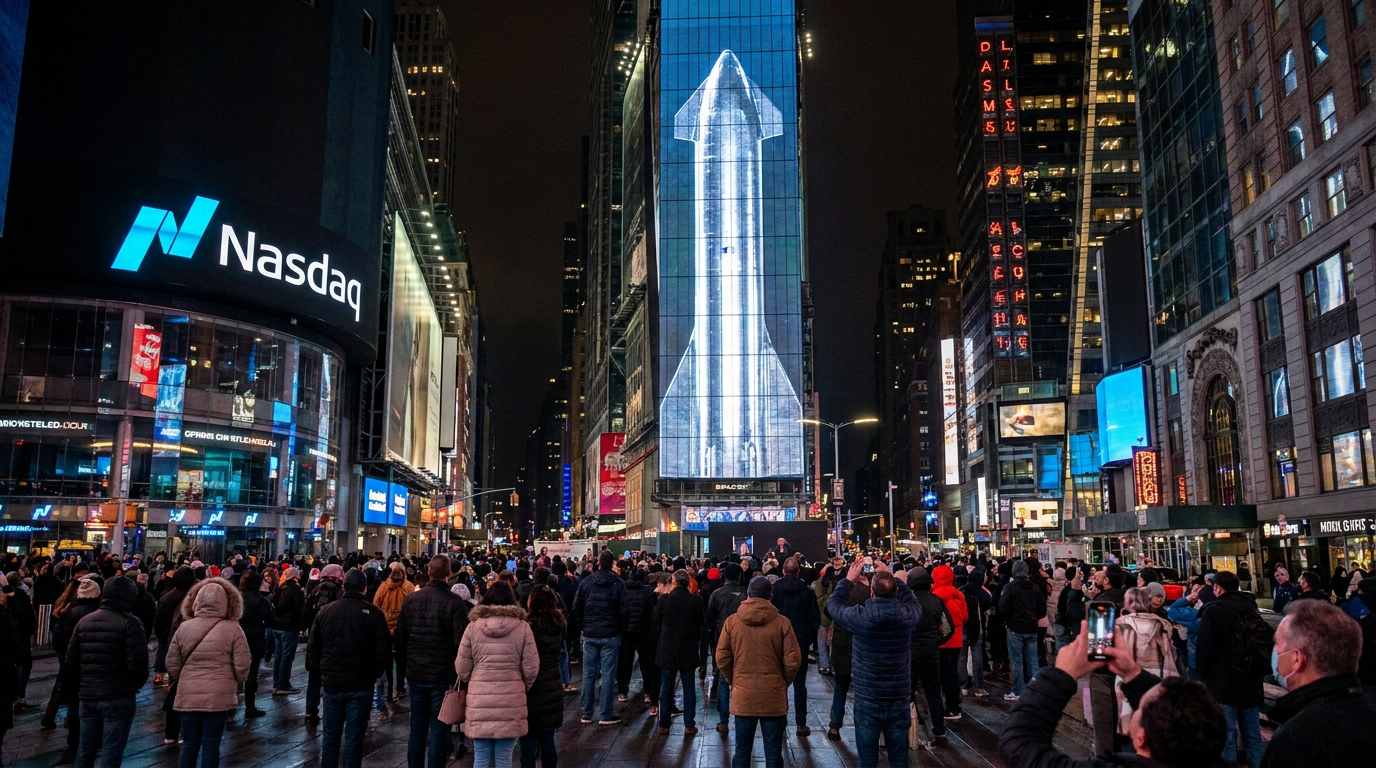
The historic market debut also triggered a personal wealth milestone: the first-day surge officially pushed founder and CEO Elon Musk's net worth past the $1 trillion mark, making him the world's first trillionaire. To celebrate the listing, SpaceX broadcast a massive projection of its towering Starship rocket across a New York City skyscraper.[2][6]

Unlike typical mega-IPOs where institutional investors hoard the initial shares, SpaceX radically altered the distribution model. The company allocated up to 30% of the offering directly to retail investors through brokerages like Fidelity, which lowered its participation threshold to just $2,000 to accommodate the unprecedented everyday demand.[4]
"Most initial public offerings offer retail customers only 5% to 10% of the total offering," Fidelity noted in its participation guide, highlighting that SpaceX's decision to reserve nearly a third of the shares democratized access to a generational tech asset.[4]
Investors are buying into a complex, three-engine business model. While the company is famous for its reusable Falcon 9 rockets and the in-development Starship, the financial core of the IPO rests heavily on Starlink, its satellite internet constellation that recently passed 10 million subscribers and generates massive cash flow.[1]

Investors are buying into a complex, three-engine business model.
Furthermore, the prospectus revealed that SpaceX had quietly acquired Musk's artificial intelligence startup, xAI, in an all-stock merger earlier in 2026. This positions SpaceX not just as an aerospace company, but as an orbital AI infrastructure play, with plans to build data centers in space to support advanced computing needs.[1][5]
Buried deeper in the S-1 filing was a disclosure that sent shockwaves through the cryptocurrency markets: SpaceX holds 18,712 Bitcoin in its corporate treasury. Valued at roughly $1.3 billion, it is the largest crypto reserve ever attached to a public listing.[7]
Under new fair-value accounting rules, SpaceX must mark this Bitcoin stake to market every quarter. This means the company's quarterly earnings will now serve as a live feed of crypto volatility, introducing a unique variable for traditional equity investors who are suddenly exposed to digital asset swings.[7]

The massive float and high volatility immediately spawned a secondary ecosystem on Wall Street. Within the first week, financial institutions launched a historic land grab of risky, leveraged exchange-traded funds (ETFs) tied to SPCX, allowing traders to amplify their bets on the stock's daily movements.[3]
Despite the euphoria, some institutional analysts are urging caution. Research firm Morningstar issued a report arguing the stock is wildly overvalued, placing a fair value estimate of just $62 per share on the company and warning that the $1.77 trillion valuation requires flawless execution of Mars colonization and AI dominance.[6]
Conversely, investment bank Oppenheimer raised its projection for the stock to $250, citing the xAI acquisition and Starlink's near-monopoly on low-Earth orbit connectivity as insurmountable moats.[6]
For now, the market is digesting the sheer gravity of the listing. With Musk retaining roughly 85% of the voting power and a 366-day lock-up period preventing insiders from selling, the public float remains tightly controlled, ensuring that SPCX will remain one of the most volatile and closely watched stocks of the decade.[1][5]
How we got here
2002
Elon Musk founds SpaceX with the goal of reducing spaceflight costs and colonizing Mars.
2020
SpaceX becomes the first private company to send humans to the International Space Station.
February 2026
SpaceX quietly acquires Musk's artificial intelligence startup, xAI, in an all-stock merger.
May 20, 2026
SpaceX publicly files its S-1 prospectus, revealing its financials and a massive Bitcoin treasury.
June 12, 2026
SpaceX debuts on the Nasdaq, raising $75 billion in the largest IPO in history.
Viewpoints in depth
Retail Investors
Celebrating the democratization of a mega-cap tech stock.
For years, retail investors have been locked out of the explosive growth of private tech unicorns, only gaining access after the companies went public at inflated valuations. SpaceX's decision to allocate 30% of its shares to everyday investors—combined with low entry thresholds at brokerages like Fidelity—has been hailed as a watershed moment for market democratization. Retail advocates argue this model should become the new standard for mega-cap listings.
Institutional Bulls
Focusing on the massive cash flow potential of Starlink and xAI.
Bullish analysts argue that SpaceX is no longer just a rocket company, but a foundational infrastructure layer for the next century. By combining the lowest-cost orbital launch system in history with Starlink's near-monopoly on space-based internet and xAI's computing potential, they believe the $1.77 trillion valuation is justified. They point to the company's ability to self-fund its Mars ambitions through its high-margin satellite connectivity business.
Valuation Skeptics
Warning that the stock is priced for absolute perfection.
Skeptics, including research firm Morningstar, caution that a $1.77 trillion valuation leaves zero room for error. They argue that the current price assumes SpaceX will achieve a total monopoly in space, successfully colonize Mars, and dominate the AI sector—all without regulatory setbacks or catastrophic launch failures. These analysts warn that any delay in the Starship program or slowdown in Starlink subscriber growth could trigger a massive correction.
Crypto Market Watchers
Analyzing the impact of a massive, publicly accountable Bitcoin treasury.
The cryptocurrency industry is fixated on SpaceX's disclosure of 18,712 Bitcoin. Because fair-value accounting rules require the company to report the market value of this asset quarterly, SpaceX's earnings will now fluctuate based on crypto prices. Crypto analysts view this as a massive validation of Bitcoin as a corporate reserve asset, while traditional equities analysts worry it introduces unnecessary noise and volatility into an already complex stock.
What we don't know
- How traditional equity investors will react to the quarterly earnings volatility introduced by SpaceX's massive Bitcoin holdings.
- Whether the company can maintain its aggressive timeline for Starship development and Mars missions under the scrutiny of public markets.
- How the 366-day insider lock-up expiration next year will impact the stock's price and public float.
Key terms
- Initial Public Offering (IPO)
- The process of a private company offering shares of its stock to the public for the first time.
- Retail Investor
- Individual, non-professional investors who buy and sell securities for their personal accounts.
- Lock-up Period
- A predetermined window of time after an IPO during which company insiders and early investors are restricted from selling their shares.
- Fair-Value Accounting
- A financial reporting standard requiring companies to measure and report the current market value of certain assets, like cryptocurrency, on their balance sheets.
Frequently asked
What is the SpaceX stock ticker symbol?
SpaceX trades on the Nasdaq exchange under the ticker symbol SPCX.
How much of the company did retail investors get?
SpaceX allocated up to 30% of its IPO shares to retail investors, significantly higher than the standard 5% to 10% seen in typical public offerings.
Does SpaceX own cryptocurrency?
Yes, the company's financial filings revealed a corporate treasury holding 18,712 Bitcoin, valued at roughly $1.3 billion at the time of the IPO.
Did Elon Musk lose control of SpaceX by going public?
No. Musk retains roughly 85% of the company's voting power through a tightly controlled share structure.
Sources
Source coverage
7 outlets
4 viewpoints surfaced







[1]ForbesInstitutional Bulls
SpaceX IPO: Valuation, xAI, And What Investors Need To Know
Read on Forbes →[2]Space.comInstitutional Bulls
SpaceX goes public with a mind-bogglingly historic IPO
Read on Space.com →[3]CNBCRetail Investors
The riskiest SpaceX stock trade of all had a big first week
Read on CNBC →[4]Fidelity InvestmentsRetail Investors
SpaceX IPO participation guide
Read on Fidelity Investments →[5]ReutersInstitutional Bulls
SpaceX targets $135 per share in record-shattering IPO
Read on Reuters →[6]MashableValuation Skeptics
As SpaceX IPO blasts off, Elon Musk becomes a trillionaire
Read on Mashable →[7]Crypto.newsCrypto Market Watchers
SpaceX IPO reveals largest Bitcoin treasury ever attached to a public listing
Read on Crypto.news →

Every angle. Every day.
Get business stories with full source coverage and perspective breakdowns delivered to your inbox.