
AI Drone Swarms Are Accelerating Humanitarian Landmine Clearance
Defense startups and academic researchers are deploying AI-powered drone swarms to detect unexploded ordnance, projecting massive reductions in the time and cost required to clear contaminated regions.
By Factlen Editorial Team
- Humanitarian Demining Organizations
- Value safety and proven reliability, viewing AI as a powerful mapping tool but cautioning against over-relying on unproven autonomy.
- Defense Tech Innovators
- Focus on speed, scalability, and cost reduction, advocating for rapid deployment of drone swarms to solve the crisis in decades rather than centuries.
- Academic Researchers
- Emphasize empirical accuracy and algorithmic precision, highlighting both the high detection rates and the environmental limitations of the technology.
What's not represented
- · Local farmers in contaminated regions
- · Government defense procurement officials
Why this matters
Millions of civilians live in regions contaminated by unexploded ordnance, which halts agricultural production and causes daily casualties. Automating the detection process could reduce clearance times from decades to years, saving thousands of lives and restoring vital food supplies.
Key points
- Ukraine is currently the most mined country in the world, with up to 174,000 square kilometers contaminated.
- Traditional demining methods are slow and dangerous, costing up to €3 per square meter.
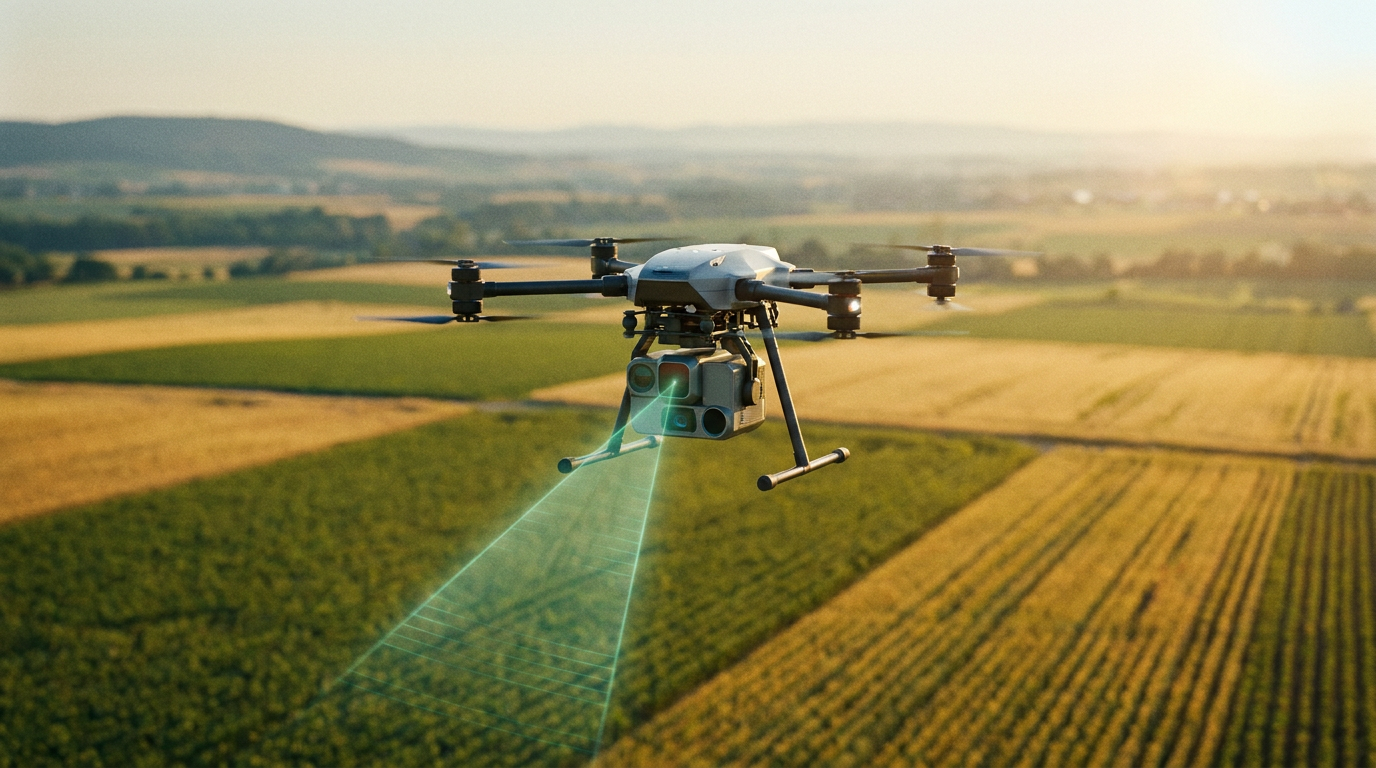
- AI-powered drone swarms use thermal imaging and multisensor fusion to map minefields from the air.
- Startups project that drone swarms could reduce clearance costs to 10 cents per square meter.
The global landmine crisis has reached an unprecedented scale, fundamentally altering the landscape of post-conflict recovery. In Ukraine alone, an estimated 144,000 to 174,000 square kilometers of territory—an area roughly the size of Greece—is contaminated with landmines and unexploded ordnance (UXO). For the millions of civilians living in these regions, the contamination represents a daily lethal threat and a paralyzing barrier to agricultural and economic revival.[1][2][3]
Historically, humanitarian demining has been an agonizingly slow and perilous endeavor. The standard protocol relies heavily on human sappers methodically sweeping fields with handheld metal detectors and physically probing the soil. This century-old approach is not only dangerous but prohibitively expensive, costing between €1 and €3 to clear a single square meter. At the current pace, experts estimate it would take more than 70 years and tens of billions of dollars to clear Ukraine's agricultural heartland alone.[1][6]
However, a convergence of artificial intelligence and autonomous robotics is beginning to rewrite the mathematics of mine clearance. Defense technology startups and academic researchers are deploying coordinated swarms of drones equipped with advanced sensors to map minefields from the air. By replacing human footsteps with algorithmic analysis, these systems aim to transform a generational crisis into a solvable logistical challenge.[1][3][8]

The foundation of this new approach is multisensor fusion. Because modern landmines are often made of plastic or scattered randomly across vast areas, traditional metal detectors are frequently insufficient. Instead, specialized drones are outfitted with high-resolution RGB cameras, LiDAR, and thermal infrared (IR) sensors. These aerial platforms scan the terrain, collecting gigabytes of environmental data without ever touching the ground.[4][6][7]
Thermal imaging has proven particularly revolutionary for detecting shallow-buried threats. Landmines and the explosive compounds within them heat up and cool down at different rates than the surrounding soil and vegetation. By flying drones equipped with IR cameras during specific thermal crossover periods—such as dawn or dusk—researchers can capture the distinct heat signatures of buried ordnance that would be completely invisible to the naked eye.[4][5]
Collecting the data is only the first step; the true breakthrough lies in how that data is processed. Machine learning models, specifically Convolutional Neural Networks (CNNs), are trained on thousands of images of known landmines in various states of concealment. These AI systems act as "digital sappers," analyzing the multisensor data to identify the precise geometric and thermal patterns that distinguish a lethal explosive from a harmless rock or piece of agricultural debris.[3][7]
Academic field trials have yielded highly promising evidence regarding the accuracy of these AI models. Researchers at Columbia University and Binghamton University conducted extensive tests using drone-mounted imaging to detect the PFM-1 scatterable anti-personnel mine. Their airborne system, analyzing temperature differentials, successfully identified the hazards with 90 percent accuracy, performing significantly faster than human teams.[5]

Academic field trials have yielded highly promising evidence regarding the accuracy of these AI models.
Further peer-reviewed studies corroborate these high detection rates. Research published in the journal Remote Sensing detailed the use of the YOLOv5 deep learning model on thermal imagery, achieving a 99.5 percent mean average precision under specific test conditions. Similarly, a study in the Ukrainian Journal of Remote Sensing utilizing DJI drones and Zenmuse IR cameras reported an overall detection accuracy of 89.3 percent, with a recall rate of 0.89.[4][7]
To scale these capabilities, defense tech innovators are moving beyond single-drone operations to deploy intelligent swarms. Startups like Dropla Tech and BeesAgainstMines have developed architectures where up to six unmanned aerial vehicles (UAVs) fly simultaneously in coordinated formations. These swarms share real-time data to avoid collisions and optimize flight paths, allowing them to map up to 0.5 square kilometers of contaminated land per day.[1][3]
The economic implications of swarm-based mapping are profound. By automating the most time-consuming phase of demining—the search and identification process—companies project a massive reduction in operational costs. Dropla Tech estimates that leveraging robotics and AI could drive the cost of clearing one square meter down to just 10 cents. More importantly, they project that the timeline for clearing a heavily contaminated country could be compressed from 70 years to just 12 years.[1]
Despite these optimistic projections, the technology is not a standalone cure. Drones do not disarm the landmines; they merely map them. Once the AI generates a georeferenced digital surface map highlighting the threats, physical intervention is still required. Currently, this involves sending in remote-controlled Unmanned Ground Vehicles (UGVs) to clear vegetation and detonate identified mines, or relying on heavily armored human sappers to neutralize the explosives manually.[1][3]
The evidence also highlights significant transparent uncertainties, primarily the challenge of false positives. In highly cluttered environments, scrap metal, shrapnel, and certain types of rocks can mimic the thermal and visual signatures of landmines. When an AI model flags too many false positives, human teams must waste valuable time investigating harmless anomalies, which degrades the overall efficiency of the clearance operation.[6][8]

Environmental limitations present another formidable hurdle. The efficacy of thermal imaging and photogrammetry drops precipitously in areas with dense foliage. Academic reviews note that detection success rates fall to near zero when vegetation cover exceeds 60 percent. Furthermore, deeply buried mines or those submerged in waterlogged soil often fail to produce a readable thermal signature, rendering aerial detection ineffective.[4][8]
Humanitarian organizations operating on the ground maintain a cautious perspective on full autonomy. The HALO Trust, the world's largest landmine clearance organization, actively uses drone imagery and AI to validate safe zones and shrink suspected hazardous areas. However, they emphasize that demining is an inherently unforgiving sector where mistakes are deadly. For these organizations, AI is currently treated as an advanced mapping tool rather than a fully autonomous replacement for human judgment.[6]

As the technology matures, the integration of AI and drone swarms represents a vital paradigm shift in humanitarian aid. While the algorithms cannot yet replace the courage of the sappers who physically clear the fields, they offer a powerful force multiplier. By rapidly identifying safe zones and pinpointing lethal threats from the sky, this technological alliance is accelerating the day when displaced civilians can safely return home and farmers can reclaim their land.[1][3][6][8]
How we got here
Pre-2022
Humanitarian demining relies almost entirely on manual probing and handheld metal detectors, a slow and dangerous process.
2022–2023
The scale of contamination in Ukraine prompts a surge in defense-tech investment, with startups testing single-drone AI mapping.
2024
Academic studies publish breakthrough accuracy rates, proving thermal imaging and deep learning can reliably detect surface and shallow-buried mines.
2025–2026
Tech companies begin deploying coordinated drone swarms, projecting massive reductions in both clearance time and cost.
Viewpoints in depth
Humanitarian Demining Organizations
A cautious approach prioritizing safety over speed.
Organizations like The HALO Trust emphasize that demining is an inherently unforgiving sector where mistakes are deadly. While they actively embrace AI and drone imagery to validate safe zones and shrink suspected hazardous areas, they view the technology strictly as an advanced mapping tool. They argue that full autonomy is not yet reliable enough to replace the human judgment required for final clearance.
Defense Tech Innovators
A focus on scalability, speed, and rewriting the economics of clearance.
Startups and defense tech companies argue that the sheer scale of modern contamination demands a radical departure from century-old manual methods. By deploying drone swarms and AI, they believe the industry can drive the cost of clearance down from euros to cents per square meter. Their ultimate goal is to solve the crisis in a matter of decades rather than centuries, relying on rapid technological iteration to overcome current limitations.
Academic Researchers
An empirical focus on algorithmic precision and environmental limitations.
Researchers celebrate the high detection rates achieved in controlled environments, noting that models like YOLOv5 can reach near-perfect precision under ideal conditions. However, they are quick to point out the transparent uncertainties of the technology. They caution that variables like soil composition, heavy rainfall, and vegetation density exceeding 60 percent still pose significant hurdles that must be solved before universal deployment is possible.
What we don't know
- How well the AI models will perform in heavily forested or deeply waterlogged environments where thermal signatures are masked.
- Whether the projected cost reduction to €0.10 per square meter can be maintained at a national scale outside of controlled test zones.
- The exact timeline for when fully autonomous ground robots will be reliable enough to handle the physical neutralization phase without human intervention.
Key terms
- Multisensor Fusion
- The process of combining data from multiple different sensors (like optical cameras, thermal imaging, and LiDAR) to create a more accurate assessment than one sensor could provide alone.
- Unexploded Ordnance (UXO)
- Explosive weapons, such as bombs, shells, and landmines, that did not explode when they were deployed and still pose a risk of detonation.
- Thermal Imaging (IR)
- A technology that detects heat (infrared energy) emitted by objects, allowing sensors to "see" buried items based on their temperature differences from the surrounding soil.
- False Positive
- In detection systems, an error where the AI incorrectly identifies a harmless object (like a rock or scrap metal) as a landmine.
Frequently asked
Can drones actually disarm the landmines?
No. Current drone systems are used exclusively for detection and mapping. Once a threat is identified, remote-controlled ground vehicles or human sappers must neutralize the explosive.
How does a drone detect a buried mine?
Drones use thermal (infrared) cameras to detect minute temperature differences between the soil and the buried explosive, as landmines heat and cool at different rates than the surrounding earth.
Does weather affect the AI's accuracy?
Yes. Heavy rain, dense vegetation, and a lack of sunlight can obscure thermal signatures and physical shapes, significantly reducing the AI's detection capabilities.
Sources
Source coverage
8 outlets
3 viewpoints surfaced








[1]MilitarnyiDefense Tech Innovators
A Danish-Ukrainian tech startup is working to address the critical issue of demining Ukrainian lands using robotics
Read on Militarnyi →[2]Odessa JournalDefense Tech Innovators
Broswarm aims to contribute to demining Ukrainian territories using drones equipped with machine learning technology
Read on Odessa Journal →[3]TechUkraineDefense Tech Innovators
BeesAgainstMines is pioneering a modular drone platform that uses Artificial Intelligence to perform demining
Read on TechUkraine →[4]MDPIAcademic Researchers
UAV Thermal Imaging for Unexploded Ordnance Detection by Using Deep Learning
Read on MDPI →[5]Columbia UniversityAcademic Researchers
Using AI and Drones to Detect Land Mines
Read on Columbia University →[6]The HALO TrustHumanitarian Demining Organizations
Harnessing technology to save lives
Read on The HALO Trust →[7]Ukrainian Journal of Remote SensingAcademic Researchers
Automated mine detection using IR images acquired from UAVs
Read on Ukrainian Journal of Remote Sensing →[8]Factlen Editorial TeamAcademic Researchers
Synthesis by Factlen editorial team
Read on Factlen Editorial Team →
Every angle. Every day.
Get defense security stories with full source coverage and perspective breakdowns delivered to your inbox.