
How Agrivoltaics is Solving the Conflict Between Solar Energy and Farming
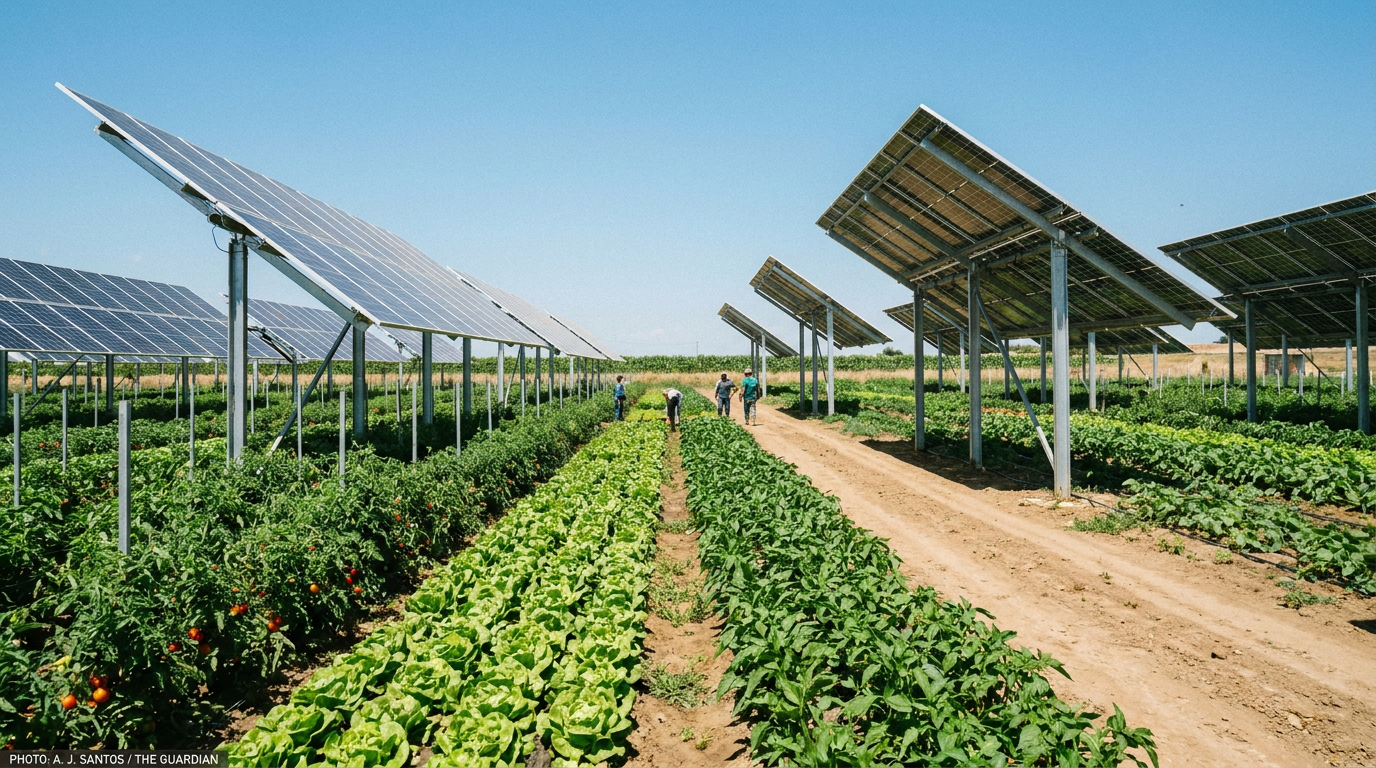
By elevating solar panels above agricultural fields, agrivoltaics creates a symbiotic environment where crops require less water and plants naturally cool the solar arrays. This dual-use approach is solving the land-use conflict between clean energy development and traditional farming.
By Factlen Editorial Team
- Research & Synthesis
- Focuses on the symbiotic benefits of water savings, microclimate regulation, and climate resilience.
- Clean Energy Industry
- Views dual-use land as a critical strategy for scaling renewable energy while minimizing local opposition.
- Agricultural Practitioners
- Prioritizes crop yields, machinery access, and the practical realities of daily farm operations.
What's not represented
- · Local Zoning Boards
- · Agricultural Equipment Manufacturers
Why this matters
As the global push for renewable energy accelerates, the competition for arable land has intensified. Agrivoltaics proves that solar power and farming don't have to be a zero-sum game, offering a blueprint to protect food security, save water, and generate clean electricity on the exact same plot of land.
Key points
- Agrivoltaics co-locates solar panels and agriculture on the same land, solving the conflict between clean energy and farming.
- Elevated panels create a microclimate that reduces water evaporation by up to 35 percent.
- Plants naturally cool the air beneath the array, which increases the efficiency of the solar panels.
- Shade-tolerant crops like lettuce and tomatoes see yield increases, while sun-intensive staples like wheat struggle.
- The physical infrastructure protects crops from extreme weather and provides shade for agricultural workers.
- The primary barrier to widespread adoption is the 10 to 20 percent higher upfront cost of elevated racking.
The transition to renewable energy has long faced a quiet but stubborn geographic bottleneck: solar panels require massive amounts of space. As nations race to decarbonize their grids, energy developers have increasingly looked to rural areas, sparking a zero-sum conflict over land use. Every acre dedicated to a traditional ground-mounted solar array is an acre taken out of food production. In many conventional setups, the topsoil is stripped, gravel is laid down, and the area is fenced off, pitting the clean energy sector directly against agricultural communities.[5][6]
But a rapidly maturing approach known as agrivoltaics is proving that this conflict is entirely avoidable. By co-locating solar arrays with agricultural pursuits—including crop cultivation and livestock grazing—agrivoltaics transforms a competition for land into a symbiotic relationship. Instead of replacing the farm, the solar infrastructure is integrated directly into it, allowing landowners to harvest both sunlight and crops from the exact same plot of earth.[1][5]
The mechanism behind this dual-use strategy relies on a fundamental redesign of the solar array itself. Rather than hugging the ground, the photovoltaic panels are elevated on taller steel racking systems and spaced further apart. This structural modification allows sufficient sunlight to reach the soil while providing enough clearance for standard agricultural machinery to operate freely underneath. The result is a shared light environment where energy production and farming coexist.[4][7]
The most profound impact of this elevated infrastructure is the creation of a distinct microclimate beneath the panels. In open fields, crops are subjected to the full, unfiltered intensity of the sun, which can lead to severe heat stress during peak summer months. The partial shade provided by the solar panels moderates these extremes, creating an environment that is significantly cooler during the day and slightly warmer at night.[3][7]

This microclimate dramatically alters the water dynamics of the farm. By shielding the soil from direct, continuous sunlight, the panels reduce the rate of evapotranspiration—the process by which water evaporates from the earth and transpires from plant leaves. Field studies indicate that this shading effect can reduce irrigation water needs by 20 to 35 percent, a massive advantage in regions increasingly prone to drought and water scarcity.[4][6]
The benefits of this arrangement flow in both directions, creating a biological-mechanical feedback loop. Solar panels are notoriously sensitive to heat; as their temperature rises, their ability to convert sunlight into electricity degrades. However, the crops growing beneath the arrays continuously release moisture into the air. This transpiration acts as a natural air-conditioning system, cooling the microclimate and, by extension, the solar panels above.[5][6]
By keeping the photovoltaic cells operating at a lower temperature, the plants actually increase the efficiency of the solar array. This cooling effect is particularly vital as global temperatures rise, offering a buffer against the predicted 12 percent drop in conventional solar efficiency expected by mid-century. The farm helps the power plant, and the power plant helps the farm.[5][6]
By keeping the photovoltaic cells operating at a lower temperature, the plants actually increase the efficiency of the solar array.
However, agrivoltaics is not a universal solution for all types of agriculture. The success of the system depends entirely on matching the right crops to the altered light environment. Shade-tolerant species thrive under the panels, often outperforming their open-field counterparts. Crops like lettuce, tomatoes, broccoli, and certain berries have shown yield increases of 8 to 18 percent, benefiting from the reduced heat stress and enhanced soil moisture.[4][6]

In stark contrast, sun-intensive staple crops struggle in the partial shade. Cereal grains like wheat and corn, which require massive amounts of direct solar radiation to reach maturity, typically experience yield reductions of 25 to 40 percent when grown under agrivoltaic arrays. For these crops, the reduction in sunlight outweighs the benefits of moisture retention, making them poor candidates for dual-use integration.[4][6]
Where crop cultivation is not viable, livestock integration offers a highly effective alternative. Sheep are particularly well-suited to agrivoltaic environments, grazing on the pasture beneath the panels while naturally managing the vegetation. This eliminates the need for mechanical mowing or chemical herbicides, reducing operational costs for the solar developer while providing the animals with vital shade during the hottest parts of the day.[1][3]
Beyond temperature regulation, the physical structure of the solar array provides a robust shield against extreme weather events. The panels act as a protective canopy, defending delicate crops from the devastating impacts of hail, torrential rain, and late-season frosts. In an era of increasingly volatile climate patterns, this physical barrier offers farmers a critical layer of risk mitigation, ensuring more consistent harvests year over year.[3][7]
The protective benefits extend to the agricultural workforce as well. Farm labor is physically demanding and often dangerous during peak summer heat. The shade provided by the agrivoltaic canopy significantly reduces the direct heat load on workers, lowering the risk of heat-related illnesses and exhaustion. Interviews with fieldworkers have highlighted this cooler environment as a major improvement in daily working conditions.[3]

Despite these compounding benefits, the widespread adoption of agrivoltaics faces significant economic hurdles. The primary barrier is the high initial capital expenditure. Elevating panels to heights of seven to ten feet and engineering the racking to withstand wind loads requires substantially more steel and specialized construction than traditional ground-mounted systems. This structural complexity can increase upfront costs by 10 to 20 percent.[4][7]
Operational logistics also require careful planning. While the systems are designed to accommodate tractors and harvesters, navigating heavy machinery around a grid of steel pylons demands precision and slows down daily farm operations. The risk of a tractor colliding with and damaging the solar infrastructure introduces new insurance considerations and requires specialized training for equipment operators.[2][7]
To justify the higher costs and operational complexities, projects must be designed with agriculture as the primary focus, rather than an afterthought. When the system is tailored to the specific light sensitivity, airflow needs, and irrigation patterns of the chosen crop, the dual-income stream of selling both food and electricity creates a highly resilient financial model. The land remains productive, and the farm gains a stable, long-term revenue source.[4][7]

As the industry moves through 2026, agrivoltaics is transitioning from a niche experimental concept to a commercial reality. Driven by the urgent need to expand renewable energy without sacrificing food security, developers and agricultural scientists are refining the structural designs and crop models. By proving that clean energy and farming can actively support one another, agrivoltaics offers a blueprint for a more integrated and climate-resilient future.[1][8]
How we got here
1981
The concept of combining solar panels and agriculture is first proposed by researchers Armin Zastrow and Adolf Goetzberger.
2016
Early economic studies in Germany highlight the massive upfront costs of elevating panels, slowing initial adoption.
2024
Research confirms that the cooling effect of crops improves solar panel efficiency, shifting the economic models.
2026
Agrivoltaics transitions from pilot projects to commercial viability, driven by climate resilience needs and dual-income strategies.
Viewpoints in depth
Research & Synthesis
Focuses on the symbiotic benefits of water savings, microclimate regulation, and climate resilience.
Researchers view agrivoltaics as a rare 'win-win' in climate adaptation. By measuring the precise microclimates created beneath the panels, they have documented how reduced evapotranspiration saves significant amounts of water while protecting crops from extreme heat and hail. This camp emphasizes that the cooling effect of the plants also boosts the efficiency of the solar panels, creating a biological-mechanical feedback loop that outperforms either system in isolation.
Clean Energy Industry
Views dual-use land as a critical strategy for scaling renewable energy while minimizing local opposition.
For solar developers, land acquisition is a major bottleneck. Rural communities often resist traditional solar farms that take arable land out of production. The clean energy sector sees agrivoltaics as the key to unlocking millions of acres of farmland for solar development. While acknowledging the higher upfront costs of elevated racking, they argue that the dual-income model and the reduction in community friction make these projects highly viable in the long term.
Agricultural Practitioners
Prioritizes crop yields, machinery access, and the practical realities of daily farm operations.
Farmers approach agrivoltaics with cautious optimism, prioritizing agricultural output over energy generation. Their primary concerns revolve around the logistics of navigating large tractors around steel pylons and the high capital expenditure required to build elevated systems. This camp stresses that agrivoltaics is not a silver bullet; it requires careful crop selection, as staple crops like wheat suffer under the shade, and demands a long-term financial horizon to offset the initial infrastructure costs.
What we don't know
- How long-term soil health will be affected by decades of partial shading.
- Whether government subsidies will be required to offset the higher initial capital costs at a global scale.
Key terms
- Agrivoltaics
- The simultaneous use of areas of land for both solar photovoltaic power generation and agriculture.
- Microclimate
- The localized climate conditions directly beneath and around the solar panels, which differ from the surrounding open field.
- Evapotranspiration
- The process by which water is transferred from the land to the atmosphere by evaporation from the soil and by transpiration from plants.
- CAPEX
- Capital expenditure; the upfront costs required to build the physical infrastructure of the solar and farming system.
Frequently asked
Can any crop be grown under solar panels?
No. Shade-tolerant crops like lettuce, tomatoes, and certain berries thrive, while sun-intensive staple crops like wheat and corn typically see significant yield reductions.
How do tractors navigate around the solar panels?
Agrivoltaic systems are custom-designed with elevated racking and wider spacing between rows, allowing standard agricultural machinery to operate freely, though it requires careful navigation.
Does the shade hurt the solar panels' energy production?
The shade doesn't hurt the panels; in fact, the moisture released by the plants cools the air beneath the array, which actually increases the solar panels' efficiency.
Why isn't every solar farm built this way?
Elevating panels and spacing them for farm equipment requires significantly more steel and engineering, making the initial capital expenditure 10% to 20% higher than traditional solar installations.
Sources
Source coverage
8 outlets
3 viewpoints surfaced








[1]National Renewable Energy LaboratoryResearch & Synthesis
Agrivoltaics: Solar and Agriculture Co-Location
Read on National Renewable Energy Laboratory →[2]MDPIResearch & Synthesis
Agrivoltaics: Integrating Photovoltaic Systems into the Agricultural Landscape
Read on MDPI →[3]ASCEResearch & Synthesis
Agrivoltaics research shows benefits of colocating solar arrays with agriculture
Read on ASCE →[4]Energy SolutionsClean Energy Industry
Agrivoltaics 2026: Farming & Solar Dual Income
Read on Energy Solutions →[5]Seneca ImpactClean Energy Industry
Agrivoltaics: Energising an Agricultural Revolution
Read on Seneca Impact →[6]Ideal EnergyClean Energy Industry
What are the Benefits of Agrivoltaics?
Read on Ideal Energy →[7]Brite SolarAgricultural Practitioners
Agrivoltaics in the Netherlands: A Practical Guide
Read on Brite Solar →[8]Factlen Editorial TeamResearch & Synthesis
Synthesis by Factlen editorial team
Read on Factlen Editorial Team →



Every angle. Every day.
Get guides stories with full source coverage and perspective breakdowns delivered to your inbox.