
The Rise of the 'Plyscraper': How Mass Timber is Rewriting the Rules of Architecture
Engineered wood is replacing steel and concrete in high-rises around the world, offering a powerful tool to decarbonize the construction industry.
By Factlen Editorial Team
- Sustainable Architects & Developers
- Advocate for mass timber as the primary solution to eliminate the massive carbon footprint of concrete and steel.
- Forestry & Conservation Advocates
- Support the shift to wood but demand strict sustainable harvesting to prevent ecological damage.
- Traditional Construction & Insurers
- Emphasize the lingering financial risks, supply chain immaturity, and insurance hurdles of the new material.
What's not represented
- · Local labor unions representing concrete pourers and steelworkers, whose jobs are displaced by prefabricated timber.
- · Residents of rural timber-producing communities experiencing the economic impacts of the new manufacturing boom.
Why this matters
The built environment is responsible for nearly 40% of global carbon emissions, largely driven by the production of steel and concrete. Transitioning to engineered wood transforms buildings from carbon emitters into massive carbon sinks, fundamentally altering the climate math of our cities.
Key points
- A 31-story tower in Milwaukee is set to become the world's tallest mass timber building in 2026.
- Cross-Laminated Timber (CLT) uses orthogonally glued wood layers to achieve steel-like structural strength.
- Mass timber buildings act as carbon sinks, storing up to 2,000 tons of CO2 per structure.
- Unlike light-frame wood, massive timber panels char during a fire, protecting their structural core.
- Updated building codes now allow mass timber structures up to 18 stories by right in 44 U.S. states.
- The global CLT market has reached $2.1 billion in 2026 and is projected to triple by 2036.
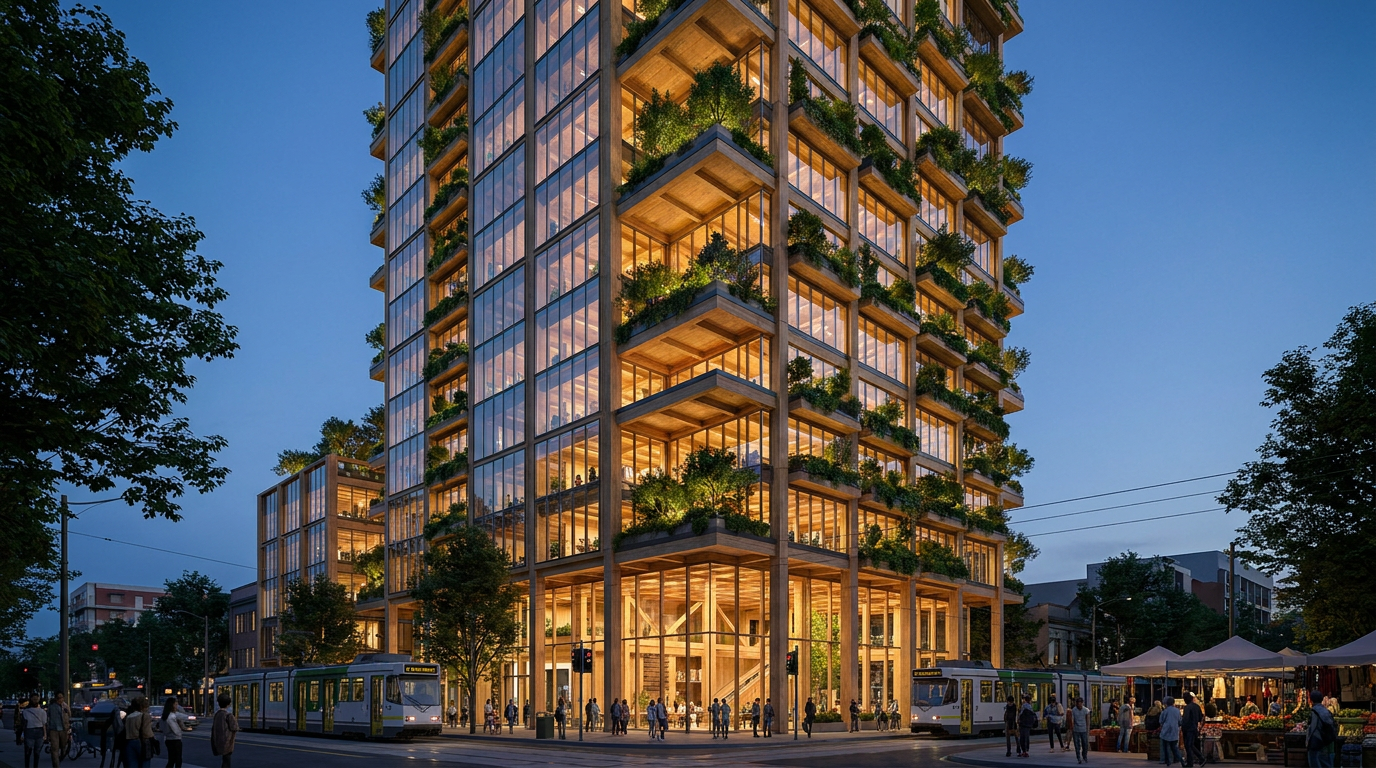
For over a century, the recipe for the modern skyline has remained stubbornly fixed: pour concrete, erect steel, and clad in glass. But across North America and Europe, a radically different kind of high-rise is taking root. In downtown Milwaukee, construction crews are currently assembling the Neutral Edison, a 31-story residential tower that, upon its topping out later this year, will become the tallest mass timber building in the world. Reaching 362 feet, it represents a watershed moment for an architectural movement that is trading the blast furnace for the forest.[1][6]
The Edison is not an anomaly. From the 14-story Academic Wood Tower at the University of Toronto to sprawling tech campuses in Sydney, architects are increasingly turning to engineered wood. The global cross-laminated timber (CLT) market has surged to $2.1 billion in 2026, driven by a desperate need to decarbonize the construction industry. The stakes are immense: the built environment accounts for roughly 40% of global carbon emissions, with the production of cement alone responsible for a staggering 8%.[2][4]
To understand the shift, one must understand the material. Mass timber is not the standard two-by-four lumber used in suburban homebuilding. The industry standard, Cross-Laminated Timber (CLT), is essentially plywood on a massive, structural scale. Manufacturers take solid-sawn lumber and glue it together in layers, with each layer oriented at a right angle to the one below it. This orthogonal lamination creates massive, prefabricated panels that possess exceptional dimensional stability and load-bearing capacity, rivaling the structural rigidity of steel and concrete.[4][6]
The climate math of CLT is its primary selling point. While manufacturing steel and concrete releases massive amounts of greenhouse gases, trees actively pull carbon dioxide out of the atmosphere as they grow. When those trees are harvested and turned into mass timber, that carbon is locked into the building's structure for its entire lifespan. A single large-scale mass timber commercial building can sequester up to 2,000 tons of carbon dioxide, effectively turning the structure into a long-term carbon sink.[5][6]

But whenever wooden skyscrapers—often dubbed 'plyscrapers'—are proposed, the immediate public question is inevitably about fire. It is a counterintuitive truth of mass timber that it performs exceptionally well in a blaze. Unlike light-frame wood, which combusts rapidly, massive blocks of compressed timber char on the outside when exposed to extreme heat. This char layer acts as an insulator, protecting the structural integrity of the wood's core. In rigorous testing, CLT panels have maintained their load-bearing capacity longer than unprotected steel, which can warp and buckle under high temperatures.[3][6]
But whenever wooden skyscrapers—often dubbed 'plyscrapers'—are proposed, the immediate public question is inevitably about fire.
Building codes have rapidly evolved to reflect this science. The International Code Council, which writes the rules governing building safety in the United States, first recognized CLT in 2015. By the early 2020s, the International Building Code (IBC) was updated to allow mass timber structures up to 18 stories by right, with taller buildings like the 31-story Edison requiring special, though increasingly common, performance-based permitting. Today, 44 U.S. states have adopted these mass timber provisions, clearing the regulatory hurdles that once stifled innovation.[1][3]

Beyond the structural and environmental benefits, mass timber is fundamentally changing the construction process itself. Because CLT panels are precision-milled in offsite factories using digital models, they arrive at the construction site ready to be slotted together like a massive piece of flat-pack furniture. This prefabrication dramatically reduces on-site labor, minimizes construction waste, and shaves months off traditional building timelines. A floor that might take weeks to pour and cure in concrete can be installed in days with timber.[4][5]
The material is also reshaping the psychological experience of indoor spaces. The 2026 architectural landscape is heavily influenced by 'biophilic design'—the concept that humans possess an innate biological need to connect with nature. Instead of hiding the structural skeleton behind drywall, mass timber architects leave the wood exposed. The visible grain, warm tones, and natural acoustic dampening of timber ceilings and columns have been shown to reduce cortisol levels and improve cognitive function, making these buildings highly sought-after by commercial tenants and residents alike.[5][6]

Europe currently dominates the mass timber ecosystem, accounting for nearly half of the global market. Countries like Austria and Germany, which boast mature manufacturing bases and deep architectural familiarity with engineered wood, remain the epicenters of production. However, North America is experiencing the highest growth rate in 2026. Massive investments in domestic manufacturing capacity, coupled with the updated building codes, are rapidly localizing the supply chain and driving down the premium costs historically associated with importing European panels.[4]
Despite the momentum, the mass timber revolution faces genuine constraints. The most pressing is the ecological limit of the supply chain. For mass timber to be truly sustainable, the wood must be sourced from responsibly managed forests, often certified by the Forest Stewardship Council (FSC). If the demand for CLT outpaces sustainable forestry practices, the industry risks incentivizing clear-cutting and habitat destruction, which would entirely negate the material's climate benefits.[5][6]

Furthermore, the insurance industry is still catching up to the technology. While fire testing has proven CLT's safety, many underwriters lack the decades of actuarial data they possess for steel and concrete. As a result, developers of mass timber high-rises often face higher builder's risk and property insurance premiums, creating a financial friction point that can deter risk-averse investors.[3][6]
Yet, the trajectory is clear. As the urgency of the climate crisis intensifies, the architecture and construction industries can no longer afford the carbon footprint of the 20th century. With projects like the Neutral Edison proving that wood can scrape the sky just as effectively as steel, mass timber is transitioning from a niche architectural experiment into the foundational material of the sustainable city.[1][6]
How we got here
2015
The International Code Council first officially recognizes Cross-Laminated Timber (CLT) in its building standards.
2021
Major updates to the International Building Code (IBC) allow mass timber buildings up to 18 stories.
2022
The Ascent tower in Milwaukee is completed, setting the record for the tallest mass timber building at 25 stories.
2025
Construction begins on the Neutral Edison in Milwaukee, designed to break the height record at 31 stories.
2026
The global CLT market surpasses $2.1 billion as North American adoption rapidly accelerates.
Viewpoints in depth
Sustainable Architects & Developers
View mass timber as the most viable tool to rapidly decarbonize the built environment.
For this camp, the transition away from concrete and steel is an existential necessity. They point to the fact that the built environment is responsible for 40% of global emissions, and argue that energy-efficient operations are no longer enough; the 'embodied carbon' of the materials themselves must be addressed. By utilizing CLT, they argue that developers can actively remove carbon from the atmosphere and lock it into city skylines, turning urban centers into massive carbon banks while simultaneously speeding up construction timelines through prefabrication.
Forestry & Conservation Advocates
Support the technology but warn that unchecked demand could harm forest ecosystems.
Conservationists acknowledge the climate benefits of substituting wood for steel, but they caution that the math only works if the timber is harvested sustainably. If the booming $2.1 billion CLT market incentivizes clear-cutting, monoculture tree farming, or the harvesting of old-growth forests, the biodiversity loss and immediate carbon release from the soil will outweigh the benefits of the buildings. This group heavily lobbies for strict adherence to Forest Stewardship Council (FSC) certifications and advocates for using mass timber as a financial engine to thin overstocked, fire-prone forests rather than logging pristine habitats.
Traditional Construction & Insurers
Highlight the current logistical, financial, and actuarial hurdles of mass timber.
The legacy steel and concrete industries, alongside risk-averse insurance underwriters, emphasize that mass timber is not a silver bullet. They point out that while European supply chains are mature, North American manufacturing is still scaling, often resulting in higher upfront material costs. Furthermore, insurers argue that while lab tests prove CLT's fire resistance, they lack the century of real-world actuarial data they have for concrete structures. This uncertainty often translates to higher builder's risk premiums, making financing these innovative towers more complex for developers.
What we don't know
- Whether domestic North American timber manufacturing can scale fast enough to meet surging demand without relying on European imports.
- How the insurance industry will adjust premiums long-term once more actuarial data on aging mass timber high-rises becomes available.
- If global forestry regulations can prevent the over-harvesting of natural habitats as the demand for engineered wood skyrockets.
Key terms
- Mass Timber
- A category of engineered wood products made by binding together large panels or beams of wood to create structural load-bearing elements.
- Cross-Laminated Timber (CLT)
- A specific type of mass timber made by gluing layers of solid-sawn lumber at right angles to one another, creating massive, highly rigid panels.
- Embodied Carbon
- The total greenhouse gas emissions generated by the extraction, manufacturing, transportation, and assembly of building materials.
- Biophilic Design
- An architectural approach that seeks to connect building occupants more closely to nature, often through the use of natural lighting, plants, and exposed organic materials like wood.
- Char Layer
- The blackened, burned outer surface of thick timber that forms during a fire, which acts as an insulator to protect the unburned wood inside from losing its structural strength.
Frequently asked
Is mass timber safe in a fire?
Yes. Unlike the thin wood used in standard home construction, massive timber panels char on the outside when exposed to fire. This char layer acts as insulation, protecting the inner core and allowing the building to maintain its structural integrity longer than unprotected steel.
How tall can a mass timber building be?
Current standard building codes in the U.S. allow mass timber buildings up to 18 stories by right. However, with special performance-based permitting, developers are building much taller; the Neutral Edison in Milwaukee will reach 31 stories.
Does mass timber cause deforestation?
It can, if not managed properly. To be environmentally beneficial, the wood must be sourced from certified, sustainably managed forests where trees are replanted, or from forest-thinning projects designed to prevent wildfires.
Is mass timber cheaper than concrete and steel?
Currently, the upfront material costs can be slightly higher or roughly equal, depending on the region. However, developers often save money overall because prefabricated timber panels require less on-site labor and significantly speed up construction time.
Sources
Source coverage
6 outlets
3 viewpoints surfaced






[1]Construction BriefingTraditional Construction & Insurers
World's tallest mass timber building under construction in Milwaukee
Read on Construction Briefing →[2]The GuardianSustainable Architects & Developers
Milwaukee plans to build tallest timber building in the world
Read on The Guardian →[3]University of PennsylvaniaTraditional Construction & Insurers
Mass Timber's Moment
Read on University of Pennsylvania →[4]DataNext ResearchForestry & Conservation Advocates
Cross Laminated Timber Market Size & Share Analysis 2026-2036
Read on DataNext Research →[5]March ConstructionSustainable Architects & Developers
Why Developers Are Choosing Mass Timber for Commercial Projects
Read on March Construction →[6]Factlen Editorial TeamSustainable Architects & Developers
Synthesis by Factlen editorial team
Read on Factlen Editorial Team →
Every angle. Every day.
Get culture stories with full source coverage and perspective breakdowns delivered to your inbox.