
The Science of the Maillard Reaction: How Heat Transforms Food
Understanding the chemical reaction between proteins and sugars is the secret to achieving perfectly seared steaks, golden-brown bread, and deeply roasted coffee.
By Factlen Editorial Team
- Culinary Scientists
- Focus on the molecular breakdown of amino acids and sugars, and the precise temperature thresholds required for the reaction.
- Professional Chefs
- Emphasize practical kitchen techniques, such as moisture control and heat management, to maximize flavor development.
- Home Cooks
- Value accessible, everyday applications of the science, like patting meat dry or using baking soda to speed up browning.
What's not represented
- · Industrial food manufacturers who rely on artificial Maillard flavorings
- · Nutritionists studying the dietary impact of advanced glycation end products (AGEs)
Why this matters
Understanding the chemistry behind browning allows home cooks to reliably produce restaurant-quality flavors, turning pale, steamed meals into deeply savory, perfectly seared dishes.
Key points
- The Maillard reaction is a chemical process between amino acids and sugars that creates complex flavors and brown pigments in cooked food.
- The reaction requires high heat, typically beginning at surface temperatures around 285°F (140°C).
- Moisture prevents browning because water evaporates at 212°F, keeping the food's surface below the required temperature threshold.
- Unlike caramelization, which only involves sugars, the Maillard reaction requires proteins to create its signature savory, meaty flavors.
- Alkaline environments, such as those created by adding baking soda, can significantly accelerate the reaction rate.
- Heating food beyond 355°F (180°C) leads to pyrolysis, destroying flavor compounds and causing bitter, burnt tastes.
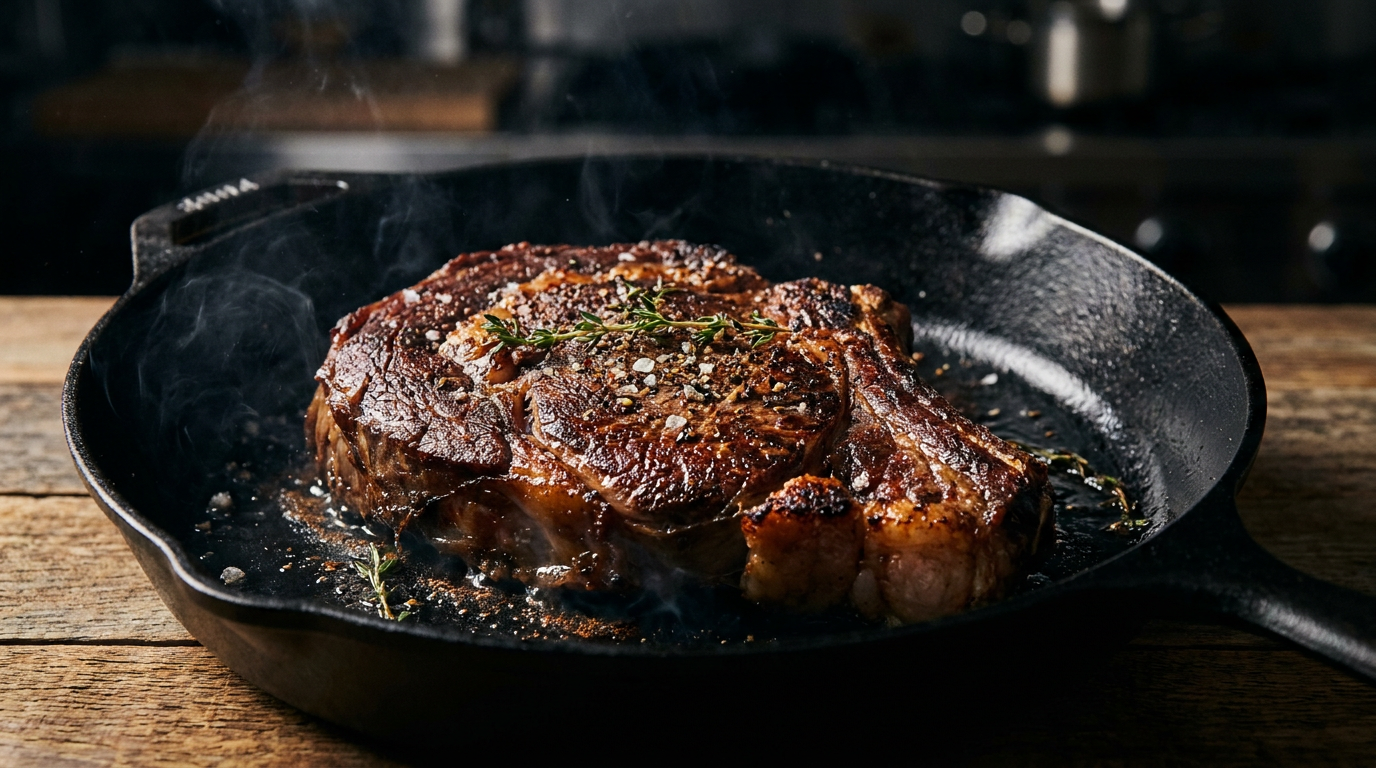
The aroma of a steak hitting a hot cast-iron skillet, the golden crust of a freshly baked baguette, and the deep, roasted notes of morning coffee all share a common origin. It is not culinary magic that transforms these raw ingredients into complex, savory delights, but rather a precise cascade of chemical events. This transformation is known as the Maillard reaction, a foundational principle of food science that dictates how heat interacts with the molecular structure of our food.[1]
Named after the French chemist Louis-Camille Maillard, who first described the phenomenon in 1912, the reaction was initially discovered during his research into how amino acids link together to form proteins. Maillard noticed that when he heated sugars and amino acids together, the mixture slowly turned brown. While his original goal was to understand cellular biology and potential medical applications, his findings inadvertently unlocked one of the most important secrets in the culinary world.[2][3]
At its core, the Maillard reaction is a complex chemical dance between amino acids—the building blocks of proteins—and reducing sugars, such as glucose or fructose. When these compounds are subjected to high heat, they fuse to form an unstable intermediate structure. This structure rapidly breaks down and rearranges itself, triggering a cascading waterfall of secondary and tertiary reactions.[4][2]

The result of this molecular chaos is the creation of hundreds, sometimes thousands, of entirely new flavor and aroma compounds. Food scientists often refer to the Maillard reaction as the "flavor reaction" rather than simply a browning reaction, because the visual color change is merely a byproduct of the intense flavor development. These newly formed molecules—including pyrazines, furans, and thiophenes—are responsible for the earthy, meaty, nutty, and floral notes that define cooked food.[1][3]
Alongside these aromatic compounds, the reaction produces large, complex polymers called melanoidins. These pigments coat the surface of the food, providing the characteristic golden-brown to deep-mahogany hues that signal a well-roasted dish. Because different foods contain different ratios of specific amino acids and sugars, the Maillard reaction produces a unique flavor profile for every ingredient; the reaction in a coffee bean yields vastly different aromatic compounds than the reaction on the surface of a pork chop.[4][1]
However, the Maillard reaction does not occur spontaneously. It requires a specific set of environmental conditions to activate, the most critical of which is temperature. The reaction typically begins to occur at a rapid, noticeable rate only when the surface temperature of the food reaches approximately 285 degrees Fahrenheit (140 degrees Celsius). As the temperature climbs higher, the rate of the reaction accelerates exponentially, creating more complex flavors in a shorter amount of time.[4][1]

However, the Maillard reaction does not occur spontaneously.
This temperature threshold explains why moisture is the primary enemy of a good sear. Water boils and evaporates at 212 degrees Fahrenheit (100 degrees Celsius). As long as there is liquid water on the surface of a piece of meat or a vegetable, the temperature of that surface cannot exceed the boiling point. The thermal energy from the pan is entirely consumed by the process of evaporating the water, leaving the food steaming rather than browning.[2][1]
Professional chefs mitigate this by meticulously drying ingredients before they hit the heat. Patting a steak dry with paper towels, or leaving it uncovered in the refrigerator overnight to desiccate the surface, ensures that the pan's heat immediately drives the temperature past the 285-degree threshold. Without this crucial step, the meat will simmer in its own juices, resulting in a gray, flavorless exterior.[2][4]
It is also common to confuse the Maillard reaction with caramelization, though the two are distinct chemical processes. Caramelization is the pyrolysis of sugar—it occurs when pure carbohydrates are heated to the point that they break down and form new, nutty, and slightly bitter compounds. The Maillard reaction, by contrast, strictly requires the presence of amino acids. While both reactions can occur simultaneously in foods that contain both proteins and high amounts of sugar, such as a chocolate chip cookie, the savory depth of a seared steak is entirely a Maillard process.[2][3]

Beyond heat and moisture, the pH level of the cooking environment plays a surprisingly significant role in how quickly the Maillard reaction occurs. The chemical pathways that lead to browning are accelerated in alkaline environments and inhibited in acidic ones. This scientific quirk is frequently utilized in professional kitchens and food manufacturing to manipulate flavor and color development.[1][4]
For example, adding a small pinch of baking soda—an alkaline powder—to a pan of sliced onions will dramatically reduce the time it takes for them to brown. Similarly, traditional pretzels are dipped in an alkaline lye solution before baking, which rapidly accelerates the Maillard reaction on the dough's surface, resulting in their signature deep-brown, glossy crust and distinctively alkaline, toasted flavor.[1][3]
While pushing the temperature higher accelerates flavor development, there is a strict upper limit to the Maillard reaction's benefits. When surface temperatures exceed 355 degrees Fahrenheit (180 degrees Celsius), the delicate flavor compounds begin to break down entirely. This secondary process, known as pyrolysis, is the chemical definition of burning.[1]

Pyrolysis destroys the nuanced savory notes created by the Maillard reaction, replacing them with harsh, acrid, and bitter carbon compounds. Furthermore, excessive charring at these extreme temperatures can lead to the formation of acrylamides and heterocyclic amines, which are potentially harmful chemical byproducts. The culinary sweet spot lies in maintaining the heat high enough to sustain the Maillard cascade, but low enough to prevent the onset of pyrolysis.[2][4]
Ultimately, understanding the mechanics of the Maillard reaction transforms cooking from a game of guesswork into an exercise in applied chemistry. By controlling surface moisture, managing pan temperatures, and occasionally manipulating pH, cooks can reliably unlock the deepest, most complex flavors hidden within their ingredients. It is a reminder that the most powerful tool in the kitchen is not a sharper knife or a hotter stove, but a fundamental grasp of the science happening on the plate.[5]
How we got here
1912
French chemist Louis-Camille Maillard first describes the reaction between amino acids and sugars.
1953
Chemist John E. Hodge publishes a detailed mechanism of the reaction, establishing its culinary importance.
2004
Harold McGee publishes the revised edition of 'On Food and Cooking', popularizing food science for home cooks.
Viewpoints in depth
The Scientific View
Researchers view the Maillard reaction as a complex, cascading chemical equation.
For food chemists and researchers, the Maillard reaction is a marvel of molecular biology. It is not a single event, but a cascading waterfall of secondary and tertiary reactions. When amino acids and reducing sugars fuse, they create unstable intermediate structures that rapidly break down into hundreds of new aromatic compounds, such as pyrazines and furans. Scientists emphasize that understanding the precise temperature thresholds and pH dependencies of these pathways is crucial for industrial food production, where consistency in flavor and color is paramount.
The Professional Kitchen View
Chefs treat the Maillard reaction as a foundational technique that requires strict environmental control.
In professional kitchens, the Maillard reaction is less about chemical formulas and more about environmental management. Chefs are trained to view moisture as the primary enemy of flavor. By meticulously drying proteins, managing pan crowding to prevent steam buildup, and utilizing heavy cookware that retains heat, professionals ensure that the surface of the food rapidly crosses the 285-degree threshold. For chefs, mastering the Maillard reaction is the dividing line between amateur cooking and restaurant-quality execution.
What we don't know
- The exact chemical structure of every single flavor compound produced during the reaction, as hundreds of new molecules form and dissipate in milliseconds.
- The precise long-term health impacts of consuming high levels of melanoidins, though some studies suggest they may have antioxidant properties.
Key terms
- Maillard Reaction
- A chemical reaction between amino acids and reducing sugars that gives browned food its distinctive flavor.
- Amino Acids
- Organic compounds that combine to form proteins, essential for triggering the Maillard reaction.
- Melanoidins
- Large, complex polymer molecules created during the Maillard reaction that give cooked food its brown color.
- Caramelization
- The browning of pure sugar subjected to high heat, a distinct process from the protein-dependent Maillard reaction.
- Pyrolysis
- The chemical decomposition of organic materials at highly elevated temperatures, commonly known as burning.
Frequently asked
Why doesn't boiled meat turn brown?
Water boils at 212°F (100°C), which prevents the surface of the meat from reaching the 285°F (140°C) threshold required for the Maillard reaction to occur.
Is the Maillard reaction the same as caramelization?
No. Caramelization involves the breakdown of pure sugars under high heat, while the Maillard reaction requires the presence of both sugars and amino acids (proteins).
How can I speed up the browning process?
You can accelerate browning by ensuring the surface of the food is completely dry before cooking, using high heat, or slightly raising the pH by adding a pinch of baking soda.
Sources
Source coverage
5 outlets
3 viewpoints surfaced





[1]Modernist CuisineCulinary Scientists
The Maillard Reaction: The Flavor Reaction
Read on Modernist Cuisine →[2]Serious EatsHome Cooks
What Is the Maillard Reaction? The Science of Browning
Read on Serious Eats →[3]On Food and CookingCulinary Scientists
On Food and Cooking: The Science and Lore of the Kitchen
Read on On Food and Cooking →[4]Escoffier School of Culinary ArtsProfessional Chefs
What Is the Maillard Reaction and Why Does It Matter?
Read on Escoffier School of Culinary Arts →[5]Factlen Editorial TeamHome Cooks
Synthesis by Factlen editorial team
Read on Factlen Editorial Team →
Every angle. Every day.
Get food drink stories with full source coverage and perspective breakdowns delivered to your inbox.