
OLED vs. Mini-LED in 2026: The Great Convergence in Premium TVs
As Tandem OLEDs push past 2,500 nits and RGB Mini-LEDs master absolute black levels, the gap between the two dominant TV technologies has never been narrower.
By Factlen Editorial Team
- Home Theater Purists
- Prioritize absolute black levels, pixel-level contrast, and wide viewing angles for cinematic viewing in controlled lighting.
- Bright-Room Viewers
- Value peak brightness, sustained full-screen luminance, and glare reduction for daytime viewing and sports.
- Value Maximizers
- Focus on the price-to-size ratio, favoring technologies that allow for massive 85-inch+ screens without an exponential price hike.
What's not represented
- · Environmental advocates focused on the energy consumption and e-waste implications of ultra-bright, large-format televisions.
Why this matters
A premium television is a multi-year investment that dictates how you experience movies, sports, and gaming. Choosing the wrong panel technology for your specific room lighting and viewing habits can result in years of distracting glare or washed-out shadows.
Key points
- The 2026 TV market is defined by a 'Great Convergence,' with OLEDs getting brighter and Mini-LEDs achieving near-perfect blacks.
- Tandem OLED architecture stacks light-emitting layers to push peak brightness past 2,500 nits without increasing burn-in risk.
- RGB Mini-LEDs utilize upwards of 20,000 dimming zones to hit 3,000+ nits of sustained brightness.
- Mini-LED offers superior value in ultra-large screen sizes (85 inches and above).
- OLED remains the gold standard for dark-room cinematic viewing and wide seating arrangements.
- The right choice depends entirely on room lighting, seating, and whether the TV will display static content.
Buying a premium television in 2026 is a two-horse race between OLED and Mini-LED. But the old rules—buying OLED for dark rooms and Mini-LED for bright rooms—are being aggressively rewritten by a phenomenon industry analysts are calling the "Great Convergence." For years, OLED panels offered perfect, pixel-level blacks but struggled to overcome the glare of a sunlit living room. Conversely, Mini-LEDs could sear the retinas with brightness but suffered from "blooming"—a distracting halo effect around bright objects on dark backgrounds. Today, both technologies have successfully invaded each other's territory, making the choice less about absolute superiority and more about highly specific trade-offs.[5][6]
The case for OLED in 2026 rests on a massive leap in panel architecture known as Tandem OLED. By stacking multiple RGB light-emitting layers on top of one another, flagship models like the LG G5 and Samsung S95H have shattered previous brightness ceilings. This allows the television to produce a far more forceful High Dynamic Range (HDR) image without overdriving the organic compounds.[2][4]
The evidence for OLED's leap is striking: these new panels can hit peak HDR highlights of 2,500 nits, delivering glistening stars and blinding explosions that rival LCDs, all without increasing the thermal load that historically caused burn-in. However, against OLED, full-screen brightness remains a limitation. When displaying a bright scene across the entire panel—like a hockey rink or a snow-covered documentary—an automatic brightness limiter (ABL) still dims the image to protect the display, which can look slightly muted in a sun-drenched room.[1][4]
The case for Mini-LED in 2026 is built on brute-force computational power and a shift to "RGB Mini-LED" backlighting. By stripping away traditional color filters and utilizing tens of thousands of microscopic LEDs, manufacturers have achieved unprecedented luminance and color purity. Models from Sony, TCL, and Hisense are using advanced algorithms to control these massive arrays with surgical precision.[3][5]

The evidence for Mini-LED's dominance is in the numbers: flagship models like the Sony Bravia 9 now feature upwards of 20,000 independent local dimming zones. They can sustain 3,000 nits of peak brightness and maintain that intense luminance across the entire screen without dimming. Against Mini-LED, however, physical limitations remain. Despite the advanced algorithms, off-axis viewing angles still degrade compared to OLED, and a trained eye can still spot minor blooming in extreme high-contrast scenes, such as white subtitles resting on a black cinematic letterbox.[1][2][5]
The evidence for Mini-LED's dominance is in the numbers: flagship models like the Sony Bravia 9 now feature upwards of 20,000 independent local dimming zones.
When comparing the two side-by-side for gaming, the trade-offs become highly specific to the player's habits. Both technologies now routinely offer 144Hz refresh rates, Variable Refresh Rate (VRR), and multiple HDMI 2.1 ports, ensuring that current-generation consoles and high-end PCs are fully supported.[2][6]
For OLED gaming, the technology boasts near-instantaneous pixel response times measured in microseconds (0.1ms), eliminating motion blur entirely during fast-paced shooters or racing simulators. Against OLED gaming, players who leave the same HUD-heavy title on the screen for eight hours a day still harbor lingering anxieties about permanent image retention, even if 2026 mitigation software makes actual burn-in highly unlikely.[4][6]
For Mini-LED gaming, the absolute immunity to burn-in provides total peace of mind, making it the superior choice for PC gamers who use the TV as a massive monitor with static taskbars and desktop icons. Against Mini-LED gaming, the complex local dimming algorithms required to manage the backlight can sometimes introduce a fraction of a millisecond of input lag, and the liquid crystal transitions simply cannot match the physical speed of organic diodes.[1][4]

Pricing and sizing dynamics have also shifted dramatically, creating a clear dividing line in the market. While 55-inch and 65-inch models see fierce price parity between the two technologies, the 85-inch, 98-inch, and 115-inch ultra-large categories heavily favor LCD-based manufacturing.[2][5]
The evidence in the market is clear: a premium 85-inch Mini-LED can often be secured for the same price as a 77-inch OLED. For buyers prioritizing sheer cinematic scale and immersive size over microscopic contrast perfection, the value proposition of large-format Mini-LED is nearly impossible to beat in 2026.[4][5]
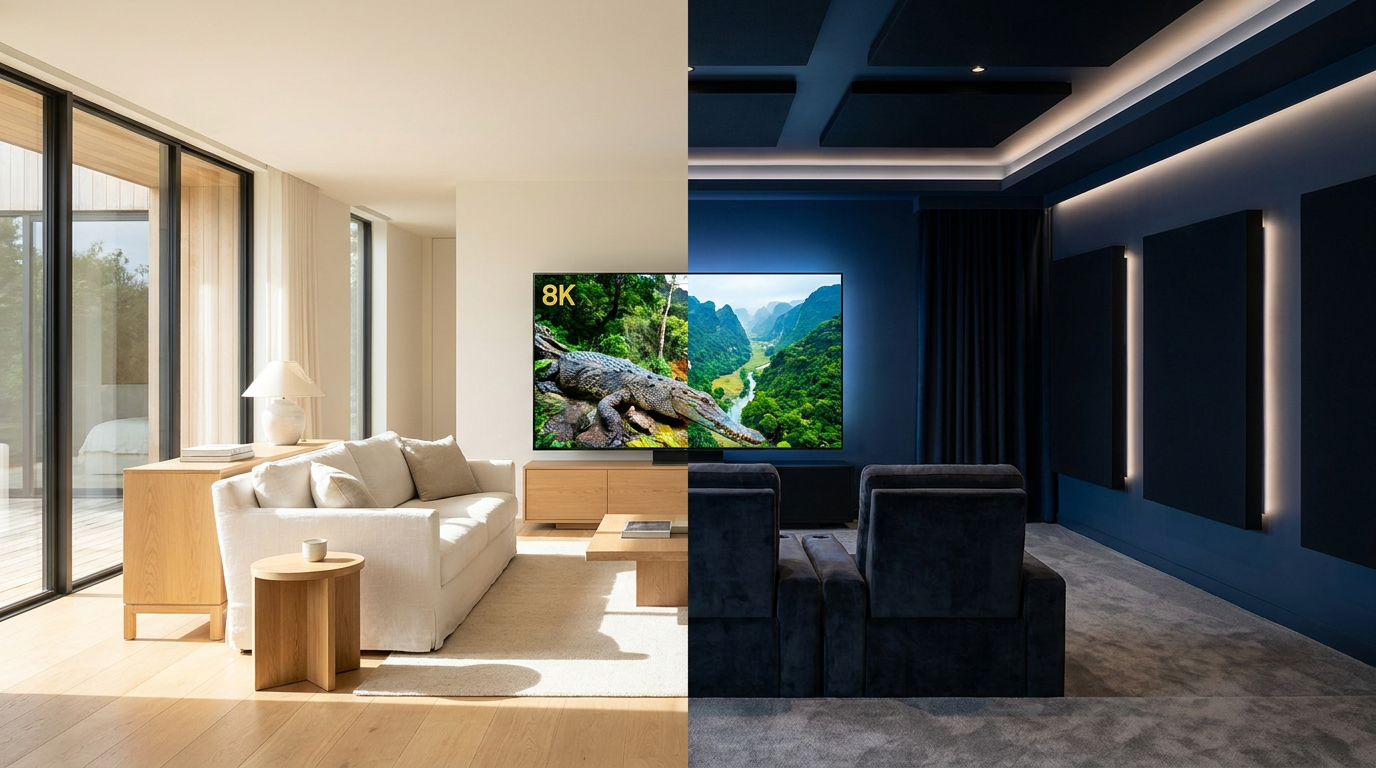
Ultimately, declaring a single winner is impossible without knowing the room the television will live in. OLED fits perfectly when the TV is destined for a dedicated home theater, a light-controlled basement, or a bedroom where nighttime movie watching is the primary use case. It does not fit well when the room features massive, unshaded south-facing windows or when the TV serves as an all-day background display for news channels with static tickers.[1][4]

Conversely, Mini-LED fits perfectly when the television is the centerpiece of an open-concept, sun-drenched living room, or when the buyer wants an 85-inch screen without paying an ultra-premium tax. It does not fit well when the viewer is a contrast purist who demands absolute, inky blackness in a pitch-dark room, or when wide seating arrangements force viewers to watch from off-center angles.[2][6]
How we got here
2013
First commercial OLED TVs launch, offering perfect blacks but struggling with low brightness and burn-in.
2019
Mini-LED technology enters the consumer market, bridging the gap between standard LED and OLED.
2024
QD-OLED panels introduce quantum dots to OLED, significantly boosting color volume and brightness.
2026
Tandem OLED and RGB Mini-LED architectures converge, largely eliminating the traditional weaknesses of both technologies.
Viewpoints in depth
Home Theater Purists
Advocates for absolute picture perfection in controlled lighting environments.
For cinephiles and home theater enthusiasts, the conversation still begins and ends with OLED. This camp argues that no amount of local dimming zones can replicate the pixel-level precision of an organic light-emitting diode turning itself completely off. They point to complex scenes—like a starfield or fireworks against a night sky—where Mini-LEDs still exhibit minor blooming. For this group, the introduction of Tandem OLED in 2026 is the final piece of the puzzle, providing enough HDR punch to satisfy modern mastering standards without sacrificing the infinite contrast that makes movies look three-dimensional.
Bright-Room Viewers
Prioritizes raw brightness and glare reduction for daytime viewing and sports.
This perspective represents the reality of most modern living rooms: open concepts, large windows, and daytime viewing. For these buyers, perfect black levels are irrelevant if the screen acts like a mirror reflecting the sun. They champion Mini-LED for its ability to sustain massive full-screen brightness—crucial for watching sports or playing games during the day. They argue that the minor blooming visible in a pitch-black room is completely invisible in a well-lit environment, making Mini-LED the far more practical and versatile choice for a family television.
Value Maximizers
Focuses on the price-to-size ratio, prioritizing massive screens over microscopic contrast gains.
As the demand for 85-inch and 98-inch televisions skyrockets, this camp argues that screen size is the single most impactful upgrade a viewer can make. Because manufacturing massive OLED panels remains prohibitively expensive, Value Maximizers lean heavily toward Mini-LED. They point out that for the price of a 77-inch OLED, a consumer can purchase a flagship 85-inch Mini-LED that offers 95% of the picture quality but provides a vastly more immersive, theater-like scale. To this group, the sheer physics of a larger screen outweigh the microscopic contrast advantages of OLED.
What we don't know
- How the long-term degradation curve of the new Tandem OLED panels will compare to traditional single-layer OLEDs over a 10-year lifespan.
- Whether MicroLED technology will drop in price fast enough by 2030 to render both OLED and Mini-LED obsolete.
Key terms
- Blooming
- A visual artifact where light from a bright object bleeds into surrounding dark areas of the screen, common on backlit TVs.
- Tandem OLED
- A display architecture that stacks multiple organic light-emitting layers to increase brightness and lifespan.
- Local Dimming Zones
- Specific areas of a TV's backlight that can dim or turn off completely to improve black levels and contrast.
- Nits
- A unit of measurement for the brightness of a display; higher numbers indicate a brighter screen.
Frequently asked
Does OLED still suffer from burn-in in 2026?
While the risk is never zero, 2026 Tandem OLED panels and advanced pixel-shifting algorithms have made burn-in a non-issue for varied, normal viewing.
What is Tandem OLED?
It is a new panel architecture that stacks multiple light-emitting layers, allowing the TV to produce much brighter images without overworking the pixels.
Is Mini-LED the same as MicroLED?
No. Mini-LED uses tiny LEDs as a backlight for an LCD panel. MicroLED is a completely different, ultra-expensive technology where each pixel is its own microscopic LED.
Sources
Source coverage
6 outlets
3 viewpoints surfaced






[1]RTINGSBright-Room Viewers
The Best TVs - Spring 2026 Reviews
Read on RTINGS →[2]Data Wire SolutionsValue Maximizers
Best TVs for 2026: 10 OLED and Mini-LED Picks by Room, Brightness, and Install Reality
Read on Data Wire Solutions →[3]What Hi-Fi?Home Theater Purists
The best TVs 2026: flagship OLEDs and affordable Mini LEDs tested
Read on What Hi-Fi? →[4]EcoPicksGoBright-Room Viewers
OLED vs Mini LED TVs Comparison (2026 Buyer's Guide)
Read on EcoPicksGo →[5]B2B Market InsightsValue Maximizers
2026 OLED vs. Mini LED TV Market: The Great Convergence
Read on B2B Market Insights →[6]Digital TrendsHome Theater Purists
OLED, QLED, or Mini-LED? Which TV to Buy in Early 2026
Read on Digital Trends →



Every angle. Every day.
Get shopping stories with full source coverage and perspective breakdowns delivered to your inbox.