
Do School Smartphone Bans Actually Work? The Evidence is Finally In
As 'bell-to-bell' phone bans sweep across U.S. schools, new data reveals they successfully reduce classroom distractions but fall short of being a silver bullet for academic and mental health crises.
By Factlen Editorial Team
- Educators & Administrators
- Teachers view the bans as essential for restoring focus and classroom management.
- Parents & Guardians
- Parents support focused classrooms but worry about emergency communication.
- Education Researchers
- Researchers caution that bans are a management tool, not a complete solution.
What's not represented
- · Students who rely on smartphones for accessibility tools or managing health conditions like diabetes.
- · Technology companies and app developers whose engagement metrics are impacted by daytime school bans.
Why this matters
School districts nationwide are fundamentally changing how students experience the school day by locking away their primary communication devices. Understanding the actual outcomes of these bans helps parents and educators navigate the messy transition period and set realistic expectations for their children's academic and mental well-being.
Key points
- Nearly half of U.S. states have implemented or encouraged 'bell-to-bell' school smartphone bans by 2026.
- Bans successfully reduce in-school phone usage by over 80%, drastically cutting classroom distractions.
- Academic results are mixed, with some districts seeing modest gains and others showing 'close to zero' impact on test scores.
- Studies show no significant improvement in student mental health, as teens often shift their screen time to after school.
- Schools frequently experience a temporary spike in suspensions during the first year of enforcement as students adjust.
- While 74% of parents support in-class bans, only 44% favor full-day restrictions due to safety concerns.
Over the past three years, a quiet revolution has swept through American education. Driven by mounting anxieties over plunging test scores and a worsening teen mental health crisis, school districts and state legislatures have aggressively targeted what they view as the primary culprit: the smartphone. What began as a patchwork of classroom rules has rapidly evolved into strict, statewide mandates.
By 2026, nearly half of all U.S. states have adopted some form of "bell-to-bell" legislation, prohibiting students from accessing their devices from the moment they arrive on campus until the final dismissal bell. Florida led the charge in 2023, and dozens of states quickly followed suit, promising parents and educators that removing screens would be a silver bullet for both academic recovery and student well-being.[4]
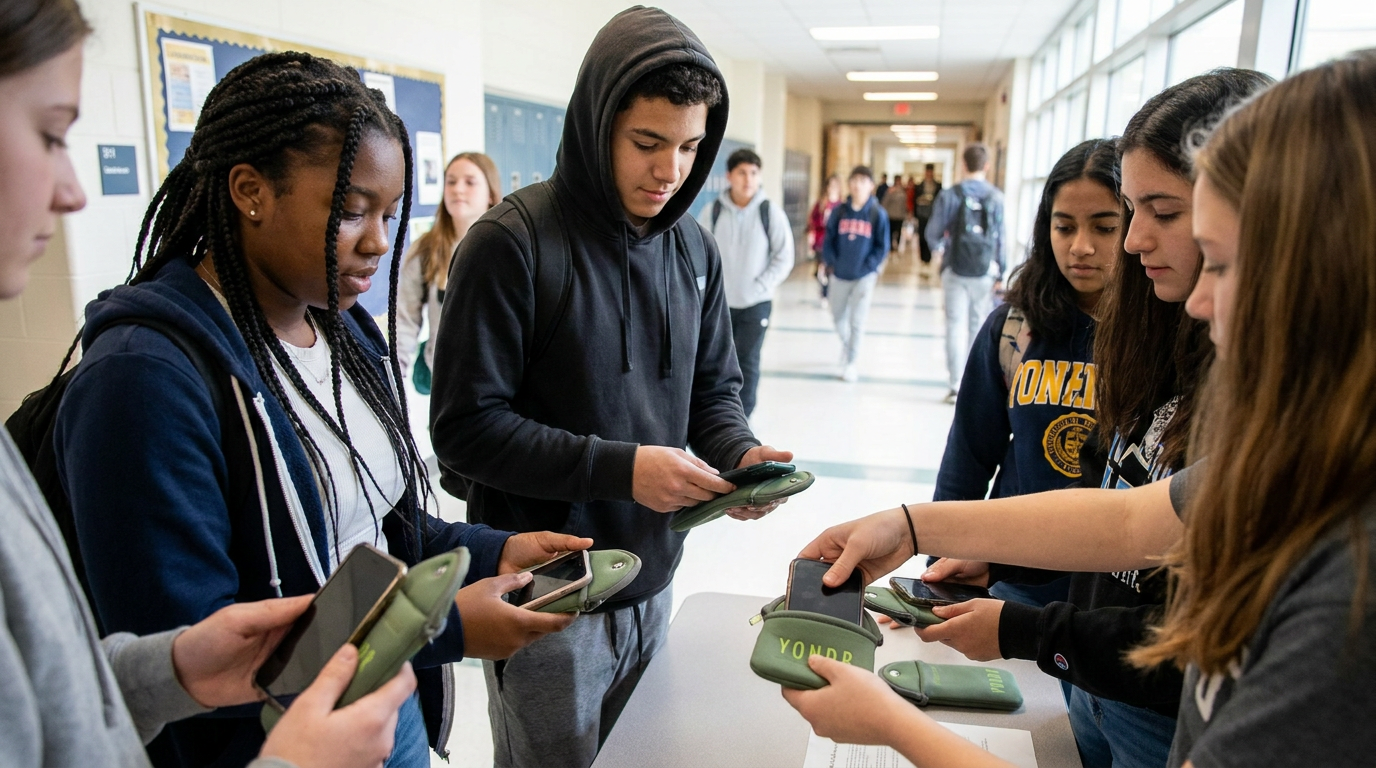
To enforce these mandates, schools have had to get creative. Many have invested heavily in physical infrastructure, requiring students to place their devices in magnetically sealed Yondr pouches or designated lockers for the duration of the day. For teachers, these state-backed mandates and physical barriers have brought a wave of relief, allowing them to point to state law rather than fighting individual battles with students over screen time.[8]
But as the first major wave of students completes multi-year stretches under these strict policies, a clearer picture of the results is finally emerging. Comprehensive data from economists, education researchers, and public health officials reveals that while the bans are highly effective at changing immediate behavior, they are not the cure-all politicians promised.
On the academic front, the evidence is decidedly mixed. A detailed analysis of a large, unnamed urban school district in Florida by the National Bureau of Economic Research found that strict bans did lead to measurable improvements. By the second year of the policy, students demonstrated a modest but statistically significant bump in standardized test scores, alongside a notable drop in unexcused absences.[2][5]

However, a massive nationwide study paints a less dramatic picture. Researchers from Stanford and Duke universities analyzed data from nearly 1,800 schools utilizing Yondr pouches and found that the average effect on standardized test scores was "consistently close to zero." While the bans successfully reduced in-school phone activity by over 80%, that reclaimed attention did not automatically translate into massive learning gains across the board.[1][3]
However, a massive nationwide study paints a less dramatic picture.
The data suggests a nuanced reality: removing a distraction clears the runway for learning, but it does not guarantee the plane will take off. If the underlying curriculum or student engagement isn't strong, simply taking away a phone won't magically produce an honor-roll student.
The findings regarding mental health and bullying—arguably the biggest driving forces behind the bans—are equally surprising. Multiple studies, including comprehensive reviews from the University of Birmingham and data from Dutch schools, found no significant improvements in student anxiety, depression, or perceived online bullying following the implementation of strict phone restrictions.[7]
Researchers attribute this to a "compensation effect." While students are undeniably spending less time on social media during school hours, many simply shift their screen time to the late afternoon and evening. Because their overall daily screen time remains largely unchanged, the broader mental health impacts of digital life persist.[7]
Furthermore, the transition to a phone-free environment is rarely smooth. The Florida data highlights a turbulent "adjustment period" that administrators must navigate. In the first month of strict enforcement, student suspension rates skyrocketed by 25%, disproportionately affecting Black students, as teenagers actively resisted the new rules and clashed with administrators.[2][3][5]
Fortunately, this disciplinary spike appears to be temporary. By the second year of the ban, as the policy normalized and became an accepted part of the school culture, suspension rates dropped back to pre-ban levels. Researchers emphasize that schools must plan for this rocky transition and ensure equitable enforcement during the initial shock phase.[3][5]
The debate over these policies also reveals a fascinating divide between the adults in the room. Teachers overwhelmingly support the bans, citing vastly improved classroom management and higher student engagement when devices are physically locked away.[8]

Parents, however, are more conflicted. While surveys show that 74% of U.S. adults support banning phones during actual instruction time, only 44% favor full "bell-to-bell" bans. Many parents remain deeply anxious about losing direct communication with their children during emergencies, preferring a moderate approach over total restriction.[6]
Ultimately, the emerging consensus frames school smartphone bans not as a panacea, but as a highly effective, foundational tool. They successfully disrupt the constant ping of notifications and force students to engage with their immediate physical environment. While they won't single-handedly solve the teen mental health crisis or fix systemic educational challenges, they provide schools with the necessary quiet to begin addressing them.

How we got here
May 2023
Florida becomes the first U.S. state to implement a statewide cellphone ban during instructional time.
2024–2025
Over two dozen states pass legislation restricting or banning the use of cellphones in K-12 schools.
Late 2025
Initial data from early adopters reveals a spike in disciplinary actions as students resist the new policies.
Spring 2026
Comprehensive studies from Stanford, Duke, and the NBER reveal mixed academic results and limited mental health impacts.
Viewpoints in depth
Educators & Administrators
Teachers view the bans as essential for restoring focus and classroom management.
For those on the front lines of education, smartphone bans are a desperately needed intervention. Teachers report that prior to the bans, they were spending a significant portion of their instructional time policing device usage and competing with algorithms for student attention. State-mandated bans, especially those utilizing physical pouches, remove the burden of enforcement from individual teachers, allowing them to focus entirely on instruction and fostering a more engaged classroom environment.
Parents & Guardians
Parents support focused classrooms but worry about emergency communication.
The parental perspective is defined by a tension between academic focus and safety. While a strong majority of parents agree that phones are a distraction during lessons, many are deeply uncomfortable with full "bell-to-bell" bans that sever their direct line of communication with their children. In an era marked by anxieties over school safety and emergencies, many parents advocate for a middle ground—such as allowing phone access during lunch or passing periods—rather than total restriction.
Education Researchers
Researchers caution that bans are a management tool, not a complete solution.
Economists and public health experts analyzing the data emphasize nuance. They acknowledge that bans successfully achieve their primary goal: drastically reducing screen time during school hours. However, they caution policymakers against viewing these bans as a silver bullet for complex issues like the teen mental health crisis or systemic academic deficits. Because students often compensate by increasing their screen time at home, researchers argue that school bans must be paired with broader cultural shifts regarding technology use.
What we don't know
- Whether the modest academic gains seen in some districts will compound over multiple years of phone-free schooling.
- How the long-term social development of students who spend their entire high school career under these bans will compare to previous cohorts.
- If schools will eventually transition away from physical pouches as phone-free environments become a normalized cultural expectation.
Key terms
- Bell-to-bell ban
- A policy prohibiting students from accessing their personal electronic devices from the start of the school day until dismissal, including during lunch and passing periods.
- Yondr pouch
- A specialized fabric bag with a magnetic lock used by schools and entertainment venues to securely store smartphones until they are unlocked at designated stations.
- Compensation effect
- A behavioral phenomenon where students restricted from using screens during the day make up for the lost time by heavily increasing their usage after school.
Frequently asked
Do school phone bans improve test scores?
The evidence is mixed. While some districts in Florida saw modest improvements in test scores by the second year, a massive nationwide study found the average effect on standardized tests to be close to zero.
Do the bans help with student mental health?
Current research indicates they do not significantly improve mental health or reduce online bullying, largely because students still spend the same total amount of time on their phones by shifting their usage to after school.
How are schools enforcing these rules?
Many schools use physical barriers, such as requiring students to lock their phones in magnetically sealed Yondr pouches or designated lockers for the entire school day.
Why do suspensions increase when bans start?
Schools often experience an 'adjustment period' where students actively resist the new rules, leading to a temporary spike in disciplinary actions and suspensions before the policy normalizes.
Sources
Source coverage
8 outlets
3 viewpoints surfaced








[1]The GuardianEducation Researchers
'Close to zero impact': US study casts doubt on effect of phone ban in schools
Read on The Guardian →[2]Florida PoliticsEducation Researchers
A new study shows that students do better in school without their cellphone, though the state's ban has unintended consequences
Read on Florida Politics →[3]K-12 DiveEducation Researchers
Cellphone ban led to improved learning, attendance in Florida district
Read on K-12 Dive →[4]Harvard Kennedy SchoolEducation Researchers
Is it working? An HKS education expert explains “bell-to-bell” cellphone bans
Read on Harvard Kennedy School →[5]National Bureau of Economic ResearchEducation Researchers
The Impact of Cellphone Bans in Schools on Student Outcomes: Evidence from Florida
Read on National Bureau of Economic Research →[6]Pew Research CenterParents & Guardians
Parent opinion: support for moderation in school phone bans
Read on Pew Research Center →[7]National Institutes of HealthEducation Researchers
Smartphone bans in schools and adolescent well-being: A mixed-methods study
Read on National Institutes of Health →[8]The BeaconEducators & Administrators
How Kansas City schools are enforcing new cellphone rules
Read on The Beacon →
Every angle. Every day.
Get community stories with full source coverage and perspective breakdowns delivered to your inbox.