
How the U.S. Finally Built a Thriving Professional Women's Volleyball Ecosystem
After decades of top American talent heading overseas, a massive influx of capital and record-breaking collegiate viewership has birthed two major domestic leagues. Here is how LOVB and MLV are transforming the sport in 2026.
By Factlen Editorial Team
- Grassroots Model Advocates
- Argue that building a professional league on top of an existing youth club network guarantees a loyal, built-in fanbase.
- Traditional Franchise Proponents
- Believe the sport needs independently owned, city-based franchises operating in major arenas to achieve top-tier status.
- Cautious Industry Veterans
- Warn that launching multiple competing leagues simultaneously could splinter the talent pool and overwhelm the market.
What's not represented
- · European League Executives
- · Collegiate Athletic Directors
Why this matters
For decades, America's best volleyball players had to move overseas to make a living. The sudden explosion of domestic leagues means fans can finally watch homegrown stars in local arenas, while athletes secure lucrative, sustainable careers in the United States.
Key points
- The U.S. now hosts two major professional women's volleyball leagues: LOVB and MLV.
- Record-breaking collegiate viewership and attendance catalyzed hundreds of millions in institutional investment.
- LOVB utilizes a unique community-up model, integrating 77 youth clubs to build a grassroots fanbase.
- MLV operates on a traditional franchise model following a landmark merger with the Pro Volleyball Federation.
- The domestic leagues allow American stars to earn lucrative salaries without relocating overseas.
- Both leagues plan aggressive expansion in 2027, adding teams in major media markets.
For decades, the pipeline for elite American women's volleyball players ended abruptly at the international border. After dominating the collegiate ranks in the NCAA and securing Olympic gold medals on the global stage, the sport's brightest stars faced a frustrating reality: they were forced to relocate to professional leagues in Italy, Turkey, or Brazil just to earn a living. The United States, despite producing some of the most talented athletes in the world, completely lacked a sustainable, fully capitalized domestic professional league. This forced migration meant that American fans could rarely watch their hometown heroes compete in person once their college eligibility expired. Players endured grueling overseas schedules, language barriers, and isolation from their families, all while the domestic market remained entirely untapped. The absence of a U.S. league was a glaring anomaly in the American sports landscape, especially given the massive grassroots participation numbers across the country.
By 2026, that outdated paradigm has completely fractured, giving way to a new era of opportunity. The United States is now home to a booming, heavily capitalized domestic professional ecosystem that is keeping top-tier talent on American soil. Anchored by two distinct and ambitious organizations—League One Volleyball (LOVB) and Major League Volleyball (MLV)—the American market has finally built the infrastructure necessary to support a thriving professional scene. These leagues have secured hundreds of millions of dollars in institutional funding, secured major national broadcast deals, and established franchises in major media markets from coast to coast. For the first time in the sport's history, collegiate standouts can transition directly into a lucrative domestic career, playing in front of packed arenas of homegrown fans. The era of the American volleyball diaspora has officially ended, replaced by a fierce competition to build the premier women's sports league in the country.
The primary catalyst for this rapid professionalization was the undeniable, record-breaking explosion of the college game over the past three years. The turning point occurred in August 2023, when the University of Nebraska drew an astonishing 92,003 fans to a match at Memorial Stadium, setting a global attendance record for any women's sporting event. That singular moment proved that volleyball could command stadium-scale audiences. The momentum only compounded from there; the 2024 NCAA tournament became the most-consumed collegiate volleyball event in history, logging over 1.3 billion minutes watched across ESPN platforms. The championship match alone drew millions of television viewers, proving to broadcasters and investors alike that the sport possessed a massive, highly engaged demographic that was hungry for high-level competition beyond the collegiate season.[3][4]
Institutional investors and sports entrepreneurs quickly recognized the massive gap between grassroots participation and professional monetization. With high school girls' volleyball participation hitting an all-time high of over 470,000 athletes—second only to outdoor track and field—the foundational fanbase was already in place. Market analysts projecting the sport's financial trajectory estimate that domestic volleyball revenue could surge from its current $3.9 billion valuation to nearly $6.9 billion over the next decade, driven heavily by apparel, team branding, and media rights. This staggering economic potential triggered a gold rush among venture capitalists, celebrity investors, and traditional sports owners, all eager to establish a foothold in what is widely considered the next great frontier in American professional sports.[3][6]

To capture that lucrative market, League One Volleyball (LOVB) launched its inaugural professional season in 2025 using a highly unconventional "community-up" business model. Rather than simply launching top-tier franchises in a vacuum and hoping fans would show up, LOVB spent years quietly acquiring a massive network of youth volleyball clubs. By the time the professional league debuted, LOVB had integrated 77 club locations across 28 states, encompassing over 22,000 youth athletes and 3,500 coaches. This built-in grassroots network serves as an immediate, fiercely loyal fanbase for its professional tier. The youth players attend matches, buy merchandise, and view the professional athletes as direct, accessible role models, creating a vertically integrated ecosystem that traditional sports leagues spend decades trying to build.[4]
LOVB's 2026 season demonstrated the viability of this model, featuring six teams playing a national schedule broadcast across ESPN networks and the Victory+ streaming platform. The league's unique structure eschews traditional city mascots, referring to teams simply by their host cities, such as LOVB Austin, LOVB Houston, and LOVB Nebraska. This branding choice emphasizes the collective league identity over individual franchise rivalries. The 2026 campaign saw significant viewership growth, with ESPN presenting 28 matches across its platforms, building on the historic viewership numbers established by the NCAA tournament. The broadcast strategy ensured that fans across the country could follow the league's top stars, many of whom were familiar faces from their recent collegiate careers.[1][4]
The competition on the court has already reached an elite international level, culminating in a dramatic postseason. In April 2026, LOVB Austin successfully defended its league championship in a grueling, highly anticipated five-set victory over LOVB Salt Lake. The match, played in front of a packed house at the LBS Financial Credit Union Pyramid in Long Beach, California, showcased the sheer athleticism of the league. After trailing in the match, Austin forced a decisive "golden set"—a high-stakes race to 15 points to determine the champion. Austin's Madisen Skinner secured Finals MVP honors with a dominant 20-kill performance, while teammate Logan Eggleston delivered the championship-clinching point for the second consecutive year, cementing Austin as the league's first true dynasty.[5]

The competition on the court has already reached an elite international level, culminating in a dramatic postseason.
Riding the momentum of its successful sophomore season, LOVB is already executing an aggressive expansion strategy. The league plans to expand to 10 teams by the 2027 season, adding new franchises in Miami, Los Angeles, Minnesota, and San Francisco. This expansion will allow the league to split into formal Eastern and Western conferences, reducing travel fatigue and fostering regional rivalries. The addition of these major media markets is expected to significantly boost the league's broadcast value and corporate sponsorship opportunities, proving that the community-up model can scale effectively across the entire continental United States.[4]
Running parallel to LOVB's grassroots approach is Major League Volleyball (MLV), which operates on a much more traditional, independently owned franchise model akin to the NBA or NFL. MLV's 2026 season is the result of a dramatic corporate consolidation that fundamentally reshaped the sport's landscape over the past year. Backed by heavy-hitting investors who believe that volleyball must mirror the established "Big Four" American sports leagues to achieve true mainstream success, MLV focuses on securing major arena leases, building distinct city-based brands, and attracting high-net-worth ownership groups capable of weathering the financial challenges of a start-up league.[2][4]
The origins of MLV's current structure stem from a fierce boardroom battle. Originally, the Pro Volleyball Federation (PVF) launched in 2024 as the primary franchise-based league in the country. However, in early 2025, a rival start-up named Major League Volleyball announced its intention to launch with over $100 million in committed funding from prominent figures like Sacramento Kings owner Vivek Ranadivé, musician Jason Derulo, and Olympic legend Kerri Walsh Jennings. The new MLV aggressively poached the PVF's most successful franchise, the Omaha Supernovas, signaling a willingness to spend heavily to dominate the market. This sparked fears of a protracted turf war that could damage the sport's growth.[3][4]
Facing a fractured market that threatened to cannibalize ticket sales, dilute the talent pool, and confuse casual fans, the two competing entities executed a landmark merger in August 2025. The unified organization adopted the Major League Volleyball (MLV) branding and consolidated the most viable markets from both leagues into a single, powerful entity. This merger was widely praised by sports economists as a necessary step to ensure long-term survival, preventing the kind of destructive rivalries that have historically plagued emerging sports leagues. By combining resources, the new MLV secured a much stronger negotiating position for future media rights deals.[2]

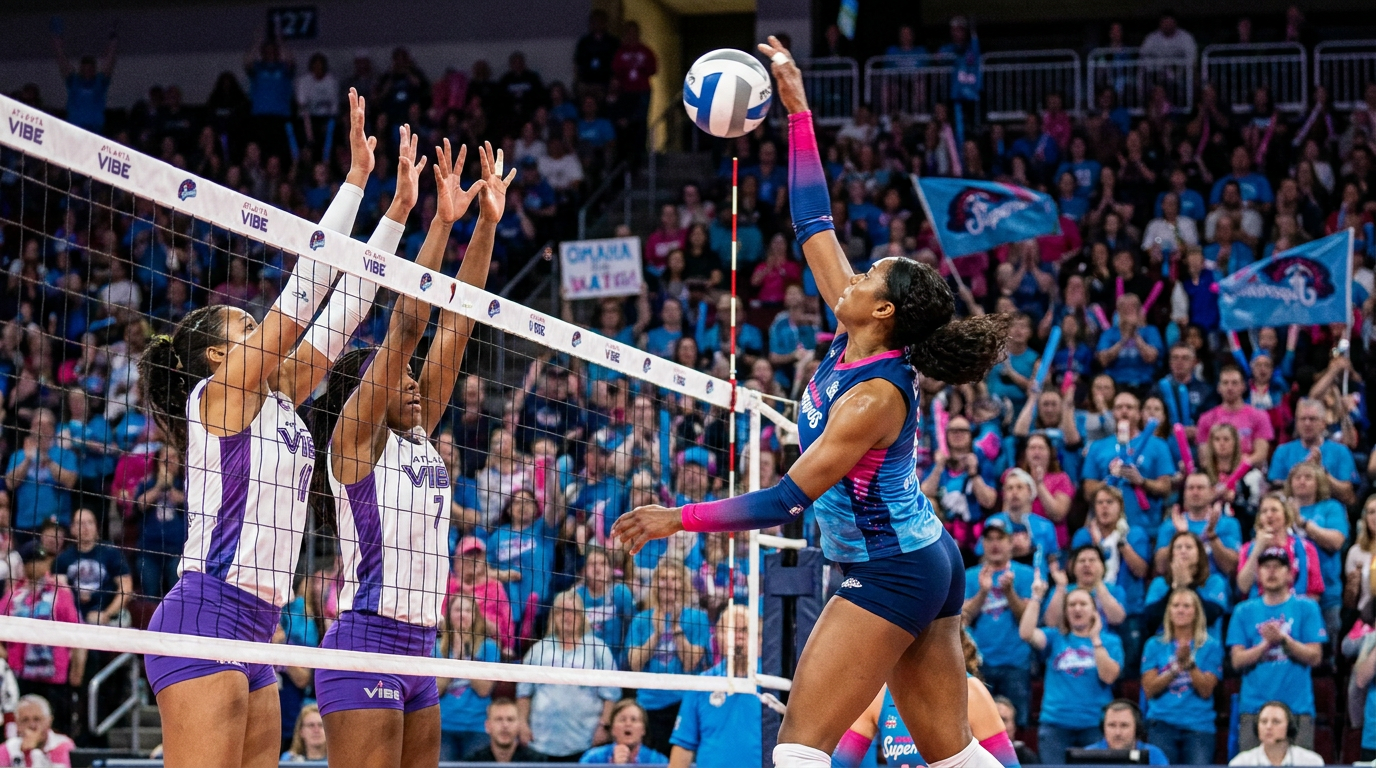
For its 2026 campaign, the newly unified MLV features eight teams—including strong carryovers like the Atlanta Vibe, Columbus Fury, and Grand Rapids Rise, alongside a brand-new franchise in Dallas. The league has implemented a strict salary cap and comprehensive minimum operational standards, aiming to provide a centralized, elite platform with scalable infrastructure. By mandating high standards for training facilities, medical staff, and player travel, MLV is actively working to shed the "start-up" label and present itself as a fully mature, top-tier professional sports organization capable of attracting the best international talent.[2]
Like its rival LOVB, MLV is also eyeing aggressive geographic expansion, with new franchises already slated to launch in Washington, D.C., and Northern California in 2027. The dual expansion of both leagues means that by next year, the United States could host nearly 20 fully professional women's volleyball teams operating at the highest level of the sport. This unprecedented density of professional opportunities is a stark contrast to just five years ago, when American players had zero domestic options. The sheer volume of roster spots available is transforming the career trajectories of hundreds of athletes.[2]
This massive influx of institutional capital is fundamentally changing the financial realities for the athletes themselves. The fierce competition between LOVB and MLV to secure top talent is naturally driving up salaries, offering players the leverage to negotiate highly lucrative contracts. Beyond base salaries, athletes are benefiting from superior medical support, state-of-the-art training facilities, and robust marketing support that helps them build their personal brands. For established stars like Jordan Larson and emerging talents like Madisen Skinner, the ability to earn a premium living while staying close to family and domestic endorsement opportunities is a game-changer.[4][5][6]

Despite the overwhelming positivity surrounding the sport's growth, the rapid proliferation of teams has sparked debate over long-term sustainability. While the grassroots demand is undeniable, some industry veterans and Olympic legends have expressed cautious optimism, questioning whether the American sports consumer can truly support two distinct, expanding professional volleyball leagues simultaneously. Skeptics point to the graveyard of failed alternative sports leagues, warning that if LOVB and MLV engage in a destructive bidding war for talent or oversaturate the television market, the resulting financial strain could lead to sudden franchise collapses or a forced, messy contraction.[3][6]
For now, however, the sheer volume of investment and the consistently strong viewership metrics suggest a long, prosperous runway for growth. Whether the market eventually forces a final grand merger between LOVB and MLV, or whether they successfully coexist by targeting different segments of the calendar and fanbase, the primary objective has already been achieved. The era of the American volleyball diaspora is definitively over. The infrastructure is finally here, the capital is deployed, and American volleyball players finally have a permanent, thriving home court.
How we got here
August 2023
Nebraska draws 92,003 fans for a college volleyball match, setting a global attendance record for women's sports.
January 2024
The Pro Volleyball Federation (PVF) launches its inaugural season as a traditional franchise league.
January 2025
League One Volleyball (LOVB) debuts its professional tier, backed by a massive network of youth clubs.
Early 2025
Major League Volleyball (MLV) announces its formation with $100 million in funding, poaching the PVF's Omaha franchise.
August 2025
PVF and MLV merge under the MLV banner to consolidate the franchise-model market.
April 2026
LOVB Austin wins the 2026 LOVB championship in a thrilling five-set victory over Salt Lake.
Viewpoints in depth
The Grassroots Pipeline Strategy
LOVB's strategy relies on converting youth players and their families into lifelong professional fans.
Proponents of the League One Volleyball (LOVB) model argue that traditional sports leagues spend decades trying to build local fanbases from scratch. By acquiring 77 youth clubs across the country before even launching its professional tier, LOVB engineered a built-in audience. Supporters point out that the thousands of youth athletes playing in LOVB-branded clubs provide a reliable ticket-buying demographic, while the professional players serve as direct, accessible role models for the grassroots pipeline.
The Major League Blueprint
MLV's backers believe volleyball must mirror the NBA and NFL to attract institutional capital.
Advocates for Major League Volleyball (MLV) contend that to be taken seriously as a top-tier American sport, volleyball must adopt the proven structures of the Big Four leagues. This means independent, deep-pocketed ownership groups, traditional city-based branding, and a focus on major arena deals rather than community gyms. By securing over $100 million in funding and merging with the existing Pro Volleyball Federation, MLV supporters argue they have the financial runway and structural maturity to secure massive broadcast rights and corporate sponsorships.
The Consolidation Warning
Skeptics worry that a turf war between leagues could stall the sport's momentum.
While the influx of capital is universally celebrated by players, some sports economists and veteran athletes warn of the 'splinter effect.' They point to historical examples of rival leagues cannibalizing each other's talent pools and confusing casual fans. These cautious voices argue that while the U.S. market is large, asking fans to follow two distinct leagues with different rules, schedules, and broadcast partners might dilute the product, eventually forcing a painful contraction or a mandatory merger.
What we don't know
- Whether the American sports market can sustain two distinct professional volleyball leagues long-term.
- How the aggressive expansion to nearly 20 teams by 2027 will impact the overall talent pool.
- If LOVB and MLV will eventually be forced into a final merger to consolidate media rights.
Key terms
- Golden Set
- A tie-breaking final set played to 15 points to determine the winner of a match or playoff series when teams are tied.
- Franchise Model
- A league structure where individual teams are independently owned and operated by local ownership groups, typical of major American sports.
- Grassroots Pipeline
- A development system that connects youth and amateur club programs directly to a professional league.
- Salary Cap
- A league-mandated limit on the amount of money a team can spend on player salaries, designed to maintain competitive balance.
Frequently asked
What is the difference between LOVB and MLV?
League One Volleyball (LOVB) is built on a network of youth clubs and uses a centralized model without traditional city mascots. Major League Volleyball (MLV) operates like a traditional sports league with independently owned, city-based franchises.
Why did the Pro Volleyball Federation (PVF) merge?
Facing competition from the newly announced MLV, which had secured $100 million in funding and poached a top team, the PVF merged with MLV in August 2025 to consolidate the market and avoid splintering the fanbase.
Where do these leagues broadcast their games?
LOVB matches are broadcast across ESPN networks and the Victory+ streaming platform. MLV matches also target national media exposure, building on the broadcast foundations established during the PVF's early seasons.
Are college players joining these leagues?
Yes. The massive popularity of NCAA volleyball has created a direct pipeline of elite talent entering both LOVB and MLV, allowing American stars to begin their professional careers domestically.
Sources
Source coverage
6 outlets
3 viewpoints surfaced






[1]ESPNGrassroots Model Advocates
ESPN and League One Volleyball (LOVB) announce distribution schedule for 2026
Read on ESPN →[2]Sports Business JournalTraditional Franchise Proponents
Pro Volleyball Federation, Major League Volleyball to merge for 2026 season
Read on Sports Business Journal →[3]SportsProTraditional Franchise Proponents
New US$100m women's volleyball league to launch in 2026
Read on SportsPro →[4]USA VolleyballTraditional Franchise Proponents
Major League Volleyball Women's Pro League to Launch in January 2026
Read on USA Volleyball →[5]The562.orgGrassroots Model Advocates
LOVB Austin defends title in thrilling five-set victory
Read on The562.org →[6]EssentiallySportsCautious Industry Veterans
Increasing Volleyball Leagues and Interest to Boost $3 Billion Revenue in USA Market
Read on EssentiallySports →

More in sports
See all 9 stories →Standings
San Diego Wave Seize NWSL Top Spot as League Enters World Cup Break
7 sources
Equipment Tech
Badminton's Quiet Revolution: The Engineering Race to Replace the Feather Shuttlecock
7 sources

Injury
Toronto Tempo Issue Hopeful Recovery Timelines for Brittney Sykes and Kiki Rice
6 sources
Standings
WNBA 2026 Standings: Aces Reclaim Top Spot as Expansion Teams Make Immediate Impact
6 sources
Every angle. Every day.
Get sports stories with full source coverage and perspective breakdowns delivered to your inbox.