
NASA's X-59 Reaches Target Speed and Altitude, Paving the Way for Quiet Supersonic Travel
The experimental X-59 aircraft successfully flew at Mach 1.4 and 55,000 feet, hitting the critical mission conditions needed to test 'quiet thump' technology over U.S. communities.
By Factlen Editorial Team
- Aviation Regulators
- Focused on gathering empirical data to establish new noise thresholds for overland flight.
- Aerospace Engineers
- Focused on the technical achievement of shaping shockwaves through airframe design.
- Community Advocates
- Focused on the real-world acoustic impact and ensuring the 'thump' is genuinely non-disruptive.
What's not represented
- · Commercial Airlines
- · Environmental Groups concerned about high-altitude emissions
Why this matters
Since 1973, commercial supersonic flight over land has been banned due to the destructive noise of sonic booms. If the X-59 proves that aircraft can break the sound barrier with only a quiet 'thump,' it could overturn a half-century of regulations and drastically reduce global travel times.
Key points
- NASA's X-59 reached its target mission conditions of Mach 1.4 at 55,000 feet on June 12, 2026.
- The milestone follows the aircraft's first supersonic flight on June 5, capping a rapid phase of envelope expansion.
- The aircraft is designed to reduce the traditional sonic boom to a quiet 'thump' of around 75 EPNdB.
- NASA will soon use a chase plane to measure the X-59's shockwave signature in the air.
- Future tests will fly the aircraft over U.S. communities to gauge public reaction to the noise.
- The data could convince regulators to lift the 1973 ban on commercial supersonic flight over land.
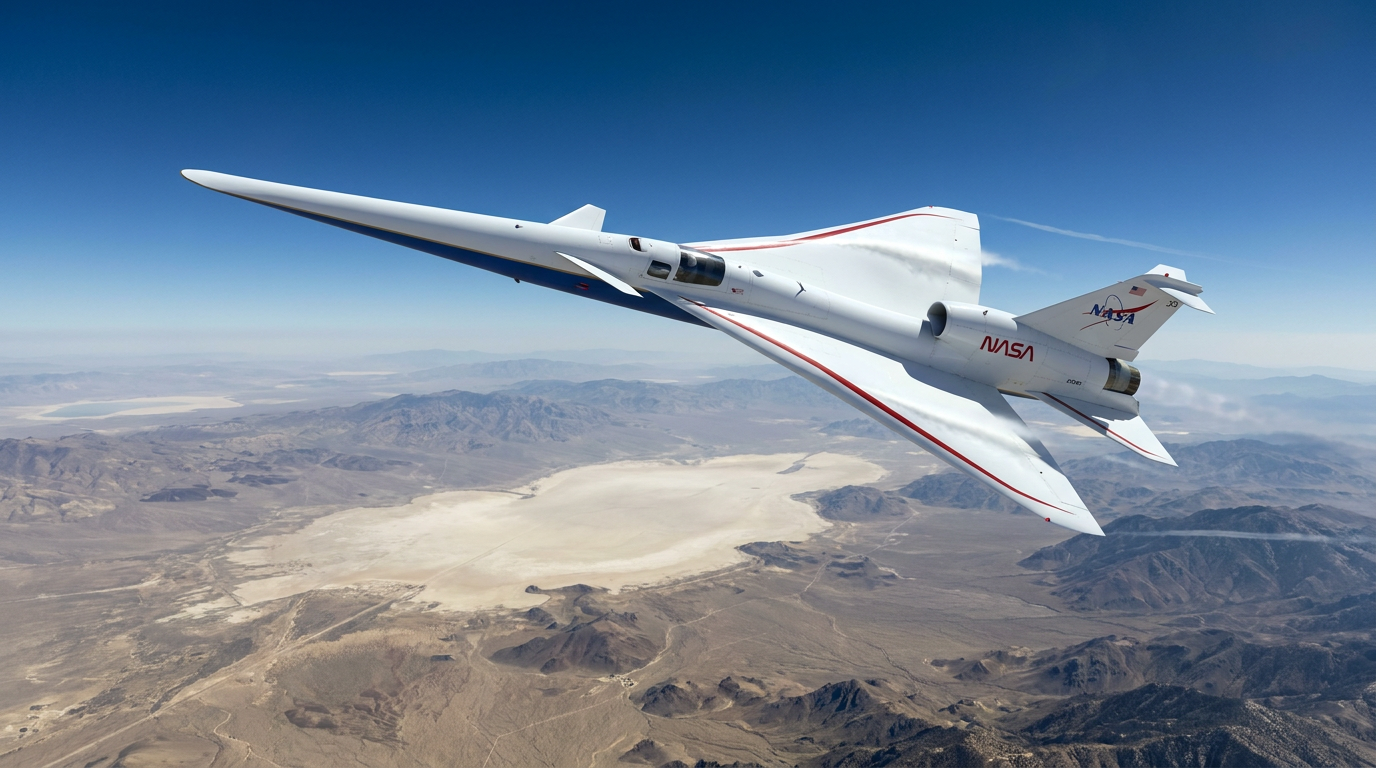
NASA's experimental X-59 aircraft has reached the precise speed and altitude it was built to fly, clearing a major technical hurdle in the agency's decades-long quest to bring back commercial supersonic travel. On June 12, 2026, test pilot Jim 'Clue' Less pushed the needle-nosed jet to Mach 1.4—approximately 924 miles per hour—at an altitude of 55,000 feet over the expansive testing ranges of Edwards Air Force Base in California. The achievement marks the first time the aircraft has hit its target 'mission conditions' in a single flight. These are the exact atmospheric and performance parameters under which the X-59 will eventually fly over American communities to prove that breaking the sound barrier does not have to result in a window-rattling sonic boom. The successful flight signals that the aircraft's core aerodynamic design is functioning exactly as engineers intended at high altitudes.[1][4]
The milestone caps a period of rapid and highly successful envelope expansion for NASA's Quesst mission. After spending years on the ground addressing complex structural and systems issues, the flight test campaign accelerated dramatically this spring. The aircraft completed an impressive 16 flights in just 90 days, methodically testing its handling characteristics and systems before breaking the sound barrier for the first time at Mach 1.1 on June 5. Pushing to Mach 1.4 just one week later demonstrates the team's growing confidence in the airframe. The pilot reported that the transition to supersonic speeds was incredibly smooth, with the only indication of breaking the sound barrier coming from the instrument readouts rather than any physical sensation in the cockpit.[2][4]
The entire reason for the X-59's existence is fundamentally acoustic. When a conventional aircraft exceeds Mach 1, the pressure waves created by its nose, wings, cockpit, and engine are forced together, coalescing into a sharp, double-crack shockwave that hits the ground with immense force. The Concorde, the world's most famous commercial supersonic airliner, generated booms measuring approximately 105 perceived noise decibels (EPNdB). This level of noise was loud enough to startle livestock, trigger a flood of noise complaints from residents, and even cause minor structural damage to buildings along its flight path.[4][5]

In response to the severe disruption caused by these early supersonic jets, the Federal Aviation Administration and international regulators took decisive action, banning civilian supersonic flight over land in 1973. That sweeping regulation effectively killed the commercial supersonic market everywhere except over the open ocean, freezing overland commercial air travel speeds for more than half a century. For decades, aerospace manufacturers have known that the only way to make supersonic overland flight economically viable again is to solve the physics of the sonic boom, a challenge that has stymied engineers until the development of the X-59.[4][5]
To solve this persistent noise problem, NASA partnered with Lockheed Martin's legendary Skunk Works division to design an aircraft with a radically different aerodynamic approach. The X-59 is 99.7 feet long but remarkably slender, featuring an elongated nose that accounts for roughly a third of its entire length. This needle-like shape is specifically engineered to physically separate the pressure waves generated during supersonic flight, keeping them apart as they travel through the atmosphere. Because the nose is so long, it entirely blocks the pilot's forward visibility, requiring the use of an advanced eXternal Vision System (XVS)—a high-resolution camera and display setup—to see the airspace ahead.[4][5][6]
The X-59 is 99.7 feet long but remarkably slender, featuring an elongated nose that accounts for roughly a third of its entire length.
By the time these carefully separated pressure waves reach the ground, they arrive not as an explosive, merged pulse but as a series of softer, rolling waves. NASA's target sound level for the X-59 is roughly 75 EPNdB, a dramatic reduction from the Concorde's deafening roar. Acoustic engineers compare the resulting 'sonic thump' to the sound of a car door closing down the street, or distant, muffled thunder. If the aircraft consistently produces this muted sound profile, it will prove that the fundamental physics of supersonic shockwaves can be managed and mitigated through advanced airframe shaping.[4][5]
With the aircraft now proven at its Mach 1.4 cruising speed, the team will spend the coming months conducting further performance testing and moving into the critical acoustic validation phase. During these upcoming test flights, a NASA F-15 chase plane equipped with a specialized shock-sensing probe will fly in close proximity to the X-59. The F-15 will fly through the invisible shockwaves trailing behind the experimental jet, taking precise measurements to confirm that the pressure waves are remaining separated in the air exactly as the supercomputer simulations predicted.[1][2][3]

Once the airborne acoustic validation phase is complete and the data confirms the aircraft's quiet profile, the true test of the Quesst mission begins: community overflights. NASA plans to fly the X-59 over a diverse selection of cities and towns across the United States. Ground-based microphone arrays will be deployed to record the aircraft's acoustic signature as it passes overhead at 55,000 feet, while residents will be actively surveyed to gauge their real-world reaction to the quieter sonic thumps, ensuring the noise is genuinely non-disruptive to daily life.[1][4]
The stakes for the global aviation industry are immense, as the data gathered from these community overflights could fundamentally reshape the future of air travel. NASA will compile the acoustic measurements and public response surveys and share them directly with the FAA and the International Civil Aviation Organization (ICAO). If the results confirm that the shaped sonic signature is acceptable to communities, regulators could rewrite the 1973 rules, replacing the outright speed ban with new, data-driven noise thresholds.[2][4]
Lifting the ban on overland supersonic flight would usher in a new era of high-speed commercial aviation, drastically reducing travel times for cross-country and international routes. Aerospace manufacturers are already watching the X-59 program closely, eager to adapt its quiet technology into viable passenger airliners. While it will take years for commercial supersonic jets to enter service, the successful Mach 1.4 flight of the X-59 proves that the technological foundation for a faster, quieter world is now firmly in place.[2][6]
How we got here
1973
The FAA bans commercial supersonic flight over U.S. land due to the disruptive noise of sonic booms.
October 2025
The X-59 completes its first subsonic test flight after years of development.
June 5, 2026
The X-59 breaks the sound barrier for the first time, reaching Mach 1.1.
June 12, 2026
Test pilot Jim Less pushes the aircraft to its target cruising speed of Mach 1.4 at 55,000 feet.
Viewpoints in depth
Aviation Regulators
Focused on establishing data-driven noise thresholds to replace outright bans.
For over 50 years, the FAA and international bodies have relied on a simple speed limit: civilian aircraft cannot exceed Mach 1 over land. Regulators are now open to replacing this speed-based ban with a noise-based standard. If NASA's community overflight data proves that the X-59's 75 EPNdB 'thump' does not disturb residents or damage property, regulatory agencies like the ICAO could establish new certification standards, allowing any aircraft that meets the acoustic threshold to fly supersonic over populated areas.
Aerospace Engineers
Focused on the aerodynamic challenge of shaping and separating shockwaves.
For the teams at NASA and Lockheed Martin's Skunk Works, the X-59 is a triumph of acoustic engineering. The challenge was not simply flying fast—military jets do that daily—but managing the physics of displaced air. By lengthening the aircraft to nearly 100 feet and carefully contouring the lifting surfaces, engineers successfully prevented the bow and tail shockwaves from merging. The recent Mach 1.4 flights validate years of wind-tunnel testing and supercomputer simulations, proving the physical airframe behaves exactly as modeled.
What we don't know
- It remains to be seen how the general public will actually react to the 75 EPNdB 'sonic thump' during the upcoming community overflights.
- There is no set timeline for when the FAA or ICAO might officially rewrite the regulations governing overland supersonic flight.
- It is unclear how quickly commercial aerospace manufacturers will be able to adapt the X-59's quiet technology into viable passenger airliners.
Key terms
- Mach 1
- The speed of sound, which varies depending on altitude and temperature but is roughly 767 mph at sea level.
- Sonic Boom
- A loud, explosive noise caused by the shockwaves created when an object travels through the air faster than the speed of sound.
- EPNdB
- Effective Perceived Noise in decibels, a measurement used to quantify the annoyance level of aircraft noise as heard by the human ear.
- Envelope Expansion
- The methodical process in flight testing where an aircraft is pushed to fly faster, higher, or through more extreme maneuvers to establish its safe operating limits.
Frequently asked
Why is supersonic flight currently banned over land?
When conventional jets fly faster than the speed of sound, they create a loud, explosive sonic boom that can rattle windows and disturb communities. The FAA banned overland civilian supersonic flights in 1973 to prevent this noise pollution.
How does the X-59 stop the sonic boom?
The aircraft features an extremely long, needle-like nose that physically separates the pressure waves created during supersonic flight. This prevents the waves from merging into a loud boom, resulting instead in a softer 'thump'.
When will the X-59 fly over cities?
After completing performance testing and acoustic validation with a chase plane, NASA plans to begin flying the X-59 over selected U.S. communities to survey residents about the noise.
Sources
Source coverage
6 outlets
3 viewpoints surfaced






[1]NASAAviation Regulators
NASA's X-59 Reaches Speed, Altitude for Future Quiet Supersonic Flights
Read on NASA →[2]Aviation International NewsAviation Regulators
NASA's X-59 Reaches Mission Performance of Mach 1.4
Read on Aviation International News →[3]AVwebAerospace Engineers
NASA X-59 Hits Planned Supersonic Test Conditions
Read on AVweb →[4]MiGFlugCommunity Advocates
X-59 Hits Mach 1.4 at Quiet Boom Altitude
Read on MiGFlug →[5]Science & Technology DeskCommunity Advocates
Nasa's supersonic X-59 just hit the speed and height it needs to silence sonic boom
Read on Science & Technology Desk →[6]Lockheed MartinAerospace Engineers
X-59 Quesst: Quiet Supersonic Flight
Read on Lockheed Martin →

Every angle. Every day.
Get meta stories with full source coverage and perspective breakdowns delivered to your inbox.