
How Spain's Tactical Evolution Transformed Them Into 2026 World Cup Favorites
Under Luis de la Fuente, the Spanish national team has abandoned pure possession for a lethal, wing-oriented 4-3-3 system. By combining Rodri's midfield control with the direct threat of Lamine Yamal and Nico Williams, La Roja has built a dynamic offense tailored for the 48-team tournament.
By Factlen Editorial Team
- Pragmatic Supporters
- Fans and media who praise the shift away from sterile possession toward a more direct, results-oriented style.
- Tactical Analysts
- Observers focused on the statistical and structural mechanics of how De la Fuente utilizes wide overloads.
- International Observers
- Neutral voices evaluating Spain's overall threat level and tournament viability compared to other global powerhouses.
What's not represented
- · Traditional Tiki-Taka Purists
- · Defensive Coaches
Why this matters
Understanding Spain's tactical shift is essential for following the 2026 World Cup, as their hybrid system of possession and direct wing play has set the tactical benchmark for the tournament and dictates how opposing nations must adapt.
Key points
- Spain has transitioned from a pure possession-based tiki-taka to a direct, wing-oriented 4-3-3 system.
- Lamine Yamal and Nico Williams are utilized to stretch the pitch horizontally and isolate opposing defenders.
- Rodri operates as the single pivot, orchestrating rapid switches of play to exploit the flanks.
- The team employs an aggressive counter-press to win the ball back high up the pitch and create transition chances.
For over a decade, the Spanish national football team was synonymous with a single, uncompromising philosophy: tiki-taka. The methodology of suffocating opponents through endless, rhythmic possession brought unparalleled success between 2008 and 2012, but by the 2022 World Cup, it had devolved into a sterile exercise. Spain’s elimination by Morocco in Qatar—a match where they completed over a thousand passes but generated minimal threat—served as a stark breaking point. Fast forward to the 2026 World Cup in North America, and La Roja has undergone a profound tactical metamorphosis. Under the guidance of manager Luis de la Fuente, Spain has systematically dismantled the dogma of possession for possession's sake. They have retained their technical superiority but injected a ruthless verticality that has transformed them into the tournament's most dynamic attacking force. This evolution is not a rejection of their roots, but rather a necessary modernization, blending the control of the past with the explosive directness demanded by contemporary international football.[6]
The core of Spain’s current system is a fluid 4-3-3 formation that prioritizes wide areas and rapid transitions. Unlike previous iterations that relied on inverted wingers crowding the central midfield to create overloads, De la Fuente’s setup is explicitly designed to stretch the pitch horizontally. The mandate is clear: maintain structural control of the ball, but the moment an opening appears, attack the space with devastating speed. This hybrid approach has drastically altered their statistical profile. While Spain still dominates the ball against most opponents, their average possession has dropped from the staggering 77% seen in Qatar to a more purposeful 62% in 2026. The reduction in raw possession is offset by a massive increase in final-third entries and expected goals (xG) generated from open play. They are no longer trying to walk the ball into the net; they are actively looking to break defensive lines with early, decisive passes.[1][2]
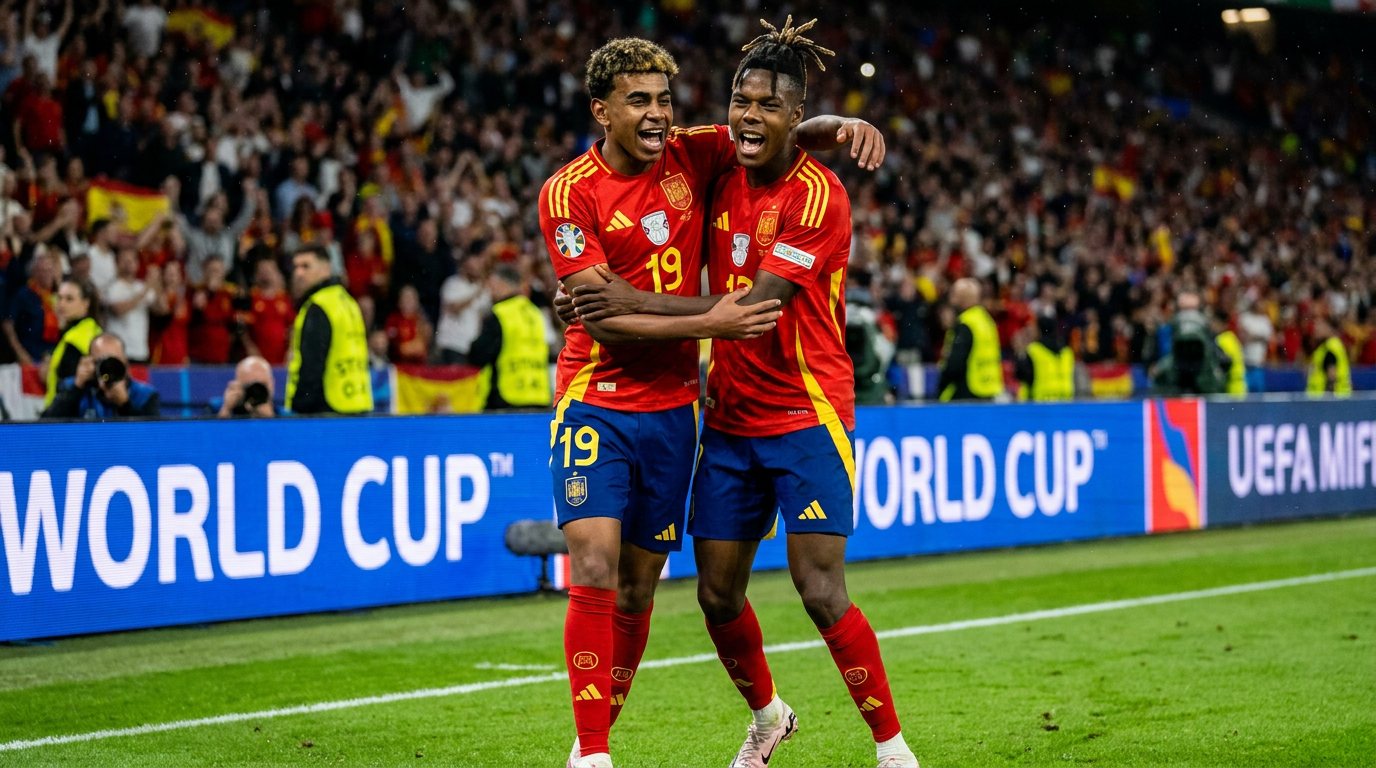
The catalysts for this vertical revolution are the wingers: Lamine Yamal on the right and Nico Williams on the left. Their emergence has fundamentally rewired Spain’s attacking mechanics. Both players possess elite one-on-one dribbling ability, explosive acceleration, and the tactical intelligence to stay high and wide, pinning back opposing fullbacks. When Spain builds out from the back, Yamal and Williams hug the touchlines, forcing the opposition's defensive block to expand. This horizontal stretching creates the very central gaps that Spain's midfielders previously struggled to pry open. If a defending team stays compact to protect the middle, Spain rapidly cycles the ball to the flanks, isolating their wingers in favorable one-on-one matchups. It is a classic 'overload to isolate' principle, executed with terrifying efficiency by two of the most electrifying young talents in world football.[1][3][5]

To maximize the threat of Yamal and Williams, Spain relies heavily on rapid switches of play, a tactic orchestrated primarily by their midfield fulcrum, Rodri. Operating as the single pivot at the base of the midfield triangle, Rodri is the undisputed metronome of the side. His role extends far beyond merely breaking up opposition attacks; he is the primary launchpad for Spain’s offensive transitions. With a pass completion rate consistently hovering around 94% even under intense pressure, Rodri possesses the vision and technique to hit sweeping, 40-yard diagonal balls that bypass the opposition's midfield entirely. When Spain overloads the left flank with quick, short passes, drawing the defensive block toward Williams, Rodri is constantly scanning for the moment to switch the play to an isolated Yamal on the right. This pendulum-like shifting of the attack exhausts defensive structures and inevitably leads to fractured backlines.[4][7]
Ahead of Rodri, the two advanced central midfielders—typically Pedri, Fabian Ruiz, or Dani Olmo—operate in the half-spaces, the vertical channels between the wing and the center. In the old tiki-taka system, these players would often drop deep to help circulate possession. In De la Fuente’s 4-3-3, they are instructed to push higher, operating almost as dual number 10s when Spain has sustained possession. Their positioning serves a dual purpose: it occupies the opposition's central defenders and defensive midfielders, preventing them from sliding over to double-team Spain's wingers. Furthermore, when Yamal or Williams beats their man and drives toward the byline, these advanced eights make late, untracked runs into the penalty area, providing high-percentage targets for cutbacks. This coordinated movement between the wingers and the central midfielders is a highly choreographed mechanism that consistently overwhelms low-block defenses.[3][6]
In the old tiki-taka system, these players would often drop deep to help circulate possession.
The role of the central striker in this system is equally specialized, requiring a selfless profile that prioritizes space creation over pure goalscoring volume. Whether it is Alvaro Morata or a more fluid false nine, the center-forward’s primary job is to manipulate the opposition's center-backs. By making decoy runs across the face of the defense or dropping slightly deeper to link play, the striker drags defenders out of position, creating the central corridors that the wingers and advanced midfielders exploit. When Yamal cuts inside onto his favored left foot, the striker’s run takes the nearest center-back away, opening a clear shooting lane. It is a demanding, often underappreciated role, but it is the linchpin that allows the rest of the attacking structure to function seamlessly. The striker is less of a traditional target man and more of a tactical facilitator.[2][5]

Out of possession, Spain’s tactical setup is defined by an aggressive, highly coordinated counter-press. The moment the ball is lost, particularly in the attacking third, the nearest players swarm the ball carrier, attempting to win it back before the opponent can transition into an attack. This 'gegenpressing' approach is not just a defensive mechanism; it is a primary source of chance creation. Because Spain commits so many bodies forward in their 4-3-3, losing the ball leaves them structurally exposed. However, by immediately suffocating the ball carrier, they frequently force turnovers high up the pitch, catching the opposition disorganized and vulnerable. Rodri’s anticipation is crucial here, as he steps up to intercept clearances and sustain the pressure, ensuring that the ball remains pinned in the opponent's half.[4][7]
Despite its attacking brilliance, the system is not without vulnerabilities, and opposing managers have identified specific mechanisms to exploit Spain's setup. The most glaring weakness stems from their high defensive line and the advanced positioning of their fullbacks. Because Spain's wingers stay wide, the fullbacks often underlap or push high into the midfield to provide passing options, leaving vast tracts of space in the wide defensive areas. Teams equipped with elite pace on the counter-attack—particularly those utilizing a 5-4-1 or 5-3-2 formation—can bypass Spain's counter-press with early, direct balls into these vacated channels. If the initial press is broken, Spain's center-backs are frequently left isolated in two-on-two or three-on-three situations with 50 yards of space behind them, a scenario that demands flawless individual defending to survive.[3][5]
To mitigate this risk, De la Fuente has instilled a greater degree of tactical pragmatism than his predecessors. While the high press is the default, Spain is now willing to drop into a compact 4-2-3-1 mid-block during specific phases of the game, particularly when defending a lead against high-quality opposition. In this shape, one of the advanced eights drops alongside Rodri to form a double pivot, providing an extra layer of central solidity. The wingers tuck in slightly, narrowing the defensive shape and forcing the opposition to play through the crowded center or settle for low-percentage crosses. This newfound ability to suffer without the ball, to absorb pressure rather than obsessively trying to control it, marks a significant psychological and tactical maturation for the squad.[1][6]

Another critical area of improvement under this new regime is set-piece execution. Historically, Spain viewed corners and free-kicks as secondary opportunities, often opting for short routines to restart possession rather than delivering the ball into the box. In the 2026 cycle, they have weaponized dead-ball situations. With the aerial presence of Rodri, their center-backs, and a dedicated set-piece coach designing intricate blocking routines, Spain has turned corners into a genuine scoring threat. This adds a crucial dimension to their attack, providing a reliable route to goal in tight knockout matches where open-play chances are scarce and the opposition is deeply entrenched. It is a hallmark of a complete tournament team that does not rely on a single method of scoring.[2][7]
Ultimately, Spain’s tactical evolution reflects a broader trend in international football: the shift away from ideological purity toward adaptable, hybrid systems. The 48-team format of the 2026 World Cup presents a grueling gauntlet of diverse tactical challenges, from deep-lying defensive blocks in the group stages to elite, transition-heavy powerhouses in the knockouts. A one-dimensional approach, no matter how refined, is easily decoded over a seven-game tournament. By fusing the technical mastery of their tiki-taka heritage with the lethal directness of modern wing play, Spain has constructed a tactical framework capable of solving a wide array of problems. They can dominate the ball when required, but they can also destroy teams in transition.[3][4][6]
As the tournament progresses, the ultimate test of this system will be its resilience under the immense pressure of the knockout rounds. Can the wingers maintain their explosive output against elite fullbacks? Can the high line survive against the world's fastest forwards? The answers to these questions will determine whether La Roja can add a second star to their crest. But from a purely tactical perspective, Spain has already achieved something remarkable. They have successfully reinvented their footballing identity on the global stage, proving that evolution, rather than revolution, is the key to remaining at the pinnacle of the sport. They are no longer just a team that keeps the ball; they are a team that knows exactly what to do with it.[1][5][7]

How we got here
Dec 2022
Spain is eliminated from the 2022 World Cup by Morocco, prompting a shift away from sterile possession.
Jun 2023
Spain wins the UEFA Nations League, showing early signs of Luis de la Fuente's tactical evolution.
Jul 2024
Spain wins Euro 2024, cementing the success of their wing-focused 4-3-3 system on the international stage.
Jun 2026
Spain enters the 2026 World Cup utilizing their refined hybrid tactics, blending control with direct attacking play.
Viewpoints in depth
Spanish Media
Domestic outlets overwhelmingly support the pragmatic shift away from sterile possession.
Outlets like Marca and AS have championed Luis de la Fuente's willingness to abandon the ideological purity of tiki-taka. They argue that the 2022 World Cup exposed the limitations of holding the ball without a cutting edge, and view the integration of genuine wingers as a necessary modernization. For the domestic press, the current iteration of La Roja is more entertaining, less predictable, and better equipped to handle the physical demands of modern tournament football.
Tactical Purists
A subset of analysts debating whether abandoning tiki-taka sacrifices Spain's unique footballing identity.
While acknowledging the effectiveness of the new system, some tactical purists and traditionalists worry that Spain is becoming just another transition-heavy European side. They argue that the extreme possession model, while flawed in its final years, provided a defensive mechanism—teams cannot score if they do not have the ball. By embracing a more open, vertical game, these critics suggest Spain is exposing themselves to a higher variance of outcomes, relying more on individual brilliance than collective structural dominance.
Opposing Managers
Rival coaches highlighting the nightmare of defending both the center and the wings simultaneously.
For opposing managers, preparing for Spain has shifted from an exercise in patience to an exercise in crisis management. Coaches note that if they deploy a low block to deny space behind, Spain simply isolates Yamal and Williams on the flanks to win one-on-one battles. Conversely, if they press high to disrupt Rodri, Spain possesses the technical ability to play through the press and launch devastating counter-attacks. The consensus among rivals is that Spain's dual-threat capability makes them the most tactically demanding opponent in the tournament.
What we don't know
- Whether Spain's high defensive line can consistently withstand the pace of elite counter-attacking teams in the knockout stages.
- How the team will adapt if key orchestrators like Rodri or dynamic wingers like Yamal are unavailable due to injury or suspension.
Key terms
- Single Pivot
- A lone defensive midfielder positioned in front of the defense, responsible for breaking up attacks and initiating possession.
- Half-spaces
- The vertical channels on the pitch between the wing and the center, often exploited by attacking midfielders to create scoring chances.
- Counter-press (Gegenpressing)
- The tactic of immediately attempting to win the ball back high up the pitch the moment possession is lost, rather than retreating into a defensive shape.
- Overload to Isolate
- Concentrating players on one side of the pitch to draw the defense over, then quickly switching the ball to a one-on-one matchup on the opposite side.
Frequently asked
Why did Spain change their tactics from the 2022 World Cup?
After struggling to break down low defensive blocks with high possession in 2022, they shifted to a more direct style to create clearer scoring chances.
Who are the key players in Spain's new system?
Wingers Lamine Yamal and Nico Williams provide the attacking threat on the flanks, while midfielder Rodri controls the tempo and orchestrates the defense.
What is Spain's biggest tactical weakness?
Their aggressive high defensive line and attacking fullbacks can leave them vulnerable to quick counter-attacks from teams with fast forwards.
Sources
Source coverage
7 outlets
3 viewpoints surfaced







[1]The AthleticTactical Analysts
Spain's tactical shift: How De la Fuente unlocked Yamal and Williams
Read on The Athletic →[2]MarcaPragmatic Supporters
El nuevo estilo de La Roja: Verticalidad y control en el Mundial 2026
Read on Marca →[3]ESPNInternational Observers
Why Spain's 4-3-3 is the most dangerous formation at the 2026 World Cup
Read on ESPN →[4]The GuardianInternational Observers
Rodri's masterclass: The pivot behind Spain's World Cup dominance
Read on The Guardian →[5]BBC SportTactical Analysts
Tactical Analysis: How to stop Spain's wingers
Read on BBC Sport →[6]ASPragmatic Supporters
La evolución táctica de España desde 2022 hasta 2026
Read on AS →[7]Sky SportsTactical Analysts
Data dive: Spain's crossing and transition metrics at the World Cup
Read on Sky Sports →

More in sports
See all 10 stories →Standings
San Diego Wave Seize NWSL Top Spot as League Enters World Cup Break
7 sources

Equipment Tech
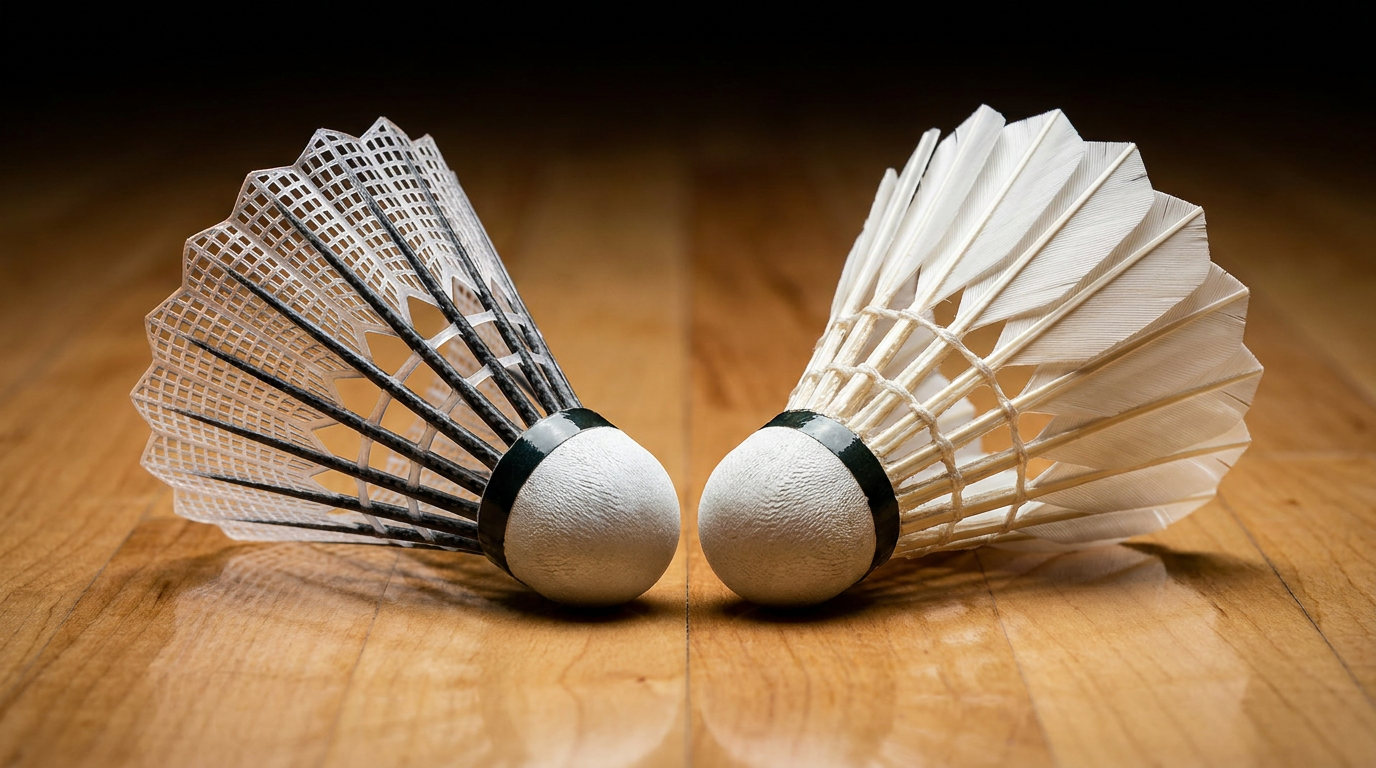
Badminton's Quiet Revolution: The Engineering Race to Replace the Feather Shuttlecock
7 sources
Injury
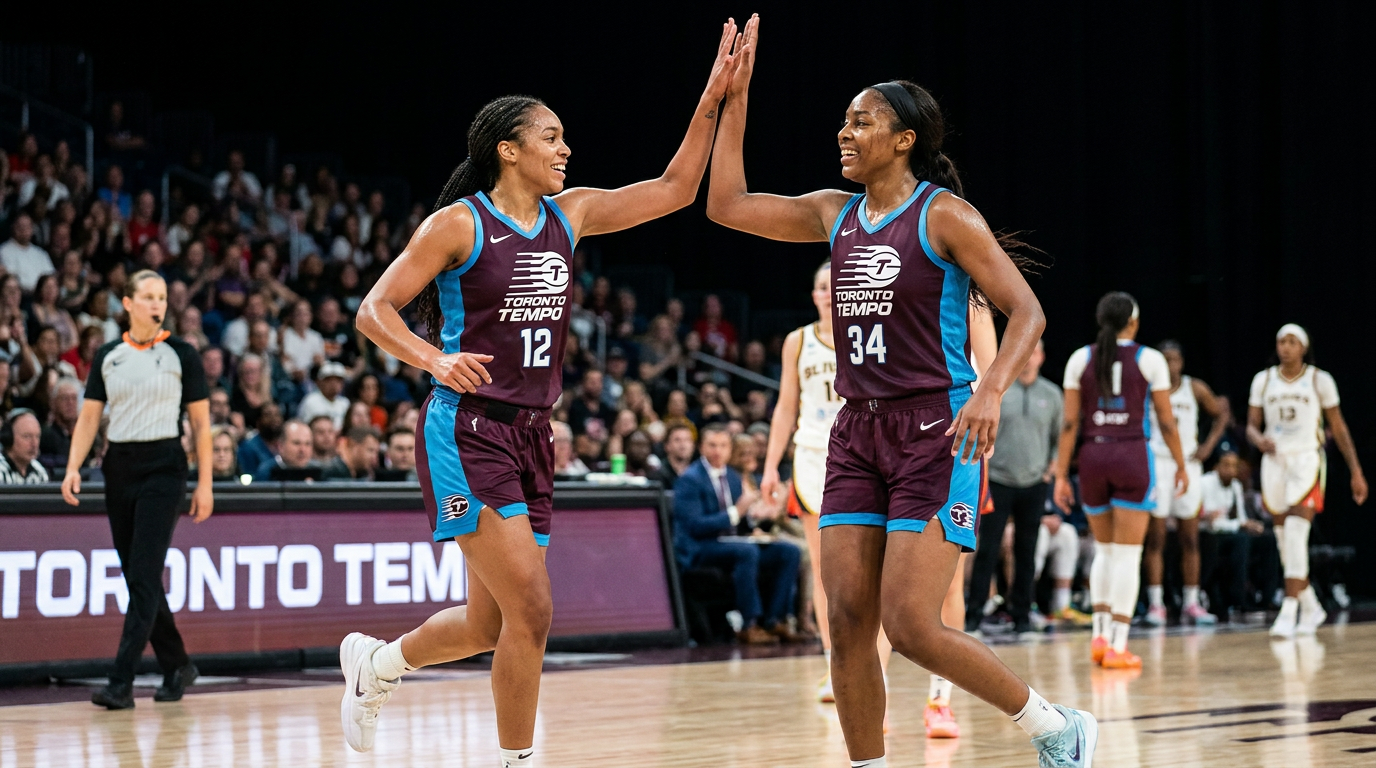
Toronto Tempo Issue Hopeful Recovery Timelines for Brittney Sykes and Kiki Rice
6 sources
Standings
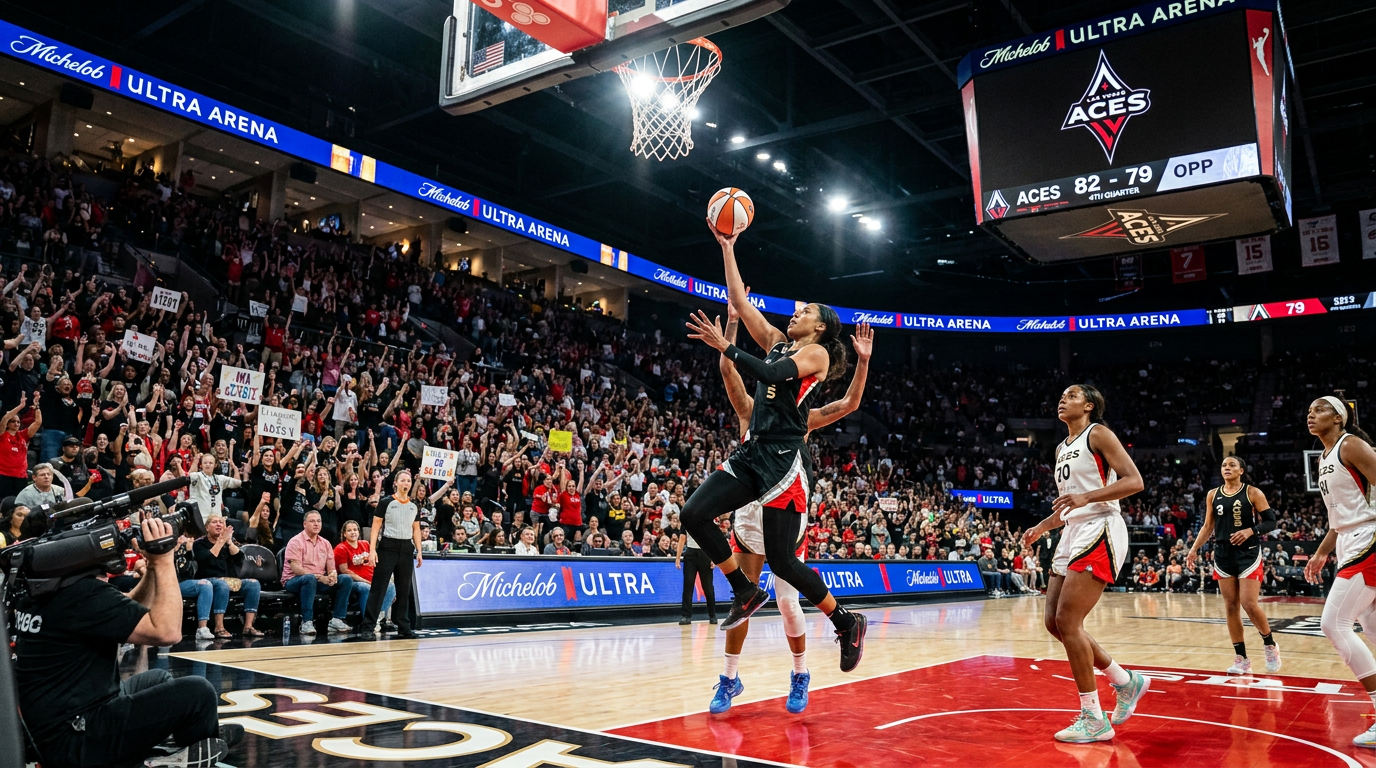
WNBA 2026 Standings: Aces Reclaim Top Spot as Expansion Teams Make Immediate Impact
6 sources
Every angle. Every day.
Get sports stories with full source coverage and perspective breakdowns delivered to your inbox.