
Memory stocks are having their best year ever. Why do they still look so cheap?
Despite crossing the $1 trillion valuation mark and posting record revenues fueled by the AI boom, memory chipmakers are trading at surprisingly low multiples. The disconnect highlights a fierce Wall Street debate over whether artificial intelligence has permanently transformed the industry or if another cyclical crash is looming.
By Factlen Editorial Team
- Structural Bulls
- Believe the AI supercycle has permanently transformed memory chips from commodities into custom logic.
- Cyclical Skeptics
- Argue that the low valuation is a classic warning sign of peak earnings in a boom-bust industry.
- Market Pragmatists
- Focus on the immediate cash flow and data center demand rather than predicting the next five years.
What's not represented
- · Hyperscaler procurement officers managing the supply bottleneck
- · Retail investors caught in previous memory cycle crashes
Why this matters
Understanding how to value cyclical tech stocks is crucial for investors trying to navigate the AI boom. If the market is mispricing the structural shift in memory chips, these stocks represent a rare bargain; if history repeats itself, they could be a value trap.
Key points
- Micron and SK Hynix recently crossed $1 trillion in market capitalization due to AI-driven demand.
- Despite record revenues, top memory stocks trade at forward P/E ratios between 8.5x and 11x, far below the semiconductor average.
- High-Bandwidth Memory (HBM) is the critical bottleneck for AI, and top manufacturers are sold out through 2026.
- Wall Street is debating whether the AI supercycle has ended the industry's historical boom-bust commodity cycles.
The AI boom has minted a new class of trillion-dollar titans. In June 2026, memory chipmakers Micron Technology and South Korea's SK Hynix both crossed the $1 trillion market capitalization threshold, joining the rarified air previously occupied only by designers like Nvidia.[1]
Yet, despite shares surging more than 200% over the past year, these stocks look remarkably cheap on paper. While the broader semiconductor sector trades at roughly 36 times forward earnings, Micron sits near 11x, and SK Hynix trades at an even lower 8.5x.[2][3]
The core question for investors is why Wall Street is applying a discount-bin multiple to the companies manufacturing the most critical physical bottleneck in the artificial intelligence revolution. The answer lies in the historical trauma of the memory chip business.[1][5]

To understand the current boom, one must first understand the technology. Artificial intelligence does not just require raw processing power; it requires moving massive datasets between processors at lightning speed.[4]
Think of an AI processor as a world-class chef capable of cooking 10,000 meals a minute. Traditional memory, known as DRAM, is like having a single assistant fetching ingredients one bag at a time. No matter how fast the chef gets, the kitchen inevitably slows to the assistant's pace.[5]
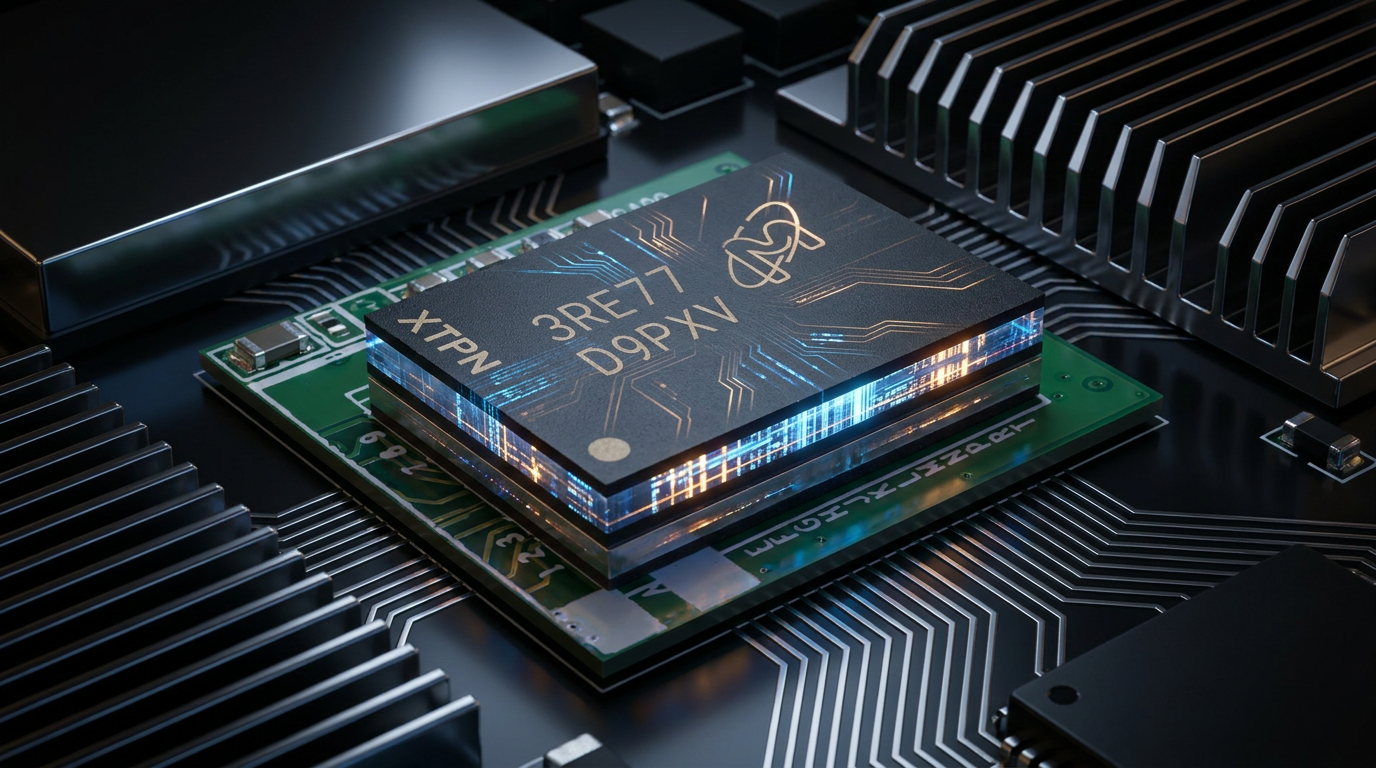
Enter High-Bandwidth Memory (HBM). This architecture stacks memory chips vertically and connects them directly to the processor, effectively giving the chef fifty assistants working through a wider door. This setup is non-negotiable for training large language models.[4][5]
The supply crunch is severe because only three companies in the world—SK Hynix, Samsung, and Micron—can manufacture HBM at the scale and yield required by hyperscalers.[1][4]
The financial results reflecting this bottleneck are staggering. Micron recently reported a 196% year-over-year revenue surge, with its cloud memory business unit seeing margins nearly double. SK Hynix has similarly reported operating profits driven almost entirely by its HBM dominance.[3][4]
The financial results reflecting this bottleneck are staggering.
Furthermore, the immediate future is already sold out. All three major manufacturers have confirmed that their entire HBM production capacity for 2026 is fully committed through non-cancellable contracts, with much of 2027 already spoken for.[1][4]

This brings the focus back to the valuation disconnect. In traditional finance, a company with locked-in hyper-growth and expanding margins trades at a premium multiple. But memory has historically been a brutal, highly cyclical commodity business.[5]
For decades, memory makers followed a predictable trap: they would see a spike in demand from PCs or smartphones, build massive new fabrication plants, oversupply the market, and watch prices crash.[1]
Bears argue that a low forward P/E ratio is actually a warning sign, not a bargain. In cyclical industries, stocks often look cheapest right at the top of the cycle, because the 'E' (earnings) in the P/E ratio is temporarily inflated and about to collapse.[2]
Bulls counter that the AI supercycle is fundamentally different. Because HBM requires complex, custom packaging and is tied directly to specific AI accelerators, it behaves less like a fungible commodity and more like a specialized logic chip.[4][5]
Additionally, manufacturing HBM is incredibly resource-intensive. Producing it consumes roughly three times the wafer capacity of traditional DRAM. This naturally constrains the overall supply of conventional memory, keeping prices elevated across the board.[5]

The rising tide is lifting adjacent players as well. Companies focused on enterprise storage and NAND flash, such as Western Digital and Seagate, are seeing massive revenue jumps as data centers require vast storage for AI inference workloads.[4]
The verdict remains undecided. Wall Street analysts are caught in a loop of continuously upgrading their price targets to catch up with the stock prices, while the multiples refuse to expand.[2]
For investors, the memory sector in 2026 offers a rare setup: pure-play exposure to the AI infrastructure buildout without the nosebleed valuations of software and processor companies.[1][3]
Whether these stocks are the bargains of the decade or a classic cyclical value trap depends entirely on whether the 'Memory Wall' has permanently transformed the economics of the semiconductor industry.[5]
How we got here
Late 2022
ChatGPT launches, sparking the generative AI boom and an unprecedented demand for AI accelerators.
2024 - 2025
Hyperscalers realize traditional memory cannot keep up with AI processors, triggering a massive shift toward HBM.
March 2026
Micron begins volume production of next-generation HBM4 chips, locking in supply contracts through 2027.
June 2026
Micron and SK Hynix both cross the $1 trillion market capitalization threshold.
Viewpoints in depth
Structural Bulls
Believe the AI supercycle has permanently transformed memory chips from commodities into custom logic.
This camp argues that High-Bandwidth Memory is fundamentally different from the DRAM of the past. Because HBM requires complex, custom packaging and is tied directly to specific AI accelerators, it cannot be easily swapped or overproduced like a generic commodity. Bulls point to the fact that the 'Big Three' have already sold out their capacity through 2026 via non-cancellable contracts, providing unprecedented earnings visibility that justifies a higher valuation multiple.
Cyclical Skeptics
Argue that the low valuation is a classic warning sign of peak earnings in a boom-bust industry.
Skeptics look at the history of the semiconductor industry and see a familiar pattern: a new technology drives a massive demand spike, manufacturers race to build multi-billion-dollar fabrication plants, and the resulting oversupply crashes prices. They argue that the current low forward P/E ratios are not a bargain, but rather the market correctly anticipating that today's inflated profit margins will inevitably revert to the mean once new capacity comes online in 2027 and 2028.
Infrastructure Pragmatists
Focus on the immediate cash flow and data center demand rather than predicting the next five years.
Pragmatists care less about whether the cycle will eventually turn and more about the reality of today's data center buildout. They note that hyperscalers have no choice but to buy memory at current prices if they want to remain competitive in the AI arms race. This camp also highlights the spillover effects into enterprise storage, noting that companies like Western Digital and Seagate are generating massive cash flows right now, regardless of the long-term macroeconomic debate.
What we don't know
- Whether the massive capital expenditures by hyperscalers on AI infrastructure will sustain current memory demand into 2028.
- How quickly competitors in China might scale up domestic memory production to challenge the 'Big Three'.
- If the custom nature of HBM will truly protect manufacturers from the price crashes seen in previous memory cycles.
Key terms
- Forward P/E Ratio
- A valuation metric that divides a company's current share price by its estimated future earnings per share.
- High-Bandwidth Memory (HBM)
- A specialized type of computer memory that stacks chips vertically to drastically increase the speed at which data moves to a processor.
- Hyperscaler
- Massive cloud service providers, such as Amazon Web Services, Google Cloud, and Microsoft Azure, that operate data centers at a global scale.
- DRAM (Dynamic Random Access Memory)
- The standard type of memory used in traditional computers and servers to store data that is actively being used.
- The Memory Wall
- The performance bottleneck that occurs when a computer's processor is faster than the memory's ability to feed it data.
Frequently asked
What is High-Bandwidth Memory (HBM)?
HBM is a specialized type of computer memory that stacks chips vertically, allowing massive amounts of data to move to a processor simultaneously. It is essential for training artificial intelligence models.
Why are memory stocks considered cyclical?
Historically, memory manufacturers would overbuild factories during periods of high demand, leading to a glut of supply and crashing prices once demand cooled.
Are Micron and SK Hynix the only companies making HBM?
No, Samsung is also a major producer. Together, these three companies control nearly the entire global supply of High-Bandwidth Memory.
Why is a low forward P/E ratio sometimes a warning sign?
In cyclical industries, earnings can temporarily spike during a boom. A low P/E ratio might indicate that the market expects those earnings to collapse in the near future.
Sources
Source coverage
5 outlets
3 viewpoints surfaced





[1]MarketWatchMarket Pragmatists
Memory stocks are having their best year ever. Why do they still look so cheap?
Read on MarketWatch →[2]TIKRCyclical Skeptics
How the Valuation Stacks Up: Micron and the Semiconductor Peer Group
Read on TIKR →[3]GuruFocusCyclical Skeptics
SK Hynix Forward PE Ratio and Valuation Metrics
Read on GuruFocus →[4]Zacks Investment ResearchStructural Bulls
4 AI Memory Stocks to Buy Now Before Prices Spike Even Higher
Read on Zacks Investment Research →[5]Factlen Editorial TeamStructural Bulls
Synthesis by Factlen editorial team
Read on Factlen Editorial Team →


Every angle. Every day.
Get finance stories with full source coverage and perspective breakdowns delivered to your inbox.