
SpaceX Backs AI Startup Cursor, Defying the 'Death of the Application Layer' Narrative
Written off after the rise of major tech competitors, AI code editor Cursor has secured a massive lifeline from SpaceX. The deal signals a major shift in venture capital, proving that specialized AI workflows can survive against foundational model monopolies.
By Factlen Editorial Team
- Application-Layer Optimists
- Venture capitalists and founders who believe that specialized workflows and user experience are highly defensible moats against Big Tech.
- Foundation Model Maximalists
- Analysts who argue that companies training the core AI models will eventually absorb all valuable software features natively.
- Industrial AI Adopters
- Enterprise engineering leaders who prioritize deep, secure integration with proprietary hardware over generic coding chatbots.
What's not represented
- · Open-source maintainers whose code trains these models
- · Junior developers facing changing entry-level job requirements
Why this matters
For developers and tech workers, this proves that independent tools can still thrive in an era dominated by Big Tech monopolies. For investors, it reopens the door to funding AI application startups that focus on workflow and user experience rather than just raw model training.
Key points
- SpaceX has provided a massive financial and operational lifeline to AI coding startup Cursor.
- The deal defies the prevailing narrative that independent AI application startups cannot survive against Big Tech foundation models.
- Cursor secured the partnership by offering deep, secure integration with SpaceX's proprietary aerospace codebases.
- The partnership signals a shift in venture capital toward funding highly specialized, enterprise-grade AI workflows.
The technology industry has a well-documented habit of writing premature obituaries for startups that dare to compete with established giants. For the better part of the last year, venture capitalists, industry analysts, and social media commentators had largely concluded that Cursor—the AI-powered code editor that once captivated Silicon Valley—was effectively dead in the water. The prevailing narrative was simple and seemingly unassailable: major players like Anthropic with its Claude Code and Microsoft with its GitHub Copilot had successfully monopolized the developer ecosystem. Independent "wrapper" startups, which build application layers on top of foundational AI models, were widely considered uninvestable by Sand Hill Road.[1][5][8]
That entrenched consensus was completely shattered this week. In a stunning reversal of fortune, aerospace giant SpaceX has officially stepped in, handing Cursor what market analysts are describing as a massive "$60 billion lifeline." This unprecedented deal reportedly involves a complex mixture of direct venture capital investment, massive compute subsidies, and a transformative enterprise deployment contract that integrates Cursor directly into SpaceX's most critical engineering workflows. The sheer scale of the partnership has sent shockwaves through the venture capital community, forcing a rapid recalculation of what makes an AI startup defensible in 2026.[1][5]
The implications of this deal extend far beyond a single startup's survival; it fundamentally rewrites the rules of artificial intelligence venture capital. For months, the "foundation model monopoly" thesis dictated that any successful AI application would inevitably be cloned and absorbed by the companies training the underlying models. The SpaceX-Cursor alliance proves that the "application layer" can still command astronomical valuations and secure enterprise-defining contracts, provided the startup solves highly specific, high-stakes workflow problems that generic models cannot address out of the box.[5][8]
To truly understand how Cursor managed to survive and ultimately thrive against the foundation model onslaught, one must examine the industry-wide shift toward a concept known as "vibe-coding." This emerging software engineering paradigm moves away from the traditional method of typing syntax line-by-line. Instead, it empowers developers to direct autonomous AI systems using natural language, effectively turning programmers into systems architects and product managers. The AI handles the tedious boilerplate, complex refactoring, and syntax generation, allowing the human to focus purely on logic and design.[2][3]

Cursor did not simply build a chat window attached to a language model; they engineered a deeply integrated, context-aware workflow. By maintaining a real-time, semantic index of a company's entire proprietary codebase, Cursor's AI engine can accurately predict how a single variable change in one file will cascade through hundreds of interconnected microservices. This level of deep integration requires sophisticated local indexing and retrieval-augmented generation techniques that generic web-based chatbots simply cannot replicate without access to the local development environment.[3][5]
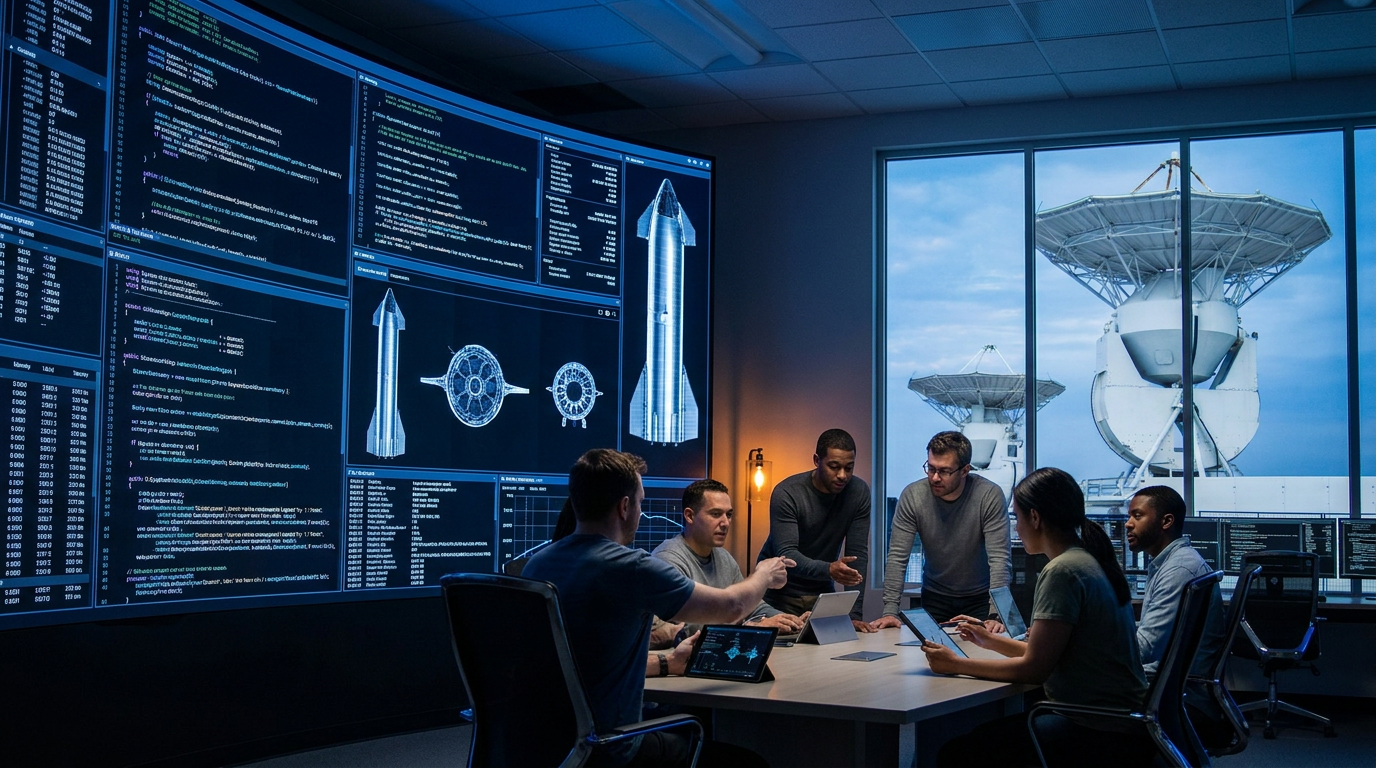
This hyper-specific context-awareness is precisely what caught the attention of engineering leadership at SpaceX. The aerospace manufacturer is currently in the process of rapidly scaling its Starship logistics network and orbital deployment capabilities. This monumental physical engineering challenge requires an equally monumental software engineering effort, demanding unprecedented agility in how flight control systems, telemetry analysis pipelines, and autonomous docking protocols are written, tested, and deployed.[1][5]
SpaceX engineers are tasked with maintaining millions of lines of mission-critical code that must be updated dynamically as physical hardware undergoes rapid iteration. According to industry insiders, SpaceX found that generic coding assistants provided by major tech giants struggled significantly when confronted with the highly specialized, proprietary physics engines and hardware-in-the-loop testing environments utilized in modern aerospace manufacturing. The generic models lacked the specific architectural context required to be genuinely useful.[1][2]
SpaceX engineers are tasked with maintaining millions of lines of mission-critical code that must be updated dynamically as physical hardware undergoes rapid iteration.
Cursor, conversely, allowed SpaceX to securely fine-tune the editor's context engine specifically for their internal, highly classified repositories. The result was a reported dramatic reduction in the time required to translate complex engineering physics into deployable, bug-free flight software. By embedding itself deeply into the daily habits and specific workflows of elite aerospace engineering teams, Cursor transformed itself from a disposable utility into an indispensable piece of enterprise infrastructure.[1][5]
The venture capital implications of this enterprise success story are profound and immediate. For the past eighteen months, early-stage tech investing has been largely paralyzed by what insiders call "OpenAI risk"—the pervasive fear that any novel AI application will be rendered obsolete by the next major foundational model update. Investors have hoarded dry powder, waiting for clarity on where value will actually accrue in the AI tech stack.[6][7]

Cursor’s survival and subsequent mega-deal provides a definitive blueprint for defying that gravity. The evidence strongly suggests that while foundational models provide the raw, commoditized reasoning engine, the workflow, the user experience, and the deep enterprise integration constitute a highly defensible economic moat. "The models themselves are rapidly becoming commodities, but the workflow is where the actual enterprise value is captured and retained," notes a leading venture capitalist analyzing the deal.[5][8]
Furthermore, the broader financial context of this deal cannot be ignored. As SpaceX's own options volume explodes and trading activity surges, the company is leveraging its massive market capitalization to act as a kingmaker in the AI startup ecosystem. By utilizing its balance sheet to secure the software supply chain it desperately needs, SpaceX is blurring the lines between traditional venture capital, strategic corporate partnership, and aggressive vendor lock-in.[1][7]
Yet, despite the celebratory atmosphere surrounding the deal, significant uncertainty remains regarding the long-term viability of the independent AI application layer. The staggering $60 billion valuation metric—whether it represents Cursor's new theoretical cap or the total value of the SpaceX ecosystem it now supports—places immense, perhaps unprecedented, pressure on the startup to deliver flawless execution at a global scale.[1][5]

Additionally, the sheer compute costs associated with maintaining real-time, codebase-wide AI context for thousands of enterprise engineers are astronomically high. Cursor must now prove that its unit economics can scale sustainably without rapidly burning through its newly acquired capital reserves. The infrastructure required to support vibe-coding at an enterprise level is fundamentally different from consumer-grade AI applications.[3][5]
Microsoft and Anthropic are also highly unlikely to cede the lucrative enterprise developer market without a fierce fight. Both technology giants are already rapidly updating their own integrated development environments, attempting to mimic Cursor's most popular features and leverage their massive existing distribution networks to squeeze out independent competitors.[2][4]

Ultimately, the SpaceX-Cursor alliance signals a crucial maturation point in the artificial intelligence industry. The initial, frenzied hype cycle focused purely on raw model capabilities has definitively ended. We have now entered the era of hyper-specialized, deeply integrated industrial AI, where the winners will be determined not by who has the smartest model, but by who builds the most indispensable workflow.[5][8]
How we got here
Early 2025
Anthropic releases Claude Code, leading analysts to declare independent AI coding startups obsolete.
Late 2025
Venture capital funding for AI 'wrapper' applications drops significantly due to foundation model monopoly fears.
Spring 2026
SpaceX begins testing specialized AI coding environments to accelerate Starship software deployment.
June 2026
SpaceX officially backs Cursor in a massive deal, reviving the AI application layer venture market.
Viewpoints in depth
Application-Layer Optimists
Venture capitalists and founders who believe that specialized workflows and user experience are highly defensible moats against Big Tech.
This camp argues that the raw intelligence of an AI model is rapidly becoming a commoditized utility, much like cloud computing or electricity. In their view, the true enterprise value is captured by the companies that build the best user interfaces, integrate most deeply into existing corporate workflows, and solve specific industry problems. They view the Cursor deal as ultimate validation that a superior product experience can successfully defend against the massive distribution advantages of incumbents like Microsoft and Google.
Foundation Model Maximalists
Analysts who argue that companies training the core AI models will eventually absorb all valuable software features natively.
Maximalists maintain a skeptical outlook on the long-term survival of independent application startups. They argue that as foundational models expand their context windows and improve their native reasoning capabilities, the need for third-party orchestration tools will evaporate. From this perspective, Cursor's success is a temporary anomaly driven by SpaceX's unique, highly classified security requirements, rather than a reproducible blueprint for the broader software industry.
Industrial AI Adopters
Enterprise engineering leaders who prioritize deep, secure integration with proprietary hardware over generic coding chatbots.
For heavy industry and aerospace leaders, the AI debate is entirely pragmatic. They are less concerned with which tech giant trains the smartest general-purpose model and more focused on which tool can securely index millions of lines of proprietary, hardware-specific code without leaking intellectual property. This camp values bespoke fine-tuning, on-premise security options, and the ability of an AI to understand the physical constraints of the hardware it is programming—features that consumer-grade AI assistants currently lack.
What we don't know
- Whether Cursor's unit economics can scale sustainably given the massive compute costs of enterprise-wide code indexing.
- How quickly Microsoft and Anthropic will update their own enterprise tools to match Cursor's specific workflow features.
- The exact financial structure of the '$60 billion' figure and how much represents direct equity versus enterprise contract value.
Key terms
- Application Layer
- The tier of software that users directly interact with, built on top of underlying foundational AI models.
- Foundation Model
- A massive, general-purpose artificial intelligence model trained on vast amounts of data, like OpenAI's GPT-4 or Anthropic's Claude.
- Vibe-coding
- A programming paradigm where developers guide AI with high-level natural language instructions rather than manually typing out syntax.
- Context Window
- The amount of text or code an AI model can hold in its memory and analyze at one single time.
Frequently asked
What is vibe-coding?
Vibe-coding is an emerging software development method where programmers use natural language to direct an AI, which then autonomously writes, refactors, and tests the actual code syntax.
Why did SpaceX invest in Cursor?
SpaceX required a highly specialized, context-aware coding assistant capable of understanding its proprietary aerospace physics engines, a task where generic AI models from major tech companies struggled.
What does this mean for AI venture capital?
It proves that startups building applications on top of AI models can still achieve massive valuations if they create indispensable, deeply integrated enterprise workflows.
Sources
Source coverage
8 outlets
3 viewpoints surfaced








[1]MarketWatchApplication-Layer Optimists
Social media declared Cursor dead. Then SpaceX handed the AI startup a $60 billion lifeline.
Read on MarketWatch →[2]WikipediaIndustrial AI Adopters
Artificial intelligence in software engineering
Read on Wikipedia →[3]arXivFoundation Model Maximalists
A Survey on Large Language Models for Software Engineering
Read on arXiv →[4]GitHub BlogFoundation Model Maximalists
Engineering at GitHub: The Future of AI-Assisted Development
Read on GitHub Blog →[5]Factlen Editorial TeamApplication-Layer Optimists
Synthesis by Factlen editorial team
Read on Factlen Editorial Team →[6]SEC EDGARIndustrial AI Adopters
Company Search - Venture Capital Filings
Read on SEC EDGAR →[7]FREDIndustrial AI Adopters
ICE BofA US Corporate Index Effective Yield
Read on FRED →[8]Y CombinatorApplication-Layer Optimists
The State of AI Startups in 2026
Read on Y Combinator →

Every angle. Every day.
Get finance stories with full source coverage and perspective breakdowns delivered to your inbox.